Where a Major Tool is Not So Cool

During my engagements in selecting and working with the major data management tools on the market, I have from time to time experienced that they often lack support for specialized data management needs in minor markets.

Two such areas I have been involved with as a Denmark based consultant are:

  • Address verification
  • Data masking

Address verification:

The authorities in Denmark offers a free of charge access to very up to data and granular accurate address data that besides the envelope form of an address also comes with a data management friendly key (usually referred to as KVHX) on the unit level for each residential and business address within the country. Besides the existence of the address you also have access to what activity that takes place on the address as for example if it is a single-family house, a nursing home, a campus and other useful information for verification, matching and other data management activities.

If you want to verify addresses with the major international data managements tools I have come around, much of these goodies are gone, as for example:

  • Address reference data are refreshed only once per quarter
  • The key and the access to more information is not available
  • A price tag for data has been introduced

Data Masking:

In Denmark (and other Scandinavian countries) we have a national identification number (known as personnummer) used much more intensively than the national IDs known from most other countries as told in the post Citizen ID within seconds.

The data masking capabilities in major data management solutions comes with pre-build functions for national IDs – but only covering major markets as the United States Social Security Number, the United Kingdom NINO and the kind of national id in use in a few other large western countries.

So, GDPR compliance is just a little bit harder here even when using a major tool.
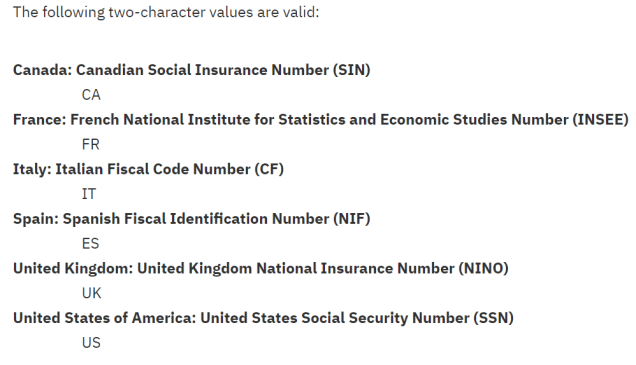
Data Masking National ID.png
From IBM Data Masking documentation

6 Decades of the LEGO® Brick and the 2nd Decade of MDM

28th January 2018 marks the 60th anniversary of the iconic LEGO® brick.

As I was raised close to the LEGO headquarter in Billund, Denmark, I also remember having a considerable amount of LEGO® bricks to play with as a child back in the 60’s in the first decade of the current LEGO® brick design. At that time the brick was a brick, where you had to combine a few sizes and colours of bricks into resembling a usable thing from the real world. Since then the range of shapes and colours of the pieces from the Lego factory have grown considerably.

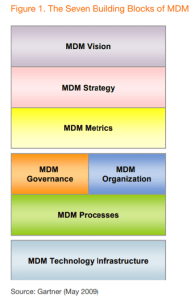
MDM BlocksMaster Data Management (MDM) went into the 2nd decade some years ago as reported in the post Happy 10 Years Birthday MDM Solutions. MDM has some basic building blocks, as proposed by former Gartner analyst John Radcliffe  back in 00’s and touched in the post The Need for a MDM Vision.
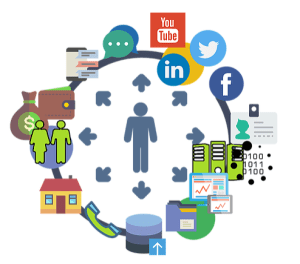
These blocks indeed look like the original LEGO® bricks.

Through the 2nd decade of MDM and in coming decades we will probably see a lot of specialised blocks in many shapes describing and covering the people, process and technology parts of MDM. Let us hope that they will all stick well together as the LEGO® bricks have done for the past 60 years.

PS: Some if the sticking together is described in the post How MDM, PIM and DAM Stick Together.

Welcome AllSight on the Disruptive MDM List

I am thrilled to welcome AllSight as the next disruptive MDM solution on The Disruptive Master Data Management Solutions list.

AllSight2I resonate very well with the AllSight Advantage that is: “The hardest part about understanding the customer is representing them within archaic systems designed to manage ‘customer records’.  AllSight manages all customer data in its original format.  It creates a realistic and accurate likeness of who your customer actually is.  Really knowing your customer is the first step to being intelligent about your customers.”

A true disruptive approach in my eyes.

Check out the full Disruptive Master Data Management Solutions list here.

Can You Keep Track of MDM and PIM Vendors?

If you have the job to shortlist a range of MDM and/or PIM vendors to help you getting a grip on product master data (MDM) and detailed product features (PIM), or have the job to assist a client in doing so, you may have a hard time.

As mentioned in the post Disruptive Forces in MDM Land now Gartner (the analyst firm) only mentions the 11 most expensive MDM vendors. This leaves very little room for taking into account the differences in product specific offerings, geographic presence, industry focus and other parameters.

As a consequence, PIM and Product MDM Consultant Nadim Georges WARDÉ, who runs his business from Geneva in Switzerland, is keeping track of the vendors in his own comprehensive list and have kindly provided the list to be shared here on the blog:

Nadim Warde List

You can access the full spreadsheet here.

The list also has a small section on professional service vendors, vendors that have achieved substantial funding and finally a list of vendors supporting product serialization exchange within the pharma industry – a topic covered on this blog in the post Spectre vs James Bond and the Unique Product Identifier.


Welcome Riversand on The Disruptive MDM List

I am delighted to welcome Riversand as the next disruptive MDM / PIM / DAM solution on The Disruptive Master Data Management Solutions list.

As a European MDM and PIM (Product Information Management) practitioner I have followed Riversand’s growing presence on the European scene both through being on the customer side in solution selection activities, on conferences and on the social media community and I have watched that MDM / PIM peers as Mark Thorpe and Ben Rund have joined the company.

Riversand is in a very exciting development with a recent funding that is used to accelerate Riversand’s global expansion and for further investment in its disruptive MDM platform. See how Riversand presents themselves on The Disruptive MDM List here.

banner


Building a MDM Solution Using Best-in-Class Modules

Sometimes keeping it simple is the shortcut to getting it all wrong. While I am a believer in mastering all master data domains under the same vision and strategy, there are still best-in-class options when it comes to orchestrating processes and applying technology in the right chunks.

Customer Data Integration (CDI)

A recent post on this blog was called What Happened to CDI? This post examines the two overlapping disciplines Master Data Management (MDM) and Customer Data Integration (CDI). In a comment Jeff Jones argues that MDM vendors have forgotten about proper CDI workflows. Jeff says: “It seems the industry wants to go from Source to Match/Merge, instead of Source to Match/Identify and finally to Merge.” Please find and jump into the discussion here.

Also, this question was touched some years ago in the post The Place for Data Matching in and around MDM.

Product Information Management (PIM)

The product domain within Multi-Domain MDM also holds some risks of forgetting the proper ways of handling product information. In this domain we must also avoid being blinded by the promise of a single source of master data with surrounding processes and applied technology.

There are many end-to-ends to cover properly as exemplified in the post A Different End-to-End Solution for Product Information Management (PIM).


Master Data or

Welcome Semarchy xDM on The Disruptive MDM List

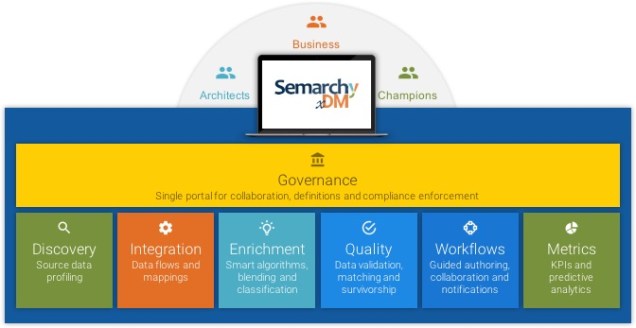
I am happy to welcome Semarchy xDM as the first disruptive Master Data Management Solution on the disruptive MDM list. You can learn more about, and review, Semarchy xDM here.

xDM Capabilities (002)

Semarchy has been a part of developing Product Data Lake, as the first prototype of this service was made using the Semarchy platform. I owe Salah Kamel, the Semarchy CEO, big thanks for his support in doing that.

By making that prototype, I can confirm that Semarchy caters for a fast track, when it comes to setting up a Master Data Management solution.

The Disruptive MDM List

As reported in the previous post on this blog, Gartner (the analyst firm) has stopped having a list of smaller and potential disruptive MDM solutions in their Magic Quadrant for Master Data Management Solutions.

I think it is time to have an alternative list of MDM solutions with room for the disruptive ones.

Therefore, I have created a new site for a list of MDM and similar solutions. This site is meant to be a list of available:

  • Master Data Management (MDM) solutions
  • Customer Data Integration (CDI) solutions
  • Product Information Management (PIM) solutions
  • Digital Asset Management (DAM) solutions

You can use this site as an alternative to the likes of Gartner, Forrester, MDM Institute and others when selecting a MDM / CDI / PIM / DAM solution, not at least because this site will also include smaller and disruptive solutions.

Vendors can register their solutions here and the crowd, being processional users, can review the solutions.

I will welcome vendors of all sizes, at all stages and from all geographies to register your solution at the disruptive MDM list.

Master Data or

Please have a look at the current stage of The Disruptive MDM List

Disruptive Forces in MDM Land

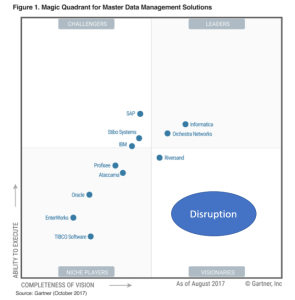
MDM 2017 disruptionFor the second time this year there is a Gartner Magic Quadrant for Master Data Management Solutions out. The two leaders, Orchestra Networks and Informatica, have released their free copies here and here.

Now Gartner have stopped having a list of vendors on the market too small to be in the actual quadrant. So, if you are looking for new thinking, you will have to read the section about disruptive forces in the MDM market.

Gartner says that every market experiences disruptive forces that influence its overall shape and trajectory over time, and that inspire innovation, both transformational and incremental. According to Gartner, those most prominent in the MDM market appear diametrically opposed.

The current market is dominated by vendors who have predominantly taken a platform-centric approach involving robust technology stacks categorized as application-neutral hub-based solutions. Thus, the business value of the resulting master data is realized through utilization of that data within business applications or suites, or analytics platforms, external to the MDM solution — such as CRM, ERP and e-commerce systems, and data warehouses.

One disruptive force against that is an increase in business applications or suites with embedded ADM (Application Data Management) capabilities that address organizational needs for data management, including MDM (to varying degrees), while also managing nonmaster data for the pertinent application. Gartner states that application-centric approaches for some organizations can return greater value than platform-centric approaches in the short term and do so at reduced cost.

The opposing disruptive force stems from the emergence of more generalized data management solutions. These provide for unified execution logic on top of what is effectively an integrated technology stack. Vendors envision the primary consumption model to be cloud-based subscription. As such, these solutions will also provide a means for midmarket organizations and SMBs to procure advanced data management capabilities (such as MDM) using this model of consumption. Executed crisply, cloud-based subscriptions to these solutions may even moderate the rise of cloud-based MDM offerings.

Regular readers of this blog may guess, that I see a coming third disruptive force in MDM land, being specialized data management services for business ecosystems as explored in the post Ecosystems are The Future of Digital and MDM.

The Product Data Domain and the 2017 Gartner Data Quality Magic Quadrant

data-quality-magic-quadrant-2017The Gartner Magic Quadrant for Data Quality Tools 2017 is out. One place to get it for free is at the Informatica site.

As data quality for product data is high on my agenda right now, I did a search for the word product in the report. There are 123 occurrences of the word product, but the far majority is about the data quality tool as a product with a strategy and a roadmap.

The right context saying about the product domain is, as I could distil it based on word mentioning, as follows:

Product data is part of multidomain

Gartner says that the product domain is a part of multidomain support, being packaged capabilities for specific data subject areas, such as customer, product, asset and location.

Some vendors were given thumbs up for including product data in the offering. These were:

  • BackOffice Associates has this strength: Multidomain support across a wide range of use cases: BackOffice Associates’ data quality tools provide good support for all data domains, with particular depth in the product data domain.
  • Information Builders has this strength: Multidomain support and diverse use cases: Deployments by Information Builders’ reference customers indicate a diversity of usage scenarios and data domains, such as customer, product and financial data.
  • SAS (Institute, not the airline) has this strength: Strong knowledge base for the contact and product data domains.

One should of course be aware, that other vendors also may have support for product data, but this is overshadowed by other strengths.

Effect on positioning

Multidomain brings vendors to the top right. Gartner’s metrics means that leaders address all industries, geographies, data domains and use cases. Their products support multidomain and alternative deployment options such as SaaS.

Product data focus can make a vendor a challenger. Gartner tells that challengers may not have the same breadth of offering as Leaders, and/or in some areas they may not demonstrate as much thought-leadership and innovation. For example, they may focus on a limited number of data domains (customer, product and location data, for example). This also means, that missing product data focus keeps vendors away from the top right positioning, which seems to be hitting Pitney Bowes and Experian Data Quality.

Product data will become more important, but is currently behind other domains

Gartner emphasizes that data and analytics leaders including Chief Data Officers and CIOs must, to achieve CEOs’ business priorities, ensure that the quality of their data about customers, employees, products, suppliers and assets is “fit for purpose” and trusted by users.

Organizations are increasingly curating external data to enrich and augment their internal data. Finally, they are expanding their data quality domains from traditional party domains (such as customer and organization data) to other domains (such as product, location and financial data).

According to Gartner, data quality initiatives address a wide variety of data domains. However, party data (for existing customers, prospective customers, citizens or patients, for example) remains the No. 1 priority: 80% of reference customers considered it the top priority among their three most important domains. Transactional data came second highest, with 45% of reference customers naming it among their top three. Financial/quantitative data was third, with 39% of reference customers naming it. The figure for product data was 34%.

In my view, the 34% figure is because not all organizations have high numbers of product data and have major business pains related to product data. But those who have are looking at data quality tool and service vendors for suitable solutions.