Informatics for adding value to information

Recently the Global Agenda Council on Emerging Technologies within the World Economic Forum has made a list of the top 10 emerging technologies for 2012. According to this list the technology with the greatest potential to provide solutions to global challenges is informatics for adding value to information.

As said in the summary: “The quantity of information now available to individuals and organizations is unprecedented in human history, and the rate of information generation continues to grow exponentially. Yet, the sheer volume of information is in danger of creating more noise than value, and as a result limiting its effective use. Innovations in how information is organized, mined and processed hold the key to filtering out the noise and using the growing wealth of global information to address emerging challenges.”

Big data all over

Surely “big data” is the buzzword within data management these days and looking for extreme data quality will be paramount.

Filtering out the noise and using the growing wealth of global information will help a lot in our endurance to make a better world and to make better business.

In my focus area, being master data management, we also have to filtering out the noise and exploit the growing wealth of information related to what we may call Big Master Data.

Big external reference data

The growth of master data collections is also seen in collections of external reference data.

For example the Dun & Bradstreet Worldbase holding business entities from around the world has lately grown quickly from 100 million entities to over 200 millions entities. Most of the growth has been due to better coverage outside North America and Western Europe, with the BRIC countries coming in fast. A smaller world resulting in bigger data.

Also one of the BRICS, India, is on the way with a huge project for uniquely identifying and holding information about every citizen – that’s over a billion. The project is called Aadhaar.

When we extend such external registries also to social networking services by doing Social MDM, we are dealing with very fast growing number of profiles in Facebook, LinkedIn and other services.

Surely we need informatics for adding the value of big external reference data into our daily master data collections.

Bookmark and Share

Wildcard Search versus Fuzzy Search

My last post about search functionality in Master Data Management (MDM) solutions was called Search and if you are lucky you will find.

In the comments the use of wildcards versus fuzzy search was touched.

The problem with wildcards

I have a company called “Liliendahl Limited” as this is the spelling of the name as it is registered with the Companies House for England and Wales.

But say someone is searching using one of the following strings:

  • “Liliendahl Ltd”,
  • “Liliendal Limited” or
  • “Liljendahl Limited”

Search functionality should in these situations return with the hit “Liliendahl Limited”.

Using wildcard characters could, depending on the specific syntax, produce a hit in all combinations of the spelling with a string like this: “lil?enda*l l*”.

The problem is however that most users don’t have the time, patience and skills to construct these search strings with wildcard characters. And maybe the registered name was something slightly else not meeting the wildcard characters used.  

Matching algorithms

Tools for batch matching of name strings have been around for many years. When doing a batch match you can’t practically use wildcard characters. Instead matching algorithms typically rely of one, or in best case a combination, of these techniques:

The same techniques can be used for interactive search thus reaching a hit in one fast search.

Fuzzy search

I have worked with the Omkron FACT algorithm for batch matching. This algorithm has morphed into being implemented as a fuzzy search algorithm as well.

One area of use for this is when webshop users are searching for a product or service within your online shop. This feature is, along with other eCommerce capabilities, branded as FACT-Finder.

The fuzzy search capabilities are also used in a tool I’m involved with called iDQ. Here external reference data sources, in combination with internal master data sources, are searched in an error tolerant way, thus making data available for the user despite heaps of spelling possibilities.

Bookmark and Share

The Pond

The term ”The Pond” is often used as an informal term for the Atlantic Ocean, especially the North Atlantic Ocean being the waters that separates North America and Europe.

Within information technology and not at least my focus areas being data quality and master data management there is a lot of exchange going on over the pond as European companies are using North American technology and sometimes vice versa. Also European companies are setting up operations in North America and of course also the other way around.

Some technologies works pretty much the same regardless of in which country it is deployed. A database manager product is an example of that kind of technology. Other pieces of software must be heavily localized. An ERP application belongs to that category. Data quality and master data management tools and implementation practice are indeed also subject to diversity considerations.

When North American companies go to Europe my gut feeling is that an overwhelming part of them chooses to start with a European or EMEA wide head quarter on the British Isles – and that again means mostly in the London area.

The reasons for that may be many. However I guess that the fact that people on the British Isles doesn’t speak a strange language has a lot to say. What many North American companies with a head quarter in London often has to realize then is, that this move only got them half way over the pond.  

Bookmark and Share

The Database versus the Hub

In the LinkedIn Multi-Domain MDM group we have an ongoing discussion about why you need a master data hub when you already got some workflow, UI and a database.

I have been involved in several master data quality improvement programs without having the opportunity of storing the results in a genuine MDM solution, for example as described in the post Lean MDM. And of course this may very well result in a success story.

However there are some architectural reasons why many more organizations than those who are using a MDM hub today may find benefits in sooner or later having a Master Data hub.

Hierarchical Completeness

If we start with product master data the main issue with storing product master data is the diversity in the requirements for which attributes is needed and when they are needed dependent on the categorization of the products involved.

Typical you will have hundreds or thousands of different attributes where some are crucial for one kind of product and absolutely ridiculous for another kind of product.

Modeling a single product table with thousands of attributes is not a good database practice and pre-modeling tables for each thought categorization is very inflexible.

Setting up mandatory fields on database level for product master data tables is asking for data quality issues as you can’t miss either over-killing or under-killing.

Also product master data entities are seldom created in one single insertion, but is inserted and updated by several different employees each responsible for a set of attributes until it is ready to be approved as a whole.

A master data hub, not at least those born in the product domain, is built for those realities.

The party domain has hierarchical issues too. One example will be if a state/province is mandatory on an address, which is dependent on the country in question.

Single Business Partner View

I like the term “single business partner view” as a higher vision for the more common “single customer view”, as we have the same architectural requirements for supplier master data, employee master data and other master data concerning business partners as we have for the of course extremely important customer master data.

The uniqueness dimension of data quality has a really hard time in common database managers. Having duplicate customer, supplier and employee master data records is the most frequent data quality issue around.

In this sense, a duplicate party is not a record with accurately the same fields filled and with accurate the same values spelled accurately the same as a database will see it. A duplicate is one record reflecting the same real world entity as another record and a duplicate group is more records reflecting the same real world entity.

Even though some database managers have fuzzy capabilities they are still very inadequate in finding these duplicates based on including several attributes at one time and not at least finding duplicate groups.

Finding duplicates when inserting supposed new entities into your customer list and other party master data containers is only the first challenge concerning uniqueness. Next you have to solve the so called survivorship questions being what values will survive unavoidable differences.

Finally the results to be stored may have several constructing outcomes. Maybe a new insertion must be split into two entities belonging to two different hierarchy levels in your party master data universe.

A master data hub will have the capabilities to solve this complexity, some for customer master data only, some also for supplier master data combined with similar challenges with product master data and eventually also other party master data.

Domain Real World Awareness

Building hierarchies, filling incomplete attributes and consolidating duplicates and other forms of real world alignment is most often fulfilled by including external reference data.

There are many sources available for party master as address directories, business directories and citizen information dependent on countries in question.

With product master data global data synchronization involving common product identifiers and product classifications is becoming very important when doing business the lean way.

Master data hubs knows these sources of external reference data so you, once again, don’t have to reinvent the wheel.

Bookmark and Share

Some Deduplication Tactics

When doing the data quality kind of deduplication you will often have two kinds of data matching involved:

  • Data matching in order to find duplicates internally in your master data, most often your customer database
  • Data matching in order to align your master data with an external registry

As the latter activity also helps with finding the internal duplicates, a good question is in which order to do these two activities.

External identifiers

If we for example look at business-to-business (B2B) customer master data it is possible to match against a business directory. Some choices are:

  • If you have mostly domestic data in a country with a public company registration you can obtain a national ID from matching with a business directory based on such a registry. An example will be the French SIREN/SIRET identifiers as mentioned in the post Single Company View.
  • Some registries cover a range of countries. An example is the EuroContactPool where each business entity is identified with a Site ID.
  • The Dun & Bradstreet WorldBase covers the whole world by identifying approximately 200 million active and dissolved business entities with a DUNS-number. The DUNS-number also serves as a privatized national ID for companies in the United States.

If you start with matching your B2B customers against such a registry, you will get a unique identifier that can be attached to your internal customer master data records which will make a succeeding internal deduplication a no-brainer.

Common matching issues

A problem is however is that you seldom get a 100 % hit rate in a business directory matching, often not even close as examined in the post 3 out of 10.

Another issue is the commercial implications. Business directory matching is often performed as an external service priced per record. Therefore you may save money by merging the duplicates before passing on to external matching. And even if everything is done internally, removing the duplicates before directory matching will save process load.

However a common pitfall is that an internal deduplication may merge two similar records that actually are represented by two different entities in the business directory (and the real world).

So, as many things data matching, the answer to the sequence question is often: Both.

A good process sequence may be this one:

  1. An internal deduplication with very tight settings
  2. A match against an external registry
  3. An internal deduplication exploiting external identifiers and having more loose settings for similarities not involving an external identifier

Bookmark and Share

Lean MDM

With a discipline as master data management there will of course always be an agile or lean way of doing things.

What is lean MDM?

A document from 2008 called A LEAN APPROACH TO MASTER DATA MANAGEMENT by Duff Bailey examines the benefits of lean MDM.

The document has a view close to me saying that: “While there is little argument over what constitutes an individual person, many existing data models make the mistake of modeling “roles” (customer, employee, stock-holder, vendor contact, etc.) instead”.

As discussed in the article similar views can be made around organization entities, location entities and product entities.

In conclusion Duff says that: “Because of their universality and their abstract nature, these core data models can be established quickly, without the need for lengthy review that normally accompanies an enterprise data model. Thereafter, the focus of the lean data managemnent effort will be to grow the models and populate the repositories in support of specific business objectives”.

MDM in the high gear

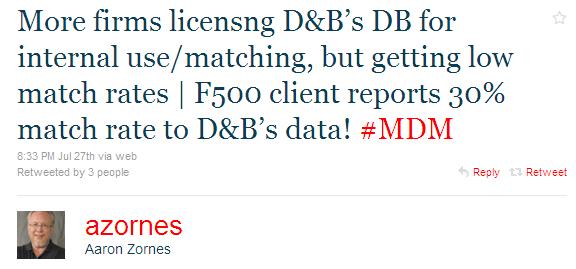
The fast time-to-value for lean MDM was also emphasized by MDM guru Aaron Zornes in a tweet yesterday:

The mentioned LeanMDM offer from Omikron Data Quality (which is one of my employers) is described in the link (in German). A short resume of the text is that you among other things will get this from lean MDM:

  • An increase in the corporate value of customer data
  • Short project times and fast results
  • Lower implementation costs through service-oriented architecture (SOA)

I have been involved in one of the implementations of the LeanMDM concept as described in this article (in English) about how the car rental giant Avis achieved lean MDM for the Scandinavian business.

Bookmark and Share

Bluetooth and Me

Bluetooth is a wonderful technology that allows me to browse the phone book stored on my cell phone and activate a call from my car cockpit even though my mobile is in my jacket pocket and my hands are on the wheel.

By the way: Bluetooth is a communication standard named after king Harald Bluetooth of Denmark because he united all the Danish tribes a thousand years ago, even though his father, Gorm the Sleepy, probably did most of it. Harald however was the guy who abandoned the Old Norse gods in favor of Christianity leaving Odin and Thor the humiliating fate of becoming American comic and film characters.

History aside, Bluetooth doesn’t do anything more than exposing my party master data hub on the cell phone made up from numerous SIM card changes and outlook synchronizations with all the resulting duplicates and outdated numbers even a data quality geek and master data management enthusiast is wearing.

Bookmark and Share

Who Is Not Using Data Quality Magic?

The other day the latest Gartner Magic Quadrant for Data Quality Tools was released.

If you are interested in knowing what it says, it’s normally possible to download a copy from the leading vendors’ website.

Among the information in the paper you will find some estimated numbers of customers who has purchased the tools from the vendors included in the quadrant.

If you sum up these numbers, then it is estimated that 16,540 organizations worldwide is a customer at an included vendor.

So, if I matched that compiled customer list with the Dun & Bradstreet WorldBase holding at least 100 million active business entities worldwide, I will have a group of at least 99,983,460 companies who is not using magical data quality tools.

And that is probably falsely excluding that there are customers who has more than one vendor.

Anyway, what do all the others do then?

Well, of course the overwhelming number of companies will be too small to have any chance of investing in a data quality tool from a vendor that made it to the quadrant.

The quadrant also list a range of other vendors of data quality tools typically operating locally around the world. These vendors also have customers and probably more customers in numbers but not at the size of the companies who chooses a vendor in the quadrant.   

A lot of data quality technology is also used by service providers who either use a tool from a data quality tool vendor or has made a homegrown solution. So a lot of companies benefit from such services when processing large number of data records to be standardized, deduplicated and enriched.

Then we must not forget that technology doesn’t solve all your data quality issues as stated by the founder of DataQualityPro Dylan Jones in a recent post on a data quality forum operated by the (according to Gartner) leading data quality tool vendor. The post is called Finding the Passion for Data Quality.

My take is that it’s totally true that data quality tools doesn’t solve most of your data quality issues, but those issues addressed, typically data profiling and data matching, are hard to solve without a tool. So there is still a huge market out there currently covered by the true leader in the data quality market: Laissez-Faire.

Bookmark and Share

Proactive Data Governance at Work

Data governance is 80 % about people and processes and 20 % (if not less) about technology is a common statement in the data management realm.

This blog post is about the 20 % (or less) technology part of data governance.

The term proactive data governance is often used to describe if a given technology platform is able to support data governance in a good way.

So, what is proactive data governance technology?

Obviously it must be the opposite of reactive data governance technology which must be something about discovering completeness issues like in data profiling and fixing uniqueness issues like in data matching.

Proactive data governance technology must be implemented in data entry and other data capture functionality. The purpose of the technology is to assist people responsible for data capture in getting the data quality right from the start.

If we look at master data management (MDM) platforms we have two possible ways of getting data into the master data hub:

  • Data entry directly in the master data hub
  • Data integration by data feed from other systems as CRM, SCM and ERP solutions and from external partners

In the first case the proactive data governance technology is a part of the MDM platform often implemented as workflows with assistance, checks, controls and permission management. We see this most often related to product information management (PIM) and in business-to-business (B2B) customer master data management. Here the insertion of a master data entity like a product, a supplier or B2B customer involves many different employees each with responsibilities for a set of attributes.

The second case is most often seen in customer data integration (CDI) involving business-to-consumer (B2C) records, but certainly also applies to enriching product master data, supplier master data and B2B customer master data. Here the proactive data governance technology is implemented in the data import functionality or even in the systems of entry best done as Service Oriented Architecture (SOA) components that are hooked into the master data hub as well.

It is a matter of taste if we call such technology proactive data governance support or upstream data quality. From what I have seen so far, it does work.

Bookmark and Share

Data Quality and Decision Intelligence

“The substitute for Business Intelligence is called Decision Intelligence” was the headline in an article on the Danish IT site Version2 last month. The article was an interview with Michael Borges, head of Copenhagen based data management system integrator Platon. The article is introduced in English on Platon’s Australia site.

The term Decision Intelligence as a successor for Business Intelligence (BI) has been around for a while. In an article from 2008 Claudia Imhoff and Colin White explains what Decision Intelligence does that Business Intelligence don’t.  Very simplified it is embracing and integrating operational Business Intelligence, traditional Data Warehouse based Business Intelligence and (Business) Content Analytics.  

It is said in the article: “This, of course, has implications for both data integration and data quality. This aspect of decision intelligence will be covered in a future article.” I haven’t been able to find that future article. Maybe it’s still pending.

Anyway, certainly this – call it Decision Intelligence or something else – has implications for data quality.

The operational BI side is about supporting, and maybe have the systems making, decisions based on events taking place here and now based on incoming transactions and related master data. This calls for data quality prevention at data collection time opposite to data cleansing downstream which may have served well for informed decisions in traditional Data Warehouse based BI.

The content analysis side, which according to Imhoff/White article includes information expertise, makes me consider the ever recurring discussion in the data quality realm about the difference between data quality and information quality. Maybe we will come to an intelligent decision on that one when Business Intelligence is succeeded by Decision Intelligence.   

Bookmark and Share