Avoiding Contact Data Entry Flaws

Contact data is the data domain most often mentioned when talking about data quality. Names and addresses and other identification data are constantly spelled wrong, or just different, by the employees responsible of entering party master data.

Cleansing data long time after it has been captured is a common way of dealing with this huge problem. However, preventing typos, wrong hearings and multi-cultural misunderstandings at data entry is a much better option wherever applicable.

I have worked with two different approaches to ensure the best data quality for contact data entered by employees. These approaches are:

  • Correction and
  • Assistance

Correction

With correction the data entry clerk, sales representative, customer service professional or whoever is entering the data will enter the name, address and other data into a form.

After submitting the form, or in some cases leaving each field on the form, the application will check the content against business rules and available reference data and return a warning or error message and perhaps a correction to the entered data.

As duplicated data is a very common data quality issue in contact data, a frequent example of such a prompt is a warning about that a similar contact record already exists in the system.

Assistance

With assistance we try to minimize the needed number of key strokes and interactively help with searching in available reference data.

For example when entering address data assistance based data entry will start with the highest geographical level:

  • If we are dealing with international data the country will set the context and know about if a state or province is needed.
  • Where postal codes (like ZIP) exists, this is the fast path to the city.
  • In some countries the postal code only covers one street (thoroughfare), so that’s settled by the postal code. In other situations we will usually have a limited number of streets that can be picked from a list or settled with the first characters.

(I guess many people know this approach from navigation devices for cars.)

When the valid address is known you may catch companies from business directories being on that address and, depending on the country in question, you may know citizens living there from phone directories and other sources and of course the internal party master data, thus avoiding entering what is already known about names and other data.

When catching business entities a search for a name in a business directory often leads to being able to pick a range of identification data and other valuable data and not at least a reference key to future data updates.

Lately I have worked intensively with an assistance based cloud service for business processes embracing contact data entry. We have some great testimonials about the advantages of such an approach here: instant Data Quality Testimonials.


Bookmark and Share

Social MDM, Privacy and Data Quality

The term “Social MDM” has been promoted quite well this week not at least as part of the social media information stream from the ongoing user conference of the tool vendor Informatica.

In a blog post called Informatica 9.5 for Big Data Challenge #2: Social Jody Ko of Informatica introduces the opportunities and challenges.

In the closing remarks Judy says: “There’s still a long way to go to bring social data into the mainstream enterprise, in part due to concerns over privacy and the potential “creepiness” factor of mining social data.”

As I understand it the spearhead Social MDM part of the tool release is a Facebook App that provides connectivity between Facebook and the MDM solution.

Industry analyst R “Ray” Wang examines this in the blog post News Analysis: Informatica Launches MDM 9.5. The analysis states that it now is time to “drive data out of Facebook and not into Facebook”.

The opportunities and challenges of driving data out of Facebook was discussed in a post called exactly Out of Facebook here on the blog some years ago.

Balancing privacy with data hoarding is still for sure a subject that in no way is settled and probably never will be.

Connecting systems of record in traditional MDM solutions with social network profiles is in no way a walk over too. The classic data quality challenges with uniqueness of records and completeness of data only gets more difficult, but also, there are great opportunities for getting a better picture of your customers and other business partners.

If you are interested in Social MDM and the related challenges and opportunities there is a LinkedIn group for Social MDM.

The group is new, less than a month old at the present time, but there is already a lot of content to dip into, including:

Bookmark and Share

Deduplication vs Identity Resolution

When working with data matching you often finds that there basically is a bright view and a dark view.

Traditional data matching as seen in most data quality tools and master data management solutions is the bright view: Being about finding duplicates and making a “single customer view”. Identity resolution is the dark view: Preventing fraud and catching criminals, terrorists and other villains.

These two poles were discussed in a blog post and the following comments last year. The post was called What is Identity Resolution?

While deduplication and identity resolution may be treated as polar opposites and seemingly contrary disciplines they are in my eyes interconnected and interdependent. Yin and Yang Data Quality.

At the MDM Summit in London last month one session was about the Golden Nominal, Creating a Single Record View. Here Corinne Brazier, Force Records Manager at the West Midlands Police in the UK told about how a traditional data quality tool with some matching capabilities was used to deal with “customers” who don’t want to be recognized.

In the post How to Avoid Losing 5 Billion Euros it was examined how both traditional data matching tools and identity screening services can be used to prevent and discover fraudulent behavior.

Deduplication becomes better when some element of identity resolution is added to the process. That includes embracing big reference data in the process. Knowing what is known in available sources about the addresses that is being matched helps. Knowing what is known in business directories about companies helps. Knowing what is known in appropriate citizen directories when deduping records holding data about individuals helps.

Identity Resolution techniques is based on the same data matching algorithms we use for deduplication. Here for example a fuzzy search technology helps a lot compared to using wildcards. And of course the same sources as mentioned above are a key to the resolution.

Right now I’m dipping deep into the world of big reference data as address directories, business directories, citizen directories and the next big thing being social network profiles. I have no doubt about that deduplication and identity resolution will be more yinyang than yin and yang in the future.

Bookmark and Share

The Data Quality Tool Vendor Difference

How do analysts look at the data quality tool vendor market? As with everything data quality there are differences and apparently no single source of truth.

Gartner has its magic quadrant. They sell it for money, but usually you are able to get a free copy from the leading vendors.

The Information Difference has its DQ Landscape in the cloud for free.

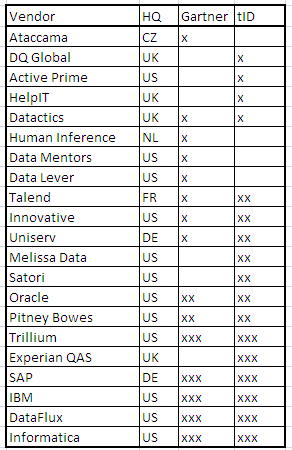
It is interesting to compare which vendors are included in the latest main pictures, as I have tried below:

The number of x’s is a rough measure of the ability to execute / market strength.

Three smaller vendors are considered by Gartner, but not by The Information Difference and vice versa. Two midsize vendors are included by The Information Difference, but not by Gartner. Experian QAS are included as a big one by The Information Difference, but did not (yet) meet the inclusion criteria used by Gartner.

Bookmark and Share

How to Avoid Losing 5 Billion Euros

Two years ago I made a blog post about how 5 billion Euros were lost due to bad identity resolution at European authorities. The post was called Big Time ROI in Identity Resolution.

In the carbon trade scam criminals were able to trick authorities with fraudulent names and addresses.

One way of possible discovery of the fraudster’s pattern of interrelated names and physical and digital locations was, as explained in the post, to have used an “off the shelf” data matching tool in order to achieve what is sometimes called non-obvious relationship awareness. When examining the data I used the Omikron Data Quality Center.

Another and more proactive way would have been upstream prevention by screening identity at data capture.

Identity checking may be a lot of work you don’t want to include in business processes with high volume of master data capture, and not at least screening the identity of companies and individuals on foreign addresses seems a daunting task.

One way to help with overcoming the time used on identity screening covering many countries is using a service that embraces many data sources from many countries at the same time. A core technology in doing so is cloud service brokerage. Here your IT department only has to deal with one interface opposite to having to find, test and maintain hundreds of different cloud services for getting the right data available in business processes.

Right now I’m working with such a solution called instant Data Quality (iDQ).

Really hope there’s more organisations and organizations out there wanting to avoid losing 5 billion Euros, Pounds, Dollars, Rupees, Whatever or even a little bit less.

Bookmark and Share

Big Reference Data as a Service

This morning I read an article called The Rise of Big Data Apps and the Fall of SaaS by Raj De Datta on TechCrunch.

I think the first part of the title is right while the second part is misleading. Software as a Service (SaaS) will be a big part of Big Data Apps (BDA).

The article also includes a description of LinkedIn merely as a social recruitment service. While recruiters, as reported in the post Indulgent Moderator or Ruthless Terminator?, certainly are visible on this social network, LinkedIn is much more than that.

Among other things LinkedIn is a source of what I call big reference data as examined in the post Social MDM and Systems of Engagement.

Besides social network profiles big reference data also includes big directory services, being services with large amount of data about addresses, business entities and citizens/consumers as told in the post The Big ABC of Reference Data.

Right now I’m working with a Software as a Service solution embracing Big (Reference) Data as a Service thus being a Big Data App called instant Data Quality.

And hey, I have made a pin about that:

Bookmark and Share

The Taxman: Data Quality’s Best Friend

Collection of taxes has always been a main driver for having registries and means of identifying people, companies and properties.

5,000 years ago the Egyptians made the first known census in order to effectively collect taxes.

As reported on the Data Value Talk blog, the Netherlands have had 200 years of family names thanks to Napoleon and the higher cause of collecting taxes.

Today the taxman goes cross boarder and wants to help with international data quality as examined in the post Know Your Foreign Customer. The US FATCA regulation is about collecting taxes from activities abroad and as said on the Trillium blog: Data Quality is The Core Enabler for FATCA Compliance.

My guess is that this is only the beginning of a tax based opportunity for having better data quality in relation to international data.

In a tax agenda for the European Union it is said: “As more citizens and companies today work and operate across the EU’s borders, cooperation on taxation has become increasingly important.”.

The EU has a program called FISCALIS in the making. Soon we not only have to identify Americans doing something abroad but practically everyone taking part in the globalization.

For that we all need comprehensive accessibility to the wealth of global reference data through “cutting-edge IT systems” (a FISCALIS choice of wording).

I am working on that right now:

Bookmark and Share

Updating a Social Business Directory

Business directories have been around for ages. In the old days it was paper based as in the yellow pages for a phone book. The yellow pages have since made it to be online searchable. We also know commercial business directories as the Dun & Bradstreet WorldBase as well as government operated national wide directories of companies and industry specific business directories.

Such business directories often takes a crucial role in master data quality work as sources for data enrichment in the quest for getting as close as possible to a single version of the truth when dealing with B2B customer master data, supplier master data and other business partner master data.

A classic core data model for Master Data in CRM systems, SCM solutions and Master Data hubs when doing B2B is that you have:

  • Accounts being the BUSINESS entities who are your customers, suppliers, prospects and all kind of other business partners
  • Contacts being the EMPLOYEEs working there and acting in the roles as decision makers, influencers, gate keepers, users and so on

Today we also have to think about social master data management, being exploiting reference data in social media as a supplementary source of external data.

As all social activity this exercise goes two ways:

  • Finding and monitoring your existing and wanted business partners in the social networks
  • Updating your own data

Most business entities in this world are actually one-man-bands. So are mine. Therefore I went to the LinkedIn company pages this morning and updated data about my company Liliendahl Limited: Unlimited Data Quality and Master Data Management consultancy for tool and service vendors.

Bookmark and Share

The Big Search Opportunity

The other day Bloomberg Businessweek had an article telling that Facebook Delves Deeper Into Search.

I have always been advocating for having better search functionality in order to get more business value from your data. That certainly also applies to big data.

In a recent post called Big Reference Data Musings here on the blog, the challenge of utilizing large external data sources for getting better master data quality was discussed. In a comment Greg Leman pointed out, that there often isn’t a single source of the truth, as you for example could expect from say a huge reference data source as the Dun & Bradstreet WorldBase holding information about business entities from all over the world.

Indeed our search capabilities optimally must span several sources. In the business directory search realm you may include several sources at a time like supplementing the D&B  WorldBase with for example EuroContactPool, if you do business in Europe, or the source called Wiki-Data (under rename to AvoxData) if you are in financial services and wants to utilize the new Legal Entity Identifier (LEI) for counterparty uniqueness in conjunction with other more complete sources.

As examined in Search and if you are lucky you will find combining search on external reference data sources and internal master data sources is a big opportunity too. In doing that you, as described the follow up piece named Wildcard Search versus Fuzzy Search, must get the search technology right.

I see in the Bloomberg article that Facebook don’t intend to completely reinvent the wheel for searching big data, as they have hired a Google veteran, the Danish computer scientist Lars Rasmussen, for the job.

Bookmark and Share

Data Quality at Terminal Velocity

Recently the investment bank Saxo Bank made a marketing gimmick with a video showing a BASE jumper trading foreign currency with the banks mobile app at terminal velocity (e.g. the maximum speed when free falling).

Today business decisions have to be taken faster and faster in the quest for staying ahead of competition.

When making business decisions you rely on data quality.

Traditionally data quality improvement has been made by downstream cleansing, meaning that data has been corrected long time after data capture. There may be some good reasons for that as explained in the post Top 5 Reasons for Downstream Cleansing.

But most data quality practitioners will say that data quality prevention upstream, at data capture, is better.

I agree; it is better.  Also, it is faster. And it supports faster decision making.

The most prominent domain for data quality improvement has always been data quality related to customer and other party master data. Also in this quest we need instant data quality as explained in the post Reference Data at Work in the Cloud.

Bookmark and Share