This week I had the pleasure of being at the Informatica MDM 360 event in Paris. The “360” predicate is all over in the Informatica communication. There are the MDM 360 events around the world. The Product 360 solution – the new wrap of the old Heiler PIM solution, as I understand it. The Supplier 360 solution. Some Customer 360 stuff including the Cloud Customer 360 for Salesforce edition.
All these solutions constitutes one of the leading Multi-Domain MDM offerings on the market – if not the leading. We will be wiser on that question when Gartner (the analyst firm) makes their first Multi-Domain MDM Magic Quadrant later this year as reported in the post Gravitational Waves in the MDM World.
Until now, Informatica has been very well positioned for Customer MDM, but not among the leaders for Product MDM in the ranking according to Gartner. Other analysts, as Information Difference, have Informatica in the top right corner of the (Multi-Domain) MDM landscape as seen here.
MDM and big data is another focus area for Informatica and Informatica has certainly been one of the first MDM vendors who have embraced big data – and that not just with wording in marketing. Today we cannot say big data without saying data lake. Informatica names their offering the Intelligent Data Lake.
For me, it will be interesting to see how Informatica can take full Multi-Domain MDM leadership with combining a good Product MDM solution with an Intelligent Data Lake.
How do you exchange product data with your trading partners today? At the Product Data Lake we would like to know some more about that. We do expect that many still send eMails with spreadsheets and digital assets. But please tell us how it is with you. Take the survey by clicking here.
Also please comment on this blog post on your plans or if you work with Product Information Management (PIM) as a service provider and have experiences to share.
Omichannel has become a buzzword in marketing and beyond. The jury is still out on what omnichannel really is, but most will agree that it is a refinement and/or extension of earlier known buzzwords as multichannel and cross channel. You may learn more in this article.
In omnichannel you will try really, really hard to have a single customer view across all channels, and you will try really, really, really hard to present your product information in a uniform and consistent way across all channels.
One challenge here is that your business is not an island. You are part of a business ecosystem, or several of them, as examined in the post Data Management for Business Ecosystems.
“Your customer” may look at “your product” in the sphere of another member of your business ecosystem. It may be at one of your trading partners or at one of your competitors.
So, what can you do about this when it comes to data management?
In the hard case, your competitors, it is about knowing more about your customer. Knowing about your customers relationships. Knowing about your customers relations with products and their categories. Knowing about your customer’s locational belonging. All in all the case of multidomain MDM as seen in the post Multi-Domain MDM and Data Quality Dimensions.
Expand digitilization across business ecosystems from single purposes to cover an omnichannel view
Besides your own product information you must register what you know about that product information as it is stored and handled by other members in your business ecosystem – trading partners and competitors.
With product information, you must be able to exchange that with your trading partners. You cannot expect that everyone is handling the information about the same product in exact the same way as you. Actually you should not want that. You want to be better than your competitors in some ways and you want to add value for your trading partners. But you would for sure find value in joining a place of intersection where common known characteristics about products are exchanged between trading partners – such as the Product Data lake.
The increased use of self-service based sales approaches as in ecommerce has put a lot of pressure on cross company supply chains. Besides handling the logistics and controlling pricing, you also have to take care of a huge amount of product data and digital assets describing the goods.
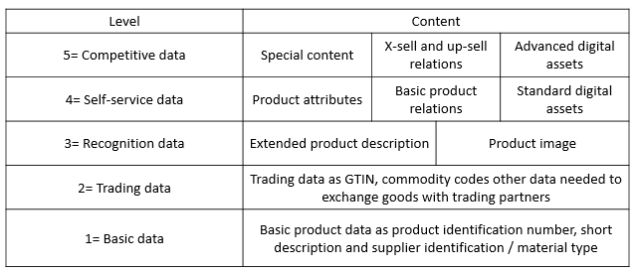
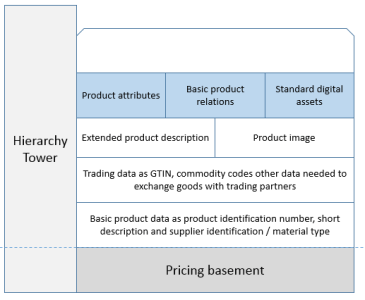
You may divide product information into these five levels:
Please learn more about the five levels of product information, including how hierarchies, pricing and logistics fits in, by visiting the product information castle.
Level 4 in this model is self-service product data being:
Product attributes, also sometimes called product properties or product features. These are up to thousands of different data elements that describes a product. Some are very common for most products like height, length, weight and colour. Some are very specific to the product category. This challenge is actually the reason of being for dedicated Product Information Management (PIM) solutions.
Basic product relations are the links between a product and other products like a product that have several different accessories that goes with the product or a product being a successor of another now decommissioned product.
Standard digital assets are documents like installation guides, line drawings and data sheets.
These are the product data that helps the end customer comparing products and making an objective choice when buying a product for a specific purpose of use. These data are also helpful in answering the questions a buyer may have when making a purchase.
Every piece of data belonging to any level of product information may be forwarded through the cross company supply chain from the manufacturer to the end seller. Self-service product data are however the data that most obviously will do so.
In order to support end customer self-service when producing, distributing and selling goods you must establish a process driven service that automates the introduction of new products with extensive product data, the inclusion of new kinds of product data and updates to those data. You must be a digitalized member of your business ecosystem. The modern solution for that is the Product Data Lake.
Is that piece of data wrong or right? This may very well be a question about in what language we are talking about.
In an earlier double post on this blog I had a small quiz about the name of the Pope in the Catholic church. The point was that all possible answers were right as explained in post When Bad Data Quality isn’t Bad Data. The thing is that the Pope over the wold has local variants over the English name Francis. François in French, Franziskus in German, Francesco in Italian, Francisco in Spanish Franciszek in Polish, Frans in Danish and Norwegian and so on.
In today’s globalized, or should I say globalised, world, it is important that our data can be represented in different languages and that the systems we use to handle the data is built for that. The user interface may be in a certain flavor/flavour of English only, but the data model must cater for storing and presenting data in multiple languages and even variants of languages as English in its many forms. Add to that the capability of handling other characters than Latin in other script systems than alphabets as examined in the post called Script Systems.
This challenge is very close to me right when we are building a service for sharing product information in business ecosystems. So will the Product Data Lake be multilingual? Mais oui! Natürlich. Jo da.
PS: The Product Data Lake will actually help with collecting product information in multiple languages through the supply chains of product manufacturers, distributors, retailers and end users.
It is never too late to start up, I have heard. So despite I usually brag about having +35 years of experience in the intersection of business and IT and a huge been done list in Data Quality and Master Data Management (MDM) which can get me nice consultancy engagements, a certain need on the market has been puzzling in my head for some time.
Before that, when someone asked me what to do in the MDM space I told them to create something around sharing master data between organisations. Most MDM solutions are sold to a given organization to cover the internal processes there. There are not many solutions out there that covers what is going on between organizations.
But why not do that myself? – with the help of some younger people.
You may have noticed, that I during the last year have been writing about something called the Product Data Lake. This has until recently mostly just been a business concept that could be presented on power point slides. So called slideware. But now it is becoming real software being deployed in the cloud.
At home in Denmark, some young people are working on our solution too as well as the related launching activities and social media upbeat. This includes a LinkedIn company page. For continuous stories about our start-up, please follow the Product Data Lake page on LinkedIn here.
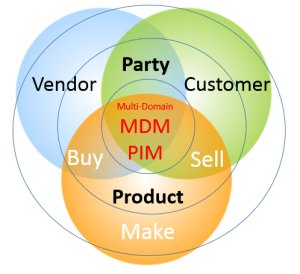
As reported in the post Gravitational Waves in the MDM World there is a tendency in the MDM (Master Data Management) market and in MDM programmes around to encompass both the party domain and the product domain.
The party domain is still often treated as two separate domains, being the vendor (or supplier) domain and the customer domain. However, there are good reasons for seeing the intersection of vendor master data and customer master data as party master data. These reasons are most obvious when we look at the B2B (business-to-business) part of our master data, because:
You will always find that many real world entities have a vendor role as well as a customer role to you
The basic master data has the same structure (identification, names, addresses and contact data
You need the same third party validation and enrichment capabilities for customer roles and vendor roles.
When we look at the product domain we also have a huge need to connect the buy side and the sell side of our business – and the make side for that matter where we have in-house production.
Multi-Domain MDM has a side effect, so to speak, about bringing the sell-side together with the buy- and make-side. PIM (Product Information Management), which we often see as the ancestor to product MDM, has the same challenge. Here we also need to bring the sell-side and and the buy-side together – on three frontiers:
Bringing the internal buy-side and sell-side together not at least when looking at product hierarchies
Bringing our buy-side in synchronization with our upstream vendors/suppliers sell-side when it comes to product data
Bringing our sell-side in synchronization with our downstream customers buy-side when it comes to product data
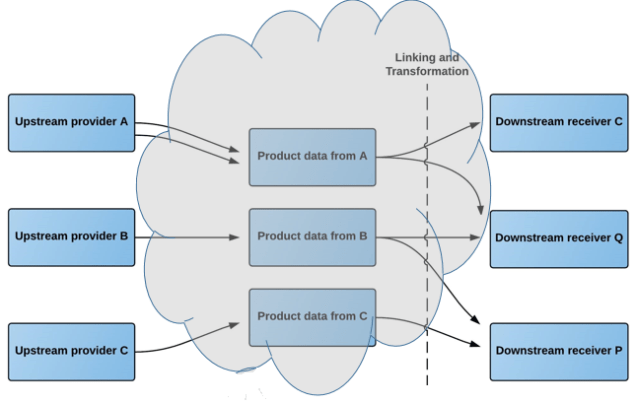
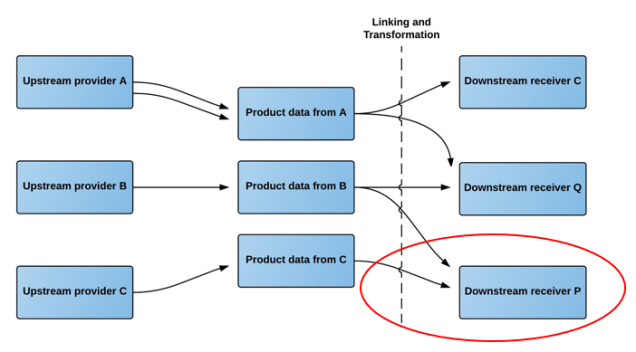
The Product Data Lake is a cloud service for sharing product data in the eco-systems of manufacturers, distributors, retailers and end users of product information.
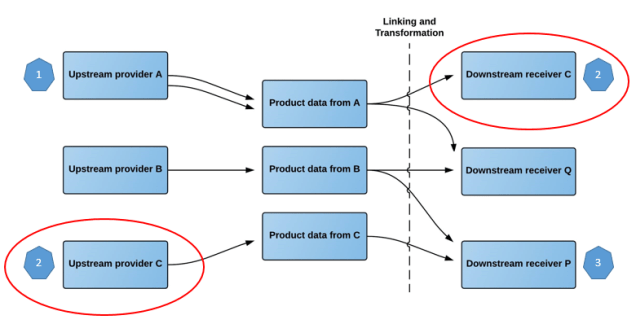
As an upstream provider of products data, being a manufacturer or upstream distributor, you have these requirements:
When you introduces new products to the market, you want to make the related product data and digital assets available to your downstream partners in a uniform way
When you win a new downstream partner you want the means to immediately and professionally provide product data and digital assets for the agreed range
When you add new products to an existing agreement with a downstream partner, you want to be able to provide product data and digital assets instantly and effortless
When you update your product data and related digital assets, you want a fast and seamless way of pushing it to your downstream partners
When you introduce a new product data attribute or digital asset type, you want a fast and seamless way of pushing it to your downstream partners.
The Product Data Lake facilitates these requirements by letting you push your product data into the lake in your in-house structure that may or may not be fully or partly compliant to an international standard.
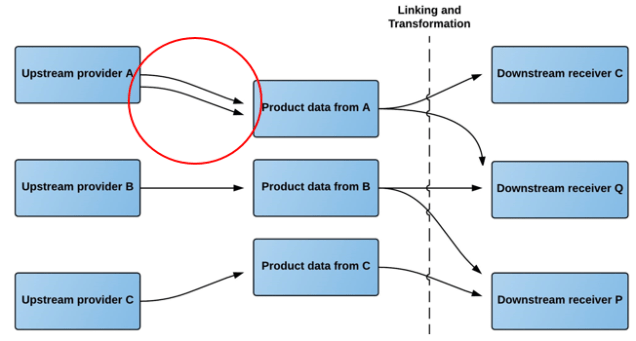
As an upstream provider, you may want to push product data and digital assets from several different internal sources.
The product data lake tackles this requirement by letting you operate several upload profiles.
As a downstream receiver of product data, being a downstream distributor, retailer or end user, you have these requirements:
When you engage with a new upstream partner you want the means to fast and seamless link and transform product data and digital assets for the agreed range from the upstream partner
When you add new products to an existing agreement with an upstream partner, you want to be able to link and transform product data and digital assets in a fast and seamless way
When your upstream partners updates their product data and related digital assets, you want to be able to receive the updated product data and digital assets instantly and effortless
When you introduce a new product data attribute or digital asset type, you want a fast and seamless way of pulling it from your upstream partners
If you have a backlog of product data and digital asset collection with your upstream partners, you want a fast and cost effective approach to backfill the gap.
The Product Data Lake facilitates these requirements by letting you pull your product data from the lake in your in-house structure that may or may not be fully or partly compliant to an international standard.
In the Product Data Lake, you can take the role of being an upstream provider and a downstream receiver at the same time by being a midstream subscriber to the Product Data Lake. Thus, Product Data Lake covers the whole supply chain from manufacturing to retail and even the requirements of B2B (Business-to-Business) end users.
The Product Data Lake uses the data lake concept for big data by letting the transformation and linking of data between many structures be done when data are to be consumed for the first time. The goal is that the workload in this system has the resemblance of an iceberg where 10% of the ice is over water and 90 % is under water. In the Product Data Lake manually setting up the links and transformation rules should be 10 % of the duty and the rest being 90 % of the duty will be automated in the exchange zones between trading partners.
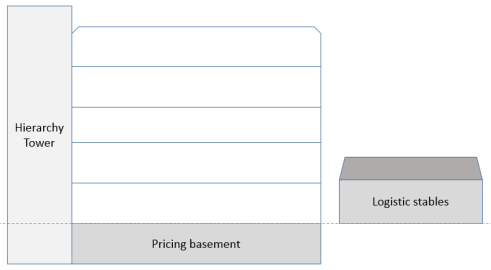
If you have ever visited some of the many castles around in Europe you may have noticed that there are many architectural similarities. You may also compare these basic structures of a castle with how we can imagine the data architecture related to Product Information Management (PIM).
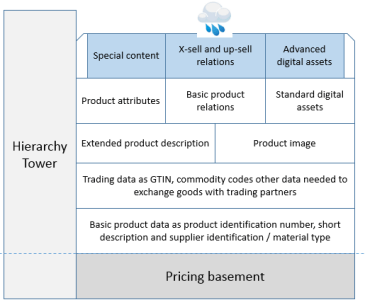
In my vision of a product information castle there is a main building with five floors of product information. There is a basement for pricing information where we often will find the valuable things as the crown jewels and other treasures. The hierarchy tower combines the pricing information and the different levels of product information. Besides the main castle, we find the logistic stables.
Hierarchy, pricing and logistic is part of whole picture
What we do not see on this figure is the product lifecycle management wall around the castle area.
Now, let us get back to the main building and examine what is on each of the floors in the building.
Ground PIM level: Basic product data
On the ground level, we find the basic product data that typically is the minimum required for creating a product in any system of record. Here we find the primary product identification number or code that is the internal key to all other product data structures and transactions related to the product. Then there usually is a short product description. This description helps internal employees identifying a product and distinguishing that product from other products. If an upstream trading partner produces the product, we may find the identification of that supplier here. If the product is part of internal production, we may have a material type telling about if it is a raw material, semi-finished product, finished good or packing material.
Except for semi-finished products, we may find more things on the next floor.
PIM level 2: Product trade data
This level has product data related to trading the product. We may have a unique Global Trade Item Number (GTIN) that may be in the form of an International Article Number (EAN) or a Universal Product Code (UPC). Here we have commodity codes and a lot of other product data that supports buying, receiving, selling and delivering the product.
Most castles were not build in one go. Many castles started modestly in maybe just two floors and a tiny tower. In the same way, our product information management solutions for finished and trading goods usually are built on the top of an elder ERP solution holding the basic and trading data.
PIM Level 3: Basic product recognition data
On the third level, we find the two grand ballrooms of product information. These ballrooms were introduced when eCommerce started to grow up.
The extended product description is needed because the usual short product description used internally have no meaning to an outsider as told in the post Customer Friendly Product Master Data. Some good best practices for governing the extended product description is to have a common structure of how the description is written, not to use abbreviations and to have a strict vocabulary as reported in the post Toilet Seats and Data Quality.
Having a product image is pivotal if you want to sell something without showing the real product face-to-face with the customer or other end user. A missing product image is a sign of a broken business process for collecting product data as pondered in the post Image Coming Soon.
PIM Level 4: Self-service product data
On the fourth level, we have three main chambers: Product attributes, basic product relations and standard digital assets.This data are the foundation of customer self-service and should, unless you are the manufacturer, be collected from the manufacturer via supplier self-service.
Product attributes are also sometimes called product properties or product features. These are up to thousands of different data elements that describes a product. Some are very common for most products like height, length, weight and colour. Some are very specific to the product category. This challenge is actually the reason of being for dedicated Product Information Management (PIM) solutions as told in the post MDM Tools Revealed.
Basic product relations are the links between a product and other products like a product that have several different accessories that goes with the product or a product being a successor of another now decommissioned product.
Standard digital assets are documents like installation guides, line drawings and data sheets as examined in the post Digital Assets and Product MDM.
PIM Level 5: Competitive product data
On the upper fifth floor we find elements like on the fourth floor but usually these are elements that you won’t necessarily apply to all products but only to your top products where you want to stand out from the crowd and distance yourself from your competitors.
Special content are descriptions of and stories about the product above the hard features. Here you tell about why the product is better than other products and in which circumstances the product can to be used. A common aim with these descriptions is also Search Engine Optimization (SEO).
X-sell (cross-sell) and up-sell product relations applies to your particular mix of products and may be made subjective as for example to look at up-sell from a profit margin point of view. X-sell and up-sell relations may be defined from upstream by you or your upstream trading partners but also dripping down on the roof from the behaviour of your downstream trading partners / customers as manifested in the classic webshop message: “Those who bought product A also bought / looked at product B”.
Advanced digital assets are broader and more lively material than the hard fact line drawings and other documents. Increasingly newer digital media types as video are used for this purpose.
All in all the rooftop takes us to the upper side of the cloud.
Product Information Management (PIM) have over the recent years emerged as an important technology enabled discipline for every company taking part in a supply chain. These companies are manufacturers, distributor, retailers and large end users of tangible products requiring a drastic increased variety of product data to be used in ecommerce and other self-service based ways of doing business.
At the same time we have seen the raise of big data. Now, if you look at every single company, product data handled by PIM platforms perhaps does not count as big data. Sure, the variety is a huge challenge and the reason of being for PIM solutions as they handle this variety better than traditional Master Data Management (MDM) solutions and ERP solutions.
The variety is about very different requirements in data quality dimensions based on where a given product sits in the product hierarchy. Measuring completeness has to be done for the concrete levels in the hierarchy, as a given attribute may be mandatory for one product but absolutely ridiculous for another product. An example is voltage for a power tool versus for a hammer. With consistency, there may be attributes with common standards (for example product name) but many attributes will have specific standards for a given branch in the hierarchy.
Product information also encompasses digital assets, being PDF files with product sheets, line drawings and lots of other stuff, product images and an increasing amount of videos with installation instructions and other content. The volume is then already quite big.
A missing product image is a sign of a broken product data business process
Volume and velocity really comes into the game when we look at eco-systems of manufacturers, distributors and retailers. The total flow of product data can then be described with the common characteristics of big data: Volume, velocity and variety. Even if you look at it for a given company and their first degree of separation with trading partners, we are talking about big data where there is an overwhelming throughput of new product links between trading partners and updates to product information that are – or not least should have been – exchanged.
Within big data we have the concept of a data lake. A key success factor of a data lake solution is minimizing the use of spreadsheets. In the same way, we can use a data lake, sitting in the exchange zone between trading partners, for product information as elaborated further in the post Gravitational Collapse in the PIM Space.
 All these solutions constitutes one of the leading Multi-Domain MDM offerings on the market – if not the leading. We will be wiser on that question when Gartner (the analyst firm) makes their first Multi-Domain MDM Magic Quadrant later this year as reported in the post Gravitational Waves in the MDM World.

 You may have noticed, that I during the last year have been writing about something called the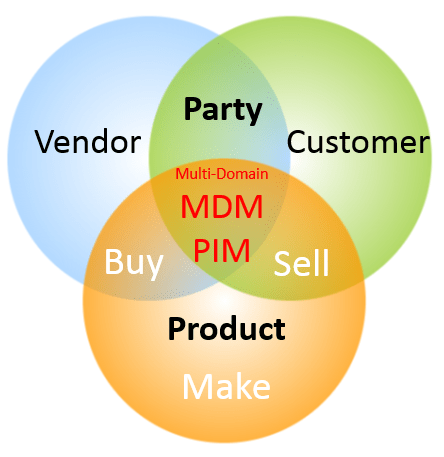
 As an upstream provider of products data, being a manufacturer or upstream distributor, you have these requirements: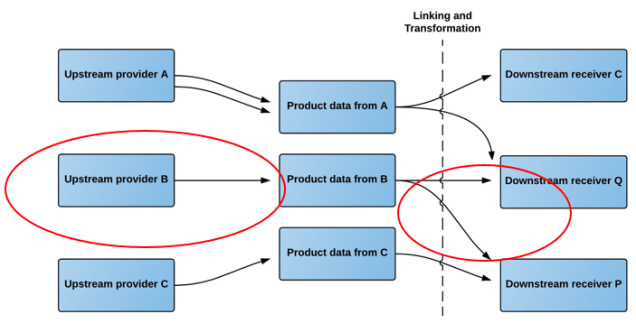







 Liliendahl on Data Quality