Neutron Star Collision and Data Quality

The scientific news of the day is the observed collision of two neutron stars resulting in gravitational waves, an extremely bright flash – and gold.

The connection between gravitational waves and Master Data Management (MDM) was celebrated here on the blog when those waves were detected for the first time as told in the post Gravitational Waves in the MDM World.

The ties to Product Information Management (PIM) was examined in the post Gravitational Collapse in the PIM Space.

Now we have seen a bright flash resembling what happens when two trading partners collide, as in makes business together encompassing sharing master data and product information. Seen from my telescope this improves data quality and thereby business outcome (gold, you know) as explained in the post Data Quality and Business Outcome.

Neutron Star Collide

Using Pull or Push to Get to the Next Level in Product Information Management

The importance of having a viable Product Information Management (PIM) solution has become well understood for companies who participates in supply chains.

The next step towards excellence in PIM is to handle product information in close collaboration with your trading partners. Product Data Lake is the solution for that. Here upstream providers of product information (manufacturers and upstream distributors) and downstream receivers of product information (downstream distributors and retailers) connect their choice of in-house PIM solution or other product master data solution as PLM (Product Lifecycle Management) or ERP.

Read more about that in the post What a PIM-2-PIM Solution Looks Like.

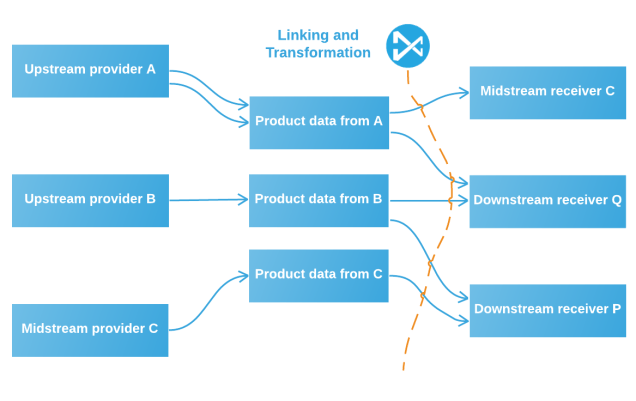
The principle behind Product Data Lake is inspired by how a data lake differs from a traditional data warehouse. In a data lake the linking and transformation takes place late, when the data is consumed by the receiver.

pdl-diagram-new

Product Data Lake resembles a social network as you connect with your trading partners from the real world in order to collaborate on getting complete and accurate product data from the manufacturer to the point-of-sales:

  • Pull-PushAs a downstream receiver, you can be on the winning side by utilizing our Product Data Pull service
  • As an upstream provider, you can be on the winning side by utilizing our Product Data Push service

Automatic for the People

R.E.M._-_Automatic_for_the_PeopleThe title of this blog post is the title of, in my rapid eye movements, one the best albums ever: Automatic for the People by R.E.M., which came out 25 years ago in 1992.

It began in manufacturing

Automation began in the manufacturing industry. Since then automation has been part of most other industries. Not at least within Information Technology, automation is part of the promise in almost every initiative.

When automating stuff, we should always be aware of not just automating old bad processes. To the most extreme, as Michael Hammer said back in 1990: Don’t Automate, Obliterate.

However, some of the most successful companies today are companies born in the information age and delivering services that in a high degree automates processes of value to their customers based on working intensively with information technology.

How can we close the loop and bring that kind of modern automation back to where it began: In the manufacturing industry? The challenges of doing that was examined by Harri Juntunen in a guest blog post called Data Born Companies and the Rest of Us.

IT will come back to manufacturing

In all humbleness we want to be part of that endeavor at Product Data Lake. Therefore, we are setting up a Product Data Push solution for manufacturers, in order to solve one of most severe issues for manufacturers today, being a dysfunctional flow of product information out to whoever is managing the point of sales for the produced goods.

Automation is the end goal. But in order to get started, we accept upload of product information in whatever format, structure and state it is available in. We will then get it in shape to be pulled by retailers, etailers and other trading partners. We will use manual workforce for that and we will use Artificial Intelligence for that too. And in the end, it will be automatic for the people.

Mantra for Retailers: Streamline Product Information to Delight Customers

In his third guest blog post here on this blog Rajneesh Kumar of Pimcore examines how this in-house PIM solution facilitates the way sales teams, online marketers, logistics departments and other units can work in perfect unison.

pimcore3

Managing retail is a complex business. It starts with keeping all the attributes of your product information consistent across all platforms. That’s because your customers are everywhere today. They check out your products online and in store. They express themselves on chat boxes, send emails asking straight questions, buy using desktops/tablets/mobiles, call customer care and use all the devices at their disposal interchangeably in doing so.

Ergo, your product information should better be accurate, high-quality, comprehensive, consistent and up-to-the-minute at all times, across all platforms. As your business expands, number of products increase, the chances of botching up only get higher.

In this sea of complexity, one of the key differentiators in your growth story can be the PIM solution you implement. Pimcore’s PIM can be an answer to your retail needs, here’s why:

Retailers’ Needs Answered with Ease:

In today’s changing consumer dynamics, where 72% of businesses have named improving customer experience as their top priority, a robust product information management system is vital for retailers.

It’s no secret that retailers are grappling with the ever-changing product information requirements. They know it very well their customers are deluged with choices. If they don’t give their customers a consistent experience across all digital touch-points irrespective of the time, date, location, phase in the customer life cycle, they stand to lose. With Pimcore’s PIM, integrating different systems, breaking down silos and managing data efficiently can put you on a trajectory of growth.

A PIM Solution that’s Simple yet Mature:

At the core, it’s all about managing the details about your products, like SKUs, specifications, core product data, digital assets, content, omni-channel data, metrics, and the works. And Pimcore does it like no other PIM software.

Be it the drag and drop approach, quick and easy data entry and management or a context sensitive navigation, it’s a breeze to maintain data assets on Pimcore. Its unrivaled interface too, makes it simple to manage data from multiple domains within one consolidated platform. Besides, Pimcore can be a great fit with CMS, DAM, and Commerce, which can immensely curb your time-to-market.

Unmatched Data Integration, Management and Delivery:

As a retailer, your business’s success will always hinge on your ability to integrate, manage and deliver properly. Pimcore’s data integration is unique in every sense. It has the capacity to integrate into just about any IT environment. This is due to its API driven approach and “connect anything” architecture, so whether it’s Oracle, SAP, Navision or anything else, you can look forward to a seamless integration.

Having rich product information in a flexible and agile data model, which is user-friendly, consistently organized, aggregated, classified, and ready for translation is one the biggest virtues of Pimcore.

Retailers can expect a lasting information infrastructure support, which will secure them for the future and ensure data integrity.

Pimcore Helps in Carving Impeccable Customer Journeys:

In retail, user’s perspective reigns supreme. Every possible trajectory of a customer’s journey must be thought through distinctly and mapped out. Everything that a customer is capable of doing, the touch-points they might engage through, all their possible actions, the way they see it must be taken into account. And Pimcore’s PIM can be of excellent help in doing this. It will act as a powerful link between your data and your customers in every step of their journey. It can subtly guide them, which will eventually lead them towards decision making.

Wrapping Up:

Customer centricity may be the driving force in today’s retail environment, but that doesn’t take away the importance of other stakeholders such as suppliers, sales teams, online marketers, logistics departments and other units. It’s pertinent that they all work in perfect unison, minus any silos, in order to contribute towards creating a great customer journey. Pimcore’s PIM can give you a leading edge in making it happen.

Rajneesh KumarA digital marketer and growth hacker, Rajneesh Kumar is currently marketing manager at Pimcore Global Services (PGS), an award-winning consolidated open source platform for product information management (PIM), web content management (CMS), digital asset management (DAM) and e-commerce. He is well versed with web analytic tools, paid media marketing and has hands on experience on seo techniques, organic promotion and content marketing.

MDM Will Go Cloud

How cloud is changing MDM (Master Data Management) is a subject examined in a very read worthy article by Julie Hunt published recently. The article is called How Does Technology Enable Effective MDM?

In here Julie says: “Adoption of cloud-based MDM or MDM-as-a-Service is on the rise, opening up new dimensions for how organizations take advantage of MDM and data governance.”

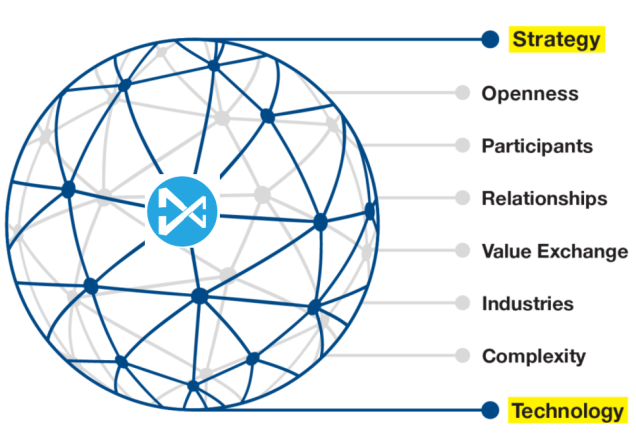
Julie’s article is part 3 of a six part series on the “New Age of Master Data Management”, so I may touch on a dimension that is covered in the upcoming articles. This dimension is how business ecosystems must be a part of your organizations MDM roadmap, and that dimension is, according to Gartner, the analyst firm, covering 8 underlying dimensions as told in the post From Business Ecosystem Strategy to PIM Technology.

Working with MDM in a business ecosystem context does require MDM in the cloud of some sort. Inhouse Mater Data Management and Product Information Management (PIM), which may be on premise or in the cloud or perhaps a hybrid, is only the beginning. Collaboration with business partners in a sophisticated environment will be controlled by a cloud solution.

More on this concept is explained in this piece about Master Data Share.

greatbeltbridge.jpg

From Business Ecosystem Strategy to PIM Technology

Recently Gartner, the analyst firm, published a paper with the title 8 Dimensions of Business Ecosystems.

Right now, I am working with the Product Data Lake service, that is aimed at supporting business ecosystems when it comes to sharing product information. Our take at business ecosystems seems to fit quite nicely into the 8-dimension model.

Business Ecosystem
Source: Gartner

Participants in supply chains must adapt a business ecosystem strategy when it comes to handling product information. An inhouse Product Information Management (PIM) system is only the beginning. This system must be an active part of a digital ecosystem as explained in the post Passive vs Active Product Information Exchange.

This digital ecosystem must be able to support different degrees of openness as public, private or hybrid and embrace engagement of diverse participants having various types of relationships. How this is achieved for product information sharing was touched in the post Product Data Management is Like an Ironman.

The value exchanged with product information was examined in the post Infonomics and Second Party Data. We do that by acknowledging the diversity of industries and complexity of multiple ecosystems as exemplified in the post Five Product Classification Standards.

As stated in the Gartner article: “Success will require a strategic integration of technology, information and business processes.”

Learn how this is achieved when it comes to Product Information Management (PIM) at Product Data Lake Documentation and Data Governance.

Customer Insight vs Product Insight

The rise of big data is very much driven by a craving for getting more insight on your (prospective) customers. However, the coin has a (better) flip side.

Looking at it from the other side

As a customer, we will strike back. We do not need to be told what to buy. But we do want to know what we are buying. This means we want to be able to see rich product information when making a self-service purchase. This subject was examined in the post You Must Supplement Customer Insight with Rich Product Data.

Many companies who are involved in selling to private and business customers are ramping up maintenance of product data by implementing inhouse Product Information Management (PIM) solutions as told in yesterday’s guest post on this blog. The article is called The Relation of PIM to Retail Success.

One further challenge is that you have to get product information from the source, usually being the manufacturers.

Big data approaches work for both

As data lakes are used to being the place to harvest customer insight, the data lake concept can be the approach to provide product insight to end customers as well.

The problem with having product data flowing from manufacturers to distributors and merchants is that everyone does not use the same standard, format, structure and taxonomy for product information.

The solution is a data lake shared by the business ecosystem. It is called Product Data Lake.

Sell more Reduce costs


The Relation of PIM to Retail Success

This is the second guest blog post from Rajneesh Kumar. In here Rajneesh examines how PIM and MDM have become a crucial aspect of retail success.

Today, every product has a variety of information. And each piece of product information is vital to influencing buyers since every buyer does in-depth research before zeroing on any product. When you deal with tens of thousands of products and their different data types and attributes, a streamlined product data becomes even more critical to ensure a higher sale.

Just think about any online store, and you will get the idea what magic product information produces in the presentation layer of marketing and sales channels.

A product information contains many components and maintains huge catalogs, bringing together the attributes of products with merchandising elements such as images, videos, audios, descriptions, and bundles. These key product facts induce greater product salability across multiple platforms to your customers— while maintaining brand visibility and consistency. When these elements are represented elegantly at the customer-facing end, it can even impact the overall customer buying experience.

Retail

Another factor is time-to-market. Retail sector has become a fast-paced industry where every day 4Ps of products could be changed and refreshed. You need a process that works like a well-oiled machine to keep your customers updated and engaged— across the board. And, you can better engage with buyers when you have a:

  • Fully centralized system— Define, create, and sync master data of product information across multiple channels
  • Rock solid operational capability— Use master data in day-to-day operations without any delay
  • Analytical capability— Reports and insights to make faster, accurate decisions

Beside that, PIM addresses the dynamic nature of constructing and reconstructing compelling packages and offers in an environment that any user can work in, regardless of their programming skills. PIM platform makes product visualization—easier; workflow management— quicker; mass product updates— faster; and integration with content tools (WCM, DAM, eCommerce, etc.)—seamless.

A flexible PIM/MDM platform enables you to harmonize product information lifecycle, including appending, modifying/updating, deleting, validating and securing access to the product information. With a single source of reliable product information, it makes easy to enrich product information across all touchpoints such as website, mobile app, social, in-store point-of-sale, and physical store. Simply, PIM and MDM have become a crucial aspect of retail success.

As digital marketer and growth hacker, Rajneesh Kumar is currently marketing manager at Pimcore Global Services (PGS), an award-winning consolidated open source platform for product information management (PIM), web content management (CMS), digital asset management (DAM) and e-commerce.

Three kinds of a MDM Data Model that comes with a tool

Master Data Management (MDM) is a lot about data modelling. When you buy a MDM tool it will have some implications for your data model. Here are three kinds of data models that may come with a tool:

An off-the-shelf model

This kind is particularly popular with customer and other party master data models. Core party data are pretty much the same to every company. We have national identification numbers, names, addresses, phone numbers and that kind of stuff where you do not have to reinvent the wheel.

Also, you will have access to rich reference data with a model such as address directories (which you may regard as belonging to a separate location domain), business directories (as for example the Dun & Bradstreet Worldbase) and in some countries citizen directories as well. MDM tools may come with a model shaped for these sources.

Tools which are optimized for data matching, including deduplication of party master data, will often shoehorn your party master data into a data model feasible for that.

A buildable model

When it comes to multi-domain MDM we will deal with entities that are not common to everyone.

Here a capability to build your model in the MDM tool is needed. One such tool I have worked with is Semarchy. Here semi-technical people are able to build and deploy incrementally more complex data models, that are default equipped with needed functionality around handling a golden copy and auditing data onboarding and changing.

A dynamic model

Product Information Management (PIM) requires that your end users can build the model on the fly, as product data are so different between product groups.

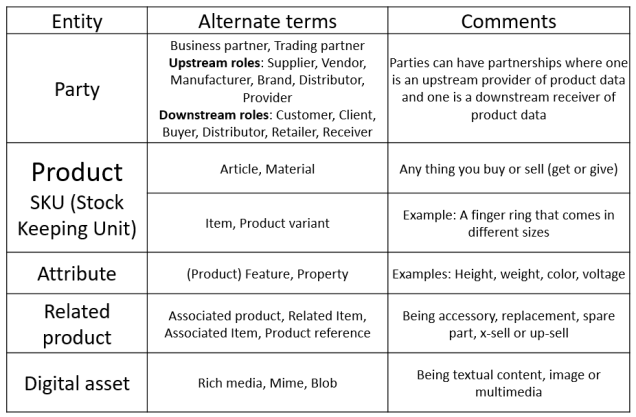
In my current venture called Product Data Lake the model has these main entities:

PDL Data Model

This model resembles the data model in most PIM solutions (and PIM based MDM solutions), except that we have the party and their two-way partnerships at the top, as Product Data Lake takes care of exchanging data between inhouse PIM solutions at trading partners participating in business ecosystems.

7 Considerations to Choose Digital Asset Management Right

Today’s guest blog post from Rajneesh Kumar is about Digital Asset Management (DAM) and 7 key factors to consider when choosing an in-house solution for that discipline. 

DAM_Blog_Resize

Digital assets are an enduring force of great value. They are the fuel of the new economy as organizations strive to be increasingly digitally driven. The way ocean of digital assets is rising, it is essential more than ever to optimally manage every type of digital content.

Organizations today put so much effort to deliver responsive, personalized and engaging experiences. Digital content has a very important role to play here. And, digital asset management (DAM) solutions are becoming a strategic priority for organizations to manage rising volume of content, streamline and automate processes for efficiency and quality.

Digital asset management supports solutions (web content management, eCommerce, and campaign management) by managing omnichannel brand and rich media content across all channels.

It also helps store, access, distribute, repurpose, and monetize digital content.  In fact, a good DAM contributes directly to the bottom line.

Organizations recognize this fact. And they are looking to transform their digital asset management solutions to improve marketing and sales performance for higher ROI.

But, it depends on how big their assets are, how distributed they are and how much integration they need to do.

Organizations must make an informed decision before choosing any DAM solution. They must choose a solution that fits well with their structure. And, it must also enable them to adopt the solution quickly with business benefits.

Here are 7 key factors to consider when choosing a DAM platform:

Implementation- Digital asset management plays a critical role to improve brand consistency across campaigns and channels. It serves many roles inside and outside of an organization. Thus, it must support greater automation in managing global or local versions of assets, various renditions of assets across channels, and integration with key systems of engagement.

Integration- A digital asset management solution should integrate well with the existing infrastructure of the organization. It should be easy for creative workflow and approval, collaboration, and version control. Your DAM solution must also allow you to take advantage of deep integration with campaign management, marketing automation, and marketing technology platforms to boost marketing agility.

Management- It should offer the deeper capability to efficiently manage a diverse set of content at reduced cost and lesser hassle.  Because, DAM is a creative innovation lab for your marketing and sales team. It must reduce time spent searching for assets, streamline approval processes, make it easy to collaborate better with external stakeholders, and provide better visibility of current status.

Infrastructure- DAM should be compatible with existing as well as modern infrastructure (like cloud and mobility) so that unnecessary cost can be avoided in the long-run. A next-generation DAM system must take advantage of the cloud and mobility to make access and sharing easier among all teams wherever and whenever they require.

Security- It must provide robust security, metadata, and workflow capabilities — along with the scalability to support or add n-numbers of assets.

Rich media capability- Today, rich media is created in bulk. The DAM solution should provide strong support for audio, video, and images (with the format conversion capability as well as previews and editing capabilities on images and rich media) to support today’s responsive, cross-channel digital experiences.

Adoption- The DAM platform must be easily adopted by both internal and external teams (using role-based accessibility) so that business value can be realized as soon as possible. It must empower teams for better asset reuse, avoid duplication of effort and rework, and reduce the number of digital assets that are created but never used.

The bottom line is: It is not about what digital asset management platform you choose. But it is more about how a DAM solution enables you to create value around your entire asset cycle— improving collaboration, strengthening brands, accelerating campaigns, and increasing the ROI. Plus, delivering amazing customer experiences that you always strive for.

As digital marketer and growth hacker, Rajneesh Kumar is currently marketing manager at Pimcore Global Services (PGS), an award-winning consolidated open source platform for product information management (PIM), web content management (CMS), digital asset management (DAM) and e-commerce.