This post is involved in a good-natured contest (i.e., a blog-bout) with two additional bloggers: Charles Blyth and Jim Harris. Our contest is a Blogging Olympics of sorts, with the Great Britain, United States and Denmark competing for the Gold, Silver, and Bronze medals in an event we are calling “Three Single Versions of a Shared Version of the Truth.”
Please take the time to read all three posts and then vote for who you think has won the debate (see poll below). Thanks!
My take
According to Wikipedia data may be of high quality in two alternative ways:
- Either they are fit for their intended uses
- Or they correctly represent the real-world construct to which they refer
In my eyes the term “single version of the truth” relates best to the real-world way of data being of high quality while “shared version of the truth” relates best to the hard work of making data fit for multiple intended uses of shared data in the enterprise.
My thesis is that there is a break even point when including more and more purposes where it will be less cumbersome to reflect the real world object rather than trying to align all known purposes.
The map analogy
In search for this truth we will go on a little journey around the world.
For a journey we need a map.
Traditionally we have the challenge that the real-world being the planet Earth is round (3 dimensions) but a map shows a flat world (2 dimensions). If a map shows a limited part of the world the difference doesn’t matter that much. This is similar to fitting the purpose of use in a single business unit.
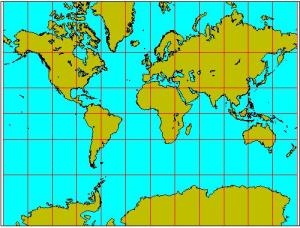 If the map shows the whole world we may have all kind of different projections offering different kind of views on the world having some advantages and disadvantages. A classic world map is the rectangle where Alaska, Canada, Greenland, Svalbard, Siberia and Antarctica are presented much larger than in the real-world if compared to regions closer to equator. This is similar to the problems in fulfilling multiple uses embracing all business units in an enterprise.
Today we have new technology coming to the rescue. If you go into Google Earth the world indeed looks round and you may have any high altitude view of a apparently round world. If you go closer the map tends to be more and more flat. My guess is that the solutions to fit the multiple uses conondrum will be offered from the cloud.
Exploiting rich external reference data
But Google Earth offers more than powerfull technolgy. The maps are connected with rich information on places, streets, companies and so on obtained from multiple sources – and also some crowdsourced photos not always placed with accuracy. Even if external reference data is not “the truth” these data, if used by more and more users (one instance, multiple tenants), will tend to be closer to “the truth” than any data collected and maintained solely in a single enterprise.
Shared data makes fit for pupose information
You may divide the data held by an enterprise into 3 pots:
- Global data that is not unique to operations in your enterprise but shared with other enterprises in the same industry (e.g. product reference data) and eventually the whole world (e.g. business partner data and location data). Here “shared data in the cloud” will make your “single version of the truth” easier and closer to the real world.
- Bilateral data concerning business partner transactions and related master data. If you for example buy a spare part then also “share the describing data” making your “single version of the truth” easier and more accurate.
- Private data that is unique to operations in your enterprise. This may be a “single version of the truth” that you find superior to what others have found, data supporting internal business rules that make your company more competitive and data referring to internal events.
While private and then next bilateral data makes up the largest amount of data held by an enterprise it is often seen that it is data that could be global that have the most obvious data quality issues like duplicated, missing, incorrect and outdated party master data information.
Here “a global or bilateral shared version of the truth” helps approaching “a single version of the truth” to be shared in your enterprise. This way accurate raw data may be consumed as valuable information in a given context at once when needed.
Call to action
If not done already, please take the time to read posts from fellow bloggers Charles Blyth and Jim Harris and then vote for who you think has won the debate. A link to the same poll is provided on all three blogs. Therefore, wherever you choose to cast your vote, you will be able to view an accurate tally of the current totals.
The poll will remain open for one week, closing at midnight on 19th November so that the “medal ceremony” can be conducted via Twitter on Friday, 20th November. Additionally, please share your thoughts and perspectives on this debate by posting a comment below. Your comment may be copied (with full attribution) into the comments section of all of the blogs involved in this debate.
Vote here.

55.580294
12.282991
 Yesterday I read a post called Taking Stock Of DQ Predictions For 2011 by Clarke Patterson of Informatica Corporation. Informatica is a well established vendor within data integration, data quality and master data management. The post is based on post called Six Data Management Predictions for 2011 by Steve Sarsfield of Talend. Talend is an open source vendor within data integration, data quality and master data management.




 Liliendahl on Data Quality