Infonomics and Second Party Data

The term infonomics does not yet run unmarked through my English spellchecker, but there are some information available on Wikipedia about infonomics. Infonomics is closely related to the often-mentioned phrases in data management about seeing data / information as an asset.

Much of what I have read about infonomics and seeing data / information as an asset is related to what we call first party data. That is data that is stored and managed within your own company.

Some information is also available in relation to third party data. That is data we buy from external parties in order to validate, enrich or even replace our own first party data. An example is a recent paper from among others infonomic guru Doug Laney of Gartner (the analyst firm). This paper has a high value if you want to buy it as seen here.

Anyway, the relationship between data as an asset and the value of data is obvious when it comes to third party data, as we pay a given amount of money for data when acquiring third party data.

Second party data is data we exchange with our trading and other business partners. One example that has been close to me during the recent years is product information that follows exchange of goods in cross company supply chains. Here the value of the goods is increasingly depending on the quality (completeness and other data quality dimensions) of the product information that follows the goods.

In my eyes, we will see an increasing focus on infonomics when it comes to exchanging goods – and the related second party data – in the future. Two basic factors will be:

pdl-top-narrow

We Need More Product Data Lake Ambassadors

ambassador

Product Data Lake is the new solution to sharing product information between trading partners. While we see many viable in-house solutions to Product Information Management (PIM), there is a need for a solution to exchange product information within cross company supply chains between manufacturers, distributors and retailers.

Completeness of product information is a huge issue for self-service sales approaches as seen in ecommerce. 81 % of e-shoppers will leave a webshop with lacking product information. The root cause of missing product information is often an ineffective cross company data supply chain, where exchange of product data is based on sending spreadsheets back and forth via email or based on biased solutions as PIM Supplier Portals.

However, due to the volume of product data, the velocity required to get data through and the variety of product data needed today, these solutions are in no way adequate or will work for everyone. Having a not working environment for cross company product data exchange is hindering true digital transformation at many organizations within trade.

As a Product Information Management professional or as a vendor company in this space, you can help manufacturers, distributors and retailers in being successful with product information completeness by becoming a Product Data Lake ambassador.

The Product Data Lake encompasses some of the most pressing issues in world-wide sharing of product data:

The first forward looking professionals and vendors in the Product Information Management realm have already joined. I would love to see you as well as our next ambassador.

Interested? Get in contact:

← Back

Thank you for your response. ✨

PIM Supplier Portals: Are They Good or Bad?

A recent discussion on the LinkedIn Multi-Domain MDM group is about vendor / supplier portals as a part of Product Information Management implementations.

A supplier portal (or vendor portal if you like) is usually an extension to a Product Information Management (PIM) solution. The idea is that the suppliers of products, and thus providers of product information, to you as a downstream participant (distributor or retailer) in a supply chain, can upload their product information into your PIM solution and thus relieving you of doing that. This process usually replace the work of receiving spreadsheets from suppliers in the many situations where data pools are not relevant.

In my opinion and experience, this is a flawed concept, because it is hostile to the supplier. The supplier will have hundreds of downstream receivers of products and thus product information. If all of them introduced their own supplier portal, they will have to learn and maintain hundreds of them. Only if you are bigger than your supplier is and is a substantial part of their business, they will go with you.

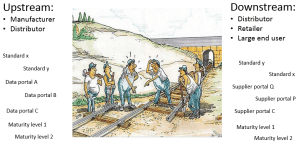
Broken data supply chainAnother concept, which is the opposite, is also emerging. This is manufacturers and upstream distributors establishing PIM customer portals, where suppliers can fetch product information. This concept is in my eyes flawed exactly the opposite way.

And then let us imagine that every provider of product information had their PIM customer portal and every receiver had their PIM supplier portal. Then no data would flow at all.

What is your opinion and experience?

The Intersections of 360 Degree MDM

In the Master Data Management (MDM) realm we have some common notions, being

  • 360 degree Customer Master Data Management, meaning how different views on customers in a company’s various business units and sales channels can be handled as a shared single view.
  • 360 degree Vendor (or Supplier) Master Data Management, meaning how different views on vendors/suppliers in a company’s various business units and supply chains can be handled as a shared single view.
  • 360 degree Product Master Data Management, meaning how different views on products in a company’s various business units, sales channels and supply chains can be handled as a shared single view.

Multi-Side MDM

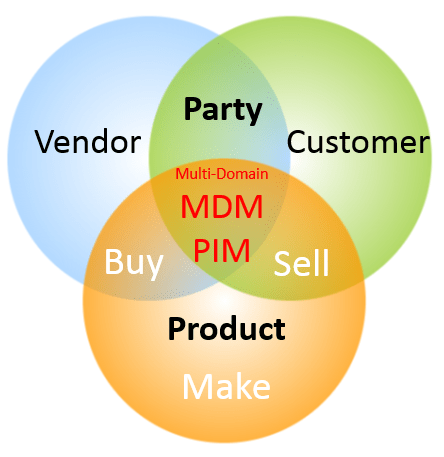
Multi-Domain Master Data Management (MDM) is the discipline that brings all these views together. Here it is not enough that the same brand of technology is used for all three domains. Handling the intersections is the important part.

The intersection of Vendor/supplier and Customer is known as the Party Master Data domain. My recommendation is to have a common party (or business partner) structure for identification, names, addresses and contact data. This should be supported by data quality capabilities strongly build on external reference data (third party data). Besides this common structure, there should be specific structures for customer, vendor/supplier and other party roles.

The Vendor/supplier and Product Master Data intersection is related to buying products, namely how to on-board data about the vendor/supplier as a party, in the vendor role (financial stuff), the supplier role (logistic stuff) and then on-boarding his product information. My recommendation for on-boarding product information from suppliers being manufacturers is to make this a Win-Win solution for both parties as described in the post How a PLM-2-PIM Solution Becomes a WIN-WIN Solution.

The Customer and Product Master Data intersection is about supporting how you sell products. The term omnichannel is popular for that these days. Again, Product Information Management (PIM) plays a crucial role here and my recommendations for that is expressed in the post Adding Business Ecosystems to Omnichannel.

Everyday Digital Transformation

Ben Rund of Informatica has a Youtube video running these days with the title/question: Enough Heard on Digital Transformation by Uber & AirBnB?

I share this sentiment with Ben. You don’t have to disrupt the whole world to take part in digital transformation and you don’t have to start something completely new. As an established enterprise you can transform your current business and combine the good things from the past with the new opportunities aroused from the digital evolution.

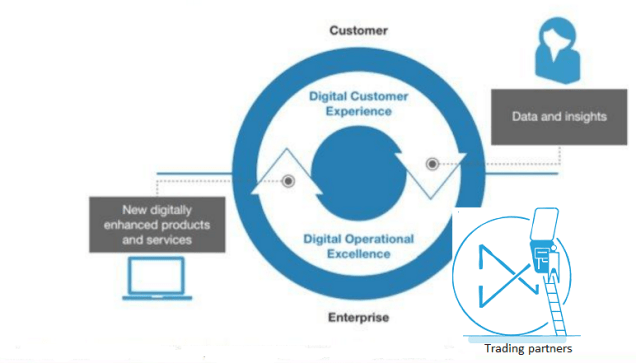
Forrester, the other analyst firm, some years ago devided digital transformation into a loop of:

  • Digital Customer Experience
  • Digital Operational Excellence

The below figure visualizes this landscape:

digital

What I would like to elaborate on related to this picture is the business ecosystem of your enterprise, which must be included in the everyday digital transformation.

Let’s take the example of product information management:

However, connect is better than collect. If you are dependent on receiving spreadsheets with product information from your trading partners or you let them put their spreadsheets into your supplier product data portal, you have an everyday digital transformation in front of you.

The solution for that is Product Data Lake.

digital2

A Data Lake, Santa Style

Following up on last years post on Big Data Quality, Santa Style (and previous years of Santa style posts) it is time to see how Santa may utilize a data lake.

birthday presentsI imagine that handling product information must be a big pain point at the Santa Corporation. All the product information from suppliers of present items comes in using different standards and various languages. In the same way the wish lists from boys and girls comes in many languages and using many different wordings.
Forcing the same standard on all suppliers (and boys and girls) is quite utopic – even for Santa.

So using a data lake for product information seems to be a good choice, not at least if that data lake encompasses the whole business ecosystem around the Santa Corporation.

By joining Product Data Lake the Santa Corporation will put their required product portfolio and the needed attributes for the products into Product Data Lake in all the languages operated at Santa’s site.

The suppliers of toys, electronics, books, clothes and heaps of other nice things will by joining Product Data Lake in the same way put their products and the attributes offered into Product Data Lake.

In here, the products and attributes will be linked to the ones used by Santa. But this is only the beginning of a joyful ride. The products and attributes can also be linked to all the other trading partners on Product Data Lake, so the manufacturer will only have to upload this information once.

Ho ho ho. This year it is not only nice boys and girls that gets a present – and this year the right one -from Santa. Smart suppliers will get a big present too.

Interenterprise Data Sharing and the 2016 Data Quality Magic Quadrant

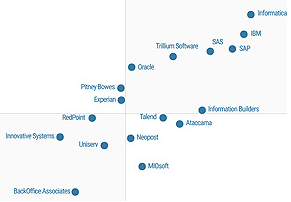
dqmq2016The 2016 Magic Quadrant for Data Quality Tools by Gartner is out. One way to have a free read is downloading the report from Informatica, who is the most-top-right vendor in the tool vendor positioning.

Apart from the vendor positioning the report as always contains valuable opinions and observations about the market and how these tools are used to achieve business objectives.

Interenterprise data sharing is the last mentioned scenario besides BI and analytics (analytical scenarios), MDM (operational scenarios), information governance programs, ongoing operations and data migrations.

Another observation is that 90% of the reference customers surveyed for this Magic Quadrant consider party data a priority while the percentage of respondents prioritizing the product data domain was 47%.

My take on this difference is that it relates to interenterprise data sharing. Parties are per definition external to you and if your count of business partners (and B2C customers) exceeds some thousands (that’s the 90%), you need some of kind of tool to cope with data quality for the master data involved. If your product data are internal to you, you can manage data quality without profiling, parsing, matching and other core capabilities of a data quality tool.  If your product data are part of a cross company supply chain, and your count of products exceeds some thousands (that’s the 47%), you probably have issues with product data quality.

In my eyes, the capabilities of a data quality tool will also have to be balanced differently for product data as examined in the post Multi-Domain MDM and Data Quality Dimensions.

Black Friday Afterthoughts before Christmas

Black Friday & Christmas: 5 Retail Strategies for Providing a Wonderful Shopping Experience” is the title of a recent blog post by Antonia Renner on the Informatica blog.

This blog post revolves around how Master Data Management (MDM) and Product Information Management (PIM) can be the foundation of a better shopping experience and how to do this within driving digital transformation, being agile, and streamlining internal and external collaboration and workflows.

I agree with that. My only concern around the means mentioned relates to the section about how great customer experience starts with great supplier product data. The proposed approach for that is a self-service supplier data portal.

pdl-whyFrom what I have experienced, the concept of a supplier data portal for product data has limited chances of success. The problem for you as retailer or other form of downstream trading partner is your supplier. They will eventually have to deal with hundreds of supplier portals with different format and structure by the choice of their downstream trading partners, whereof you are just one. If you are a big one to them, it might work. Else probably not.

In the same way, your supplier could offer their customer data portal, build with their choice of format and structure. If they are a big one to you, you might go with that. Else, you probably would object to dealing with hundreds of different upstream data portals for you to go-to.

My Christmas present to you – suppliers, retailers, other supply chain nodes / PIM-MDM solution vendors – is a free trial / ambassadorship on Product Data Lake.

Product Data Lake is a cloud service for sharing product data in business ecosystems. Product Data Lake ensures:

  • Completeness of product information by enabling trading partners to exchange product data in a uniform way
  • Timeliness of product information by connecting trading partners in a process driven way
  • Conformity of product information by encompassing various international standards for product information
  • Consistency of product information by allowing upstream trading partners and downstream trading partners to interact with in-house structure of product information
  • Accuracy of product information by ensuring transparency of product information across the supply chain

It’s in your hands. See you on Product Data Lake.