The Dangers of being a Global Shopper

The global shopper is a multi-channel beast.

A global shopper may be a tourist or a business traveler buying goods in exciting cities around the world in shops most probable operated by the very same brands that occupies his local high street. The global shopper may also do his business from his living room by shopping online on sites with strange foreign privacy rules and unusual registration forms.

Oxford_StreetBeing a global shopper is risky business.

For example it’s unbelievable why Oxford Street in London hasn’t been made into a pedestrian street long time ago like any other respectable high street in major cities. But no, global shoppers on Oxford Street are constantly in danger of being hit by a red double-decker bus when crossing the street for a good bargain while looking to the right wrong side.

And how about shoe sizes? Measuring systems and standards around the world is a jungle and as a global shopper you will in 8 ½ out of 10 trials pick the wrong number 42.

Going online isn’t any better.

When registering your home address on a foreign site you are on very slippery ground.

If the site is from the United States, and you are not, you have to choose living in one of 50 different states meaning nothing to you. But there is no way around. My favorite state then is Alaska usually being on the top of the list.

Having a postal code with letters in it can be a no go. Not having a postal code is much like not existing at all.

But don’t give up. As a global shopper you will be able to find sites online with absolutely no clue about what an address looks like. Only thing of course will be the question about if you actually will get your goods or have to settle with the credit card withdrawal only.

Bookmark and Share

Business in the Driver’s Seat for MDM

It has always been a paradox in Master Data Management (MDM), and many other IT enabled disciplines, that while most people agree that the business part of business should take the lead, often it is the IT part of business that is running the projects.

However, at Tetra Pak, a multi-national company of Swedish origin, MDM has been approached as a business problem rather than as an IT problem.

Yesterday I touched base with Program Manager Jesper Persson at Tetra Pak.

A main reason for Tetra Pak to focus on MDM was having a very specific business problem related to master data, not an IT problem. Taking it from there the business has been in the driver’s seat for the MDM journey.

Master data quality and related data quality dimensions are seen as triggers for the essential KPI’s related to process performance. The model for getting this right is starting with the business requirements, putting the needed data governance in place, getting on with managing master data which leads to the actual master data maintenance all as part of business process management.

Jesper is telling a lot more at the Master Data Management Summit Europe 2013 in London in the session Business in the Driver’s Seat for MDM – Integrating MDM with BPM.

MDM Summit Europe 2013

Bookmark and Share

Tomorrow’s Data Quality Tool

In a blog post called JUDGEMENT DAY FOR DATA QUALITY published yesterday Forrester analyst Michele Goetz writes about the future of data quality tools.

Michele says:

“Data quality tools need to expand and support data management beyond the data warehouse, ETL, and point of capture cleansing.”

and continues:

“The real test will be how data quality tools can do what they do best regardless of the data management landscape.”

As described in the post Data Quality Tools Revealed there are two things data quality tools do better than other tools:

  • Data profiling and
  • Data matching

Some of these new challenges I have worked with within designing tomorrow’s data quality tools are:

  • open-doorPoint of capture profiling
  • Searching using data matching techniques
  • Embracing social networks

Point of capture profiling:

The sweet thing about profiling your data while you are entering your data is that analysis and cleansing becomes part of the on-boarding business process. The emphasis moves from correction to assistance as explained in the post Avoiding Contact Data Entry Flaws. Exploiting big external reference data sources within point of capture is a core element in getting it right before judgment day.

Searching using data matching techniques:

Error tolerant searching is often the forgotten capability when core features of Master Data Management solutions and data quality tools are outlined. Applying error tolerant search to big reference data sources is, as examined in the post The Big Search Opportunity, a necessity to getting it right before judgment day.

Embracing social networks:

The growth of social networks during the recent years has been almost unbelievable. Traditionally data matching has been about comparing names and addresses. As told in the post Addressing Digital Identity it will be a must to be able to link the new systems of engagement with the old systems of record in order to getting it right before judgment day.

How have you prepared for judgment day?

Bookmark and Share

The Real Estate Domain

In the comments on the recent blog post about multidomain MDM (Master Data Management) it was discussed in what degree multidomain MDM is much more than CDI (Customer Data Integration) and PIM (Product Information Management).

While customer (or rather party) and product are important master entity types, there are of course a lot of other master entity types. The location domain is often mentioned as the third domain in MDM, and then there are some entity types most relevant for specific industries like an insurance policy or a vehicle in public transit, and in public transit we also have the calendar as an important master entity type.

Real estateOne of the entity types that doesn’t belong to party and in many ways is a different thing than a product is real estate (or real property or just property if you like).

For a realtor a real estate looks like a product of course. And it’s all about location, location, location.

Right now I’m working with the instant Data Quality framework. Here we are embracing the party domain by having access to external reference sources about individuals and companies, we are embracing the location domain by having access to external reference sources about addresses and then we are also embracing the real estate domain by having access to external reference sources about properties.

Real properties have addresses in many cases and are therefore close to the location domain. For some business processes it is a product with a product key like mentioned for realtors. For some business processes it is a security often identified by other keys than the postal address. It is related to different party roles like an occupier (or several) and an owner (or several) that may or may not be the same party (or parties).

What about you. Do you feel at home with the real estate entity type?

Bookmark and Share

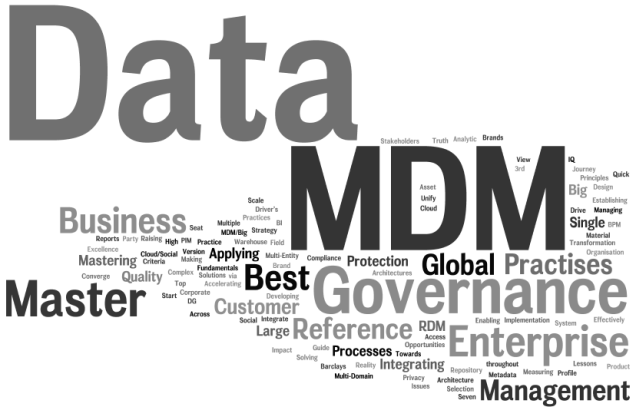
MDM Summit Europe 2013 Wordle

The Master Data Management Summit Europe 2013, co-located with the Data Governance Conference Europe 2013, takes place in London the 15th to 17th April.

Here is a wordle with the session topics:

MDMDG 2013 wordle

Some of the words catching my eyes are:

Global is part of several headlines. There is no doubt about that governing master data on a global scale is a very timely subject. Handling master data in a domestic context can be hard enough, but enterprises are facing a daunting task when embracing party master data, product master data and location master data covering the diversity of languages, script systems, measuring systems, national standards and regulatory requirements. However, there is no way around the challenges when synergies in global enterprises are to be harvested.

RDM (Reference Data Management) is becoming a popular subject as well. Being successful with governing master data requires a steady hand with the reference data layer that sits on top of the master data. Some reference data sets may be small, but the importance of getting them right must not be underestimated.

Business. Oh yes. All the data stuff is there to enable business processes, drive business transformation and make business opportunities.

Bookmark and Share

Future Identities

Recently I stumbled upon a report called Future Identities in the UK. The purpose of the report is to provide the government in the UK insight into how identities of citizens will develop over the next 10 years. But the insight certainly also applies to how private companies will have to react to this development and certainly also not just in the UK.

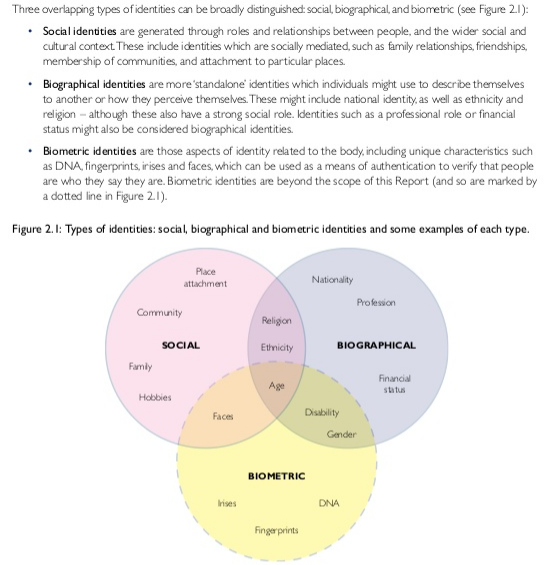
The report talks about three different kinds of identities:

identies in the UK

Applied to data quality and master data management I think these future kinds of identities will have these consequences:

Biometric identities relates to hard core identity resolution as in fighting terrorism, crime investigation and physical access control but is sometimes even used in simple commercial checks as told in the post Real World Identity. My guess is that we will see biometrics used more as a mean to have better data quality, but not considerable more due to return of investment also as examined in the post Citizen ID and Biometrics.

Biographical identities and the related attributes resembles what we often also calls demographic attributes used in handling data for direct marketing and other purposes of data management. Direct marketing may, as reported in the post Psychographic Data Quality, be in transition to go deeper into big data in order to be psychographic marketing.

Social identities is the new black. As discussed on this blog, latest in the post Defining Social MDM, my guess is that social data master management is going to be big and has to be partly interwoven with using traditional biographical attributes and even, like it or not, biometric attributes. The art of doing that in a proper way is going to be very exciting.

Bookmark and Share

Data Quality, Professional Cycling Style

Lance ArmstrongThe professional cycling sport has been havocked by the doping ghost during the last years with the confessions from Lance Armstrong as the latest paramount following other confessions for example by fellow Tour de France winner Bjarne Riis.

The word denial is probably the most central term in all this mess. The riders have kept denying the facts past the threshold of absurdity.

We do see a lot of the same kind of denial within the realm of data management where data quality issues obvious to everyone are denied often with the sentiment that of course there are a lot of data quality issues around, but certainly not with my data. My data is clean.

But they ain’t.

Bookmark and Share

Multi-Entity MDM vs Multidomain MDM

puzzleOn the upcoming MDM Summit Europe 2013 in London this April you will be able to learn about Multi-Entity MDM as well as Multi-Domain MDM.

So, what is the difference between Multi-Entity MDM and Multi-Domain MDM?

To my knowledge it is two terms having the same meaning. It is doing the two main preceding disciplines for MDM being Customer Data Integration (CDI) and Product Information Management (PIM) at the same time presumably using the same software brand.

Multi-Entity MDM was probably the first term used and still used by The MDM Institute while Multidomain MDM is used by Gartner (the analyst firm) and most tool vendors today. For example Stibo Systems is focusing on mutidomain recently in this press release about latest achievements.

Talking about Gartner and the vendor crowd Gartner analyst Andrew White wrote a blog post the other day: Round-Up of Master Data Management (MDM) 2012, and looking forward to 2013.

Herein White bashes the vendors by saying:

“Vendor hype related to multidomain …. continued to be far in excess of reality”.

What do you think? Is Andrew White right about that? And what about Multi-Entity MDM, is that any better?

Bookmark and Share

While we are waiting for the LEI

As told in the post Business Entity Identifiers there has been a new global numbering system for business entities on the way for some time. The wonder is called LEI (Legal Entity Identifier).

fsb-leiThe implementation work has been adapted by the Financial Stability Board. The latest developments are reported in a publication called Fifth progress note on the Global LEI Initiative.

Surely, while the implementations may be in good hands, the set up doesn’t give hope for a speedy process where every legal entity in the world in a short time will have a LEI.

And then the next question will be how long it will take before organizations will have enriched existing databases with that LEI and implemented on-boarding processes where a LEI is captured with every new insertion of party master data describing a legal entity.

A good way to start to be prepared will be to implement features in on-boarding business processes where available external reference data are captured when new party entities are added to your databases. Having best available information about names, addresses and business entity identifiers available today and a culture of capturing such information will be a great starting point.

And oh, the instant Data Quality concept is precisely all about doing that.

Bookmark and Share

Defining Social MDM

Social MDM2Social Master Data Management (Social MDM) has been a recurring subject on this blog for a couple of years. But what is Social MDM? What do others say it is?

Here is what Techopedia, Gartner and The MDM Institute thinks:

Techopedia has this definition of Social MDM:

Definition – What does Social Master Data Management (Social MDM) mean?

Social master data management (Social MDM) refers to the processes, policies and concepts used to gather and compile social media data sources – like Facebook, LinkedIn and Twitter – into one master file.

Gartner (the analyst firm) hasn’t to my knowledge used the term Social MDM. In 2011 they though said that this will be one of three main trends in MDM:

Increasing Links Between MDM and Social Networks

By 2015, 15 percent of organizations will have added social media data about their customers to the customer master data attributes they manage in their MDM systems….

In 2012, as reported in the post The Big MDM Trend, Gartner, The Hype Cycle firm, changed the point to be about MDM and Big Data.

The MDM Institute has a Field Report from April 2012 where Aaron Zornes (who is the MDM institute) writes:

Social MDM (Cloud-enablement, Architecture & Integration)

During 2012, cloud-enabled MDM will attract small- and mid-sized businesses as a means to engage in MDM without committing to long-term project and major expense….

By 2014-15, cloud-innate services for data quality and Data Governance will be more prevalent than full Social MDM…

So the MDM institute thinks Social MDM is MDM in the cloud.

What do you think?

Bookmark and Share