Classification of PIM Solutions

A core capability in a Product Information Management (PIM) solution is the ability to work with product classification, meaning having a way to group products for multiple purposes like how to present products in meaningful groups to potential customers and how to make sure all relevant product attributes are present for a similar group of products. This is a daunting task, usually much more demanding than the technical implementation of the PIM solution itself.

Ironically, we are also having trouble with grouping solutions for handling product data into meaningful groups. One challenge is the overlap with surrounding disciplines as discussed in the post How MDM, PIM and DAM Stick Together. This post deals with classifying solutions as Master Data Management (MDM), Product Information Management (PIM) and/or Digital Asset Management (DAM).

Then there is the selection of Three Letter Acronyms starting with P and ending with M:

  • PCM: Product Content (or Catalog) Management
  • PDM: Product Data Management
  • PIM: Product Information Management
  • PLM: Product Lifecycle Management

A recent post from the declared PIM vendor Venzee examines PCM vs. PIM: Which One Does Your Ecommerce Business Need? (The blog does not exist anymore).

In here Venzee states: “You will occasionally see PCM solutions presented as if they were actually PIM platforms. Don’t get fooled. Yes, there are similarities and terminology overlaps, but PCM is not PIM. Think of PCM as PIM’s little cousin — it’s a place to house and enrich your data, but that’s about it. Ecommerce vendors that really want to manage, optimize and distribute their data need a good PIM platform”

PDL MenuIn my current venture called Product Data Lake a challenge is explaining what kind of solution it is. I usually call it PIM-2-PIM, as it is a solution that can make two different PIM solutions at two different trading partners interact. But it might as well be PIM-2-MDM or PLM-2-PIM or DAM-2-PCM or any other available combination. Anyway, I have put our solution on The Disruptive MDM/PIM List here.

PS: If you have a solution covering Master Data and Product Information, you can register it on The Disruptive MDM/PIM List here.


What Happened to CDI?

CDI is a Three Letter Acronym which in the data management world stands for Customer Data Integration.

Today CDI is usually wrapped into Master Data Management (MDM) as examined in the post CDI, PIM, MDM and Beyond. As mentioned in this post, a well-known analyst, Aaron Zornes, runs a business called the MDM Institute, which was originally called the The Customer Data Integration Institute and still has this website: http://www.tcdii.com/.

Many Master Data Management (MDM) vendors today emphasizes on being multidomain, meaning their solutions can manage customer, supplier employee and other party master data as well as product, asset, location and other core business entity types.

However, some vendors still focus on customer master data and the topic of integrating customer data by excelling in the special pain points here, not at least identity resolution and sustainable merge/purge of duplicates. One example is Uniserv Smart Customer MDM.

In my recent little venture called The Disruptive Master Data Management Solution List the aim is to cover all kinds of MDM solutions: Small or big. New (start-up) or old. Multidomain MDM, Customer Data Integration (CDI), Product Information Management (PIM) or even Digital Asset Management (DAM). As a potential buyer, you can browse all these solutions and select your choice of one-stop-shopping candidates or combine best-of-breed solution candidates that matches your requirements in your industry and geography.

First thing that must happen is that vendors register their solutions on the site here.

MDM

Welcome Stibo Systems on The Disruptive MDM List

I am happy to welcome Stibo Systems and their STEP platform as the next disruptive Master Data Management Solution on the disruptive MDM list. You can learn more about, and review, Stibo Systems STEP here.

My first encounter with Stibo Systems was 7 years ago when I started an engagement there taking part in the first steps in transforming Stibo Systems from a Product Master Data Management / Product Information Management (PIM) vendor to a multi-domain MDM vendor.

Since then I worked for some of Stibo Systems clients with implementing the STEP solution.

During both engagements types I learned how a robust but still extremely flexible MDM solution STEP is and also came to know the very professional staff at Stibo Systems. You can see them below:

Stibo Systems Group photo

How to Combine eClass and ETIM

eClass and ETIM are two different standards for product information.

eCl@ss is a cross-industry product data standard for classification and description of products and services emphasizing on being a ISO/IEC compliant industry standard nationally and internationally. The classification guides the eCl@ss standard for product attributes (in eClass called properties) that are needed for a product with a given classification.

ETIM develops and manages a worldwide uniform classification for technical products. This classification guides the ETIM standard for product attributes (in ETIM called features) that are needed for a product with a given classification.

It is worth noticing, that these two standards are much more elaborate than for example the well-known classification system called UNSPSC, as UNSPSC only classifies products, but does not tell which attributes (and with what standards) you need to specify a product in detail.

There is a cooperation between eClass and ETIM which means, that you can map between the two standards. However, it will not usually make sense for one organization to try to use both standards at the same time.

PDL How it worksWhat does make sense is combining the two standards, if there are two trading partners where one uses one of these standards and the other one uses the other standard. The place to make the combination is within Product Data Lake, the new service for exchanging product information between manufacturers and merchants. Here, trading partners can make a:
How Bosch is Aiming for Unified Partner Master Data Management

A recurrent theme on this blog is the way organizations should handle party master data management as examined in the post What is Best Practice: Customer- and Vendor- or Unified Party Master Data Management?

What I advise my clients to do, is to have a common party (or business partner) structure for identification, names, addresses and contact data. This should be supported by data quality capabilities strongly build on external reference data (third party data). Besides this common structure, there should be specific structures for customer, vendor/supplier and other party roles.

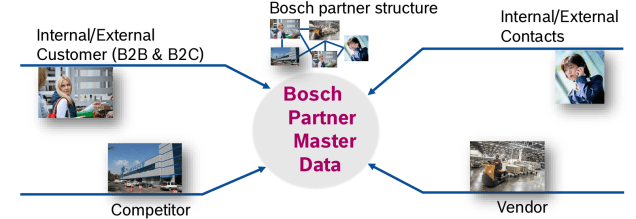
This week I attended the MDM event arranged by Marcus Evans in Barcelona. The presentation by Udo Couto Klütz of the industrial giant Robert Bosch highlighted the clever way of handling customer master data, by having a partner master data concept.

Bosch

At Bosch they have reached the conclusion, that unified partner master data management is the way to achieve:

  • A single source of truth
  • Transparency
  • Standardized processes
  • Worldwide applicability
  • One compliance standard
  • Increased efficiency

I absolutely agree.

PIM-2-PIM and More Business Outcome

The importance of having a viable Product Information Management (PIM) solution has become well understood at companies participating in supply chains. Having a PIM solution provides business outcome as told here on the blog in a recent guest post featuring the Pimcore PIM solution. The post is called Investing In PIM Is Like Investing In Customer Value.

The next step towards more business outcome from PIM is to handle product information in close collaboration with your trading partners.

At Product Data Lake we provide such a PIM-2-PIM solution. Instead of the old way of collecting product information via spreadsheets and portals, we facilitate that trading partners connect as examined in the post What a PIM-2-PIM Solution Looks Like.

By doing that both manufacturers and merchants will be able to sell more and at the time reduce costs of product information exchange as shown in the post Sell more. Reduce costs.

Sell more Reduce costs

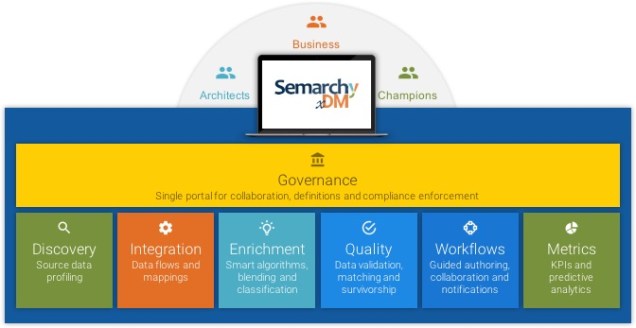
Welcome Semarchy xDM on The Disruptive MDM List

I am happy to welcome Semarchy xDM as the first disruptive Master Data Management Solution on the disruptive MDM list. You can learn more about, and review, Semarchy xDM here.

xDM Capabilities (002)

Semarchy has been a part of developing Product Data Lake, as the first prototype of this service was made using the Semarchy platform. I owe Salah Kamel, the Semarchy CEO, big thanks for his support in doing that.

By making that prototype, I can confirm that Semarchy caters for a fast track, when it comes to setting up a Master Data Management solution.

The Disruptive MDM List

As reported in the previous post on this blog, Gartner (the analyst firm) has stopped having a list of smaller and potential disruptive MDM solutions in their Magic Quadrant for Master Data Management Solutions.

I think it is time to have an alternative list of MDM solutions with room for the disruptive ones.

Therefore, I have created a new site for a list of MDM and similar solutions. This site is meant to be a list of available:

  • Master Data Management (MDM) solutions
  • Customer Data Integration (CDI) solutions
  • Product Information Management (PIM) solutions
  • Digital Asset Management (DAM) solutions

You can use this site as an alternative to the likes of Gartner, Forrester, MDM Institute and others when selecting a MDM / CDI / PIM / DAM solution, not at least because this site will also include smaller and disruptive solutions.

Vendors can register their solutions here and the crowd, being processional users, can review the solutions.

I will welcome vendors of all sizes, at all stages and from all geographies to register your solution at the disruptive MDM list.

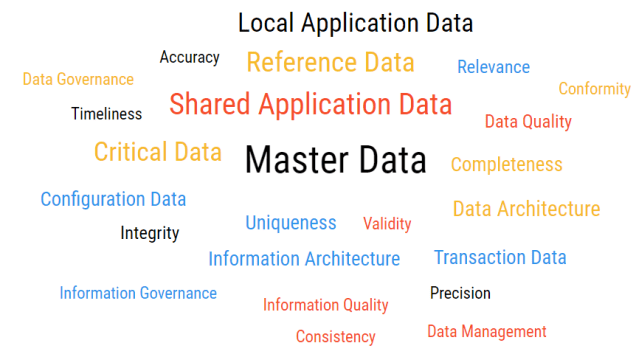
Master Data or

Please have a look at the current stage of The Disruptive MDM List

Disruptive Forces in MDM Land

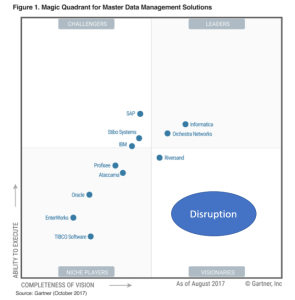
MDM 2017 disruptionFor the second time this year there is a Gartner Magic Quadrant for Master Data Management Solutions out. The two leaders, Orchestra Networks and Informatica, have released their free copies here and here.

Now Gartner have stopped having a list of vendors on the market too small to be in the actual quadrant. So, if you are looking for new thinking, you will have to read the section about disruptive forces in the MDM market.

Gartner says that every market experiences disruptive forces that influence its overall shape and trajectory over time, and that inspire innovation, both transformational and incremental. According to Gartner, those most prominent in the MDM market appear diametrically opposed.

The current market is dominated by vendors who have predominantly taken a platform-centric approach involving robust technology stacks categorized as application-neutral hub-based solutions. Thus, the business value of the resulting master data is realized through utilization of that data within business applications or suites, or analytics platforms, external to the MDM solution — such as CRM, ERP and e-commerce systems, and data warehouses.

One disruptive force against that is an increase in business applications or suites with embedded ADM (Application Data Management) capabilities that address organizational needs for data management, including MDM (to varying degrees), while also managing nonmaster data for the pertinent application. Gartner states that application-centric approaches for some organizations can return greater value than platform-centric approaches in the short term and do so at reduced cost.

The opposing disruptive force stems from the emergence of more generalized data management solutions. These provide for unified execution logic on top of what is effectively an integrated technology stack. Vendors envision the primary consumption model to be cloud-based subscription. As such, these solutions will also provide a means for midmarket organizations and SMBs to procure advanced data management capabilities (such as MDM) using this model of consumption. Executed crisply, cloud-based subscriptions to these solutions may even moderate the rise of cloud-based MDM offerings.

Regular readers of this blog may guess, that I see a coming third disruptive force in MDM land, being specialized data management services for business ecosystems as explored in the post Ecosystems are The Future of Digital and MDM.

Reduce Costs by Breaking Down Walls

Walls between data management silos are some of the worst causes of generating costs in data management. I have seen three main kinds of such walls:

The walls between enterprise units

If you have been working more than a day or two with data management within any kind of larger organization, you have probably noticed walls between data used in enterprise units. These walls may be due to using different applications in various geographies, lines of business, departments or other organizational units. It may also be different ways of storing data in the same application.

Countless Master Data Management (MDM) programmes are launched to tackle this conundrum, and many of them run into the wall without breaking it. But keep trying using more agile and lean thinking – and you will reduce costs by federating data silos.

The wall between business and IT

This is the silliest kind of wall I have ever seen as told in the post Tear Down This Wall! “Just break it” and reduce a lot of costs by simplifying data management.

The wall (and moat) around the enterprise

For some data domains, like product data, there are great cost reductions in working closely with your trading partners as told in the post The days of castle and moat are over, just as brick and mortar is slowly diminishing too.

tear-down-wall