MDM and PIM Market Reports in 2018

There are many market reports covering the Master Data Management (MDM) and Product Information Management (PIM) market. Below you can find 4 of these coming from who is usually considered as the more reliable analyst houses around:

Forrester has not issued a report on the MDM market recently, but in June 2018 they published their PIM wave as told on the post There is no PIM quadrant, but there is a PIM wave.

Information Difference came out with their MDM market coverage as examined in the post MDM Vendor Landscape 2018.

Constellation Research revealed their top vendors in August as mentioned in the post Making Your MDM Vendor Longlist and Shortlist.

Gartner got their MDM quadrant finished in December as flashed in the post Movements in the Gartner MDM Magic Quadrant 2018. You will find vendor provided links to the Gartner report in the post Who Will Make the Next Disruption on the MDM Market?
MDM 2018

PS: You can meet some of the included vendors (and some of the upcoming ones) on The Disruptive Master Data Management Solutions List.
The Road from PIM to Multidomain MDM

The previous post on this blog was about the recent Gartner Magic Quadrant for Master Data Management Solutions. The post was called Who Will Make the Next Disruption on the MDM Market?

In a comment to this post Nadim observes that this Gartner quadrant is mixing up pure MDM players and PIM players.

That is true. It has always been a discussion point if one should combine or separate solutions for Master Data Management (MDM) and Product Information Management (PIM). This is a question to be asked by end user organizations and it is certainly a question the vendors on the market(s) ask themselves.

If we look at the vendors included in the 2018 Magic Quadrant the PIM part is represented in some different ways.

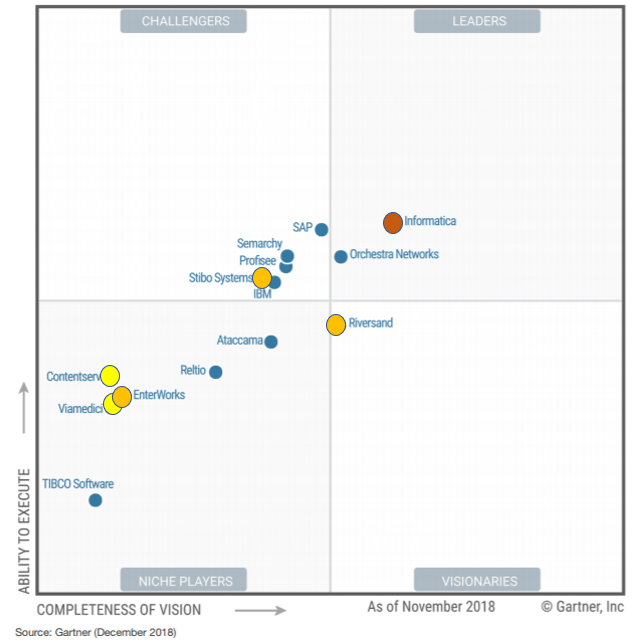
I would say that two of the newcomers, Viamedici and Contentserv (yellow dots in below figure), are mostly PIM players today. This is also mentioned as a caution by Gartner and is a reason for the current left-bottom’ish placement in the quadrant. But both companies want to be more multidomain MDM’ish.

PIM to MDM vendors

8 years ago, I was engaged at Stibo Systems as part of their first steps on the route from PIM to multidomain MDM. Enterworks and Riversand (the orange dots in above figure) is on the same road.

Informatica has taken a different path towards the same destination as they back in 2012 bought the PIM player Heiler. Gartner has some cautions about how well the MDM and PIM components makes up a whole in the Informatica offerings and similar cautions was expressed around the Forrester PIM Wave as seen in the comments to the post There is no PIM quadrant, but there is a PIM wave.

Who Will Make the Next Disruption on the MDM Market?

As reported in the previous post on this blog, there were some Movements in the Gartner MDM Magic Quadrant 2018.

But there was also a good deal of steadiness. Informatica still holds pole position in the race for going towards the top-right corner. Orchestra EBX, now disguised as Tibco EBX, is trailing them in the leaders quadrant. Old challengers as IBM, SAP and Stibo is watching them among the newcomers in the challengers quadrant and still as the only visionary – according to Gartner – we have Riversand.

In the niche players quadrant, we also still have Ataccama and Enterworks.

But there is still lot of free space in the top-right corner. There is still room for disruption. Gartner mentions some traditional forces still on the move being the good old 360 degree view on party data (customer, patient and the bit US biased provider) as well as Product Information Management (PIM) maybe in new wrappings as PCM or PXM.

Gartner still promotes this stuff as Application Data Management (ADM).

Else Gartner focuses on these tracks to disruption:

  • Subscription pricing – both for on-promise and cloud
  • The need for professional services – still a lot of money goes into that pit
  • Cloud based deployment – going up from 19% last year to 24 % this year among Gartner’s respondents
  • Machine Learning (ML) and Artificial Intelligence (AI)

Informatica is one of the vendors who – against your registration – offers a free copy of the 2018 Gartner MDM Quadrant.

If you like our personal data to be in the hands of Profisee, here is their free copy of the 2018 Gartner MDM Quadrant.

Another option is to get it from Riversand. Here is their free copy of the 2018 Gartner MDM Quadrant.

MDM 2018 Disruption

Movements in the Gartner MDM Magic Quadrant 2018

Finally, the Gartner Magic Quadrant for Master Data Management (MDM) Solutions 2018 has arrived.

This year there have been some interesting movements for the included vendors.

First of all, we have 4 new vendors: Viamedici, Contentserv, Reltio and not at least Semarchy, who have jumped into a top position in the challengers quadrant

Profisee has also advanced to the challengers quadrant.

Tibco is left-bottom cornered, but is of course saved by the recent acquisition of Orchestra, who is still a leader together with Informatica.

Oracle has effectively departed the market.

Stay tuned on this blog for more reflections on the Gartner MDM Magic Quadrant.

MDM MQ 2018

The Long Tail of Product Data Synchronization

When discussing with peers and interested parties about Product Data Lake, some of the alternatives are often brought up. These are EDI and GDSN.

So, what is the difference between those services and Product Data Lake.

Electronic Data Interchange (EDI) is the concept of businesses electronically communicating information that was traditionally communicated on paper, such as purchase orders and invoices. EDI also has a product catalog functionality encompassing:

  • Seller name and contact information
  • Terms of sale information, including discounts available
  • Item identification and description
  • Item physical details including type of packaging
  • Item pricing information including quantity and unit of measure

The Global Data Synchronization Network (GDSN) is an internet-based, interconnected network of interoperable data pools and a global registry known as the GS1 Global Registry, that enables companies around the globe to exchange standardised and synchronised supply chain data with their trading partners using a standardised Global Product Classification (GPC).

This service focuses on retail, healthcare, food-service and transport / logistics. In some geographies GS1 is also targeting DIY – do it yourself building materials and tools for consumers.

Product Data Lake is a cloud service for sharing product information (product data syndication) in the business ecosystems of manufacturers, distributors / wholesalers, merchants, marketplaces and large end users of product information.

Our vision is that Product Data Lake will be the process driven key service for exchanging any sort of product information within business ecosystems all over the world, with the aim of optimally assist self-service purchase – both B2C and B2B – of every kind of product.

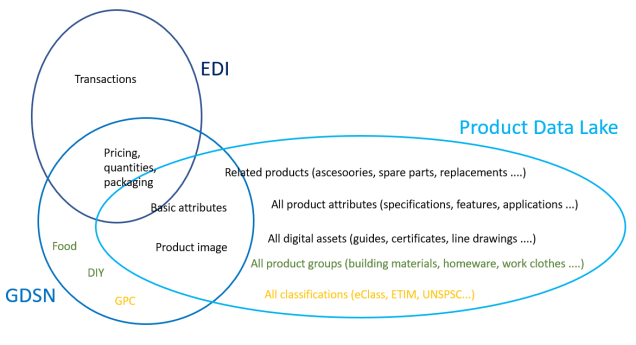
In that way, Product Data Lake is the long tail of product data synchronization supplementing EDI and GDSN for a long range of product groups, product attributes, digital assets, product relationships and product classification systems:

EDI GDSN PDLFind out more in the Product Data Lake Overview.

Shareconomy and MDM

The Master Data Management (MDM) discipline is something that belongs in the backbone of digitalization and enterprise architecture and therefore new ways of doing things always have a hard time in this realm. Fore sure there have been talk about big data and MDM for years, but actual implementations are few compared to ongoing traditional system of record implementations. The same will be the case with Artificial Intelligence (AI) and MDM. We will still see a lot of clerking around MDM for years.

So, I am stretching it far when working with yet a new must do thing for MDM (besides working with MDM, big data and AI).

But I have no doubt about that shareconomy (or sharing economy) will affect the way we work with MDM in the future. A few others are on the same path as for example the Swiss consultancy CDQ as presented on their page about Shareconomy for Customer and Supplier Data and The Corporate Data League (CDL).

Master Data ShareDoing Master Data Management (MDM) enterprise wide is hard enough. The ability to control master data across your organization is essential to enable digitalization initiatives and ensure the competitiveness of your organization in the future.

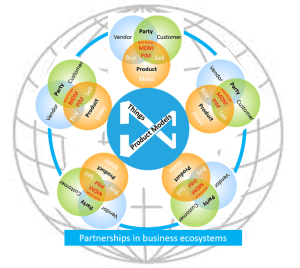
But it does not stop there. Increasingly every organization will be an integrated part of a business ecosystem where collaboration with business partners and through market places will be a part of digitalization and thus, we will have a need for working on the same foundation around master data.

This new aspect of MDM is also called multienterprise MDM. It will take years to be widespread. But you better start thinking about how this will be a part of your MDM strategy. Because in the long run you must Share or be left out of business.

Tibco, Orchestra and Netrics

Today’s Master Data Management (MDM) news is that Tibco Software has bought Orchestra Networks. So, now the 11 vendors in last year’s Gartner Magic Quadrant for Master Data Management Solutions is down to 10.

If Gartner is still postponing this year’s MDM quadrant, they may even manage to reflect this change. We are of course also waiting to see if newcomers will make it to the quadrant and make the crowd of vendors in there go back to an above 10 number. Some of the candidates will be the likes of Reltio and Semarchy.

Else, back to the takeover of Orchestra by Tibco, this is not the first time Tibco buys something in the MDM and Data Quality realm. Back in 2010 Tibco bought the data quality tool and data matching front runner Netrics as reported in the post What is a best-in-class match engine?

Then Tibco didn’t defend Netrics’ position in the Gartner Magic Quadrant for Data Quality Tools. The latest Data Quality Tool quadrant is also as the MDM quadrant from 2017 and was touched on this blog here.

So, will be exciting to see how Tibco will defend the joint Tibco MDM solution, which in 2017 was a sliding niche player at Gartner, and the Orchestra MDM solution, which in 2017 was a leader at the Gartner MDM quadrant.

Tibco Orchestra Netrics

Using a Publish-Subscribe Pattern for Product Data Syndication

In software architecture, publish–subscribe is a messaging pattern where senders of messages, called publishers, do not program the messages to be sent directly to specific receivers, called subscribers, but instead categorize published messages into classes without knowledge of which subscribers, if any, there may be. Similarly, subscribers express interest in one or more classes and only receive messages that are of interest, without knowledge of which publishers, if any, there are.

This kind of thinking is behind the service called Product Data Lake I am working with now. Whereas a publish-subscribe service is usually something that goes on behind the firewall of an enterprise, Product Data Lake takes this theme into the business ecosystem that exists between trading partners as told in the post Product Data Syndication Freedom.

Therefore, a modification to the publish-subscribe concept in this context is that we actually do make it possible for publishers of product information and subscribers of product information to care a little about who gets and who receives the messages as exemplified in the post Using a Business Entity Identifier from Day One. However, the scheme for that is a modern one resembling a social network where partnerships are requested and accepted/rejected.

As messages between global trading partners can be highly asynchronous and as the taxonomy in use often will be different, there is a storage part in between. How this is implemented is examined in the post Product Data Lake Behind the Scenes.

Pub-Sub pattern
Image credit: MSDN blog

Two Forms of Narcissism within Business-to-Business

Narcissus-CaravaggioThe term narcissism originates from Greek mythology, where the young Narcissus fell in love with his own image reflected in a pool of water. While this is about how a natural person may behave it can certainly also be applied to how a company behaves.

Not to show empathy to customers

I think we all know the classic sales presentation with endless slides about how big and wonderful the selling company is and how fantastic the products they sell are. This approach contradicts everything we know about selling, which is to start with the needs and pain points at the buying company and then how the selling company effectively can fulfill the needs and make the pain points go away.

Not to show empathy to trading partners

While business outcomes originate from selling to your customers it certainly also is affected by how you treat your trading partners and how you can put yourself in their place.

An example close to me is exchange of product information (product data syndication) between trading partners. We often see solutions which is made to make it easy for you but then being difficult for your trading partner. This includes requiring your spreadsheet format to filled out by your trading partner, may be a customer data portal set up by a manufacturer or opposite a supplier data portal set up by a merchant. These are narcissistic dead ends as told in the post The Death Trap in Product Information Management: Your Customer/Supplier Portal.

The emphatic way forward is putting your company as being an active delegate in a business ecosystem as examined in post A Product Information Management (PIM) Solar System.