Who is on The Disruptive MDM / PIM List?

The Disruptive Master Data Management Solutions List is a sister site to this blog. This site is aimed to be a list of available:

  • Master Data Management (MDM) solutions
  • Customer Data Integration (CDI) solutions
  • Product Information Management (PIM) solutions
  • Digital Asset Management (DAM) solutions.

You can use this site as an alternative to the likes of Gartner, Forrester, MDM Institute and others when selecting a MDM / CDI / PIM / DAM solution, not at least because this site will include both larger and smaller disruptive MDM solutions.

Vendors can register their solutions here and the crowd, being processional users, can review the solutions.

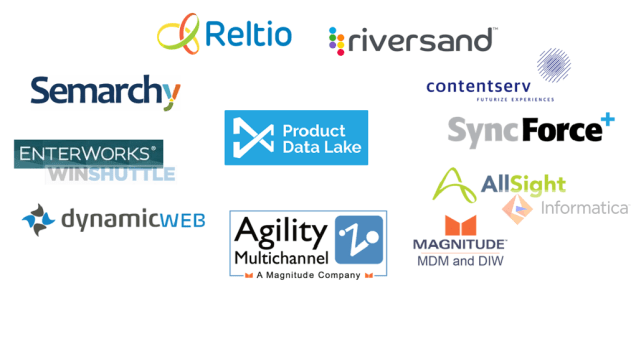
So far these solutions have been listed:

Reltio thumb

Reltio provides all the benefits of cloud like simplicity, scale, and security. On top of that, Reltio breaks down data silos by providing a unified data set with personalized views of data across departments like sales, marketing and compliance. Learn more about Reltio Cloud here.

thumbnailRiversand is an innovative global pioneer in information management. The powerful MDM, PIM and DAM solution help enterprises to transform their raw data into an engine of growth by making data usable, useful and meaningful. Learn more about Riversand here.

Semarchy IconSemarchy xDM is a platform that enables Intelligent MDM and Collaborative Data Governance. It leverages smart algorithms, an agile design, and scales to meet enterprise complexity with solid ROI. Learn more about Semarchy xDM here.

Contentserv thumbContentserv offers a real-time Product Experience Platform being recognized and recommended by international analysts as one of the top worldwide innovators and strong performers in the PIM & MDM space. Learn more about Contentserv here.

ewEnterWorks, which recently was joint with Winshuttle is a multi-domain master data solution for acquiring, managing and transforming a company’s multi-domain master data into persuasive and personalized content for marketing, sales, digital commerce and new market opportunities. Learn about Enterworks here.

SyncForce-plus-icon

SyncForce helps international consumer & professional packaged goods manufacturers realize Epic Availability. With SyncForce, your product portfolio is digitally available with a click of a button, in every shape and form, both internal and external. Learn about SyncForce here.

Dynamicweb thumb

Dynamicweb PIM brings you fewer applications, integrations and systems. It is fast and inexpensive to implement and maintain, because it is part of an all-in-one platform for omni-channel commerce. Learn more about Dynamicweb PIM here.

Agility thumbAgility® empowers marketers to acquire, enrich and deliver accurate and timely product content through every touchpoint, channel and region along with the analytical support required to maximize effectiveness in the market. Learn more about Agility here.

Magnitude thumbMagnitude Software’s Master Data Management solution offers enterprises the core capabilities to model multiple data entities, harmonize the data sources and manage governance processes for reference data and master data. Learn more about Magnitude MDM here.

AllsightAllSight, which is now a part of Informatica, is using state-of-the-art AI-driven technology in an MDM and Customer 360 solution. AllSight matches and links all customer data and provides multiple views of the customer for different users.

Smallest

Product Data Lake, which is affiliated to this blog, is a cloud service for sharing product master data in the business ecosystems of manufacturers, distributors, merchants, marketplaces and large end users of product information. Learn more about Product Data Lake here.

Disruptive MDM M and A


The Need for Speed in Product Information Flow

One of the bottlenecks in Product Information Management (PIM) is getting product data ready for presentation to the buying audience as fast as possible.

Product data travels a long way from the origin at the manufacturing company, perhaps through distributors and wholesalers to the merchant or marketplace. In that journey the data undergo transformation (and translation) from the state it has at the producing organization to the state chosen by the selling organization.

However, time to market is crucial. This applies to when a new product range is chosen by the merchant or when there are changes and improvements at the manufacturer.

At Product Data Lake we enable a much faster pace in these quests than when doing this by using emails, spreadsheets and passive portals.

Take two minutes to test if your company is exchanging product data at the speed of a cheetah or a garden snail.

Cheetah

To use Excel or not to use Excel in Product Information Management?

Excel is used heavily throughout data management and this is true for Product Information Management (PIM) too.

The reason of being for PIM solutions is often said to be to eliminate the use of spreadsheets. However, PIM solutions around have functionality to co-exist with spreadsheets, because spreadsheets are still a fact of life.

This is close to me as I have been working on a solution to connect PIM solutions (and other solutions for handling product data) between trading partners. This solution is called Product Data Lake.

Our goal is certainly also to eliminate the use of spreadsheets in exchanging product information between trading partners. However, as an intermediate state we must accept that spreadsheets exists either as the replacement of PIM solutions or because PIM solutions does not (yet) fulfill all purposes around product information.

So, consequently we have added a little co-existence with Excel spreadsheets in today´s public online release of Product Data Lake version 1.10.

PDL version 1 10

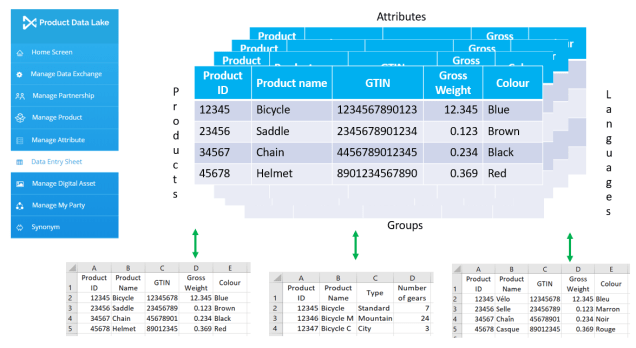
The challenge is that product information is multi-dimensional as we for example have products and their attributes typically represented in multiple languages. Also, each product group has its collection of attributes that are relevant for that group of products.

Spreadsheets are basically two dimensional – rows and columns.

In Product Data Lake version 1.10 we have included a data entry sheet that mirrors spreadsheets. You can upload a two-dimensional spreadsheet into a given product group and language, and you can download that selection into a spreadsheet.

This functionality can typically be used by the original supplier of product information – the manufacturer. This simple representation of data will then be part of the data lake organisation of varieties of product information supplemented by digital assets, product relationships and much more.

Real-World Multidomain MDM Entities

In Master Data Management (MDM) we strive to describe the core entities that are essential to running a business. Most of these entities are something that exists in the real-world. We can organize these entities in various groups as for example parties, things and locations or by their relation to the business buy-side, sell-side and make-side (production).

Multidomain MDM

The challenge in MDM is, as in life in general, that we use the same term for different concepts and different terms for the same concept.

Here are some of the classic issues:

  • An employee is someone who works within an organization. Sometimes this term must be equal to someone who is on the payroll. But sometimes it is also someone who works besides people on the payroll but is contracting and therefore is more like a vendor. Sometimes employees buy stuff from the organization and therefore acts as a customer.
  • Is it called vendor or supplier? The common perception is that a vendor brings the invoice and the supplier brings the goods and/or services. This is often the same legal entity but not too seldom two different legal entities.
  • What is a customer? There are numerous challenges in this question. It is about when a party starts being a customer and when the relationship ends. It is about whether it is a direct or an indirect customer. And also: Is it a business-to-consumer (B2C) customer, a business-to-business (B2B) or a B2B2C customer?
  • Besides employees, vendors and customers (and similar terms) we also care about other parties being business partners. We care about those entities that we must engage with in order to influence our sales. In manufacturing or reselling building materials you for example build relationships with the architects and engineers who choose the materials to be used for a building.
  • Traditionally product master data management has revolved around describing a product model which can be produced and sold in many instances over time. With the rise of intelligent things and individually configured complex products, we increasingly must describe each instance of a product as an asset. This adds to the traditional asset domain, where only a few valuable assets have been handled with focus on the financial value.
  • Each party and each thing have one and most often several relationships with a geographic location (besides digital locations as for example websites).

The relationships within multi-domain MDM was examined further in the post 3 Old and 3 New Multi-Domain MDM Relationship Types.

Data Matching and Real-World Alignment

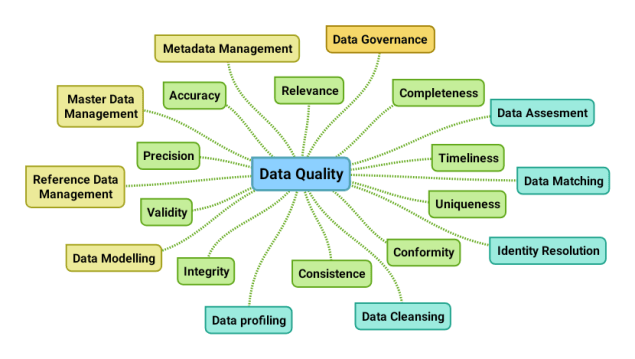
Data matching is a sub discipline within data quality management. Data matching is about establishing a link between data elements and entities, that does not have the same value, but are referring to the same real-world construct.

The most common scenario for data matching is deduplication of customer data records held across an enterprise. In this case we often see a gap between what we technically try to do and the desired business outcome from deduplication. In my experience, this misalignment has something to do with real-world alignment.

Data Matching and Real World Alignment

What we technically do is basically to find a similarity between data records that typically has been pre-processed with some form of standardization. This is often not enough.

Location Intelligence

Deduplication and other forms of data matching with customer master data revolves around names and addresses.

Standardization and verification of addresses is very common element in data quality / data matching tools. Often such at tool will use a service either from its same brand or a third-party service. Unfortunately, no single service is often enough. This is because:

  • Most services are biased towards a certain geography. They may for example be quite good for addresses in The United States but very poor compared to local services for other geographies. This is especially true for geographies with multiple languages in play as exemplified in the post The Art in Data Matching.
  • There is much more to an address than the postal format. In deduplication it is for example useful to know if the address is a single-family house or a high-rise building, a nursing home, a campus or other building with lots of units.
  • Timeliness of address reference data is underestimated. I recently heard from a leader in the Gartner Quadrant for Data Quality Tools that a quarterly refresh is fine. It is not, as told in the post Location Data Quality for MDM.

Identity Resolution

The overlaps and similarities between data matching and identity resolution was discussed in the post Deduplication vs Identity Resolution.

In summary, the capability to tell if two data records represent the same real-world entity will eventually involve identity resolution. And as this is very poorly supported by data quality tools around, we see that a lot of manual work will be involved if the business processes that relies on the data matching cannot tolerate too may, or in some cases any, false positives – or false negatives.

Hierarchy Management

Even telling that a true positive match is true in all circumstances is hard. The predominant examples of this challenge are:

  • Is a match between what seems to be an individual person and what seems to be the household where the person lives a true match?
  • Is a match between what seems to be a person in a private role and what seems to be the same person in a business role a true match? This is especially tricky with sole proprietors working from home like farmers, dentists, free lance consultants and more.
  • Is a match between two sister companies on the same address a true match? Or two departments within the same company?

We often realize that the answer to the questions are different depending on the business processes where the result of the data matching will be used.

The solution is not simple. The data matching functionality must, if we want automated and broadly usable results, be quite sophisticated in order to take advantage of what is available in the real-world. The data model where we hold the result of the data matching must be quite complex if we want to reflect the real-world.

The latest and hottest trends within MDM

Leading up to the Nordic Midsummer I am pleased to join Informatica and their co-hosts Capgemini and CGI at two morning seminars on how successful organizations can leverage data to drive their digital transformation, the needed data strategy and the urge to have a 360-view of data relationships and interactions.

My presentations will be an independent view on the question: What are the latest and hottest trends within Master Data Management?

In this session, I will give the audience a quick walk-through visiting some in vogue topics as MDM in the cloud, MDM for big data, embracing Internet of Things (IoT) within MDM, business ecosystem wide MDM and the impact of Artificial Intelligence (AI) on MDM.

The events will take place, and you can register to be there, as follows:

Infa Nordic morning seminars 2019

Data Quality Tools are Vital for Digital Transformation

The Gartner Magic Quadrant for Data Quality Tools 2019 is out. It will take you 43 minutes to read through, so let me provide a short overview.

Gartner says that “data quality tools are vital for digital business transformation, especially now that many have emerging features like automation, machine learning, business-centric workflows and cloud deployment models.”

The data quality software tools market was at 1.61 billion USD in 2017 which was an increase of 11.6% compared to 2016.

Gartner sees that end-user demand is shifting toward having broader capabilities spanning data management and information governance. Therefore, the data quality tool market continues to interact closely with the markets for data integration tools and for Master Data Management (MDM) products.

Among the capabilities mentioned is multidomain support meaning capabilities covering all the specific data subject areas, such as customer, product, asset and location. Interestingly Gartner continues to focus on customer as the one of several party data domains out there. In my experience, there are the same data quality challenges with vendor and other business partner data as well as with employee data.

According to Gartner, data quality tool vendors are competing to address shifting market requirements by introducing an array of new technologies, such as machine learning, interactive visualization and predictive/prescriptive analytics, all of which they are embedding in data quality tools. They are, according to Gartner, also offering new pricing models, based on open source and subscriptions.

The vendors included in the quadrant are positioned as seen below:

Gartner DQ 2019

If you want a full copy of the report you can, against providing your personal data, get it from Information Builders here.

Data Quality Dimensions in Motion

For the fifth year Dan Myers of DQMatters is making an Annual Dimensions of Data Quality Survey.

There are some very interesting findings when looking at the trend in the previous years surveys as seen in the figure below.

Data Quality Dimensions 2015 to 2018

Among the data quality dimensions included in this survey we see that the use of consistency, validity and not at least completeness has increased significantly over these years.

The possible use of consistency and completeness was examined here on the blog in the post Multi-Domain MDM and Data Quality Dimensions. Another dimension included in this post was uniqueness, which is a frequently addressed data quality dimension for customer master data in the quest of fighting duplicates in databases around.

You can now be part of the 2019 Annual Dimensions of Data Quality Survey here.