Connecting Silos

The building next to my home office was originally two cement silos standing in an industrial harbor area among other silos. These two silos are now transformed into a connected office building as this area has been developed into a modern residence and commercial quarter.

Master Data Management (MDM) is on similar route.

The first quest for MDM has been to be a core discipline in transforming siloed data stores within a given company into a shared view of the core entities that must be described in the same way across different departmental views. Going from the departmental stage to the enterprise wide stage is examined in the post Three Stages of MDM Maturity.

But as told in this post, it does not stop there. The next transformation is to provide a shared view with trading partners in the business ecosystem(s) where your company operates. Because the shared data in your organization is also a silo when digital transformation puts pressure on each company to become a data integrated part of a business ecosystem.

A concept for doing that is described on the blog page called Master Data Share.

Silos
Connected silos in Copenhagen North Harbor – and connecting data silos enterprise wide and then business ecosystem wide

The Intelligent Enterprise of the Future, Informatica Style

Yesterday I had the pleasure of attending the Informatica MDM 360 and Data Governance Summit in London including being in a panel discussing best practices for your MDM 360 journey. The rise of Artificial Intelligence (AI) in Master Data Management (MDM) was a main theme at this event.

Informatica has a track record of innovating in new technologies in the data management space while also acquiring promising newcomers in order to fast track their market offering. So it is with AI and MDM at Informatica too. Informatica currently has two tracks:

  • clAIre – the clairvoyant component in the Informatica portfolio that “using machine learning and other AI techniques leverages the industry-leading metadata capabilities of the Informatica Intelligent Data Platform to accelerate and automate core data management and governance processes”.
  • Informatica Customer 360 Insights which is the new branding of the recent AllSight acquisition. You can learn about that over at The Disruptive Master Data Management Solutions List in the entry about Informatica Customer 360 Insights.

At the Informatica event the synergy between these two tracks was presented as the Intelligent 360 View. Naturally, marketing synergies are the first results of an acquisition. Later we will – hopefully – see actual synergies when the technologies are to be aligned, positioned and delivered to customers who want to be an intelligent enterprise of the future.

Infa Intelligent Enterprise of the Future

Five Disruptive MDM Trends

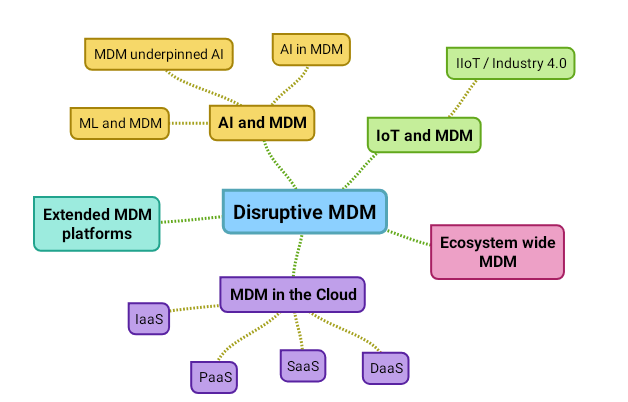
As any other IT enabled discipline Master Data Management (MDM) continuously undergo a transformation while adopting emerging technologies. In the following I will focus on five trends that seen today seems to be disruptive:

Disruptive MDM

MDM in the Cloud

According to Gartner the share of cloud-based MDM deployment has increased from 19% in 2017 year to 24 % in 2018 and I am sure that number will increase again this year. But does it come as SaaS (Software as a Service), PaaS (Platform as a Service) or IaaS (Infrastructure as a Service)? And what about DaaS (Data as a Service). Learn more in the post MDM, Cloud, SaaS, PaaS, IaaS and DaaS.

Extended MDM Platforms

There is a tendency on the Master Data Management (MDM) market that solutions providers aim to deliver an extended MDM platform to underpin customer experience efforts. Such a platform will not only handle traditional master data, but also reference data, big data (as in data lakes) as well as linking to transactions. Learn more in the post Extended MDM Platforms.

AI and MDM

There is an interdependency between MDM and Artificial Intelligence (AI). AI and Machine Learning (ML) depends on data quality, that is sustained with MDM, as examined in the post Machine Learning, Artificial Intelligence and Data Quality. And you can use AI and ML to solve MDM issues as told in the post Six MDM, AI and ML Use Cases.

IoT and MDM

The scope of MDM will increase with the rise of Internet of Things (IoT) as reported in the post IoT and MDM. Probably we will see the highest maturity for that first in Industrial Internet of Things (IIoT), also referred to as Industry 4.0, as pondered in the post IIoT (or Industry 4.0) Will Mature Before IoT.

Ecosystem wide MDM

Doing Master Data Management (MDM) enterprise wide is hard enough. But it does not stop there. Increasingly every organization will be an integrated part of a business ecosystem where collaboration with business partners will be a part of digitalization and thus we will have a need for working on the same foundation around master data. Learn more in the post Multienterprise MDM.

Six MDM, AI and ML Use Cases

One of the hottest trends in the Master Data Management (MDM) world today is how to exploit Artificial Intelligence (AI) and ignite that with Machine Learning (ML).

This aspiration is not new. It has been something that have been going on for years and you may argue about when computerized decision support and automation goes from being applying advanced algorithms to being AI. However, the AI and ML theme is getting traction today as part of digital transformation and whatever we call it, there are substantial business outcomes to pursue.

As told in the post Machine Learning, Artificial Intelligence and Data Quality perhaps all use cases for applying AI is dependent on data quality and MDM is playing a crucial role in sustaining data quality efforts.

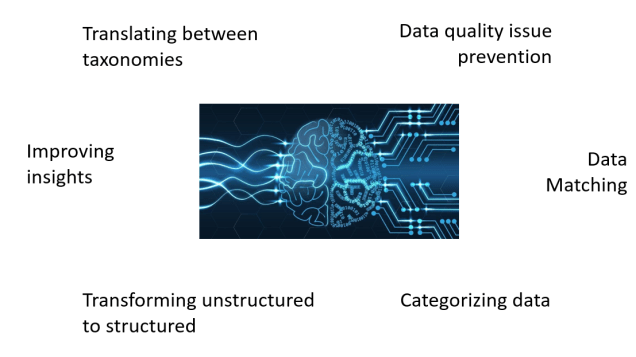
Some of the use cases for AI and ML in the MDM realm I have come across over the years are:
6 MDM, AI and ML use cases

Translating between taxonomies: As reported in the post Artificial Intelligence (AI) and Multienterprise MDM emerging technologies can help in translating between the taxonomies in use when digital transformation sets a new bar for utilizing master data in business ecosystems.

Transforming unstructured to structured: A lot of data is kept in an unstructured way and to in order to systematically exploit these data in AI supported business process we need make data more structured. AI and ML can help with that too.

Data quality issue prevention: Simple rules for checking integrity and validating data is good – but unfortunately not good enough for ensuring data quality. AI is a way to exploit statistical methods and complex relationships.

Categorizing data: Digital transformation, spiced up with increasing compliance requirements, has made data categorization a must and AI and ML can be an effective way to solve this task that usually is not possible for humans to cover across an enterprise.

Data matching: Establishing a link between multiple descriptions of the same real-world entity across an enterprise and out to third party reference data has always been a pain. AI and ML can help as examined in the post The Art in Data Matching.

Improving insight: The scope of MDM can be enlarged to Extended MDM Platforms where other data as transactions and big data is used to build a 360-degree view of the master data entities. AI and ML is a prerequisite to do that.


Marathon, Spartathlon and Data Quality

Tomorrow there is a Marathon race in my home city Copenhagen. 8 years ago, a post on this blog revolved around some data quality issues connected with the Marathon race. The post was called How long is a Marathon?

Marathon
Pheidippides at the end of his Marathon race in a classic painting

However, another information quality issue is if there ever was a first Marathon race ran by Pheidippides? Historians toady do not think so. It has something to do with data lineage. The written mention of the 42.192 (or so) kilometre effort from Marathon to Athens by Pheidippides is from Plutarch whose records was made 500 years after the events. The first written source about the Battle of Marathon is from Herodotus. It was written (in historian perspective) only 40 years after the events. He did not mention the Marathon run. However, he wrote, that Pheidippides ran from Athens to Sparta. That is 245 kilometres.

By the way: His mission in Sparta was to get help. But the Spartans did not have time. They were in the middle of an SAP roll-out (or something similar festive).

Some people make the 245-kilometre track in what is called a Spartathlon. In data and information quality context this reminds me that improving data quality and thereby information quality is not a sprint. Not even a Marathon. It is a Spartathlon.


Artificial Intelligence (AI) and Multienterprise MDM

The previous post on this blog was called Machine Learning, Artificial Intelligence and Data Quality. In here the it was examined how Artificial Intelligence (AI) is impacted by data quality and how data quality can impact AI.

Master Data Management (MDM) will play a crucial role in sustaining the needed data quality for AI and with the rise of digital transformation encompassing business ecosystems we will also see an increasing need for ecosystem wide MDM – also called multienterprise MDM.

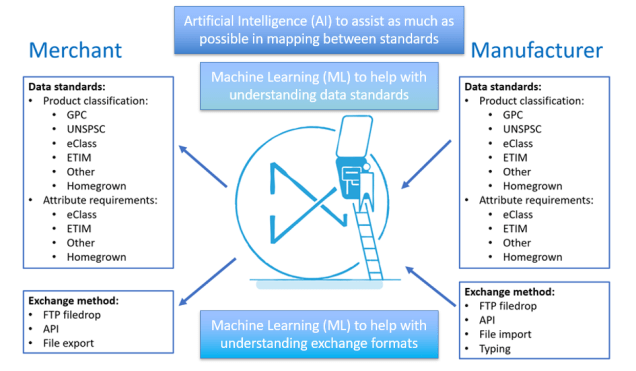
Right now, I am working with a service called Product Data Lake where we strive to utilize AI including using Machine Learning (ML) to understand and map data standards and exchange formats used within product information exchange between trading partners.

The challenge in this area is that we have many different classification systems in play as told in the post Five Product Classification Standards. Besides the industry and cross sector standards we still have many homegrown standards as well.

Some of these standards (as eClass and ETIM) also covers standards for the attributes needed for a given product classification, but still, we have plenty of homegrown standards (at no standards) for attribute requirements as well.

Add to that the different preferences for exchange methods and we got a chaotic system where human intervention makes Sisyphus look like a lucky man. Therefore, we have great expectations about introducing machine learning and artificial intelligence in this space.

AI ML PDL

Next week, I will elaborate on the multienterprise MDM and artificial theme on the Master Data Management Summit Europe in London.

Machine Learning, Artificial Intelligence and Data Quality

Using machine learning (ML) and then artificial intelligence (AI) to automate business processes is a hot topic and on the wish list at most organizations. However, many, including yours truly, warn that automating business processes based on data with data quality issues is a risky thing.

In my eyes we need to take a phased approach and double use ML and AI to ensure the right business outcomes from AI automated business processes. ML and AI can be used to rationalize data and overcome data quality issues as exemplified in the post The Art in Data Matching.

Instead of applying ML and AI using a dirty dataset at hand for a given business process, the right way will be to use ML and AI to understand and asses relevant datasets within the organization and then use thereon rationalized data to be understood my machines and used for sustainable automation of business processes.

ML AI DQ

Most of these rationalized data will be master data, where there is a movement to include ML and AI in Master Data Management solutions by forward looking vendors as examined in the post Artificial Intelligence (AI) and Master Data Management (MDM).

A Master Data Mind Map

Please find below a mind map with some of the data elements that are considered to be master data.

Master Data Mind Map

The map is in no way exhaustive and if you feel some more very important and common data elements should be there, please comment.

The data elements are grouped within the most common master data domains being party master data, product master data and location master data.

Some of the data elements have previously been examined in posts on this blog. This include:

The mind map has a selection of flags around where master data are geographically dependent. Again, this is not exhaustive. If you have examples of diversities within master data, please also comment.

Solutions for Handling Product Master Data and Digital Assets

There are three kinds of solutions for handling product master data and related digital assets:

  • Master Data Management (MDM) solutions that are either focussed on product master data or being a multi-domain MDM solution covering the product domain as well as the party domain, the location domain, the asset domain and more.
  • Product Information Management (PIM) solutions.
  • Digital Asset Management (DAM) solutions.

According to Gartner Analyst Simon Walker a short distinction is:

  • MDM of product master data solutions help manage structured product data for enterprise operational and analytical use cases
  • PIM solutions help extend structured product data through the addition of rich product content for sales and marketing use cases
  • DAM solutions help users create and manage digital multimedia files for enterprise, sales and marketing use cases

The below figure shows what kind of data that is typically included in respectively an MDM solution, a PIM solution and/or a DAM solution.

MDM PIM DAM

This is further elaborated in the post How MDM, PIM and DAM Stick Together.

The solution vendors have varying offerings going from being best-of-breed in one of the three categories to offering a OneStopShopping solution for all disciplines.

If you are to compile a list of suitable and forward-looking solutions for MDM, PIM and/or DAM for your required mix, you can start looking at The Disruptive List of MDM/PIM/DAM solutions.

Looking at The Data Quality Tool World with Different Metrics

The latest market report on data quality tools from Information Difference is out. In the introduction to the data quality landscape Q1 2019 this example of the consequences of  a data quality issue is mentioned: “Christopher Columbus accidentally landed in America when he based his route on calculations using the shorter 4,856 foot Roman mile rather than the 7,091 foot Arabic mile of the Persian geographer that he was relying on.”.

Information Difference has the vendors on the market plotted this way:

Information Difference DQ Landscape Q1 2019

As reported in the post Data Quality Tools are Vital for Digital Transformation also Gartner recently published a market report with vendor positions. The two reports are, in terms on evaluating vendors, like Roman and Arabic miles. Same same but different and may bring you to a different place depending on which one you choose to use.

Vendors evaluated by Information Difference but not Gartner are veteran solution providers Melissa and Datactics. On the other side Gartner has evaluated for example Talend, Information Builders and Ataccama. Gartner has a more spread out evaluation than Information Difference, where most vendors are equal.

PS: If you need any help in your journey across the data quality world, here are some Popular Offerings.