Social MDM, Privacy and Data Quality

The term “Social MDM” has been promoted quite well this week not at least as part of the social media information stream from the ongoing user conference of the tool vendor Informatica.

In a blog post called Informatica 9.5 for Big Data Challenge #2: Social Jody Ko of Informatica introduces the opportunities and challenges.

In the closing remarks Judy says: “There’s still a long way to go to bring social data into the mainstream enterprise, in part due to concerns over privacy and the potential “creepiness” factor of mining social data.”

As I understand it the spearhead Social MDM part of the tool release is a Facebook App that provides connectivity between Facebook and the MDM solution.

Industry analyst R “Ray” Wang examines this in the blog post News Analysis: Informatica Launches MDM 9.5. The analysis states that it now is time to “drive data out of Facebook and not into Facebook”.

The opportunities and challenges of driving data out of Facebook was discussed in a post called exactly Out of Facebook here on the blog some years ago.

Balancing privacy with data hoarding is still for sure a subject that in no way is settled and probably never will be.

Connecting systems of record in traditional MDM solutions with social network profiles is in no way a walk over too. The classic data quality challenges with uniqueness of records and completeness of data only gets more difficult, but also, there are great opportunities for getting a better picture of your customers and other business partners.

If you are interested in Social MDM and the related challenges and opportunities there is a LinkedIn group for Social MDM.

The group is new, less than a month old at the present time, but there is already a lot of content to dip into, including:

Bookmark and Share

Social Commerce and Multi-Domain MDM

The term social commerce is said to be a subset of eCommerce where social media is used to ultimately drag prospects and returning customers to your website, where a purchase of products and services can be made.

In complex sales processes, typically for Business-to-Business (B2B) sales, the website may offer product information sheets, demo requests, contact forms and other pipeline steps.

This is the moment where your social media engaged (prospective) customer meets your master data as:

  • The (prospective) customer creates and maintains name, address and communication information by using registration functions
  • The (prospective) customer searches for and reads product information on web shops and information sites

One aspect of this transition is how master data is carried over, namely:

  • How the social network profile used in engagement is captured as part of (prospective) customer master data or if it should be part of master data at all?
  • How product information from the governed master data hub has been used as part of the social media engagement or if the data governance of product data should be extended to use in social media at all?

Any thoughts?

Bookmark and Share

Big Reference Data as a Service

This morning I read an article called The Rise of Big Data Apps and the Fall of SaaS by Raj De Datta on TechCrunch.

I think the first part of the title is right while the second part is misleading. Software as a Service (SaaS) will be a big part of Big Data Apps (BDA).

The article also includes a description of LinkedIn merely as a social recruitment service. While recruiters, as reported in the post Indulgent Moderator or Ruthless Terminator?, certainly are visible on this social network, LinkedIn is much more than that.

Among other things LinkedIn is a source of what I call big reference data as examined in the post Social MDM and Systems of Engagement.

Besides social network profiles big reference data also includes big directory services, being services with large amount of data about addresses, business entities and citizens/consumers as told in the post The Big ABC of Reference Data.

Right now I’m working with a Software as a Service solution embracing Big (Reference) Data as a Service thus being a Big Data App called instant Data Quality.

And hey, I have made a pin about that:

Bookmark and Share

Social MDM and Systems of Engagement

Social Master Data Management has been an interest of mine the last couple of years and last week I have tried to reach out to others in exploring this new era of Master Data Management by creating a group on LinkedIn called Social MDM.

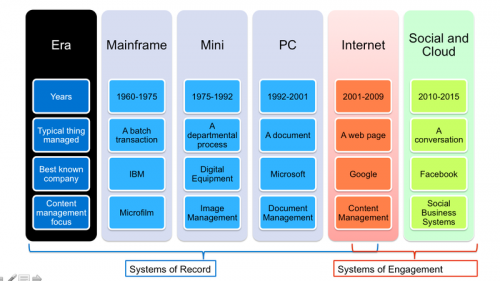
When reading a nice blog with the slogan ”Welcome to the Real (IT) World!” by Max J. Pucher I came across a good illustration by John Mancini showing the history of IT and how the term “Systems of Record” is being replaced (or at least supplemented) by the term “Systems of Engagement”:

Master Data Management (MDM) includes having a System of Record (SOR) describing the core entities that takes part in the transactional systems of record that supports the daily business in every organization. For example a golden MDM record is describing the party that acts as a customer on an order record while the products in the underlying order lines are described in golden MDM records for the things dealt with within the organization.

Social Master Data Management (Social MDM) will be about supplementing that System of Record so we are able to further describe the parties taking part in the new Systems of Engagement and link with the old Systems of Records. These parties are reflected as social network profiles that are owned by the same human beings who are our (prospective) customers, part of the same household or are a contact for a company being a (prospective) customer or any other business partner.

For a guy like me who started in IT in the mainframe era (just after it had ended according to the above illustration) and went on with mini computers, PC’s and the internet it’s very exciting to be moving on into the social and cloud era.

It will be good to be joined by even more data quality and MDM practitioners and anyone else in the LinkedIn Social MDM group.

Bookmark and Share

Well Met, Stranger

Finally wordpress.com, the hosted version of WordPress that I am using, has added geography to the stats.

The counter has been running for 14 days now, so I have tried to have a first look into the numbers.

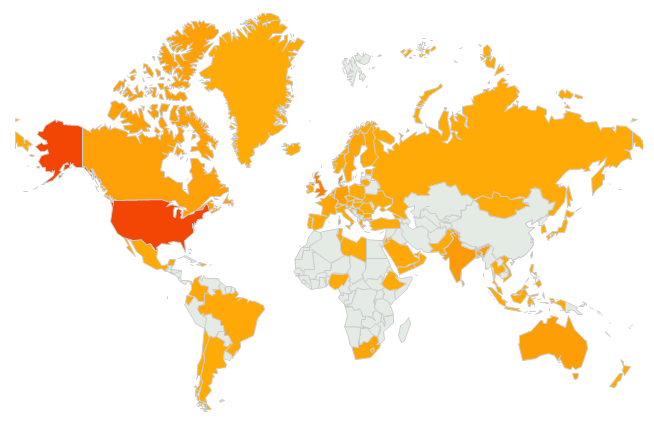
First of all I’m pleased that I during these 14 days have had visitors from 67 different countries around the globe:

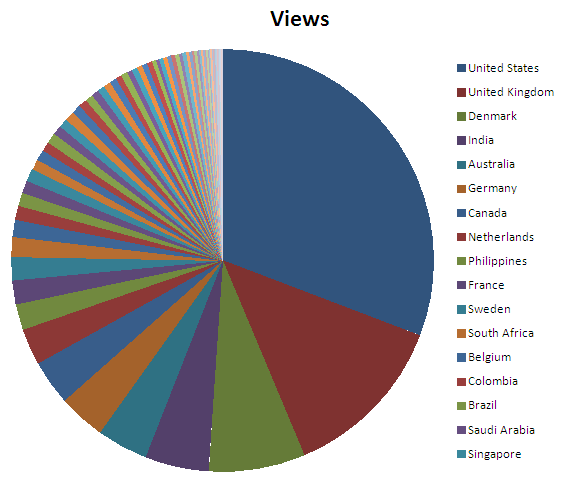
Most visitors have been from the United States, followed by my current home country United Kingdom and then my former home country Denmark:

Note: This figure is made by copying the results into excel.

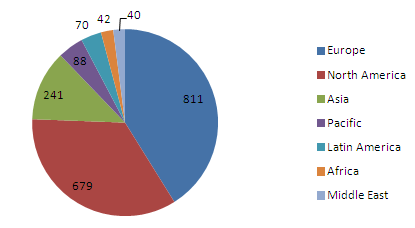
If grouped by regions of the world, it looks like this:

The world has certainly become a small place. Of course your interactions are biased towards your neighborhood, but in blogging as well as in business our success will increasingly become dependent on meeting, understanding and interacting with (maybe not so) strange people of the world.

Bookmark and Share

Indulgent Moderator or Ruthless Terminator?

I am the founder/moderator of two small niche LinkedIn groups in the data quality and Master Data Management (MDM) realm:

As a moderator I feel responsible for keeping the discussions in the group on target.

I guess my challenges in doing so resemble what nearly every other moderator on LinkedIn groups are faced with.

The postings that keep creating trouble are related to:

  • Jobs
  • Promotions

LinkedIn does have a facility to place entries into these two alternative tabs. But people seldom do that voluntary.

Jobs

In fact I’m pleased when a job is posted in one of the groups. But I also know that many people don’t like job postings coming up among the “normal” discussions in the groups.

I’m not so naive that I think recruiters forget to post as a job or don’t know how to do it. Many recruiters don’t respect the rules even if reminded. And some recruiters keep on entering the same job over and over again.

Therefore I have to mark recruiters, who twice “forget”, as subject to indulgent moderation. As said, I like job postings, so until now I haven’t practiced ruthless termination apart from deleting double entries – but that is also a destination of data matching anyway.

Promotions

With the relative small number of members in the groups in question, and recognising that most participants are tool vendors and service providers, I find it refreshing and informative with entries with promotional content, however most pleased when it’s done with limited marketing triviality.     

My indulgence may be explained by that I’m interconnected with tool makers and service providers myself. So these promotions are great ready-made competitor monitoring.

However, my indulgence has its limits when it comes to off topic promotion.

A special case here is outsourcing promotions. I find it peculiar that those people practicing this trade don’t target the message for the group where posted. It shouldn’t be too hard to make an angle with data matching or Multi-Domain MDM for your services. But I find that most out-sourcing people copy-paste their usual stuff.

So, in this area I mostly am the ruthless terminator. And there is seldom any hasta la vista, baby.

Bookmark and Share

Geocoding from 100 Feet Under

I stumbled upon this image posted by Ellie K. on Google+

The title is World map of Flickr and Twitter locations and the legend is that red dots are locations of Flickr pictures, blue dots are locations of Twitter tweets and white dots are locations that have been posted to both.

You may be able to see your city following this link.

For example Copenhagen looks like this:

Here you have Copenhagen in Denmark to the left and Malmoe in Sweden to the right.

The strip between is the fixed link known as the Øresund Bridge.

However the connection isn’t entirely a bridge. If you look at a flyover picture you may think that there wasn’t money enough to finish the connection. Fortunately there was. The part closest to Copenhagen Airport is a 4 kilometer (2.5 miles) undersea tunnel.

So what puzzles me is the dots apparently representing Flickr uploads and tweets made from the tunnel. Are you able to upload to Flickr from down there? How are the tweets geocoded with that precision? My GPS never works when passing the tunnel.

(PS: I know you may geotag when back to surface)

Bookmark and Share

Klout Data Quality

Today it was announced that yet a social media service has passed a 100 million mark, as now 100 Million People have Klout.

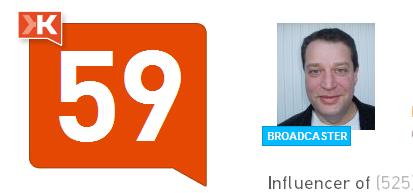
Klout is a service that measures your online influence based on your activity on Twitter, LinkedIn, FaceBook and so on. The main measure is a score between 1 and 100.


As many others I have from time to time been tempted to have a narcissistic look at my profile. I haven’t recorded it, but it seems to me that some of the other attributes on Klout changes a lot. Or maybe it’s just me who is moving around in the social media realm in all directions.

Today my Klout style is being a “broadcaster”. And that may be right, as I’m re-tweeting a lot of links. But I’m sure I was a “specialist” the last time I checked, and that is in the opposite corner of the style quadrant. Well, never mind, every description of the styles is positive.

Klout also have beliefs in what topics you are influential about. One of my top 10 topics is “magic”. I think I must be more careful about tweeting about “data quality magic”. Another topic of mine is “Tripoli”. That’s right too; I did make one tweet about Tripoli that ended up as an information quality trainwreck.

Unfortunately I’m not influential about data quality or MDM at all. I’ll have to work on that.

Bookmark and Share

Hit by an Outlier

Yesterday something weird happened on this blog. Usually I’m pleased to have between 100 and 250 so called page views on workdays. But yesterday there were 751. This Saturday morning everything is back to normal again:

I have no clue about who visited and why. I didn’t write anything very clever yesterday. Most views were on the home page. The count of referrers indicates a quiet day in the office:


Also the search terms counter doesn’t help:

Well, I guess I just have to consider this an outlier, being an observation that appears to deviate markedly from other members of the sample in which it occurs.

That is anyway my gut feeling without performing the Grubb’s test for outliers

Bookmark and Share

Lean Social MDM

I have previously written some blog posts about “Social MDM” using the term “Social MDM” to describe the trend of having social media (master) data as a new complexity on top of the already known conundrum of mastering traditional master data.

Stephan Zoder of IBM Initiate discussed this topic in a recent post called CMM is Actually High-Frequency, Social MDM (where CMM is about Customer Motivation Management).

As I also briefly examined the term “Lean MDM” last week I wonder if it is possible to start embracing social media (master) data under a term as “Lean Social MDM”.

The lean MDM post included an actual real life project I have been involved in, which was about how the car rental giant Avis achieved lean MDM for the Scandinavian business.

An underlying business case for this project was that many decisions about car rental is made by individual persons who may act as an employee at (changing) employers and as private renters. Therefore the emphasis of the master data management was at the person in contact, user and private roles.

Having a “single person view” is in my eyes, if it wasn’t before, a good place to start your “Lean Social MDM” journey.

Bookmark and Share