Counting on LinkedIn

Let’s say LinkedIn opened a bank. Would you put money into the LinkedIn bank?

I don’t think I would if they used the same technology for accounting as they use for counting members in the LinkedIn groups.

The other day I made a happy tweet telling that the Social MDM LinkedIn group just got 400 members. And now today LinkedIn told me we are only 385 members. First thought: Jesus, 15 members left in a few days. Boring subject. Missing the hype before it even got inflated.

But when I went to the statistics page we were now 400 again:

Count1

Going back to the member list and refreshing it several times showed these results:

count2

And:

Count3

And:

Count4

Well, I guess we are around 400 members. And oh, there’s room for more. Join here.

Bookmark and Share

Social Data Quality

A cornerstone in the social sphere around data quality is the site DataQualityPro founded by Dylan Jones.

This week the site had a major facelift. As Dylan explains:

“We’ve moved over to one of the most advanced content hosting sites available to make it easier for you to discover, share and engage with the huge amounts of educational content and resources we now have on the site.”

You may read more about the changes in the post Welcome to the New Look Data Quality Pro.

I remember joining DataQualityPro even before it was a site, as it started as a section of the sister site called DataMigrationPro.

During the years I have learned a lot by being a member of DataQualityPro and as most things social you don’t pay anything for being that. The only difference compared to other services is that there are no paid upgrades. You get the full package when joining.

There are sponsors too of course.

Also here I, as representing the data quality service provider iDQ, have very good experiences with DataQualityPro. Last summer we had a technology briefing on the site with a massive response.

So, if you haven’t seen the new design or you are not a member (or a sponsor) yet, hurry on and visit

DataQualityPro

Bookmark and Share

Hurray! I am on LinkedIn

These days LinkedIn are celebrating passing 200 million profiles.

This is done by sending us members a mail telling about our part in the success.

The mail message is easily sharable on LinkedIn, Twitter and Facebook. What I’ve seen is that you can be among the 1 % most viewed (including yours truly), the 5 % most viewed, the 10 % most viewed and among the first 500,000 members in a given country.

The latter incident includes for example being among the first 500,000 members in Malta.

Malta LinkedIn

I guess that will include every member in Malta as Malta has a population around 450,000, unless of course the Maltese are world champions in creating duplicate profiles.

Bookmark and Share

Tomorrow’s Data Quality Tool

In a blog post called JUDGEMENT DAY FOR DATA QUALITY published yesterday Forrester analyst Michele Goetz writes about the future of data quality tools.

Michele says:

“Data quality tools need to expand and support data management beyond the data warehouse, ETL, and point of capture cleansing.”

and continues:

“The real test will be how data quality tools can do what they do best regardless of the data management landscape.”

As described in the post Data Quality Tools Revealed there are two things data quality tools do better than other tools:

  • Data profiling and
  • Data matching

Some of these new challenges I have worked with within designing tomorrow’s data quality tools are:

  • open-doorPoint of capture profiling
  • Searching using data matching techniques
  • Embracing social networks

Point of capture profiling:

The sweet thing about profiling your data while you are entering your data is that analysis and cleansing becomes part of the on-boarding business process. The emphasis moves from correction to assistance as explained in the post Avoiding Contact Data Entry Flaws. Exploiting big external reference data sources within point of capture is a core element in getting it right before judgment day.

Searching using data matching techniques:

Error tolerant searching is often the forgotten capability when core features of Master Data Management solutions and data quality tools are outlined. Applying error tolerant search to big reference data sources is, as examined in the post The Big Search Opportunity, a necessity to getting it right before judgment day.

Embracing social networks:

The growth of social networks during the recent years has been almost unbelievable. Traditionally data matching has been about comparing names and addresses. As told in the post Addressing Digital Identity it will be a must to be able to link the new systems of engagement with the old systems of record in order to getting it right before judgment day.

How have you prepared for judgment day?

Bookmark and Share

Social MDM and Complex Sales

Social Master Data Management (Social MDM) is about linking the increasing trend of doing business via social media, using what we may call “systems of engagement”, with the traditional way of supporting business using what we call “systems of record”.

Doing social MDM is a natural consequence of adapting social CRM (Social Customer Relation Management). Many CRM solutions are supporting Business-to Business (B2B) activities helping with keeping track of what’s going on with a lot of contacts related to a business account within so called complex sales processes.

Traditional MDM in B2B environments has been much about a single view of the business account and the legal entity behind. As social CRM is much about the relations to the business contacts, the people side of business, we need a solid master data foundation behind the people being those contacts.

The same individual may in fact be an important influencer related to a range of business accounts being the legal entity with who you are aiming for a sales contract. You need a single view of that. So many sales contracts are based on a relation to a buyer moving from one business account to another. You need to be the winner in that game and the answer to that may very well be your ability to do better social MDM.

Social MDM adds a new external source of reference data to MDM solutions for B2B customer master data management. This new source is professional social network profiles where LinkedIn is the most known and used service around.

It is early days for social MDM solutions so it is quite exciting for me to work with designing the first kind of such solutions around the MDM edition of the instant Data Quality service.

Stay tuned for more news in this field on this blog in the times to come.

Bookmark and Share

Fake, Snoopy, Kitty and Duplicate Social Media Profiles

As a data quality practitioner I have never been in doubt that when it is said that FaceBook has 900 million profiles, that doesn’t mean that 900 million people have a Facebook profile.

Some people have more than one profile. Some people who had a profile are not among us anymore. As reported by BBC in the article Facebook ‘likes’ and adverts’ value doubted, some profiles are fake resulting in FaceBook earning real money that should have been fake money.

Even some profiles are not really fake but serves other purposes like a snoopbook account created to reveal fraud.

And then some profiles belongs to (the owners of) real cats, as reported by James Standen in a comment to my post called Out of Facebook.

On another social media platform, Twitter, I am guilty of having 5 profiles. Besides my real account hlsdk I have created hldsk, hsldk and hlsdq, so I have been able to thank people mentioning me with a wrong spelled handle. And then there is my female side: MissDqPiggy.

Bookmark and Share

Finding the Truth in Social Business Directories

LinkedIn has a section called companies. When browsing around on LinkedIn you are sometimes hinted to follow a company that LinkedIn think will be of interest for you.

The other day my hint included two identical logo’s for the old Master Data Management (MDM) vendor called Siperian. Curiously and data quality geeky as I am I checked and actually there are two Siperians on LinkedIn companies:

Both have an identical head quarter address in California, USA.

So, even MDM vendors have created duplicates.

Also, Siperian was acquired by the Data Integration giant Informatica some years ago, so you should expect that the Siperians was emptied. But that is not the case. Some Siperian folks still claims working for one of the Siperian duplicates (though many also for Imformatica at the same time).

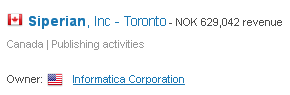
Now, I was not sure about the legal status of the old Siperian company. So I went to another social network called Companybook. On that site the company registry is based on an external business directory.

Here it seems that the Siperian company in Toronto, Canada actually still exist, though marked as owned by Informatica.

So, I’m still looking for that single source of the truth out there. Until then I will mashup the external sources out there with my internal MDM vendor knowledge as told in the post yesterday called Mashing Up Big Reference Data with Internal Master Data.

Bookmark and Share

Hierarchy Management in Social MDM

Hierarchy management is a core feature in master data management (MDM). When it comes to integrating social data and social network profiles into MDM, hierarchy management will be very important too.

Aggregated Level of Social MDM in B2C

The primarily privacy related challenges of social MDM not at least within business-to-consumer (B2C) have been a topic of a lot of blogging lately.  Examples are:

One way of overcoming the privacy considerations is linking to social data and social network profiles at an aggregate level.

Using aggregate level linking is already well known in direct marketing with the use of demographic stereotypes. These stereotypes are based on groups of consumers often defined by their address and/or their age. Combining this knowledge with product master data was examined in the post Customer Product Matrix Management.

Social MDM will add new dimensions to this way of using hierarchies in master data and linking the data across multiple channels without the need to uniquely identify a real world person in every aspect.

Contact Level Social MDM in B2B

As discussed in the post Business Contact Reference Data social network profiles has lot to offer within mastering business-to-business (B2B) contact data.

While access to external reference data at the account level has been around for many years by having available public and commercial (and even open) business directories, the problem of identifying and maintain correct and timely data about the contacts at these accounts has been huge.

Integrating with social networks can help here and social networks are actually also integrating more and more with the traditional business directories. LinkedIn has business directory links for larger companies today and lately I noticed a new professional social network called CompanyBook that is based on linking your profile to a (complete) business directory. By the way: The business directory data available in CompanyBook is surprisingly deep, for example revenue data is free for you to grab.

When it comes to contact data they are basically maintained out there by you. A service like LinkedIn is often described as a recruitment service. In my eyes it is a lot more than that. It is along with similar services a goldmine (within a minefield) for getting MDM within B2B done much better.

Bookmark and Share

State of this Data Quality Blog

Today is a big day on this blog as it has been live for 3 years.

Success versus Failure

The first entry called Qualities of Data Architecture was a promise to talk about data quality success stories. The reason for emphasizing on success stories related to data quality is a feeling that data quality improvement is too often promoted by horror stories telling about how bad your business may go if you don’t pay attention to data quality.

The problem is that stories about failure usually aren’t taken too seriously. Jim Harris recently had a very good take on that in the post Data Quality and Chicken Little Syndrome.

So, I plan to tell even more success stories along with the inevitable stories about failure that so easily and obviously could have been avoided.

Getting Social

Using social networks to promote your blogging is quite natural.

At the same time social networks has emerged as new source in doing master data management (I call this Social MDM).

Exploring this new discipline over the hype peak, down through the valley of disappointment and up to the plateau of productivity will for sure be a recurring subject on this blog.

People, Processes and Technology

Sometimes you see a statement like “Data Quality is not about technology, it’s all about people”.

Well, most things we can’t solve easily are not just about one thing. In my eyes the old cliché about addressing people, processes and technology surely also relates to getting data quality right.

There are many good blogs around about people and processes. On this blog I’ll try to tell about my comfort zone being technology without forgetting people and processes.

The Hidden Agenda

Most people blogging are doing this to promote our (employers) expertise, services and tools and I am not different.

Lately I have written a lot about a second to none cloud based service for upstream data quality prevention. The wonder is called instant Data Quality.

While upstream prevention is the best approach to data quality still a lot of work must be done every day in downstream cleansing as told in the post Top 5 Reasons for Downstream Cleansing.

As I’m also working with a new stellar cloud based platform for data quality improvement productivity I will for sure share some props for that in the near future.

Bookmark and Share

Business Contact Reference Data

When working with selling data quality software tools and services I have often used external sources for business contact data and not at least when working with data matching and party master data management implementations in business-to-business (B2B) environments I have seen uploads of these data in CRM sources.

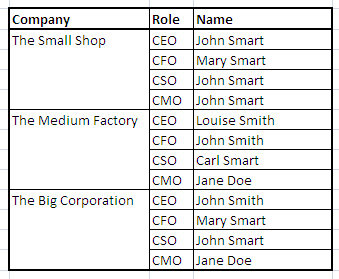
A typical external source for B2B contact data will look like this:

Some of the issues with such data are:

  • Some of the contact data names may be the same real world individual as told in the post Echoes in the Database
  • People change jobs all the time. The external lists will typically have entries verified some time ago and when you upload to your own databases, data will quickly become useless do to data decay.
  • When working with large companies in customer and other business partner roles you often won’t interact with the top level people, but people in lower levels not reflected in such external sources.

The rise of social networks has presented new opportunities for overcoming these challenges as examined in a post (written some years ago) called Who is working where doing what?

However, I haven’t seen so many attempts yet to automate and include working with social network profiles in business processes. Surely there are technical issues and not at least privacy considerations in doing so as discussed in the post Sharing Social Master Data.

Right now we have a discussion going on in the LinkedIn Social MDM group about examples of connecting social network profiles and master data management. Please add your experiences in the group here – and join if you aren’t already a member.

Bookmark and Share