More Social Master Data Management

Yesterday my American cyberspace friend Jim Harris was so kind to send an invitation for Google+ – the new social network service you must hook into. Thanks Jim, now I had to fill in yet a profile, upload the same picture as always and start networking from scratch once again 🙂

As many people I have several profiles in different social network services as Twitter, Facebook and LinkedIn. As I’m doing business also with German speaking countries I also use XING as alternative to LinkedIn as told in the post LinkedIn and the other Thing.

In a comment to that post my Austria based French connection Olivier Mathurin noted: “Disconnected duplicated siloed professional profiles, mmm…”

In a post on this blog called Social Master Data Management made one year ago it is discussed how social CRM will add new sources from social networks to the external reference data sources we already know from old time CRM.

With all the different faces everyone are wearing in the social media realm this isn’t going to be easy and one may consider if social master data management is a wrong path giving the individual nature and built-in privacy in social networking services.    

Well, Gartner (the analyst firm) says that increasing links between MDM and social networks is one of the Three Trends That Will Shape the Master Data Management Market.

So, acknowledging that Gartner predictions are self-fulfilling, you better get moving into LinkedIn, Xing, Viadeo, Twitter, Facebook, (forget MySpace), Google+  and what’s next.

Bookmark and Share

Non-Obvious Entity Relationship Awareness

In a recent post here on this blog it was discussed: What is Identity Resolution?

One angle was the interchangeable use of the terms “Identity Resolution” and “Entity Resolution”. These terms can be seen as truly interchangeable, as that “Identity Resolution” is more advanced than “Entity Resolution” or as (my suggestion) that “Identity Resolution” is merely related to party master data, but “Entity Resolution” can be about all master data domains as parties, locations and products.

Another term sometimes used in this realm is “Non-Obvious Relationship Awareness”. Also this term is merely related to finding relationships between parties, for example individuals at a casino that seems to do better than the croupiers. Here’s a link to a (rather old) O’Reilly Radar post on Non-Obvious Relationship Awareness.

Going Multi-Domain

So “Non-Obvious Entity Relationship Awareness” could be about finding these hidden relationships in a multi-domain master data scope.

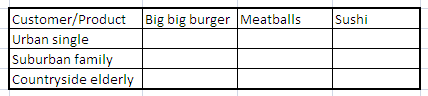
An example could be non-obvious relationships in a customer/product matrix.

The data supporting this discovery will actually not be found in the master data itself, but in transaction data probably being in an Enterprise Data Warehouse (EDW). But a multi-domain master data management platform will be needed to support the complex hierarchies and categorizations needed to make the discovery.   

One technical aspect of discovering such non-obvious relationships is how chains of keys are stored in the multi-domain master data hub.

Customer Master Data

The transactions or sums hereof in the data warehouse will have keys referencing customer accounts. These accounts can be stored in staging areas in the master data hub with references to a golden record for each individual or company in the real world. Depending on the identity resolution available the golden records will have golden relations to each other as they are forming hierarchies of households, company family trees, contacts within companies and their movements between companies and so on.

My guess as described in the post Who is working where doing what? is that this will increasingly include social media data.

Product Master Data

Some of the same transactions or sums hereof in the data warehouse will have keys referencing products. These products will exist in the master data hub as members of various hierarchies with different categorizations.

My guess is that future developments in this field will further embrace not just your own products but also competitor products and market data available in the cloud all attached to your hierarchies and categorizations.   

Bookmark and Share

Follow Friday Diversity

Every Friday on Twitter people are recommending other tweeps to follow using the #FollowFriday (or simply #FF) hashtag.

So do I.

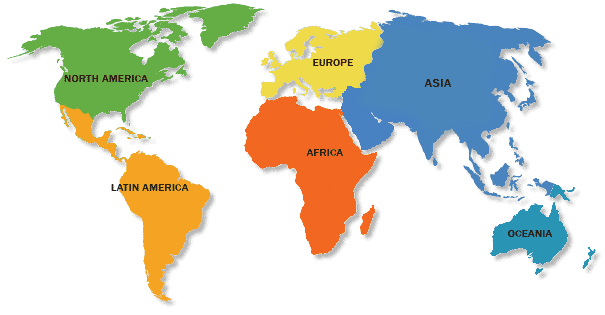
Below please find my follow Friday recommendations grouped by global region:


Canada: @carrni @datamartist @sheezaredhead @andrewsinfotech @aniagl @DQamateur @bivcons @projmgr @DQStudent @datachickUnited States: @GarnieBolling @stevesarsfield @UtopiaInc @bbreidenbach @fionamacd @RobertsPaige @BIMarcom @IDResolution @FirstSanFranMDM @dan_power @merv @NISSSAMSI @jilldyche @howarddresner @GartnerTedF @RobPaller @marc_hurst @dcervo @datamentors @VishAgashe @IBMInitiate @RamonChen @JackieMRoberts @philsimon @Nick_Giuliano @DataInfoCom @juliebhunt  @Futureratti  @dqchronicle  @jonrcrowell @elc  @Experian_QAS @paulboal @im4infomgt @WinstonChen @ocdqblog @KeithMesser @murnane @BrendaSomich @alanmstein @JGoldfed @jaimefitzgerald @tedlouie @bslarkin

Venezuela: @pigbar

Ireland: @daraghobrien @KenOConnorData @MapMyBusiness: United KIngdom: @SteveTuck @VeeMediaFactory @mktginsightguy @Daryl70 @Teresacottam @AnishRaivadera @ExperianQAS_UK @DataQualityPro @SarahBurnett @faropress @jschwa1 @mikeferguson1 @jtonline @Master_OBASHI @Nicola_Askham; France: @DataChannel @mydatanews @jmichel_franco @ydemontcheuil;Switzerland: @alexej_freund @openmethodology; Austria: @omathurin; Germany: @stiebke @dwhp @dakoller @marketingBOERSE; Belgium: @guypardon; Netherlands: @harri00413 @GrahamRhind; Denmark: @jeric40 @eobjects @StiboSystems;Norway @Orvei; Sweeden: @MrPerOlsson @DarioBezzina; Finland: @JoukoSalonen; Lithuania: @googlea; Italy: @Stray__Cat

Algeria: @aboussaidi; South Africa: @MarkGStacey

Pakistan: @monisiqbal; India: @MDMAnswers @twitrvenky @ashwinmaslekar; Indonesia: @VaiaTweets

Australia: @emx5 @vmcburney;New Zeeland: @JohnIMM @Intelligentform

It’s my hope, that I in the future will be able to interact even more diverse.

Bookmark and Share

Out of Facebook

Some while ago it was announced that Facebook signed up member number 500,000,000.

If you are working with customer data management you will know that this doesn’t mean that 500,000,000 distinct individuals are using Facebook. Like any customer table the Facebook member table will suffer from a number of different data quality issues like:

  • Some individuals are signed up more than once using different profiles.
  • Some profiles are not an individual person, but a company or other form of establishment.
  • Some individuals who created a profile are not among us anymore.

Nevertheless the Facebook member table is a formidable collection of external reference data representing the real world objects that many companies are trying to master when doing business-2- consumer activities.

For those companies who are doing business-2-business activities a similar representation of real world objects will be the +70,000,000 profiles on LinkedIn plus profiles in other social business networks around the world which may act as external reference data for the business contacts in the master data hubs, CRM systems and so on.

Customer Master Data sources will expand to embrace:

  • Traditional data entry from field work like a sales representative entering prospect and customer master data as part of Sales Force Automation.
  • Data feed and data integration with traditional external reference data like using a business directory. Such integration will increasingly take place in the cloud and the trend of governments releasing public sector data will add tremendously to this activity.
  • Self registration by prospects and customers via webforms.
  • Social media master data captured during social CRM and probably harvested in more and more structured ways as a new wave of exploiting external reference data.

Doing “Social Master Data Management” will become an integrated part of customer master data management offering both opportunities for approaching a “single version of the truth” and some challenges in doing so.

Of course privacy is a big issue. Norms vary between countries, so do the legal rules. Norms vary between individuals and by the individuals as a private person and a business contact. Norms vary between industries and from company to company.

But the fact that 500,000,000 profiles has been created on Facebook in a very few years by people from all over world shows that people are willing to share and that much information can be collected in the cloud. However no one wants to be spammed by sharing and indeed there have been some controversies around how data in Facebook is handled. 

Anyway I have no doubt that we will see less data entering clerks entering the same information in each company’s separate customer tables and that we increasingly will share our own master data attributes in the cloud.

Bookmark and Share

Follow Friday Data Quality

Every Friday on Twitter people are recommending other tweeps to follow using the #FollowFriday (or simply #FF) hash tag.

My username on twitter is @hlsdk.

Sometimes I notice tweeps I follow are recommending the username @hldsk or @hsldk or other usernames with my five letters swapped.

It could be they meant me? – but misspelled the username. Or they meant someone else with a username close to mine?

As the other usernames wasn’t taken I have taken the liberty to create some duplicate (shame on me) profiles and have a bit of (nerdish) fun with it:

@hsldk

For this profile I have chosen the image being the Swedish Chef from the Muppet show. To make the Swedish connection real the location on the profile is set as “Oresund Region”, which is the binational metropolitan area around the Danish capital Copenhagen and the 3rd largest Swedish city Malmoe as explained in the post The Perfect Wrong Answer.

@hldsk

For this profile I have chosen the image being a gorilla originally used in the post Gorilla Data Quality.

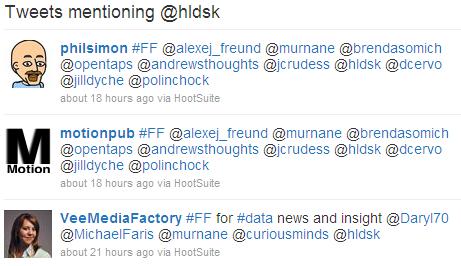
This Friday @hldsk was recommended thrice.

But I think only by two real life individuals: Joanne Wright from Vee Media and Phil Simon who also tweets as his new (one-man-band I guess) publishing company.

What’s the point?

Well, one of my main activities in business is hunting duplicates in party master databases.

What I sometimes find is that duplicates (several rows representing the same real world entity) have been entered for a good reason in order to fulfill the immediate purpose of use.

The thing with Phil and his one-man-band company is explained further in the post So, What About SOHO Homes.

By the way, Phil is going to publish a book called The New Small. It’s about: How a New Breed of Small Businesses is Harnessing the Power of Emerging Technologies.

Bookmark and Share

Business Directory Musings

This coming Sunday I have worked professionally within Information Technology for 30 years. As I will be on a (well deserved!) vacation in Andalusia on Sunday, I’ll better post my thoughts today.

I have had a lot of different positions and worked in a lot of different domains. The single subject I have worked with the most is business directories.

My first job was at the Danish Tax Authorities and one of the assignments was being a secretary to the committee working for a joint registration of companies in Denmark. Besides I learned a lot about working in political driven organizations and about aligning business and technology I feel good about having been part of the start of building a public sector master data directory. Such directories are both essential for an effective public administration and can be used as external reference data in private enterprises as a valuable mean to improve data quality with business partner master data.

Later I have been working a lot with improving data quality through matching solutions around business directories. This goes from the Dun & Bradstreet WorldBase holding nearly 170 million business entities from all over the world, over databases like the EuroContactPool to national databases either holding all businesses (available) in a single country or given industry segments.

I guess I also will be spending some additional years from now with integrating business directory information into business processes as smooth as possible and preferable along with a range of other kind of external reference data.

One of the new sources building up in the cloud in the realm of business directories is master data references in social networks. The LinkedIn Companies feature is a prominent example. Of course such directories have some data quality issues. This is seen in looking at the companies where I currently work:

  • DM Partner A/S seems OK
  • Omikron Data Quality has 90 employees according to the company profile (filled out by yours truly). Then it’s strange that there are only 25 profiles in the network. But that’s because most employees are in Germany where the competing network called Xing is stronger.
  • Trapeze Group Europe has not been updated with a recent merger and not all profiles has changed their profile accordingly yet. But I’m sure that will be done as time goes by.

I have no doubt though that including information from social networks will become a part of integrating business partner master data in my future.

Bookmark and Share

Social Master Data Management

The term ”Social CRM” has been around for a while. Like traditional CRM (Customer Relationship Management) is heavily dependent on proper MDM (Master Data Management) we will also see that enterprise wide social CRM will be dependent on a proper social MDM element in order to be a success.

The challenge in social MDM will be that we are not going to replace some data sources for MDM, but we are actually going to add some more sources and handle the integration of these sources with the sources for traditional CRM and MDM and other new sources coming from the cloud.

Customer Master Data sources will expand to embrace:

  • Traditional data entry from field work like a sales representative entering prospect and customer master data as part of Sales Force Automation.
  • Data feed and data integration with external reference data like using a business directory. Such integration will increasingly take place in the cloud and the trend of governments releasing public sector data will add tremendously to this activity.
  • Self registration by prospects and customers via webforms.
  • Social media master data captured during social CRM and probably harvested in more and more structured ways.

Social media master data are found as profiles in services as Facebook mainly for business-to–consumer activities, LinkedIn mainly for business-to-business activities and Twitter somewhere in between. These are only some prominent examples of such services. Where LinkedIn may be dominant for professional use in English speaking countries and countries where English is widely spoken as Scandinavia and the Netherlands other regions are far less penetrated by LinkedIn. For example for German speaking countries the similar network service called Xing is much more crowded. So, when embracing global business you will have to acknowledge the diversity found in social network services.

A good way to integrate all these sources in business processes is using mashup’s. An example will be a mashup for entering customer data. If you are entering a business entity you may want to know:

  • What is already known in internal databases about that entity – either via a centralized MDM hub or throughout disparate databases?
  • Is the visit address correct according to public sector data?
  • How is the business account related to other business entities learned from a business directory?
  • Do we recognize the business contact in social networks – maybe we did have contact before in another relation?

If you are entering a consumer entity you may want to know:

  • Does that person already exist in our internal databases – as an individual and as a household?
  • What do we know about the residence address from public sector data?
  • Can we obtain additional data from phone book directories, nixie lists and what else being available, affordable and legal in the country in question?
  • How do we connect in social media?

Of course privacy is a big issue. Norms vary between countries, so do the legal rules. Norms vary between individuals and by the individuals as a private person and a business contact. Norms vary between industries and from company to company.

If aligning people, processes and technology didn’t matter before, it will when dealing with social master data management.

Bookmark and Share

LinkedIn and the other Thing

I have a profile in two different business oriented social networking services: LinkedIn and XING.

I have far more connections in LinkedIn than in XING.

My connections in LinkedIn are mainly from English speaking countries (US, UK, IE, IN, AU) and from Scandinavia (DK, NO, SE) where I live and where English is widely spoken not at least by people in white-collar.

The connections I have with people in XING are almost only with people from Germany.

This picture matches very well how these two tools are positioned.

The US based LinkedIn is strong in “English speaking” countries with most profiles per capita in:

  • Denmark, Netherlands and USA followed by
  • Norway, Sweden, United Kingdom and Australia

(I have some figures from last year when LinkedIn passed 50 million profiles).

XING is strong in Germany, where XING was founded, and through acquisitions also in Spain and Turkey.

Now, it’s not that you can’t operate LinkedIn in German and Spanish; you can. Also you can operate XING in English.

It’s about meeting your connections where they are.

Bookmark and Share

Who is working where doing what?

A classic core data model for Master Data in CRM databases and Master Data hubs when doing B2B is that you have:

  • Accounts being the BUSINESS entities who are your customers, prospects and all kind of other business partners
  • Contacts being the EMPLOYEEs working there and acting in the roles as decision makers, influencers, gate keepers, users and so on – and having some kind of job title

Establishing and maintaining an optimal data quality with B2B records are often done by integrating with external reference data.

Available sources for the account layer have been in place for many years as business directories. The D&B Worldbase is one example but there are plenty around with varying scopes. Those directories offered by service providers often also covers the contact layer. But actuality has always been a problem and depth (completeness) have been limited not at least with large business entities. So in most cases I have witnessed only the account level has been integrated with external reference data while the use of external contact layer data have been limited to new market campaigns (with varying results).  

With the rise of social network sites information about employees are made more or less available to anyone. Last time (mid-October) I checked on LinkedIn the rate of profiles compared to population was:

  • Denmark had 435,628 profiles, population 5,519,441 giving a ratio of 7.89 %.
  • Netherlands had 1,278,927 profiles, population 16,500,156 giving a ratio of 7.75 %
  • USA had 23,089,079 profiles, population 307,698,000 giving a ratio of 7.50 %.  

LinkedInOther countries I checked had lesser ratios but fast increasing numbers. All in all a formidable source of reference data for the contact layer.

Of course there are data quality issues with social networking sites. Data are maintained by the persons themselves which most often means good actuality and validity – but sometimes also means exaggeration and deceit. And yes, there are duplicate profiles.

Doing Social CRM is already hot stuff. Social MDM – in the meaning of exploiting social network reference data – will follow.

Bookmark and Share

Follow Friday Master Data Hub

Social Networking needs Master Data Management.

brownbird_leftA recurring event every Friday on Twitter is the #FollowFriday with the acronym #FF, where people on Twitter tweets about who to follow.

I do it too and as every one else sometimes I perhaps forget someone, and then (s)he gets angry and don’t #FF me and that’s bad. Bad Data Management. Bad #mdm.

So now I have started building a Master Data Hub fit for the purpose of doing consistent #FF. I do see other purposes for this as well as I recognize the advantages of combining data sources, so I did a #datamatching with LinkedIn connections to improve #dataquality through Identity Resolution.

This is as far I am now (very convenient that WordPress lets me edit my blog posts):

@ReferenceData where http://www.linkedin.com/pub/carla-mangado/11/467/239 is Staff Writer

@KenOConnorData is http://www.linkedin.com/in/kenoconnor00

@ocdqblog is a blog where http://www.linkedin.com/in/jimharris is blogger-in-chief

@dataqualitypro is a community founded by http://www.linkedin.com/in/dylanjones

Dylan was a @Datanomic partner where @SteveTuck is http://www.linkedin.com/in/stevetuck

@InitiateSystems has a CTO = @wmmarty who is http://www.linkedin.com/pub/marty-moseley/0/57/43b

@VishAgashe is http://www.linkedin.com/in/vishagashe

@KeithMesser is http://www.linkedin.com/in/keithmesser running @GlobalMktgPros

@fionamacd is at @TrilliumSW as seen here http://www.linkedin.com/in/fionamacd

So is @stevesarsfield being http://www.linkedin.com/pub/steve-sarsfield/2/675/47a

Trillium is owned by Harte-Hanks where @MarkGoloboy also was http://www.linkedin.com/in/markgoloboy

@biknowledgebase is operated by http://www.linkedin.com/in/barryharmsen

@Dataexperts has a managing director who is http://www.linkedin.com/pub/gary-holland/1/101/135

@IDResolution (Infoglide) has several Data Matching members in http://www.linkedin.com/groups?gid=2107798 including http://www.linkedin.com/in/dougwood

@rdrijsen is http://www.linkedin.com/in/rdrijsen with possible duplicate http://www.linkedin.com/pub/resa-drijsen/1/389/58

@grahamrhind is http://www.linkedin.com/in/grahamrhind

@omathurin is http://www.linkedin.com/in/oliviermathurin

@zzubbuzz is probably http://www.linkedin.com/pub/charles-proctor/14/591/31

@CharlesBurleigh is http://www.linkedin.com/in/charlesburleigh

@wesharp is http://www.linkedin.com/in/williamesharp doing @dqchronicle

@decisionstats has an editor being http://www.linkedin.com/in/ajayohri

@jeric40 is my colleague at Omikron as shown here http://www.linkedin.com/in/janerikingvaldsen