Big Trouble with Big Names

An often seen issue in party master data management is handling information about your most active customers, suppliers and other roles of interest. These are often big companies with many faces.

I remember meeting that problem way back in the 80’s when I was designing a solution for the Danish Maritime Authorities.  

In relation to a ship there are three different main roles:

  • The owner of the ship, who has some legal rights and obligations
  • The operator of ship, who has responsibilities regarding the seaworthiness of the ship
  • The employer, who has responsibilities regarding the seamen onboard the ship

Sometimes these roles don’t belong to the same company (or person) for a given ship. That real world reality was modeled all right. But even if it practically is the same company, then the roles are materialized very different for each role. I remember this was certainly the case with the biggest ship-owner in Denmark (and also by far the biggest company in Denmark) being the A.P. Moller – Maersk Group.

We really didn’t make a golden record for that golden company in my time on the project.

Bookmark and Share

Business Directory Match: Global versus Local

When doing data quality improvement in business-to-business party master data an often used shortcut is matching your portfolio of business customers with a business directory and preferably picking new customers from the directory in the future.

If you are doing business in more than one country you will have some considerations about what business directory to use like engaging with a local business directory for each country or engaging with a single business directory covering all countries in question.

There are pro’s and con’s.

One subject is conformity. I have met this issue a couple of times. A business directory covering many countries will have a standardized way of formatting the different elements like a postal address, whereas a local (national) business directory will use best practice for the particular country.

An example from my home country Denmark:

The Dun & Bradstreet WorldBase is a business directory holding 170 million business entities from all over the world. A Danish street address is formatted like this:

Address Line 1 = Hovedgaden 12 A, 4. th

Observe that Denmark belongs to that half of the earth where house numbers are written after the street name.

In a local business directory (based on the public registry) you will be able to get this format:

Street name = Hovedgaden
Street code = 202 4321
House number = 012A
Floor = 04
Side/door = TH

Here you get an atomized address with metadata for the atomized elements and the unique address coding used in Denmark.

Bookmark and Share

What is Multi-Domain MDM?

Doing master data management with several different entity types is most often seen as the federated discipline of handling Customer Data Integration (CDI) and Product Information Management (PIM) with the same software brand.

And sure, doing this (including making that software) is a challenge as there are basic differences between the two disciplines as discussed in the post Same Same But Different.

But doing both well at the same time is only a starting point. Making business value from the intersection between the two disciplines is the real challenge.

I learned that 20 years ago when I started a new client relationship (which also was before MDM, CDI and PIM was household TLA’s).

The client’s head quarter was in the southern outskirts of Copenhagen, so on a good summer day I could go there on my bike. They imported else wasted peels from oranges grown in the endless South American citrus plantations to be used for our morning juice and else useless seaweed harvested in the hot waters around the countless Philippine islands.

Along with a few other raw materials the peels and seaweed were made into approximately a hundred different semi-finished products. Based on customer orders these were blended into not much more than a thousand different defined finished products being valuable ingredients for food and pharmaceutical production.

The number of different customers was also modest, as I remember not much more than a thousand different worldwide customers.

So, managing 1,000 different customers buying 1,000 different products shouldn’t be much of a MDM case. Of course customer data management with global diverse entities had its challenges and not at least product information handling with rising regulatory demands in the food and pharmaceutical segment wasn’t a walk over either.

But some big hurdles were sure in the intersection between customer master data and product master data and solving the issues did almost always involve data quality related to core transactions referencing the entities described in the master data.

Bookmark and Share

Follow Friday Diversity

Every Friday on Twitter people are recommending other tweeps to follow using the #FollowFriday (or simply #FF) hashtag.

So do I.

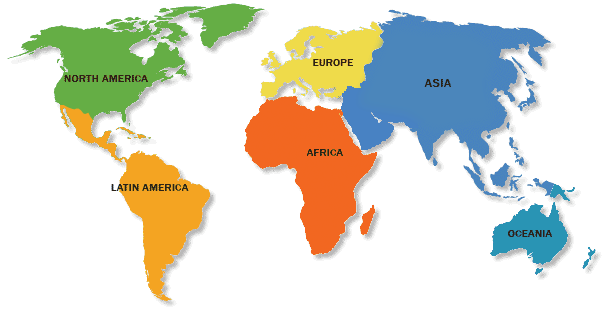
Below please find my follow Friday recommendations grouped by global region:


Canada: @carrni @datamartist @sheezaredhead @andrewsinfotech @aniagl @DQamateur @bivcons @projmgr @DQStudent @datachickUnited States: @GarnieBolling @stevesarsfield @UtopiaInc @bbreidenbach @fionamacd @RobertsPaige @BIMarcom @IDResolution @FirstSanFranMDM @dan_power @merv @NISSSAMSI @jilldyche @howarddresner @GartnerTedF @RobPaller @marc_hurst @dcervo @datamentors @VishAgashe @IBMInitiate @RamonChen @JackieMRoberts @philsimon @Nick_Giuliano @DataInfoCom @juliebhunt  @Futureratti  @dqchronicle  @jonrcrowell @elc  @Experian_QAS @paulboal @im4infomgt @WinstonChen @ocdqblog @KeithMesser @murnane @BrendaSomich @alanmstein @JGoldfed @jaimefitzgerald @tedlouie @bslarkin

Venezuela: @pigbar

Ireland: @daraghobrien @KenOConnorData @MapMyBusiness: United KIngdom: @SteveTuck @VeeMediaFactory @mktginsightguy @Daryl70 @Teresacottam @AnishRaivadera @ExperianQAS_UK @DataQualityPro @SarahBurnett @faropress @jschwa1 @mikeferguson1 @jtonline @Master_OBASHI @Nicola_Askham; France: @DataChannel @mydatanews @jmichel_franco @ydemontcheuil;Switzerland: @alexej_freund @openmethodology; Austria: @omathurin; Germany: @stiebke @dwhp @dakoller @marketingBOERSE; Belgium: @guypardon; Netherlands: @harri00413 @GrahamRhind; Denmark: @jeric40 @eobjects @StiboSystems;Norway @Orvei; Sweeden: @MrPerOlsson @DarioBezzina; Finland: @JoukoSalonen; Lithuania: @googlea; Italy: @Stray__Cat

Algeria: @aboussaidi; South Africa: @MarkGStacey

Pakistan: @monisiqbal; India: @MDMAnswers @twitrvenky @ashwinmaslekar; Indonesia: @VaiaTweets

Australia: @emx5 @vmcburney;New Zeeland: @JohnIMM @Intelligentform

It’s my hope, that I in the future will be able to interact even more diverse.

Bookmark and Share

Out of Facebook

Some while ago it was announced that Facebook signed up member number 500,000,000.

If you are working with customer data management you will know that this doesn’t mean that 500,000,000 distinct individuals are using Facebook. Like any customer table the Facebook member table will suffer from a number of different data quality issues like:

  • Some individuals are signed up more than once using different profiles.
  • Some profiles are not an individual person, but a company or other form of establishment.
  • Some individuals who created a profile are not among us anymore.

Nevertheless the Facebook member table is a formidable collection of external reference data representing the real world objects that many companies are trying to master when doing business-2- consumer activities.

For those companies who are doing business-2-business activities a similar representation of real world objects will be the +70,000,000 profiles on LinkedIn plus profiles in other social business networks around the world which may act as external reference data for the business contacts in the master data hubs, CRM systems and so on.

Customer Master Data sources will expand to embrace:

  • Traditional data entry from field work like a sales representative entering prospect and customer master data as part of Sales Force Automation.
  • Data feed and data integration with traditional external reference data like using a business directory. Such integration will increasingly take place in the cloud and the trend of governments releasing public sector data will add tremendously to this activity.
  • Self registration by prospects and customers via webforms.
  • Social media master data captured during social CRM and probably harvested in more and more structured ways as a new wave of exploiting external reference data.

Doing “Social Master Data Management” will become an integrated part of customer master data management offering both opportunities for approaching a “single version of the truth” and some challenges in doing so.

Of course privacy is a big issue. Norms vary between countries, so do the legal rules. Norms vary between individuals and by the individuals as a private person and a business contact. Norms vary between industries and from company to company.

But the fact that 500,000,000 profiles has been created on Facebook in a very few years by people from all over world shows that people are willing to share and that much information can be collected in the cloud. However no one wants to be spammed by sharing and indeed there have been some controversies around how data in Facebook is handled. 

Anyway I have no doubt that we will see less data entering clerks entering the same information in each company’s separate customer tables and that we increasingly will share our own master data attributes in the cloud.

Bookmark and Share

Out-of-Africa

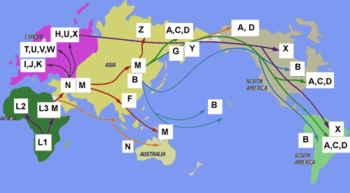
Besides being a memoir by Karen Blixen (or the literary double Isak Dinesen) Out-of-Africa is a hypothesis about the origin of the modern human (Homo Sapiens). Of course there is a competing scientific hypothesis called Multiregional Origin of Modern Humans. Besides that there is of course religious beliefs.

The Out-of-Africa hypothesis suggests that modern humans emerged in Africa 150,000 years ago or so. A small group migrated to Eurasia about 60,000 years ago. Some made it across the Bering Strait to America maybe 40,000 years ago or maybe 15,000 years ago. The Vikings said hello to the Native Americans 1,000 years ago, but cross Atlantic movement first gained pace from 500 years ago, when Columbus discovered America again again.

½ year ago (or so) I wrote a blog post called Create Table Homo_Sapiens. The comment follow up added to the nerdish angle with discussing subjects as mutating tables versus intelligent design and MAX(GEEK) counting.

But on the serious side comments also touched the intended subject about making data models reflect real world individuals.

Tables with persons are the most common entity type in databases around. As in the Out-of-Africa hypothesis it could have been as a simple global common same structural origin. But that is not the way of the world. Some of the basic differences practiced in modeling the person entity are:

  • Cultural diversity: Names, addresses, national ID’s and other basic attributes are formatted differently country by country and in some degree within countries. Most data models with a person entity are build on the format(s) of the country where it is designed.
  • Intended purpose of use: Person master data are often stored in tables made for specific purposes like a customer table, a subscriber table a contact table and so on. Therefore the data identifying the individual is directly linked with attributes describing a specific role of that individual.
  • “Impersonal” use: Person data is often stored in the same table as other party master types as business entities, projects, households et cetera.

Many, many data quality struggles around the world is caused by how we have modeled real world – old world and new world – individuals.

Bookmark and Share

Follow Friday Data Quality

Every Friday on Twitter people are recommending other tweeps to follow using the #FollowFriday (or simply #FF) hash tag.

My username on twitter is @hlsdk.

Sometimes I notice tweeps I follow are recommending the username @hldsk or @hsldk or other usernames with my five letters swapped.

It could be they meant me? – but misspelled the username. Or they meant someone else with a username close to mine?

As the other usernames wasn’t taken I have taken the liberty to create some duplicate (shame on me) profiles and have a bit of (nerdish) fun with it:

@hsldk

For this profile I have chosen the image being the Swedish Chef from the Muppet show. To make the Swedish connection real the location on the profile is set as “Oresund Region”, which is the binational metropolitan area around the Danish capital Copenhagen and the 3rd largest Swedish city Malmoe as explained in the post The Perfect Wrong Answer.

@hldsk

For this profile I have chosen the image being a gorilla originally used in the post Gorilla Data Quality.

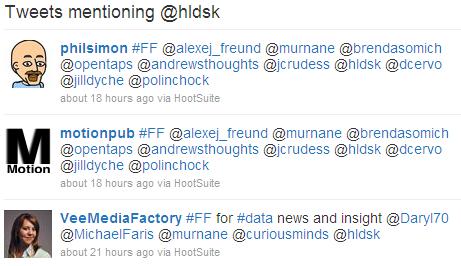
This Friday @hldsk was recommended thrice.

But I think only by two real life individuals: Joanne Wright from Vee Media and Phil Simon who also tweets as his new (one-man-band I guess) publishing company.

What’s the point?

Well, one of my main activities in business is hunting duplicates in party master databases.

What I sometimes find is that duplicates (several rows representing the same real world entity) have been entered for a good reason in order to fulfill the immediate purpose of use.

The thing with Phil and his one-man-band company is explained further in the post So, What About SOHO Homes.

By the way, Phil is going to publish a book called The New Small. It’s about: How a New Breed of Small Businesses is Harnessing the Power of Emerging Technologies.

Bookmark and Share

360° Share of Wallet View

I have found this definition of Share of Wallet on Wikipedia:

Share of Wallet is the percentage (“share”) of a customer’s expenses (“of wallet”) for a product that goes to the firm selling the product. Different firms fight over the share they have of a customer’s wallet, all trying to get as much as possible. Typically, these different firms don’t sell the same but rather ancillary or complementary product.

Measuring your share of given wallets – and your performance in increasing it – is a multi-domain master data management exercise as you have to master both a 360° view of customers and a 360° view of products.

With customer master data you are forced to handle uniqueness (consolidate duplicates) of customers and handle hierarchies of customers, which is further explained in the post 360° Business Partner View.

With product master data you are not only forced to categorize your own products and handle hierarchies  within, but you also need to adapt to external categorizations in order to getting access to external data available for spending probably on a high level for a segment of customers but sometimes even possible down to the single customer.

Location master data may be important here for geographical segmentations and identification.

My educated guess is that companies will increasing rely on having better data quality and master data management processes and infrastructure in order to measure precise shares of wallets and thereby gain advantages in a stiff competition rather than relying on gut feelings and best guesses.

Bookmark and Share

Linked Data Quality

The concept of linked data within the semantic web is in my eyes a huge opportunity for getting data and information quality improvement done.

The premises for that is described on the page Data Quality 3.0.

Until now data quality has been largely defined as: Fit for purpose of use.

The problem however is that most data – not at least master data – have multiple uses.

My thesis is that there is a breakeven point when including more and more purposes where it will be less cumbersome to reflect the real world object rather than trying to align fitness for all known purposes.

If we look at the different types of master data and what possibilities that may arise from linked data, this is what initially comes to my mind:

Location master data

Location data has been some of the data types that have been used the most already on the web. Linking a hotel, a company, a house for sale and so on to a map is an immediate visual feature appealing to most people. Many databases around however have poor location data as for example inadequate postal addresses. The demand for making these data “mappable” will increase to near unavoidable, but fortunately the services for doing so with linked data will help.

Hopefully increased open government data will help solve the data supply issue here.

Party master data

Linking party master data to external data sources is not new at all, but unfortunately not as widespread as it could be. The main obstacle until now has been smooth integration into business processes.

Having linked data describing real world entities on the web will make this game a whole lot easier.

Actually I’m working on implementations in this field right now.

Product master data

Traditionally the external data sources available for describing product master data has been few – and hard to find. But surely, at lot of data is already out there waiting to be found, categorized, matched and linked.

Bookmark and Share

Same Same But Different

The two most common master data types are:

  • Party master data (customers, prospects, suppliers and other business partners)
  • Product master data

When working with data quality within master data management you may of course encounter some similarities between these two master data types, but you will certainly also meet a range differences.  

The basic activities as standardization, consolidation and hierarchy building are the same.

Some of the differences I have learned are:

Multi-cultural issues:

  • Party master data is often stored in a single global format but should be transformed to embrace multi-cultural diversities.
  • Product master data may have multi-cultural issues but should be transformed into a single global format (of course embracing multi-language hierarchies and so).

External reference data available:

  • For party master data the possibilities for real world alignment with external data sources are plenty.
  • For product master data the possibilities for real world alignment with external data sources are few.

Industry specific requirements:

  • Requirements for party master data quality are pretty much the same across industries with few variations as B2B (corporate customers) or B2C (private customers) or both being the most prominent.
  • Requirements for product master data quality vary tremendously across different industries.

Your say:

What are your examples of (similarities and) differences between party master data quality and product master data quality?

Bookmark and Share