What’s so Special About MDM?

In a blog post from yesterday one of my favorite bloggers Loraine Lawson writes:

“Take master data management, for instance. Oh sure, experts preach that it’s a discipline, not “just” a technology, but come on. Did anybody ever hear about MDM before MDM solutions were created?”

The post is called: Let’s Talk: Do You Really Need an Executive Sponsor for MDM?

And yes we do need an executive sponsor. Also we need a business case as we must avoid doing it big bang style and we need to establish metrics for measuring success and so on.

All wise things as it is wise sayings about data quality improvement initiatives, business intelligence (BI) implementations, customer relationship management (CRM) system roll-out and almost any other kind of technology enabled project.

shiny thingsI touched this subject some years ago in the post Universal Pearls of Wisdom.

So let’s talk:

  • Is an executive sponsor more important for Master Data Management (MDM) than for Business Intelligence (BI)?
  • Is a business case more important for Master Data Management (MDM) than for Supplier Chain Management (SCM)?
  • Is big bang style more dangerous for Master Data Management (MDM) than for Service Oriented Architecture (SOA)?

And oh, don’t just tell me that I can’t compare apples and pears.

Bookmark and Share

Multi-Domain MDM Market Update

Multi-Domain MDMIn the recent post called The MDM Landscape is Slowly Changing I wrote about some findings in the latest MDM market research document by the Information Difference.

Recently Bloor published their view on the MDM Market including who is in or close to the bull’s eye. You may read the document called Master Data Management Market update by following the press release on the paper from Informatica here.

The two views are in agreement on a lot of things including how Multi-Domain MDM is becoming the norm.  The alignment of views is no surprise as I guess that there is only one Andy Hayler around in the MDM sphere and he is the man behind both documents.

And hey, if you agree with Andy about Multi-Domain MDM, why not join the LinkedIn Multi-Domain MDM group.

Bookmark and Share

Things we do with fresh master data in old packing

In a recent blog post called Understanding the sources of master data Prashanta Chandramohan writes:

“Often times, master data sources are legacy in nature, built and maintained over a long period of time, lack documentation and include procedures and terminologies which are no longer relevant in the current context.”

This saying resonates very well with my experiences.

puzzleImplementing Master Data Management (MDM) solutions doesn’t take place in a green field. Most of the hard work is not about how to build a perfect master data environment but is about how to work around what during the years has been done badly with master data for many good reasons.

Some of the maybe low practical but yet persistent challenges I have worked with are:

  • Quite a few old systems hold data as names, addresses, product descriptions and so on only in upper case. You may want to convert that to a more beautiful mix of upper and lower case (according to the culture in question) on an ongoing basis. When handling master data entities describing things outside the English alphabet, we may even want to optimize the use of national characters in strings that before only allowed characters from the English alphabet.
  • Fields are used for other things than the original purpose because there is no other way. While ongoing conversions including parsing may not be the best way around it often is the only way to go.
  • Due to limited search capabilities in old systems you may write personal names starting with the surname (in cultures where that’s not common), twist company name elements around and so on. This may not look nice when mashing up with other sources and limit the use for other purposes, so also here conversions may the only way to go.

Please find some more on the fun in doing those things in the post The Cases for UPPER CASE in Data Management.

Bookmark and Share

Know Your (Foreign Luxury Bag) Customer

Gucci BagA story featured a lot in the media the last days is the incident where one of richest women on the planet, Oprah Winfrey, was told that she couldn’t afford the handbag she wanted to look at in a Zürich shop. Was it racism or a misunderstanding because Oprah isn’t good at speaking German?

Either way it was for sure an example of bad things happening when you don’t know your customer. This story also highlights the issues we have with foreign customers as Oprah may not be just as famous in Zürich as in New York.

We have these challenges in customer master data management all over as described in the post Know Your Foreign Customer.

And oh: Maybe it’s time to start a sister blog called Liliendahl on Fashion. This is my second post on luxury handbags. The first post was called Data Quality Luxury.

Bookmark and Share

On MDM, Data Models and Big Data

As described in the post Small Data with Big Impact my guess is that we will see Master Data Management solutions as a core element in having data architectures that are able to make sustainable results from dealing with big data.

If we look at party master data a serious problem with many ERP and CRM systems around is that the data model for party master data aren’t good enough for dealing with the many different forms and differences in which the parties we hold data about are represented in big data sources which makes the linking between traditional systems of record and big data very hard.

Having a Master Data Management (MDM) solution with a comprehensive data model for party master data is essential here.

Some of the capabilities we need are:

Storing multiple occurrences of attributes

People and companies have many phone numbers, they have many eMail addresses and they have many social identities and you will for sure meet these different occurrences in big data sources. Relating these different occurrences to the same real world entity is essential as reported in the post 180 Degree Prospective Customer View isn’t Unusual.

An MDM hub with a corresponding data model is the place to manage that challenge in one place.

Exploiting rich external reference data

As told in the post Where the Streets have Two Names and emphasized in the comments to the post the real world has plenty of examples of the same thing having many names. And this real world will be reflected in big data sources.

Your MDM solution should embrace external reference data solving these issues.

Handling the time dimension

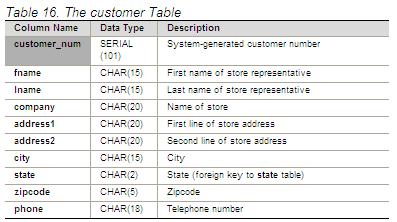
In the post A Place in Time the flaws of the usual customer table in ERP and CRM systems is examined. One common issue is handling when attributes changes. Change of address happens a lot. And this may be complicated by that we may operate several address types at the same time like visiting addresses, billing addresses and correspondence addresses. These different addresses will also pop up in big data sources. And the same goes for other attributes.

You must get that right in your MDM implementation.

Customer Table
The usual but very wrong customer table that wont work with big data.

Bookmark and Share

180 Degree Prospective Customer View isn’t Unusual

My eMail inbox is collecting received mails from several eMail accounts and therefore it’s not unusual to have duplicate messages in there.

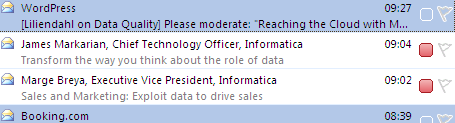
This morning I had two eMails coming in to two different eMail accounts probably part of the same campaign but with different messages:

180 degree

Apparently I have landed in two different segments with two different eMail accounts: One technology oriented and one sales and marketing oriented.

Record linking of sparse subscription profiles isn’t easy and even Informatica, a big player in Master Data Management and Data Quality solutions, have land to be covered in this game.

Bookmark and Share

Reaching the Cloud with MDM

As reported in the post The MDM Landscape is Slowly Changing a saying from the Information Difference MDM Landscape 2013 is:

  • “The market is starting to dabble in cloud-based implementations…”

I have spent some part of the last months with a cloud-based Master Data Management implementation in this case using the iDQ™ MDM Edition.

Well, actually it isn’t a full cloud implementation. There is a frontend taking care of user interaction in the cloud and there is a backend taking care of integration on-premise.

I guess many other MDM implementations embracing cloud technology will look like this solution being a hybrid, where some services are based in the cloud and some services are based on-premise.

What about your MDM implementation(s). Is it cloud-based, based on-premise or hybrid?

Hohenzollern Castle in Southern Germany

Bookmark and Share

On Washing Rental Cars and Shared Data

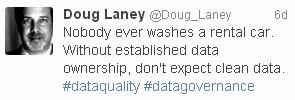
Recently a tweet from Doug Laney of Gartner has been retweeted a lot:

Rented Car

As most analogies it may fit or maybe not fit seen in different perspectives. Actually rental cars are probably some of the most washed cars as the rental company wash and clean the car between every rental.

In the same way as rental cars usually are quite clean I have also found that sharing data is a powerful way to have clean data as told on the page about Data Quality 3.0. This is also the grounding concept behind the instant Data Quality solution I’m working with, where we have just released our iDQ™ MDM Edition.

Bookmark and Share

Counting Citizens

A main story on BBC this morning is about how collection of UK migration figures is not fit for purpose as reported on the BBC website here.

UK boarderThe problem is that measuring who is going in and out of the country is designed on different purposes like measuring tourism and fighting terrorism.

Some different solutions have been mentioned:

  • The “oh no” solution: More data collection
  • The shiny new solution: Big Data
  • The unwanted solution: Master Data Management

The “oh no” solution: More data collection

Imagining you have to fill in endless forms with rigid checks when going in and out of the airports and ferry ports adding to the checks and security controls already in place. Oh no.

The shiny new solution: Big Data

A system of collecting data from passenger lists on ferries and airplanes called e-Borders is already being implemented and there are hopes that joining these new big data with the old system of record will improve accuracy. Oh, really.

The unwanted solution: Master Data Management

As said in an expert interview on TV the only sustainable solution is a central citizen registry – a solution not unknown for immigrants as me coming from Scandinavia. However, as reported here this solution is unwanted in the UK.

Bookmark and Share

The MDM Landscape is Slowly Changing

This year’s version of the MDM (Master Data Management) Landscape report from Information Difference is out.

The report confirms some trends in MDM offerings also mentioned here on the blog. Some sayings from the Information Difference report are:

  • “The market is starting to dabble in cloud-based implementations…”
  • “There continues to be a demand for MDM offerings to handle reference data….”
  • “ …still very much in their early stages, are support for Big Data…”

Categorizing the vendors into the traditional division of Customer Data Integration (CDI) versus Product Information Management (PIM) support is becoming less relevant as new Multi-Domain offerings are coming out and larger Product Master Data specialists as Hybris and Heiler has been snapped by megavendors. This leaves Stibo as the only remaining large PIM vendor, but Stibo has actually already rebranded themselves as a Multi-Domain player and have been working seriously on that for a couple of years.

MDM 2013You may view the full Information Difference MDM Landscape report here.

Bookmark and Share