Neutron Star Collision and Data Quality

The scientific news of the day is the observed collision of two neutron stars resulting in gravitational waves, an extremely bright flash – and gold.

The connection between gravitational waves and Master Data Management (MDM) was celebrated here on the blog when those waves were detected for the first time as told in the post Gravitational Waves in the MDM World.

The ties to Product Information Management (PIM) was examined in the post Gravitational Collapse in the PIM Space.

Now we have seen a bright flash resembling what happens when two trading partners collide, as in makes business together encompassing sharing master data and product information. Seen from my telescope this improves data quality and thereby business outcome (gold, you know) as explained in the post Data Quality and Business Outcome.

Neutron Star Collide

Using Pull or Push to Get to the Next Level in Product Information Management

The importance of having a viable Product Information Management (PIM) solution has become well understood for companies who participates in supply chains.

The next step towards excellence in PIM is to handle product information in close collaboration with your trading partners. Product Data Lake is the solution for that. Here upstream providers of product information (manufacturers and upstream distributors) and downstream receivers of product information (downstream distributors and retailers) connect their choice of in-house PIM solution or other product master data solution as PLM (Product Lifecycle Management) or ERP.

Read more about that in the post What a PIM-2-PIM Solution Looks Like.

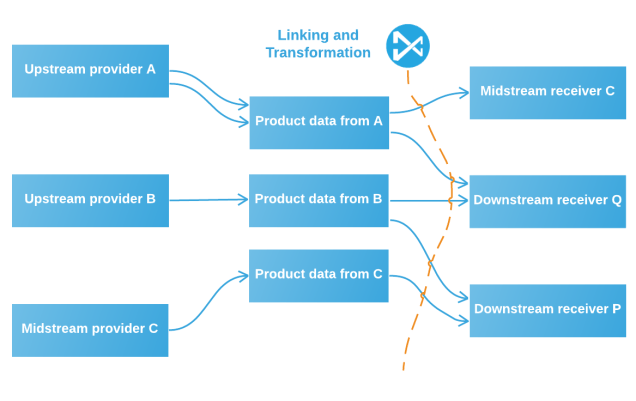
The principle behind Product Data Lake is inspired by how a data lake differs from a traditional data warehouse. In a data lake the linking and transformation takes place late, when the data is consumed by the receiver.

pdl-diagram-new

Product Data Lake resembles a social network as you connect with your trading partners from the real world in order to collaborate on getting complete and accurate product data from the manufacturer to the point-of-sales:

  • Pull-PushAs a downstream receiver, you can be on the winning side by utilizing our Product Data Pull service
  • As an upstream provider, you can be on the winning side by utilizing our Product Data Push service

MDM, Reltio, Gartner and Business Outcome

A recent well commented blog post by Andrew White of Gartner, the analyst firm, debates What’s Happening in Master Data Management (MDM) Land?

The post is an answer to a much liked and commented LinkedIn status post by Ramon Chen, Chief Product Officer of Reltio.

In his post Andrew connects the classic dots: How does technology lead to business outcome? Especially the use of cloud solutions and the multi-tenant aspect is in the focus. Andrew asks: What do you see “out there”?

My view is that multi-tenant is not just about offering the same subscription based cloud solutions to a range of clients. It is about making clients sharing the same business ecosystem work in the same MDM realm. This is the platform described in Master Data Share.

Gartner Digital Platforms 2
Source: Gartner

Oh, and what does that have to do with business outcome? A lot. Organizations will not win the future the race by optimizing there inhouse MDM capabilities alone. With the rise of digitalization, they need to connect with and understand their customers, which I believe is something Reltio is good at. Furthermore, organisations need to be much better at working with their business partners in a modern way, including at the master data level. The business outcome of this is:

  • Having complete, accurate and timely data assets needed for understanding and connecting with customers. You will sell more.
  • Having a fast and seamless flow of data assets, not at least product information, to and from your trading partners. You will reduce costs.
  • Having a holistic view of internal and external data needed for decision making. You will mitigate risks.

Solving GDPR Issues Using a Data Lake Approach

Some of the hot topics on the agenda today is the EU General Data Protection Regulation (GDPR) and the data lake concept. These are also hot topics for me, as GDPR is high on the agenda in doing MDM (and currently TDM – Test Data Management) consultancy and the data lake approach is the basic concept in my Product Data Lake venture.

EU GDPRIn my eyes the data lake concept can be used for a lot of business challenges. One of the them was highlighted in a CIO article called Informatica brings AI to GDPR compliance, data governance. In here Informatica CEO Anil Chakravarthy tells how a new tool, Informatica’s Compliance Data Lake, can help organisations getting a grasp on where data elements relevant to be compliant with GDPR resides in the IT landscape. This is a task very close to me in a current engagement.

The Informatica compliance tool is built on the Informatica’s Intelligent Data Lake, which was touched in the post Multi-Domain MDM 360 and an Intelligent Data Lake.

MDM Will Go Cloud

How cloud is changing MDM (Master Data Management) is a subject examined in a very read worthy article by Julie Hunt published recently. The article is called How Does Technology Enable Effective MDM?

In here Julie says: “Adoption of cloud-based MDM or MDM-as-a-Service is on the rise, opening up new dimensions for how organizations take advantage of MDM and data governance.”

Julie’s article is part 3 of a six part series on the “New Age of Master Data Management”, so I may touch on a dimension that is covered in the upcoming articles. This dimension is how business ecosystems must be a part of your organizations MDM roadmap, and that dimension is, according to Gartner, the analyst firm, covering 8 underlying dimensions as told in the post From Business Ecosystem Strategy to PIM Technology.

Working with MDM in a business ecosystem context does require MDM in the cloud of some sort. Inhouse Mater Data Management and Product Information Management (PIM), which may be on premise or in the cloud or perhaps a hybrid, is only the beginning. Collaboration with business partners in a sophisticated environment will be controlled by a cloud solution.

More on this concept is explained in this piece about Master Data Share.

greatbeltbridge.jpg

The Relation of PIM to Retail Success

This is the second guest blog post from Rajneesh Kumar. In here Rajneesh examines how PIM and MDM have become a crucial aspect of retail success.

Today, every product has a variety of information. And each piece of product information is vital to influencing buyers since every buyer does in-depth research before zeroing on any product. When you deal with tens of thousands of products and their different data types and attributes, a streamlined product data becomes even more critical to ensure a higher sale.

Just think about any online store, and you will get the idea what magic product information produces in the presentation layer of marketing and sales channels.

A product information contains many components and maintains huge catalogs, bringing together the attributes of products with merchandising elements such as images, videos, audios, descriptions, and bundles. These key product facts induce greater product salability across multiple platforms to your customers— while maintaining brand visibility and consistency. When these elements are represented elegantly at the customer-facing end, it can even impact the overall customer buying experience.

Retail

Another factor is time-to-market. Retail sector has become a fast-paced industry where every day 4Ps of products could be changed and refreshed. You need a process that works like a well-oiled machine to keep your customers updated and engaged— across the board. And, you can better engage with buyers when you have a:

  • Fully centralized system— Define, create, and sync master data of product information across multiple channels
  • Rock solid operational capability— Use master data in day-to-day operations without any delay
  • Analytical capability— Reports and insights to make faster, accurate decisions

Beside that, PIM addresses the dynamic nature of constructing and reconstructing compelling packages and offers in an environment that any user can work in, regardless of their programming skills. PIM platform makes product visualization—easier; workflow management— quicker; mass product updates— faster; and integration with content tools (WCM, DAM, eCommerce, etc.)—seamless.

A flexible PIM/MDM platform enables you to harmonize product information lifecycle, including appending, modifying/updating, deleting, validating and securing access to the product information. With a single source of reliable product information, it makes easy to enrich product information across all touchpoints such as website, mobile app, social, in-store point-of-sale, and physical store. Simply, PIM and MDM have become a crucial aspect of retail success.

As digital marketer and growth hacker, Rajneesh Kumar is currently marketing manager at Pimcore Global Services (PGS), an award-winning consolidated open source platform for product information management (PIM), web content management (CMS), digital asset management (DAM) and e-commerce.

Three kinds of a MDM Data Model that comes with a tool

Master Data Management (MDM) is a lot about data modelling. When you buy a MDM tool it will have some implications for your data model. Here are three kinds of data models that may come with a tool:

An off-the-shelf model

This kind is particularly popular with customer and other party master data models. Core party data are pretty much the same to every company. We have national identification numbers, names, addresses, phone numbers and that kind of stuff where you do not have to reinvent the wheel.

Also, you will have access to rich reference data with a model such as address directories (which you may regard as belonging to a separate location domain), business directories (as for example the Dun & Bradstreet Worldbase) and in some countries citizen directories as well. MDM tools may come with a model shaped for these sources.

Tools which are optimized for data matching, including deduplication of party master data, will often shoehorn your party master data into a data model feasible for that.

A buildable model

When it comes to multi-domain MDM we will deal with entities that are not common to everyone.

Here a capability to build your model in the MDM tool is needed. One such tool I have worked with is Semarchy. Here semi-technical people are able to build and deploy incrementally more complex data models, that are default equipped with needed functionality around handling a golden copy and auditing data onboarding and changing.

A dynamic model

Product Information Management (PIM) requires that your end users can build the model on the fly, as product data are so different between product groups.

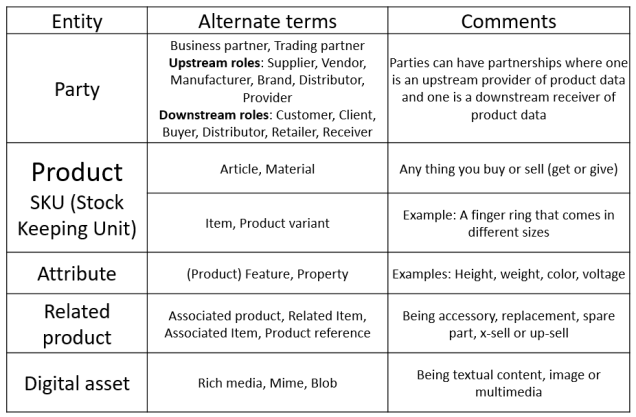
In my current venture called Product Data Lake the model has these main entities:

PDL Data Model

This model resembles the data model in most PIM solutions (and PIM based MDM solutions), except that we have the party and their two-way partnerships at the top, as Product Data Lake takes care of exchanging data between inhouse PIM solutions at trading partners participating in business ecosystems.

Betting on the Next Gartner MDM Magic Quadrant

The Gartner Magic Quadrant for Master Data Management Solutions 2016 came out early in 2017 as reported in the post Who will become Future Leaders in the Gartner Multidomain MDM Magic Quadrant?

So, it may be about time to take some bets on the next one.

First question will naturally be if Gartner is able to get the report out this year? Last year it was scheduled for November 2016 but was two months late into the next year, maybe due to some struggling with the vendors, who also are clients at Gartner, based on the form of a single MDM quadrant opposite to earlier years multiple MDM quadrants for customer and product MDM.

The scheduled date on the Gartner website is 10/31/17, which to none US people reads at the 10th day in the 31st month in year 17.

MDM BrandsNext question is if there are new entries or vendors dropping off? Another market report from Information Difference had a somewhat different crowd as examined in the post Varying Views on the MDM Market 2017.

In the comments to this post readers have posted questions about Magnitude Software, TIBCO Software and Riversand Technologies. Are they in danger? And who might be new entries?

Finally, of course we can have a guess on who will be able to brag about being the leaders. Will Informatica and Orchestra Networks be followed by other ones? Riversand was close last year in that visionaries space. Stibo Systems moves in from the challengers room.

Feel free to have your bet, or set the odds, in the comments below.

Master Data: The Frontier of Infonomics

Still, the term infonomics does not run unmarked through my English spellchecker. But I think one day it will.

Infonomics BookInfonomics is first and foremost connected to Gartner analyst Doug Laney, who recently told a bit about his upcoming book on the subject in the post Why a Book on Infonomics?

In his preview Doug Laney writes: “Perhaps the book brings about a revolution of sorts, leading to the recognition of information as an accounting asset, and subject to the same legal treatment as other forms of property.

This resonates very well with me, as I think Master Data Management (MDM) is the new bookkeeping. One example of why it should be so, is examined in a nearly 10-year-old post about a financial scandal in Denmark, that would have been avoided if the auditors had spent 10 minutes on the company’s master data. Read more in Master Data Audit.

Master data is only one form of information. However, in my eyes it is the one with the best chance of making sense as an accounting asset.

As business ecosystems and related digital ecosystems are becoming increasingly important in information management I also think that exchange of master data will be worth accounting for as pondered in the post Infonomics and Second Party Data.

Product Data Management is Like an Ironman

cofToday we have an Ironman passing through the streets of Copenhagen (and my breakfast). Kudos to the women and men who first have been on a swim lane of 3.86 km (2.4 miles), now is cycling 180.25 km (112 miles) and then will run a full Marathon of 42.2 km (26.22 miles).

Thinking about it doing product data management is a bit like an Ironman too. Overall it is a daunting task. And we have three disciplines to cover:

  • Digital Asset Management (DAM) is an activity where many organizations start. It is about handling product images in various sizes and versions along the way, as well as, depending on the product category, installation guides, line drawings, data sheets and other documents. Also videos with that and other content is becoming popular.
  • Product Information Management (PIM) is about maintaining hundreds (sometimes thousands) of different attributes describing a product. Some of these attributes are common for most products (like height, weight and colour) and some are very specific for a given product category.
  • Master Data Management (MDM) is a Marathon in itself. Here you link the above product data with product data in the overall system landscape including ERP, SCM (Supply Chain Management) and PLM (Product Lifecycle Management). Product data also forms the product domain that must be aligned with the location domain, asset domain, party domain and perhaps other domains in your MDM world.

How these disciplines stick together within your organization and your digital ecosystem was further examined in the post How MDM, PIM and DAM Stick Together.