Knowing what quality product data looks like

Recently Daniel O’Connor blogged about Three Keys to a Successful Product Data Project BEFORE You Start the Project. Number one key suggested by Daniel is to know what quality product data looks like. I agree.

Besides Daniel’s very valid points on this matter, I would like to bring data quality dimensions into the game. Looking at data quality from a completeness, timeliness, conformity, consistency and accuracy point of view will help crafting tangible measures and identifying the root causes of where current culture, processes and technology lack the capabilities of meeting the desired state of product data quality.

QualityHere is my take on how to use data quality dimensions for product data:

Completeness of product data is essential for self-service sales approaches. A recent study revealed that 81 % of e-shoppers would leave a webshop with incomplete product information. The root cause of lacking product data is often a not working cross company data supply chain as reported in the post The Cure against Dysfunctional Product Data Sharing.

Timeliness, or currency if you like, of product data is again an issue often related to challenges in cross company supply chains. You can learn more about this subject in the post How to avoid Stale Product Data.

Conformity of product data is first and foremost achieved by adhering to a public standard for product data. However, there are different international, national and industry standards to choose from. These standards also comes in versions that changes over time. Also your variety of product groups may be best served by different standards.

Consistency of product data has to be solved in two scopes. First consistency has to be solved internally within your organisation by consolidating diverse silos of product master data. This is often done using a Product Information Management (PIM) solution. Secondly you have to share your consistent product data with your flock of trading partners as explained in the post What a PIM-2-PIM Solution Looks Like.

Accuracy is usually best at the root, meaning where the product is manufactured. Then accuracy may be challenged when passed along in the cross company supply chain as examined in the post Chinese Whispers and Data Quality. Again, the remedy is about creating transparency in business ecosystems by using a modern data management approach as proposed in the post Data Lakes in Business Ecosystems.

Black Friday Afterthoughts before Christmas

Black Friday & Christmas: 5 Retail Strategies for Providing a Wonderful Shopping Experience” is the title of a recent blog post by Antonia Renner on the Informatica blog.

This blog post revolves around how Master Data Management (MDM) and Product Information Management (PIM) can be the foundation of a better shopping experience and how to do this within driving digital transformation, being agile, and streamlining internal and external collaboration and workflows.

I agree with that. My only concern around the means mentioned relates to the section about how great customer experience starts with great supplier product data. The proposed approach for that is a self-service supplier data portal.

pdl-whyFrom what I have experienced, the concept of a supplier data portal for product data has limited chances of success. The problem for you as retailer or other form of downstream trading partner is your supplier. They will eventually have to deal with hundreds of supplier portals with different format and structure by the choice of their downstream trading partners, whereof you are just one. If you are a big one to them, it might work. Else probably not.

In the same way, your supplier could offer their customer data portal, build with their choice of format and structure. If they are a big one to you, you might go with that. Else, you probably would object to dealing with hundreds of different upstream data portals for you to go-to.

My Christmas present to you – suppliers, retailers, other supply chain nodes / PIM-MDM solution vendors – is a free trial / ambassadorship on Product Data Lake.

Product Data Lake is a cloud service for sharing product data in business ecosystems. Product Data Lake ensures:

  • Completeness of product information by enabling trading partners to exchange product data in a uniform way
  • Timeliness of product information by connecting trading partners in a process driven way
  • Conformity of product information by encompassing various international standards for product information
  • Consistency of product information by allowing upstream trading partners and downstream trading partners to interact with in-house structure of product information
  • Accuracy of product information by ensuring transparency of product information across the supply chain

It’s in your hands. See you on Product Data Lake.

Approaches to Sharing Product Information in Business Ecosystems

One of the most promising aspects of digitalization is sharing information in business ecosystems. In the Master Data Management (MDM) realm, we will in my eyes see a dramatic increase in sharing product information between trading partners as touched in the post Data Quality 3.0 as a stepping-stone on the path to Industry 4.0.

Standardization (or standardisation)

A challenge in doing that is how we link the different ways of handling product information within each organization in business ecosystems. While everyone agrees that a common standard is the best answer we must on the other hand accept, that using a common standard for every kind of product and every piece of information needed is quite utopic. We haven’t even a common uniquely spelled term in English.

Also, we must foresee that one organization will mature in a different pace than another organisation in the same business ecosystem.

Product Data Lake

These observations are the reasons behind the launch of Product Data Lake. In Product Data Lake we encompass the use of (in prioritized order):

  • The same standard in the same version
  • The same standard in different versions
  • Different standards
  • No standards

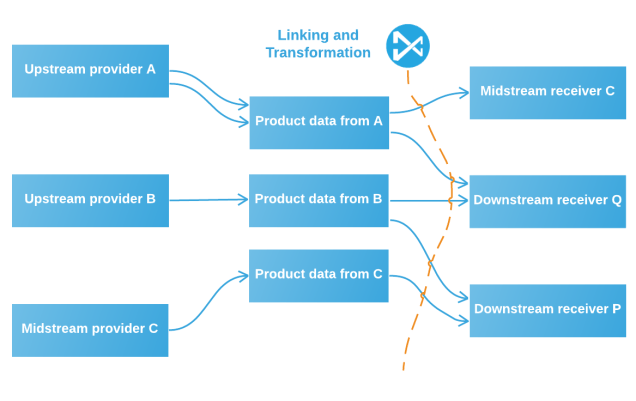
In order to link the product information and the formats and structures at two trading partners, we support the following approaches:

  • Automation based on product information tagged with a standard as explained in the post Connecting Product Information.
  • Ambassadorship, which is a role taken by a product information professional, who collaborates with the upstream and downstream trading partner in linking the product information. Read more about becoming a Product Data Lake ambassador here.
  • Upstream responsibility. Here the upstream trading partner makes the linking in Product Data Lake.
  • Downstream responsibility. Here the downstream trading partner makes the linking in Product Data Lake.

cross-company-data-governanceData Governance

Regardless of the mix of the above approaches, you will need a cross company data governance framework to control the standards used and the rules that applies to the exchange of product information with your trading partners. Product Data Lake have established a partnership with one of the most recommended authorities in data governance: Nicola Askham – the Data Governance Coach.

For a quick overview please have a look at the Cross Company Data Governance Framework.

Please request more information here.

Bookmark and Share

Ecommerce Su…ffers without Data Quality

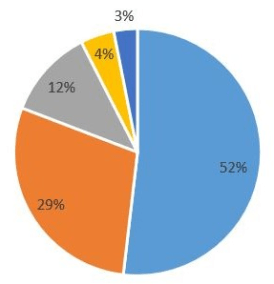
Inadequate data quality is the enemy of any business. Proof of that for ecommerce too was revealed in a recent survey from the Danish E-commerce Association (FDIH). Over 7,000 respondents were asked if they would turn away from a web-shop, if the product information is incomplete or the product image is bad.

FDIH survey

52 % answered that they totally agree. 29 % more agreed, making it 81 % in all who would leave. 12 % was not sure. 4 % disagreed and 3 % totally disagreed.

The importance of the maintenance and publishing of adequate product information in order to support self-service sales approaches has been pondered on this blog many times as for example in the post Self-service Ready Product Data.

Having product Images of good quality is a part of that and add to that you often see missing product images as reported in the post Image Coming Soon.

By the way: The root cause of incomplete product information and images is lack of agile and process driven sharing of this in business ecosystems. The remedy to that is the Product Data Lake and we will be at the Danish E-Commerce Association event in Copenhagen the 13th October 2016. More information about this event here.

Bookmark and Share

Sustainability Data in PIM

The collection of product data to be handled within PIM (Product Information Management) systems are ever increasing. End customers want more and more data to support purchase decisions.

This theme was pondered in the post Self-Service Ready Product Data.

One new kind of product data to beware of in the future is information about sustainability measures related to a given product. This is information about the environmental impact and the social impact from producing and consuming a product.

As the founder of the Product Data Lake, a solution for exchanging product data in business ecosystems, I am very pleased that sustainability information will be included as an important kind of product data ready to be exchanged between trading partners.

EA
Earth Accounting

This is due to a cooperation with Earth Accounting. The Product Data Lake will be an integrated part of the information cooperative, where the Product Data Lake will facilitate forward looking manufacturers in providing their own sustainability measures along with all other kind of product data and where progressive distributors and retailers can receive and eventually publish sustainability data along with all other self-service ready product data.

Bookmark and Share

Reducing the Reverse Supply Chain by Improving the Forward Data Supply Chain

An increasing issue arisen in the customer self-service age – first and foremost as seen in e-commerce – is the increasing reverse supply chain. A reverse supply chain is the flow of products being returned down the supply chain because the end customer did not want or like the product.

There are several reasons for returned products. Bad product quality is an old known reason. Bad data quality is a new important reason. Bad data quality is when the end customer did not have the right data to support the purchase. The main root cause for this is incomplete data as missing specification, missing images and other digital assets as well as missing information about related products.

Some different kinds of product data was examined in the post Self-Service Ready Product Data. Data that supports customer self-service sales approaches are mainly those data that should be provided through the forward supply chain, meaning that they are originated at the manufacturer and then passed and possibly value added by distributors and retailers.

Increasing reverse supply chains is a huge problem both from a business standpoint due to increased costs and from a society standpoint due to increased environmental impact. To decrease the reverse supply chain we need better means to put comprehensive product information through the forward supply chain in a timely matter.

The Product Data Lake is a solution to do so, as the Product Data Lake ensures:

  • Completeness of product information by enabling trading partners to exchange product data in a uniform way
  • Timeliness of product information by connecting trading partners in a process driven way

Further more, the Product Data Lake ensures:

  • Conformity of product information by encompassing various international standards for product information
  • Consistency of product information by allowing upstream trading partners and downstream trading partners to interact with in-house structure of product information
  • Accuracy of product information by ensuring transparency of product information across the supply chain

Please find more information about the Product Data Lake here.pdl-diagram-new


Bookmark and Share

Cultured Freshwater Pearls of Wisdom

One of my current engagements is within jewelry – or is it jewellery? The use of these two respectively US English and British English words is a constant data quality issue, when we try to standardize – or is it standardise? – to a common set of reference data and a business glossary within an international organization – or is it organisation?

Looking for international standards often does not solve the case. For example, a shop that sells this kind of bijouterie, may be classified with a SIC code being “Jewelry store” or a NACE code being “Retail sale of watches and jewellery in specialised stores”.

shiny thingsA pearl is a popular gemstone. Natural pearls, meaning they have occurred spontaneously in the wild, are very rare. Instead, most are farmed in fresh water and therefore by regulation used in many countries must be referred to as cultured freshwater pearls.
My pearls of wisdom respectively cultured freshwater pearls of wisdom for building a business glossary and finding the common accepted wording for reference data to be used within your company will be:

  • Start looking at international standards and pick what makes sense for your organization. If you can live with only that, you are lucky.
  • If not, grow the rest of the content for your business glossary and reference data by imitating the international or national standards for your industry, and use your own better wording and additions that makes the most sense across your company.

And oh, I know that pearls of wisdom are often used to imply the opposite of wisdom 🙂

Bookmark and Share

Related Products: The often Overlooked Facet of PIM

Related products

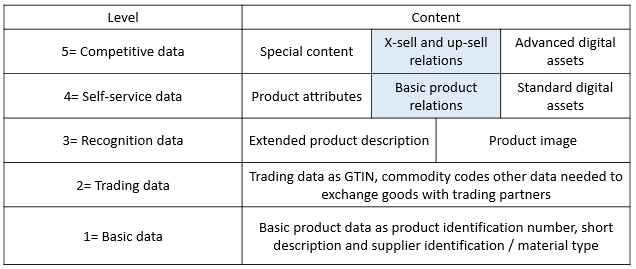
As examined in the post Self-service Ready Product Data, there are three main different kinds of information, which we deal with within Product Information Management (PIM). These are

  • Product attributes, also sometimes called product properties or product features. These are up to thousands of different data elements that describes a product. Some are very common for most products like height, length, weight and colour. Some are very specific to the product category. This challenge is actually the reason of being for dedicated PIM solutions.
  • Digital assets are documents like product images, installation guides, line drawings, data sheets and more advanced formats as videos. You may handle these digital assets in a dedicated Digital Asset Management (DAM) system or use facilities within a PIM solution or other kind of solutions for that.
  • Related products are the links between a product and other products like a product that have several different accessories that goes with the product or a product being a successor of another now decommissioned product. Spare parts for a given product is another kind of product relation. And then we have cross-sell and up-sell relations.

While PIM solutions usually have good capabilities for handling related products, it is my experience that many organizations does not utilize this very well.

One challenge is that related products can be sourced in various ways as told in the post Related Parties, Products and Locations. These ways are:

  • From the manufacturer of the product. This source is often good when it comes to product relationship types as accessory and replacement (succession) as well as spare part relations.
  • From the customer. We know this approach from the online sales trick prompting us with the message “People who bought A also bought B”.
  • From internal considerations. Facilitating up-sell can be done by enhancing product data with that kind of product relation.

Sourcing product relations from the manufacturer through the supply chain is a must for solutions that facilitates exchange of product data in business ecosystems. In the Product Data Lake we consequently handle the sharing of product attributes, digital assets and related products.

Bookmark and Share

Adding Business Ecosystems to Omnichannel

Omichannel has become a buzzword in marketing and beyond. The jury is still out on what omnichannel really is, but most will agree that it is a refinement and/or extension of earlier known buzzwords as multichannel and cross channel. You may learn more in this article.

In omnichannel you will try really, really hard to have a single customer view across all channels, and you will try really, really, really hard to present your product information in a uniform and consistent way across all channels.

One challenge here is that your business is not an island. You are part of a business ecosystem, or several of them, as examined in the post Data Management for Business Ecosystems.

“Your customer” may look at “your product” in the sphere of another member of your business ecosystem. It may be at one of your trading partners or at one of your competitors.

So, what can you do about this when it comes to data management?

In the hard case, your competitors, it is about knowing more about your customer. Knowing about your customers relationships. Knowing about your customers relations with products and their categories. Knowing about your customer’s locational belonging. All in all the case of multidomain MDM as seen in the post Multi-Domain MDM and Data Quality Dimensions.

Omni
Expand digitilization across business ecosystems from single purposes to cover an omnichannel view

Besides your own product information you must register what you know about that product information as it is stored and handled by other members in your business ecosystem – trading partners and competitors.

With product information, you must be able to exchange that with your trading partners. You cannot expect that everyone is handling the information about the same product in exact the same way as you. Actually you should not want that. You want to be better than your competitors in some ways and you want to add value for your trading partners. But you would for sure find value in joining a place of intersection where common known characteristics about products are exchanged between trading partners – such as the Product Data lake.

Bookmark and Share