Putting it Right

Data Governance (DG), Reference Data Management (RDM) and Management Data Management (MDM) are closely related disciplines.

MDM DG RDMConsequently the Data Governance Conference Europe 2013 and the Master Data Management Summit Europe 2013 are co-located and a hot topic this year is Reference Data Management.

The difficulties in putting the sessions on the conference in one right place may be seen by that the session called Establishing Reference Data Governance in the Large Enterprise is part of a MDM track, but is actually mostly about data governance. The session is labeled Product MDM & Reference Data, but will be about governing reference data for multi-domain MDM and the data governance program described was in fact based on a party master data challenge involving reference data for industry classification.

In the session Petter Larsen, Head of Data Governance at Norway’s largest financial services group called DNB, and Thomas T. Thykjaer, Lead MDM Consultant at Capgemini, will connect the dots in the landscape of business vocabularies, data models, the data governance toolbox, data domains and reference data architecture.

I for sure look forward to that Petter and Thomas will put it right.

Bookmark and Share

The Data Governance Jigsaw Puzzle

Picture this: You find yourself taking over a challenging Data Governance initiative part way through and the path to complete the implementation is far from clear.

Most learning and best practices for data governance implementation, and a lot of other implementations of whatever, are based on doing the stuff from start to end. But in fact many people are thrown into the journey somewhere along the route without any own history on how the journey began, no clear understanding on why the actual direction was taken and no clue about where the end of the rainbow is supposed to be.

If this isn’t hard enough the good people organizing the Data Governance Conference Europe 2013 (co-located with the MDM Summit) has put the session from Nicola Askham on this tough challenge almost at end of the program. Check it out here.

Last Friday I met Nicola for an after work drink at a secret place in the City of London and I can assure you that Nicola despite all odds is fit for fight and ready to kick y… well, putting the puzzle together.

DG2013

Bookmark and Share

Business in the Driver’s Seat for MDM

It has always been a paradox in Master Data Management (MDM), and many other IT enabled disciplines, that while most people agree that the business part of business should take the lead, often it is the IT part of business that is running the projects.

However, at Tetra Pak, a multi-national company of Swedish origin, MDM has been approached as a business problem rather than as an IT problem.

Yesterday I touched base with Program Manager Jesper Persson at Tetra Pak.

A main reason for Tetra Pak to focus on MDM was having a very specific business problem related to master data, not an IT problem. Taking it from there the business has been in the driver’s seat for the MDM journey.

Master data quality and related data quality dimensions are seen as triggers for the essential KPI’s related to process performance. The model for getting this right is starting with the business requirements, putting the needed data governance in place, getting on with managing master data which leads to the actual master data maintenance all as part of business process management.

Jesper is telling a lot more at the Master Data Management Summit Europe 2013 in London in the session Business in the Driver’s Seat for MDM – Integrating MDM with BPM.

MDM Summit Europe 2013

Bookmark and Share

MDM Summit Europe 2013 Wordle

The Master Data Management Summit Europe 2013, co-located with the Data Governance Conference Europe 2013, takes place in London the 15th to 17th April.

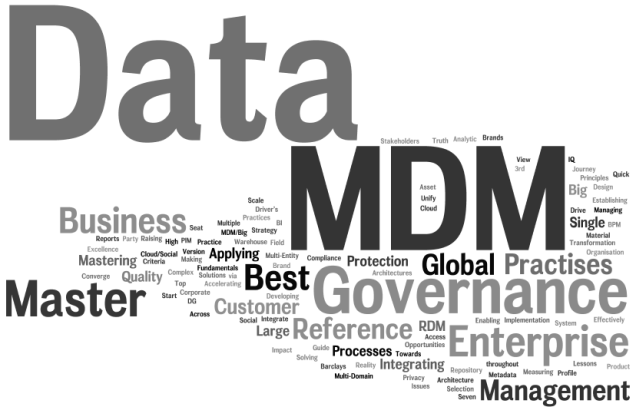
Here is a wordle with the session topics:

MDMDG 2013 wordle

Some of the words catching my eyes are:

Global is part of several headlines. There is no doubt about that governing master data on a global scale is a very timely subject. Handling master data in a domestic context can be hard enough, but enterprises are facing a daunting task when embracing party master data, product master data and location master data covering the diversity of languages, script systems, measuring systems, national standards and regulatory requirements. However, there is no way around the challenges when synergies in global enterprises are to be harvested.

RDM (Reference Data Management) is becoming a popular subject as well. Being successful with governing master data requires a steady hand with the reference data layer that sits on top of the master data. Some reference data sets may be small, but the importance of getting them right must not be underestimated.

Business. Oh yes. All the data stuff is there to enable business processes, drive business transformation and make business opportunities.

Bookmark and Share

The Big Tower of Babel

3 years ago one of the first blog posts on this blog was called The Tower of Babel.

This post was the first of many posts about multi-cultural challenges in data quality improvement. These challenges includes not only language variations but also different character sets reflecting different alphabets and script systems, naming traditions, address formats, measure units, privacy norms, government registration practice to name some of the ones I have experienced.

When organizations are working internationally it may be tempting to build a new Tower of Babel imposing the same language for metadata (probably English) and the same standards for names, addresses and other master data (probably the ones of the country where the head quarter is).

However, building such a high tower may end up the same way as the Tower of Babel known from the old religious tales.

Alternatively a mapping approach may be technically a bit more complex but much easier when it comes to change management.

The mapping approach is used in the Universal Postal Unions’ (UPU) attempt to make a “standard” for worldwide addresses. The UPU S42 standard is mentioned in the post Down the Street. The S42 standard does not impose the same way of writing on envelopes all over the world, but facilitates mapping the existing ways into a common tagging mapped to a common structure.

Building such a mapping based “standard” for addresses, and other master data with international diversity, in your organization may be a very good way to cope with balancing the need for standardization and the risks in change management including having trusted and actionable master data.

The principle of embracing and mapping international diversity is a core element in the service I’m currently working with. It’s not that the instant Data Quality service doesn’t stretch into the clouds. Certainly it is a cloud service pulling data quality from the cloud. It’s not that that it isn’t big. Certainly it is based on big reference data.

Bookmark and Share

Social Commerce and Multi-Domain MDM

The term social commerce is said to be a subset of eCommerce where social media is used to ultimately drag prospects and returning customers to your website, where a purchase of products and services can be made.

In complex sales processes, typically for Business-to-Business (B2B) sales, the website may offer product information sheets, demo requests, contact forms and other pipeline steps.

This is the moment where your social media engaged (prospective) customer meets your master data as:

  • The (prospective) customer creates and maintains name, address and communication information by using registration functions
  • The (prospective) customer searches for and reads product information on web shops and information sites

One aspect of this transition is how master data is carried over, namely:

  • How the social network profile used in engagement is captured as part of (prospective) customer master data or if it should be part of master data at all?
  • How product information from the governed master data hub has been used as part of the social media engagement or if the data governance of product data should be extended to use in social media at all?

Any thoughts?

Bookmark and Share

At Least Two Versions of the Truth

Precisely one year ago I wrote a post called Single Company View examining the challenges of getting a single business partner view in business-to-business (B2B) party master data.

Yesterday Robert Hawker of Vodafone made a keynote at the MDM Summit Europe 2012 telling about supplier master data management.

One of the points was that sometimes you really want the exactly same real world entity to be two golden records in your master data hub, as there may be totally different business activities made with the same legal entity. The Vodafone example was:

  • Having an antenna placed on the top of a building owned by a certain company and thus paying a fee for that
  • Buying consultancy services from the same company

I have met such examples many times when doing data matching as told in the post Entity Revolution vs Entity Evolution.

However at one occasion, many years ago, I worked in a company where not having a single business partner view nearly became a small disaster.

Our company delivered software for membership administration and was at the same time a member of an employer organisation that also happened to be a customer.

A new director got the brilliant idea, that cancelling the membership of the employer organization was an obvious cost reduction.

The cancellation was sent. The employer organisation confirmed the cancellation adding, that they were very sorry that internal business rules at the same time forced them to not being a customer anymore.

Cancellation was cancelled of course and damage control was initiated.

Bookmark and Share

MDM Summit Europe 2012 Preview

I am looking forward to be at the Master Data Management Summit Europe 2012 next week in London. The conference runs in parallel with the Data Governance Conference Europe 2012.

Data Governance

As I am living within a short walking distance of the venue I won’t have so much time thinking as Jill Dyché had when she recently was on a conference within driving distance, as reported on her blog post After Gartner MDM in which Jill considers MDM and takes the road less traveled. In London Jill will be delivering a key note called: Data Governance, What Your CEO Needs to know.

On the Data Governance tracks there will be a panel discussion called Data Governance in a Regulatory Environment with some good folks: Nicola Askham, Dylan Jones, Ken O’Connor and Gwen Thomas.

Nicola is currently writing an excellent blog post series on the Six Characteristics Of A Successful Data Governance Practitioner. Dylan is the founder of DataQualityPro. Ken was the star on the OCDQblog radio show today discussing Solvency II and Data Quality.

Gwen, being the founder of The Data Governance Institute, is chairing the Data Governance Conference while Aaron Zornes, the founder of The MDM Institute, is chairing the MDM Summit.

Master Data, Social MDM and Reference Data Management

The MDM Institute lately had an “MDM Alert”  with Master Data Management & Data Governance Strategic Planning Assumptions for 2012-13 with the subtitle: Pervasive & Pandemic MDM is in Your Future.
Some of the predictions are about reference data and Social MDM.

Social master data management has been a favorite subject of mine the last couple of years, and I hope to catch up with fellow MDM practitioners and learning how far this has come outside my circles.

Reference Data is a term often used either instead of Master Data or as related to Master Data. Reference data is those data defined and initially maintained outside a single enterprise. Examples from the customer master data realm are a country list, a list of states in a given country or postal code tables for countries around the world.

The trend as I see it is that enterprises seek to benefit from having reference data in more depth than those often modest populated lists mentioned above. In the customer master data realm such big reference data may be core data about:

  • Addresses being every single valid address typically within a given country.
  • Business entities being every single business entity occupying an address in a given country.
  • Consumers (or Citizens) being every single person living on an address in a given country.

There is often no single source of truth for such data.

As I’m working with an international launch of a product called instant Data Quality (iDQ™) I look forward to explore how MDM analysts and practitioners are seeing this field developing.

Bookmark and Share

Iceberg, Right Ahead!

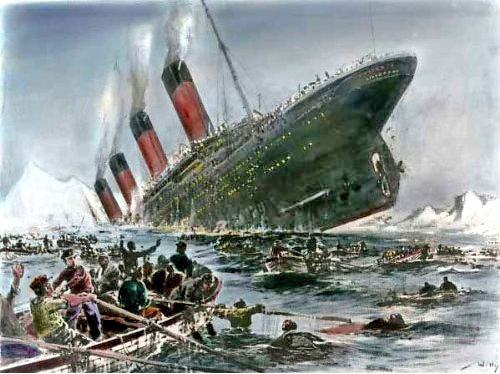
Tonight it is 100 years ago Titanic hit an iceberg and sank. So I guess it is rush hour for Titanic related blog posts. I’m going on board as well with some musings on lessons from Titanic to be learned within data management, be that migration projects, master data management implementations and data quality improvement programs.

From A to B

Why did Titanic have to sail through icy waters? There are no icebergs around Southampton, Cherbourg or Cork from where she departed, and no icebergs around New York where she was heading to. Unfortunately there is in the Iceberg Alley of Newfoundland where she passed.

In data management (and enterprise architecture too) we are often focused on the AS-IS and TO-BE states, while the dangers are on the route between these points.

Maturity

1,100 lifeboat seats are good enough for 2,200 people on an unsinkable ship, right? And why waste time and money on training the crew in evacuation. Unfortunately omitting that caused lifeboats available to be only half filled when Titanic was going down.

The maritime industry has improved a lot since then. The data management industry and discipline has a way to go still.

Real time decision making       

When the lookout reported “Iceberg, right ahead!” the officer in charge on Titanic had to make a swift decision. “Hard a’starboard!” unfortunately was the worst option, causing the ships side to be opened below the waterline. The ship would have been better off if it had sailed directly into the iceberg.

Supporting better real time decision making is a great challenge within data management today.

Bookmark and Share

Fit for repurposing

Reading a blog post by David Loshin called Data Governance and Quality: Data Reuse vs. Data Repurposing I was, perhaps a bit off topic, inspired to pose the question about if data are of high quality if they are:

  • Fit for the purpose of use
  • Fit for repurposing

The first definition has been around for many years and has been adapted by many data quality practitioners. I have however often encountered situations where the reuse of data for other purposes than the original purpose has raised data quality issues with else cleared data. One of my first pieces on my own blog discussed that challenge in a post called Fit for what purpose?

Not at least within master data management where data are maintained for multiple uses, this problem is very common.

Data in a master data hub may either:

  • Be entered directly into the hub where multiple uses is handled
  • Be loaded from other sources where data capture was done

In the latter case the data governance necessary to ensure fitness for multiple uses must stretch to the ingestion in these sources.

Now, if repurposing is seen as a future not yet discovered purpose of use, what can you then do to ensure that data today are fit for future repurposing?

The only answer is probably real world alignment as discussed here on a page called Data Quality 3.0. Make sure your data are reflecting the real world as close as we can when captured and make sure data can be maintained in order to keep that alignment. And make sure this is done and facilitated where data are entered.

Bookmark and Share