Three kinds of a MDM Data Model that comes with a tool

Master Data Management (MDM) is a lot about data modelling. When you buy a MDM tool it will have some implications for your data model. Here are three kinds of data models that may come with a tool:

An off-the-shelf model

This kind is particularly popular with customer and other party master data models. Core party data are pretty much the same to every company. We have national identification numbers, names, addresses, phone numbers and that kind of stuff where you do not have to reinvent the wheel.

Also, you will have access to rich reference data with a model such as address directories (which you may regard as belonging to a separate location domain), business directories (as for example the Dun & Bradstreet Worldbase) and in some countries citizen directories as well. MDM tools may come with a model shaped for these sources.

Tools which are optimized for data matching, including deduplication of party master data, will often shoehorn your party master data into a data model feasible for that.

A buildable model

When it comes to multi-domain MDM we will deal with entities that are not common to everyone.

Here a capability to build your model in the MDM tool is needed. One such tool I have worked with is Semarchy. Here semi-technical people are able to build and deploy incrementally more complex data models, that are default equipped with needed functionality around handling a golden copy and auditing data onboarding and changing.

A dynamic model

Product Information Management (PIM) requires that your end users can build the model on the fly, as product data are so different between product groups.

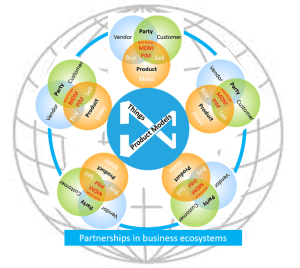
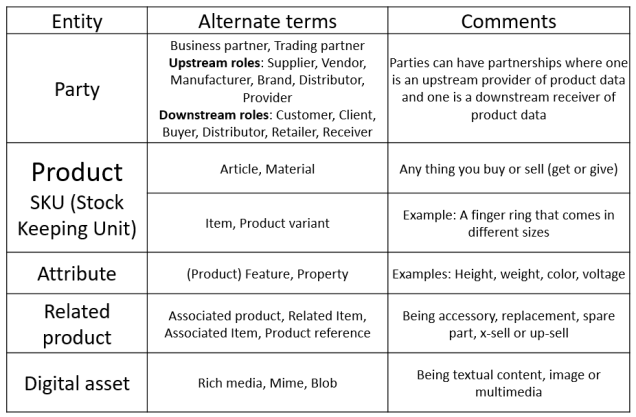
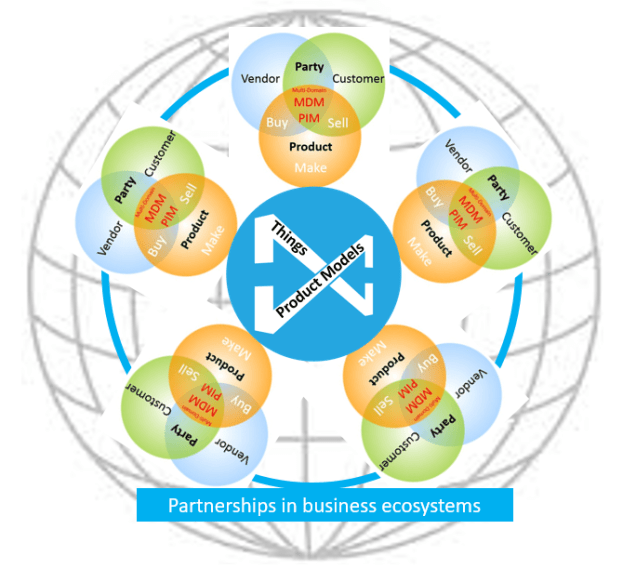
In my current venture called Product Data Lake the model has these main entities:

PDL Data Model

This model resembles the data model in most PIM solutions (and PIM based MDM solutions), except that we have the party and their two-way partnerships at the top, as Product Data Lake takes care of exchanging data between inhouse PIM solutions at trading partners participating in business ecosystems.

7 Considerations to Choose Digital Asset Management Right

Today’s guest blog post from Rajneesh Kumar is about Digital Asset Management (DAM) and 7 key factors to consider when choosing an in-house solution for that discipline. 
DAM_Blog_Resize

Digital assets are an enduring force of great value. They are the fuel of the new economy as organizations strive to be increasingly digitally driven. The way ocean of digital assets is rising, it is essential more than ever to optimally manage every type of digital content.

Organizations today put so much effort to deliver responsive, personalized and engaging experiences. Digital content has a very important role to play here. And, digital asset management (DAM) solutions are becoming a strategic priority for organizations to manage rising volume of content, streamline and automate processes for efficiency and quality.

Digital asset management supports solutions (web content management, eCommerce, and campaign management) by managing omnichannel brand and rich media content across all channels.

It also helps store, access, distribute, repurpose, and monetize digital content.  In fact, a good DAM contributes directly to the bottom line.

Organizations recognize this fact. And they are looking to transform their digital asset management solutions to improve marketing and sales performance for higher ROI.

But, it depends on how big their assets are, how distributed they are and how much integration they need to do.

Organizations must make an informed decision before choosing any DAM solution. They must choose a solution that fits well with their structure. And, it must also enable them to adopt the solution quickly with business benefits.

Here are 7 key factors to consider when choosing a DAM platform:

Implementation- Digital asset management plays a critical role to improve brand consistency across campaigns and channels. It serves many roles inside and outside of an organization. Thus, it must support greater automation in managing global or local versions of assets, various renditions of assets across channels, and integration with key systems of engagement.

Integration- A digital asset management solution should integrate well with the existing infrastructure of the organization. It should be easy for creative workflow and approval, collaboration, and version control. Your DAM solution must also allow you to take advantage of deep integration with campaign management, marketing automation, and marketing technology platforms to boost marketing agility.

Management- It should offer the deeper capability to efficiently manage a diverse set of content at reduced cost and lesser hassle.  Because, DAM is a creative innovation lab for your marketing and sales team. It must reduce time spent searching for assets, streamline approval processes, make it easy to collaborate better with external stakeholders, and provide better visibility of current status.

Infrastructure- DAM should be compatible with existing as well as modern infrastructure (like cloud and mobility) so that unnecessary cost can be avoided in the long-run. A next-generation DAM system must take advantage of the cloud and mobility to make access and sharing easier among all teams wherever and whenever they require.

Security- It must provide robust security, metadata, and workflow capabilities — along with the scalability to support or add n-numbers of assets.

Rich media capability- Today, rich media is created in bulk. The DAM solution should provide strong support for audio, video, and images (with the format conversion capability as well as previews and editing capabilities on images and rich media) to support today’s responsive, cross-channel digital experiences.

Adoption- The DAM platform must be easily adopted by both internal and external teams (using role-based accessibility) so that business value can be realized as soon as possible. It must empower teams for better asset reuse, avoid duplication of effort and rework, and reduce the number of digital assets that are created but never used.

The bottom line is: It is not about what digital asset management platform you choose. But it is more about how a DAM solution enables you to create value around your entire asset cycle— improving collaboration, strengthening brands, accelerating campaigns, and increasing the ROI. Plus, delivering amazing customer experiences that you always strive for.

As digital marketer and growth hacker, Rajneesh Kumar is currently marketing manager at Pimcore Global Services (PGS), an award-winning consolidated open source platform for product information management (PIM), web content management (CMS), digital asset management (DAM) and e-commerce.

Passive vs Active Product Information Exchange

Product information is the kind of data that usually flows cross company. The most common routes start with that the hard facts about a product originates at the manufacturer. Then the information may be used on the brands own website, propagated to a marketplace (online shop-in-shop) and also propagated downstream to distributors and merchants.

The challenge to the manufacturer is that this represent many different ways of providing product information, not at least when it comes to distributors and merchants, as these will require different structures and formats using various standards and not being on the same maturity level.

Looking at this from the downstream side, the distributors and merchants, we have the opposite challenge. Manufacturers provide product information in different structurers and formats using various standards and are not on the same maturity level.

Supply chain participants can challenge this in a passive or an active way. Unfortunately, many have chosen – or are about to choose – the passive way. It goes like this:

  • As a manufacturer, we have a product data portal where trading partners who wants to do business with us, who obviously is the best manufacturer in our field, can download the product information we have in our structure and format using the standards we have found best.
  • As a distributor/merchant we have a supplier product data portal where trading partners who wants to do business with us, the leading player in our field, can upload the product information we for the time being will require in our structure and format using the standard(s) we have found best.

Passive vs ActiveThis approach seems to work if you are bigger than your trading partner. And many times one will be bigger than the other. But unless you are very big, you will in many cases not be the biggest. And in all cases where you are the biggest, you will not be seen as a company being easy to do business with, which eventually will decide how big you will stay.

The better way is the active way creating a win-win situation for all trading partners as described in the article about Product Data Lake Business Benefits.

You Must Supplement Customer Insight with Rich Product Data

school_420x310This week I attended an event called Retail Summer School at Columbia Business School in New York.

Much of the talking was about how to get insights on your (prospective) customers by collecting data in all kinds of ways – while observing the thin line between cool and creepy.

My thinking, of course biased by my current Product Data Lake venture, is that you should also pay attention to product data. For at least two reasons:

Algorithm effectiveness: Your algorithms on what products to present based on your rich insight into your customers need will only work if you are able to automatically match the needs against very specific product attributes. And most retailers don not have that today if you look at product descriptions on their ecommerce sites.

Also, I am not impressed by the suggestions I get today. They generally fall into two buckets:

  • Things I absolutely do not need
  • Things I just bought

Self-service craving: As a customer, we will strike back. We do not need to be told what to buy. But we do want to know what we are buying. This means we want to be able to see rich product information. Therefore retailers must maintain a lot of product data and related digital assets that they should fetch at a trusted source: From the manufactures. And if the manufacturer wants their products to be the ones selected by the end customers, they must be able to deliver these data seamlessly to all their distributors, retailers and marketplaces.

Party Master Data and the Data Subject

Within the upcoming EU General Data Protection Regulation (GDPR) the term data subject is used for the persons for whom we must protect the privacy.

These are the persons we handle as entities within party Master Data Management (MDM).

In the figure below the blue area covers the entity types and roles that are data subjects in the eyes of GDPR

Data Subjects

While GDPR is of very high importance in business-to-consumer (B2C) and government-to-citizen (G2C) activities, GDPR is also of importance for business-to-business (B2B) and government-to-business (G2B) activities.

GDPR does not cover unborn persons which may be a fact of interest in very few industries as for example healthcare. When it comes to minors, there are special considerations within GDPR to be aware of. GDPR does not apply to deceased persons. In some industries like financial services and utility, the handling of the estate after the death of a person is essential, as well as knowing about that sad event is of importance in general as touched in the post External Events, MDM and Data Stewardship.

One tough master data challenge in the light of GDPR will be to know the status of your registered party master data entities. This also means knowing when it is a private individual, a contact at an organization or an organization or department hereof as such. From my data matching days, I know that heaps of databases do not hold that clarity as reported in the post So, how about SOHO homes.

A Pack of Wolves, Master Data and Reference Data

Pack of WolvesDuring the last couple years social media have been floating with an image and a silly explanation about how a pack of wolves are organized on the go. Some claims are that the three in the front should be the old and sick who sets the pace so everyone are able to stay in the pack and the leader is the one at the back.
This leadership learning lesson, that I have seen liked and shared by many intelligent people, is made up and does not at all correspond to what scientists know about a pack of wolves.

This is like when you look at master data (wolves) without the right reference data and commonly understood metadata. In order to make your interpretation trustworthy you have to know: ¿Who is the alpha male (if that designation exists), who is the alpha female (if that designation exists) and who is old and sick (and what does that mean)?

PS: For those of you who like me are interested in Tour de France, I think this is like the peloton. In front are the riders breaking the wind (snow), who will eventually fall to the back of the standings, and at the back you see Chris Froome having yet a mechanical problem when the going gets tough and thereby making sure that the entire pack stays together.

The Customer, Product and Thing Side of MDM

With the rise of the Internet of Things (IoT) you may regard the Master Data Management (MDM) discipline as yet a bit more complicated.

The most addressed part of MDM has traditionally been achieving a 360 degree view of customers.

Also, a 360 degree view of products within your organization has been a good old chestnut to deal with. The way we have managed products has mostly been by looking at product models, meaning things made up by the same ingredients in the same way under the same brand.

When entering the IoT era MDM now needs to take care of each physical instance of a product model: Each smartphone, each intelligent refrigerator, each big data producing drilling machine.

The theme of connecting Customer 360, Customer Experience (CX) and IoT was examined by Prash Chandramohan of Informatica in his recent post called MDM is the Foundation for Intelligent Engagement.

In here Prash states: “The IoT plays an ever-increasing role in CX across a variety of industries, and MDM delivers the context it requires to deliver value.”

I agree with that – with an important amendment: In order not to over complicate every-thing, you have to implement a MDM landscape, where you are able to collaborate closely with your business partners as exemplified in the concept of Master Data Share.

Master Data Share

Master Data, Product Information, Digital Assets and Digital Ecosystems

When it comes to mastering product data there are these three kinds of data and supporting managing disciplines and solutions:

  • Master data and the supporting Master Data Management (MDM) discipline and a choice of MDM solutions for the technology part
  • Product information and the supporting Product Information Management (PIM) discipline and a choice of PIM solutions for the technology part
  • Digital assets and the supporting Digital Asset Management (DAM) discipline and a choice of DAM solutions for the technology part

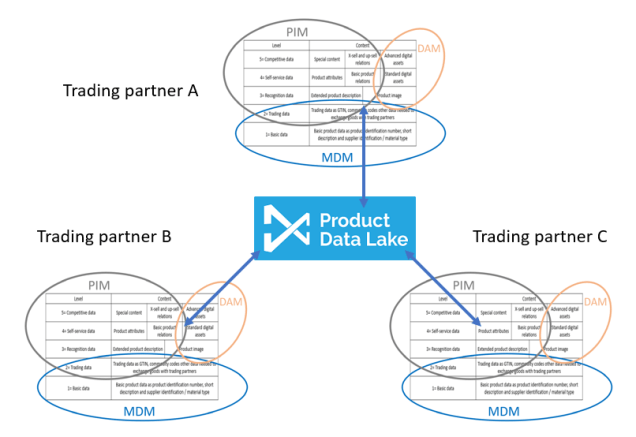
What these disciplines are and how the available solutions relate was examined in the post How MDM, PIM and DAM Sticks Together. This post includes a model for that proposed by Simon Walker of Gartner (the analyst firm).

The right mix for your company depends on your business model and you will also have the choice of using a best of breed technology solution for your focus, that being MDM, PIM or DAM, as well as there are choices for a same branded solution, and in some cases also actually integrated solution, that supports MDM, PIM and DAM.

When selecting a (product) data management platform today you also must consider how this platform supports taking part in digital ecosystems, here meaning how you share product data with your trading partners in business ecosystems.

For the digital platform part supporting interacting with master data, product information and digital assets with your trading partners, who might have another focus than you, the solution is Product Data Lake.

MDM PIM DAM PDL

MDM / PIM Platform Vendors Need to Grow Up Too

Participating in digital ecosystems is the way forward for enterprises who wants to be tomorrow’s winners through digital transformation.

Some figures from Gartner, the analyst firm, tells this about digital transformation:

  • 79% of top performing companies indicate that they participate in a digital ecosystem
  • 49% of typical companies indicate the same
  • 24% of trailing companies does it

These figures were lately examined by Bryan Kirschner of Apigee (now part of Google) in a Cio.com article called Ecosystems: when digital transformation grows up.

Master Data Share
Master Data Share for Business Ecosystems

As a Master Data Management (MDM) and/or Product Information Management (PIM) platform vendor you should support your current and prospective clients with means to participate in digital ecosystems.

Current offerings from MDM and PIM platforms vendors have become quite mature in supporting inhouse (enterprise wide) handling of master data and product information. Next step is supporting sharing within business ecosystems. A concept for that is introduced in Master Data Share.

The days of castle and moat are over, just as brick and mortar is slowly diminishing too

A recent post called Ecosystem Architecture is replacing Enterprise Architecture from Oliver Cronk of Deloitte has these statements:

Kronborg_Castle“Organisations need architectural thinking beyond their organisational boundaries” and “The days of Enterprise Architecture taking a castle and moat approach are over”.

The end of the castle and moat thinking in Enterprise Architecture (and Business Information Architecture) is also closely related to the diminished importance of the brick and mortar ways of selling, being increasingly overtaken by eCommerce.

However, some figures I have noticed that cause the brick and mortar way to resist the decline by still having a castle and moat thinking is:

Merchants, distributors and manufacturers need to move on from the castle and moat thinking in Enterprise Architecture and Business Information Architecture and start interacting effectively in their business ecosystems with product information.

This is the thinking behind Product Data Lake. You can keep your castle by breaking down the walls and replace the moat with a stream as shown in our 5 + 5 Business Benefits.