The Taxman: Data Quality’s Best Friend

Collection of taxes has always been a main driver for having registries and means of identifying people, companies and properties.

5,000 years ago the Egyptians made the first known census in order to effectively collect taxes.

As reported on the Data Value Talk blog, the Netherlands have had 200 years of family names thanks to Napoleon and the higher cause of collecting taxes.

Today the taxman goes cross boarder and wants to help with international data quality as examined in the post Know Your Foreign Customer. The US FATCA regulation is about collecting taxes from activities abroad and as said on the Trillium blog: Data Quality is The Core Enabler for FATCA Compliance.

My guess is that this is only the beginning of a tax based opportunity for having better data quality in relation to international data.

In a tax agenda for the European Union it is said: “As more citizens and companies today work and operate across the EU’s borders, cooperation on taxation has become increasingly important.”.

The EU has a program called FISCALIS in the making. Soon we not only have to identify Americans doing something abroad but practically everyone taking part in the globalization.

For that we all need comprehensive accessibility to the wealth of global reference data through “cutting-edge IT systems” (a FISCALIS choice of wording).

I am working on that right now:

Bookmark and Share

Updating a Social Business Directory

Business directories have been around for ages. In the old days it was paper based as in the yellow pages for a phone book. The yellow pages have since made it to be online searchable. We also know commercial business directories as the Dun & Bradstreet WorldBase as well as government operated national wide directories of companies and industry specific business directories.

Such business directories often takes a crucial role in master data quality work as sources for data enrichment in the quest for getting as close as possible to a single version of the truth when dealing with B2B customer master data, supplier master data and other business partner master data.

A classic core data model for Master Data in CRM systems, SCM solutions and Master Data hubs when doing B2B is that you have:

  • Accounts being the BUSINESS entities who are your customers, suppliers, prospects and all kind of other business partners
  • Contacts being the EMPLOYEEs working there and acting in the roles as decision makers, influencers, gate keepers, users and so on

Today we also have to think about social master data management, being exploiting reference data in social media as a supplementary source of external data.

As all social activity this exercise goes two ways:

  • Finding and monitoring your existing and wanted business partners in the social networks
  • Updating your own data

Most business entities in this world are actually one-man-bands. So are mine. Therefore I went to the LinkedIn company pages this morning and updated data about my company Liliendahl Limited: Unlimited Data Quality and Master Data Management consultancy for tool and service vendors.

Bookmark and Share

The Big Search Opportunity

The other day Bloomberg Businessweek had an article telling that Facebook Delves Deeper Into Search.

I have always been advocating for having better search functionality in order to get more business value from your data. That certainly also applies to big data.

In a recent post called Big Reference Data Musings here on the blog, the challenge of utilizing large external data sources for getting better master data quality was discussed. In a comment Greg Leman pointed out, that there often isn’t a single source of the truth, as you for example could expect from say a huge reference data source as the Dun & Bradstreet WorldBase holding information about business entities from all over the world.

Indeed our search capabilities optimally must span several sources. In the business directory search realm you may include several sources at a time like supplementing the D&B  WorldBase with for example EuroContactPool, if you do business in Europe, or the source called Wiki-Data (under rename to AvoxData) if you are in financial services and wants to utilize the new Legal Entity Identifier (LEI) for counterparty uniqueness in conjunction with other more complete sources.

As examined in Search and if you are lucky you will find combining search on external reference data sources and internal master data sources is a big opportunity too. In doing that you, as described the follow up piece named Wildcard Search versus Fuzzy Search, must get the search technology right.

I see in the Bloomberg article that Facebook don’t intend to completely reinvent the wheel for searching big data, as they have hired a Google veteran, the Danish computer scientist Lars Rasmussen, for the job.

Bookmark and Share

Big Reference Data Musings

The term “big data” is huge these days. As Steve Sarsfield suggest in a blog post yesterday called Big Data Hype is an Opportunity for Data Management Pros, well, let’s ride on the wave (or is it tsunami?).

The definition of “big data” is as with many buzzwords not crystal clear as examined in a post called It’s time for a new definition of big data on Mike2.0 by Robert Hillard. The post suggests that big may be about volume, but is actually more about big complexity.

As I have worked intensively with large amounts of rich reference data, I have a homemade term called “big reference data”.

Big Reference Data Sets

Reference Data is a term often used either instead of Master Data or as related to Master Data. Reference data is those data defined and (initially) maintained outside a single organization. Examples from the party master data realm are a country list, a list of states in a given country or postal code tables for countries around the world.

The trend is that organizations seek to benefit from having reference data in more depth than those often modest populated lists mentioned above.

An example of a big reference data set is the Dun & Bradstreet WorldBase. This reference data set holds around 300 different attributes describing over 200 million business entities from all over world.

This data set is at first glance well structured with a single (flat) data model for all countries. However, when you work with it you learn that the actual data is very different depending on the different original sources for each country. For example addresses from some countries are standardized, while this isn’t the case for other countries. Completeness and other data quality dimensions vary a lot too.

Another example of a large reference data set is the United Kingdom electoral roll that is mentioned in the post Inaccurately Accurate. As told in the post there are fit for purpose data quality issues. The data set is pretty big, not at least if you span several years, as there is a distinct roll for every year.

Big Reference Data Mashup

Complexity, and opportunity, also arises when you relate several big reference data sets.

Lately DataQualityPro had an interview called What is AddressBase® and how will it improve address data quality? Here Paul Malyon of Experian QAS explains about a new combined address reference source for the United Kingdom.

Now, let’s mash up the AddressBase, the WorldBase and the Electoral Rolls – and all the likes.

Image called Castle in the Sky found on photobotos.

Bookmark and Share

Data Quality at Terminal Velocity

Recently the investment bank Saxo Bank made a marketing gimmick with a video showing a BASE jumper trading foreign currency with the banks mobile app at terminal velocity (e.g. the maximum speed when free falling).

Today business decisions have to be taken faster and faster in the quest for staying ahead of competition.

When making business decisions you rely on data quality.

Traditionally data quality improvement has been made by downstream cleansing, meaning that data has been corrected long time after data capture. There may be some good reasons for that as explained in the post Top 5 Reasons for Downstream Cleansing.

But most data quality practitioners will say that data quality prevention upstream, at data capture, is better.

I agree; it is better.  Also, it is faster. And it supports faster decision making.

The most prominent domain for data quality improvement has always been data quality related to customer and other party master data. Also in this quest we need instant data quality as explained in the post Reference Data at Work in the Cloud.

Bookmark and Share

Know Your Foreign Customer

I’m not saying that Customer Master Data Management is easy. But if we compare the capabilities within most companies with handling domestic customer records they are often stellar compared to the capabilities of handling foreign customer records.

It’s not that the knowledge, services and tools doesn’t exist. If you for example are headquartered in the USA, you will typically use best practice and services available there for domestic records. If you are headquartered in France, you will use best practice and services available there for domestic records. Using the best practices and services for foreign (seen from where you are) records is more seldom and if done, it is often done outside enterprise wide data management.

This situation can’t, and will not, continue to exist. With globalization running at full speed and more and more enterprise wide data management programs being launched, we will need best practices and services embracing worldwide customer records.

Also new regulatory compliance will add to this trend. Being effective next year the US Foreign Account Tax Compliance Act (FATCA) will urge both US Companies and Foreign Financial Institutions to better know your foreign customers and other business partners.

In doing that, you have to know about addresses, business directories and consumer/citizen hubs for an often large range of countries as described in the post The Big ABC of Reference Data.

It may seem a daunting task for each enterprise to be able to embrace big reference data for all the countries where you have customers and other business partners.

My guess, well, actually plan, is, that there will be services, based in the cloud, helping with that as indicated in the post Partnerships for the Cloud.

Bookmark and Share

Inaccurately Accurate

The public administrative practice for keeping track of the citizens within a country is very different between my former country of living being Denmark and my current country of living being the United Kingdom.

In Denmark there is an all-purpose citizen registry where you are registered “once and for all” seconds after you are born as told in the post Citizen ID within Seconds.

In the United Kingdom there are separate registries for different purposes. For example there is a registry dealing with your health care master data and there is a registry, called the electoral roll, dealing with your master data as a voter.

Today I was reading a recent report about data quality within the British electoral roll. The report is called Great Britain’s electoral registers 2011

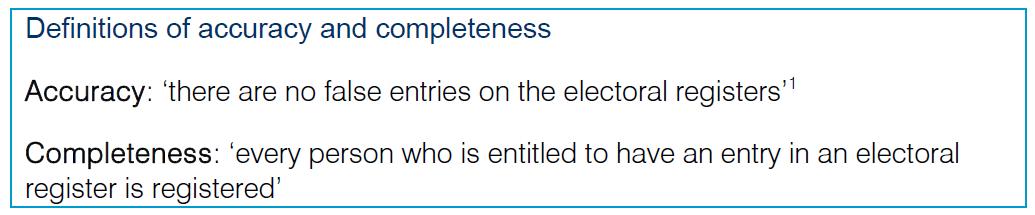
The report revolves around the two data quality dimensions: Accuracy and completeness.

In doing so, these two bespoke definitions are used:

There is a note about accuracy saying:


This is a very interesting precision, so to speak. Having fitness for the purpose of use is indeed the most common approach to data quality.

This does of course create issues when such data are used for other purposes. For example credit risk agencies here in the UK use appearance on the electoral roll as a parameter for their assessment of credit risk related to individuals.

Surely, often there isn’t a single source of the truth as pondered in the post The Big ABC of Reference Data.

However, this mustn’t make us stop in the search for getting high quality data. We just have to realize that we may look in different places in order to mash up a best picture of the real world as explained in the post Reference Data at Work in the Cloud.  

Bookmark and Share

Partnerships for the Cloud

Earlier this month Loraine Lawson was so kind to quote me in an article on IT Business Edge called New Partnerships Create Better Customer Data via the Cloud.

The article mentions some cloud services from StrikeIron and Melissadata. These services are currently based on improving North American, being US and Canadian, customer data.

I am involved in similar services that currently are based on improving Danish customer data, which then covers the rest of North America being Greenland.

Improving customer data from all over the world is surely a daunting task that needs partnerships.

The cloud is the same, the reference data isn’t and the rules and traditions aren’t either as governments around the world has found 240 (or so) different solutions to balancing privacy concerns and administrative efficiency.

So, if not partnering, you risk getting solutions that are nationally international.

Bookmark and Share

Informatics for adding value to information

Recently the Global Agenda Council on Emerging Technologies within the World Economic Forum has made a list of the top 10 emerging technologies for 2012. According to this list the technology with the greatest potential to provide solutions to global challenges is informatics for adding value to information.

As said in the summary: “The quantity of information now available to individuals and organizations is unprecedented in human history, and the rate of information generation continues to grow exponentially. Yet, the sheer volume of information is in danger of creating more noise than value, and as a result limiting its effective use. Innovations in how information is organized, mined and processed hold the key to filtering out the noise and using the growing wealth of global information to address emerging challenges.”

Big data all over

Surely “big data” is the buzzword within data management these days and looking for extreme data quality will be paramount.

Filtering out the noise and using the growing wealth of global information will help a lot in our endurance to make a better world and to make better business.

In my focus area, being master data management, we also have to filtering out the noise and exploit the growing wealth of information related to what we may call Big Master Data.

Big external reference data

The growth of master data collections is also seen in collections of external reference data.

For example the Dun & Bradstreet Worldbase holding business entities from around the world has lately grown quickly from 100 million entities to over 200 millions entities. Most of the growth has been due to better coverage outside North America and Western Europe, with the BRIC countries coming in fast. A smaller world resulting in bigger data.

Also one of the BRICS, India, is on the way with a huge project for uniquely identifying and holding information about every citizen – that’s over a billion. The project is called Aadhaar.

When we extend such external registries also to social networking services by doing Social MDM, we are dealing with very fast growing number of profiles in Facebook, LinkedIn and other services.

Surely we need informatics for adding the value of big external reference data into our daily master data collections.

Bookmark and Share

Search and if you are lucky you will find

This morning I was following the tweet stream from the ongoing Gartner Master Data Management (MDM) conference here in London, when another tweet caught my eyes:

This reminded me about that (error tolerant) search is The Overlooked MDM Feature.

Good search functionality is essential for making the most out of your well managed master data.

Search functionality may be implemented in these main scenarios:

Inside Search

You should be able to quickly find what is inside your master data hub.

The business benefits from having fast error tolerant search as a capacity inside your master data management solution are plenty, including:

  • Better data quality by upstream prevention against duplicate entries as explained in this post.
  • More efficiency by bringing down the time users spends on searching for information about entities in the master data hub.
  • Higher employee satisfaction by eliminating a lot of frustration else coming from not finding what you know must be inside the hub already.

MDM inside search capabilities applies to multiple domains: Party, product and location master data.

Search the outside

You should be able to quickly find what you need to bring inside your master data hub.

Data entry may improve a lot by having fast error tolerant search that explores the cloud for relevant data related to the entry being done. Doing that has two main purposes:

  • Data entry becomes more effective with less cumbersome investigation and fewer keystrokes.
  • Data quality is safeguarded by better real world alignment.

Preferably the inside and the outside search should be the same mash-up.

Searching the outside is applies especially to location and party master data.

Search from the outside

Website search applies especially to product master data and in some cases also to related location master data as described in the post Product Placement.

Your website users should be able to quickly find what you publish from your master data hub be that description of physical products, services or research documents as in the case of Gartner, which is an analyst firm.

As said in the tweet on the top of this post, (good) search makes the life of your coming and current customers much easier. Do I need to emphasize the importance of good customer experience?

Bookmark and Share