Social Selling: Does it Work?

Social Master Data Management (Social MDM) has been on my radar for quite a long time. Social MDM is the natural consequence of Social CRM and social selling.

Social MDMNow social selling has become very close to me in the endeavour of putting a B2B (Business-to-Business) cloud service called Product Data Lake on the market.

In our quest to do that we rely on social selling for the following reasons:

  • If we do not think too much about, that time is money, social selling is an inexpensive substitution for a traditional salesforce, not at least when we are targeting a global market.
  • We have a subscription model with a very low entry level, which really does not justify many onsite meetings outside downtown Copenhagen – but we do online meetings based on social engagement though 🙂
  • The Product Data Lake resembles a social network itself by relying on trading partnerships for exchange of product information.

I will be keen to know about your experiences and opinions about social selling. Does it work? Does it pay off to sell socially? Does it feel good to buy socially?

Bookmark and Share

Choosing the Best Term to Use in MDM

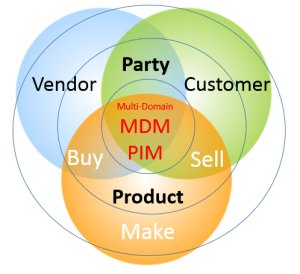
Right now I am working with a MDM (Master Data Management) service for sharing product data in the business ecosystems of manufacturers, distributors, retailers and end users of product information.

One of the challenges in putting such a service to the market is choosing the best term for the entities handled by the service.

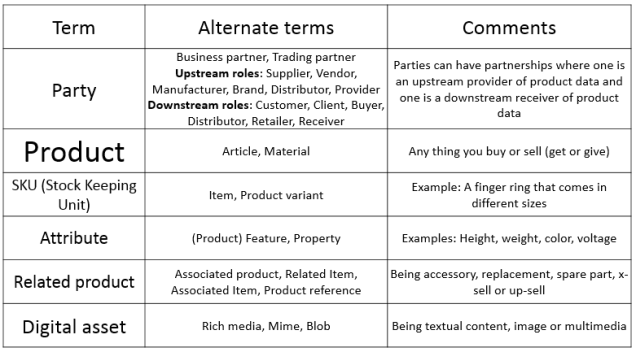
Below is the current selection with the chosen term and some recognized alternate terms used frequently and found in various standards that exists for exchanging product data:

Terms

Please comment, if you think there are other English (or variant of English) terms that deserves to be in here.

Related Products: The often Overlooked Facet of PIM

Related products

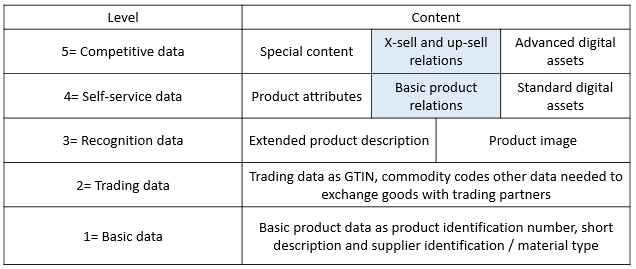
As examined in the post Self-service Ready Product Data, there are three main different kinds of information, which we deal with within Product Information Management (PIM). These are

  • Product attributes, also sometimes called product properties or product features. These are up to thousands of different data elements that describes a product. Some are very common for most products like height, length, weight and colour. Some are very specific to the product category. This challenge is actually the reason of being for dedicated PIM solutions.
  • Digital assets are documents like product images, installation guides, line drawings, data sheets and more advanced formats as videos. You may handle these digital assets in a dedicated Digital Asset Management (DAM) system or use facilities within a PIM solution or other kind of solutions for that.
  • Related products are the links between a product and other products like a product that have several different accessories that goes with the product or a product being a successor of another now decommissioned product. Spare parts for a given product is another kind of product relation. And then we have cross-sell and up-sell relations.

While PIM solutions usually have good capabilities for handling related products, it is my experience that many organizations does not utilize this very well.

One challenge is that related products can be sourced in various ways as told in the post Related Parties, Products and Locations. These ways are:

  • From the manufacturer of the product. This source is often good when it comes to product relationship types as accessory and replacement (succession) as well as spare part relations.
  • From the customer. We know this approach from the online sales trick prompting us with the message “People who bought A also bought B”.
  • From internal considerations. Facilitating up-sell can be done by enhancing product data with that kind of product relation.

Sourcing product relations from the manufacturer through the supply chain is a must for solutions that facilitates exchange of product data in business ecosystems. In the Product Data Lake we consequently handle the sharing of product attributes, digital assets and related products.

Bookmark and Share

Multi-Domain MDM 360 and an Intelligent Data Lake

This week I had the pleasure of being at the Informatica MDM 360 event in Paris. The “360” predicate is all over in the Informatica communication. There are the MDM 360 events around the world.  The Product 360 solution – the new wrap of the old Heiler PIM solution, as I understand it. The Supplier 360 solution. Some Customer 360 stuff including the Cloud Customer 360 for Salesforce edition.

GW MDMAll these solutions constitutes one of the leading Multi-Domain MDM offerings on the market – if not the leading. We will be wiser on that question when Gartner (the analyst firm) makes their first Multi-Domain MDM Magic Quadrant later this year as reported in the post Gravitational Waves in the MDM World.

Until now, Informatica has been very well positioned for Customer MDM, but not among the leaders for Product MDM in the ranking according to Gartner. Other analysts, as Information Difference, have Informatica in the top right corner of the (Multi-Domain) MDM landscape as seen here.

MDM and big data is another focus area for Informatica and Informatica has certainly been one of the first MDM vendors who have embraced big data – and that not just with wording in marketing. Today we cannot say big data without saying data lake. Informatica names their offering the Intelligent Data Lake.

For me, it will be interesting to see how Informatica can take full Multi-Domain MDM leadership with combining a good Product MDM solution with an Intelligent Data Lake.

Bookmark and Share