A Data Quality Appliance?

Today it was announced that IBM is to acquire Netezza, a data warehouse appliance vendor.

5 years ago I guess the interest for data warehouse appliances was very sparse. I guess this because I attended a session held by Netezza at the 2005 London Information Management conference. We were 3 people in the room: The presenter, a truly interested delegate and me. I was basically in the room because I was the next speaker in the room and wanted to see how things worked out. For the record: It was a good session, I learned a lot about appliances.  
Probably therefore I noticed a piece from 2007 where Philip Howard of Bloor wrote about The scope for appliances. In this article Phillip Howard also suggested other types of appliances, for example a data quality (data matching) appliance.  

I have been around some implementations where we could use the power of an appliance when we have to match a lot of rows. The Achilles’ heel in data matching is candidate selection and often you have to restrict on your methods in order to maintain a reasonable performance.

But I wonder if I ever will see an on promise data quality (data matching) appliance or it will be placed in the cloud. Or maybe there already is one out there? If so, please tell about it.    

Bookmark and Share

The Sound of Soundex

The probably oldest and most used error tolerant algorithm in searching and data matching is a phonetic algorithm called Soundex. If you are not familiar with Soundex: Wikipedia to the rescue here.

In the LinkedIn group Data Matching we seem to have an ongoing discussion about the usefulness of Soundex. Link to the discussion here – if you are not already a member: Please join, spammers are dealt with, though it is OK to brag about your data matching superiority.

To sum up the discussion on Soundex I think we at this stage may conclude:

  • Soundex is of course very poor compared to the more advanced algorithms, but it may be better than nothing (which will be exact searching and matching)
  • Soundex (or a variant of Soundex) may be used for indexing in order to select candidates to be scored with better algorithms.

Let’s say you are going to match 100 rows with names and addresses against a table with 100 million rows with names and addresses and let’s say that the real world individual behind the 100 rows is in fact represented among the 100 million, but not necessary spelled the same.

Your results may be as this:

  • If you use exact automated matching you may find 40 matching rows (40 %).
  • If you use automated matching with (a variant of) Soundex you may find 95 matching rows, but only 70 rows (70 %) are correct matches (true positives) as 25 rows (25 %) are incorrect matches (false positives).
  • If you use automated matching with (a variant of) Soundex indexing and advanced algorithm for scoring you may find 75 matching rows where 70 rows (70 %) are correct matches (true positives) and 5 rows (5 %) are incorrect matches (false positives).
  • By tuning the advanced algorithm you may find 67 matching rows where 65 rows (65 %) are correct matches (true positives) and 2 rows (2 %) are incorrect matches (false positives).

So when using Soundex you will find more matching rows but you will also find more manual work in verifying the results. Adding an advanced algorithm may reduce the manual work or eliminate manual work at the cost of some not found matches (false negatives) and the risk of a few wrong matches (false positives).

PS: I have a page about other Match Techniques including standardization, synonyms and probabilistic learning.

PPS: When googling for if the title of this blog has been used before I found this article from a fellow countryman.

Bookmark and Share

Data Quality Tools: The Cygnets in Information Quality

Since engaging in the social media community around data and information quality I have noticed quite a lot of mobbing going on pointed at data quality tools. The sentiment seems to be that data quality tools are no good and will play only a very little role, if any, in solving the data and information quality conundrum.

I like to think of data quality tools as being like the cygnet (the young swan) in the fairy tale “The Ugly Duckling” by Hans Christian Andersen. An immature clumsy flapper in the barnyard. And sure, until now tools have generally not been ready to fly, but been mostly situated in the downstream corner of the landscape.

Since last September I have been involved in making a new data quality tool. The tool is based on the principles described in the post Data Quality from the Cloud.

We have now seen the first test flights in the real world and I am absolutely thrilled about the testimonial sayings. Examples:

  • “It (the tool) is lean”.  I like that since lean is a production practice that considers the expenditure of resources for any goal other than the creation of value for the end customer to be wasteful.
  • “It is gold”. I like to consider that as a calculated positive business case.
  • “It is the best thing happened in my period of employment”. I think happy people are essential to data quality.

Paraphrasing Andersen: I never dreamed there could be so much happiness, when I was working with ugly ducklings.

Bookmark and Share

Complicated Matters

A while ago I wrote a short blog post about a tweet from the Gartner analyst Ted Friedman saying that clients are disappointed with the ability to support wide deployment of complex business rules in popular data quality tools.

Speaking about popular data quality tools; on the DataFlux Community of Experts blog Founder of DataQualityPro Dylan Jones posted a piece this Friday asking: Are Your Data Quality Rules Complex Enough?

Dylan says: “Many people I speak to still rely primarily on basic data profiling as the backbone of their data quality efforts”.

The classic answers to the challenge of complex business rules are:

  • Relying on people to enforce complex business rules. Unfortunately people are not as consistent in enforcing complex rules as computer programs are.
  • Making less complex business rules. Unfortunately the complexity may be your competitive advantage.

In my eyes there is no doubt about that data quality tool vendors has a great opportunity in research and development of tools that are better at deploying complex business rules. In my current involvement in doing so we work with features as:

  • Deployment as Service Oriented Architecture components. More on this topic here.
  • Integrating multiple external sources. Further explained here.
  • Combining the best algorithms. Example here.

Bookmark and Share

3 out of 10

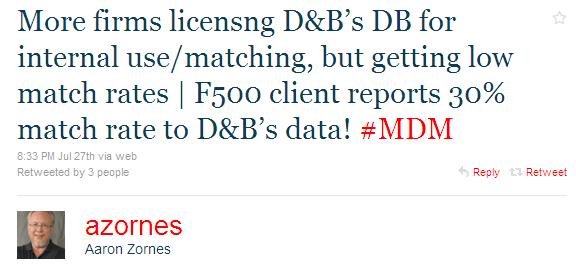
Just before I left for summer vacation I noticed a tweet by MDM guru Aaron Zornes saying:

This is a subject very close to me as I have worked a lot with business directory matching during the last 15 years not at least matching with the D&B WorldBase.

The problem is that if you match your B2B customers, suppliers and other business partners with a business directory like the D&B WorldBase you could naively expect a 100% match.

If your result is only a 30% hit rate the question is: How many among the remaining 70% are false negatives and how many are true negatives.

True negatives

There may be a lot of reasons for true negatives, namely:

  • Your business entity isn’t listed in the business directory. Some countries like those of the old Czechoslovakia, some English speaking countries in the Pacifics, the Nordic countries and others have a tight public registration of companies and then it is less tight from countries in North America, other European countries and the rest of the world.
  • Your supposed business entity isn’t a business entity. Many B2B customer/prospect tables holds a lot of entities not being a formal business entity but being a lot of other types of party master data.
  • Uniqueness may be different defined in the business directory and your table to be matched. This includes the perception of hierarchies of legal entities and branches – not at least governmental and local authority bodies is a fuzzy crowd. Also the different roles as those of small business owners are a challenge. The same is true about roles as franchise takers and the use of trading styles.

False negatives

In business directory matching the false negatives are those records that should have been matched by an automated function, but isn’t.

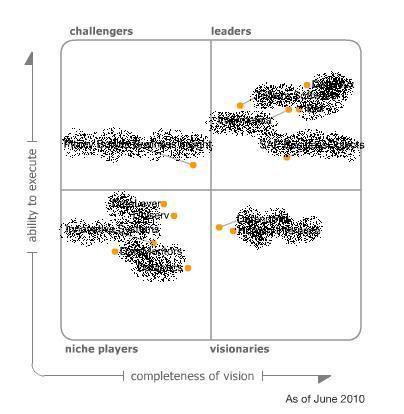
The number of false negatives is a measure of the effectiveness of the automated matching tool(s) and rules applied. Big companies often use the magic quadrant leaders in data quality tools, but these aren’t necessary the best tools for business directory matching.

Personally I have found that you need a very complex mix of tools and rules for getting a decent match rate in business directory matching, including combining both deterministic and probabilistic matching. Some different techniques are explained in more details here.

Bookmark and Share

No Re-Tweets?

12 hours ago from now I noticed the following tweet on Twitter from the profile @GartnerTedF:

The person behind @GartnerTedF is the analyst Ted Friedman of Gartner, Inc. He is a very important person in the data quality realm as he co-writes the Magic Quadrant.

Many of Ted’s tweets are usually re-tweeted by other tweeps.

But not this one.

I think I know why: It’s because technology simply doesn’t work.

I have noticed this often. What happens is that twitter somehow simply doesn’t index some tweets from time to time, so people don’t see them.

What a Lovely Day

As promised earlier today, here is the first post in an endless row of positive posts about success in data quality improvement.

This beautiful morning I finished yet another of these nice recurring jobs I do from time to time: Deduplicating bunches of files ready for direct marketing making sure that only one, the whole one and nothing but one unique message reaches a given individual decision maker, be that in the online or offline mailbox.

Most jobs are pretty similar and I have a fantastic tool that automates most of the work. I only have the pleasure to learn about the nature of the data and configure the standardisation and matching process accordingly in a user friendly interface. After the automated process I’m enjoying looking for any false positives and checking for false negatives. Sometimes I’m so lucky that I have the chance to repeat the process with a slightly different configuration so we reach the best result possible.

It’s a great feeling that this work reduces the costs of mailings at my clients, makes them look more smart and professional and facilitates that correct measure of response rates that is so essential in planning future even better direct marketing activities.

But that’s not all. I’m also delighted to be able to have a continuing chat about how we over time may introduce data quality prevention upstream at the point of data entry so we don’t have to do these recurring downstream cleansing activities any more. It’s always fascinating going through all the different applications that many organisations are running, some of them so old that I didn’t dream about they existed anymore. Most times we are able to build a solution that will work in the given landscape and anyway soon the credit crunch is totally gone and here we go.

I’ll be back again with more success from the data quality improvement frontier very soon.

Bookmark and Share

Seeing Is Believing

One of my regular activities as a practice manager at a data quality tool vendor is making what we call a ”Test Report”.

Such a “Test Report” is a preferable presale activity regardless of if we are against a competitor or the option of doing nothing (or no more) to improve data quality. In the latter case I usually name our competitor “Laissez-Faire”.

The most test reports I do is revolving around the most frequent data quality issue being duplicates in party master data – names and addresses.

Looking at what an advanced data matching tool can do with your customer master data and other business partner registries is often the decisive factor for choosing to implement the tool.

I like to do the test with a full extract of all current party master data.

A “Test Report” has two major outcomes:

  • Quantifying the estimated number of different types of duplicates, which is the basis for calculating expected Return on Investment for implementing such an advanced data matching tool.
  • Qualifying both some typical and some special examples in order to point at the tuning efforts needed both for an initial match and the recommended ongoing prevention.

When participating in follow up meetings I have found that discussions around what a tool can do (and not do) is much more sensible when backed up by concrete numbers and concrete examples with your particular data.

Bookmark and Share