Take an Ultra Short Survey on Product Data Exchange

How do you exchange product data with your trading partners today? At the Product Data Lake we would like to know some more about that. We do expect that many still send eMails with spreadsheets and digital assets. But please tell us how it is with you. Take the survey by clicking here.

Survey

Also please comment on this blog post on your plans or if you work with Product Information Management (PIM) as a service provider and have experiences to share.

Bookmark and Share

Self-service Ready Product Data

The increased use of self-service based sales approaches as in ecommerce has put a lot of pressure on cross company supply chains. Besides handling the logistics and controlling pricing, you also have to take care of a huge amount of product data and digital assets describing the goods.

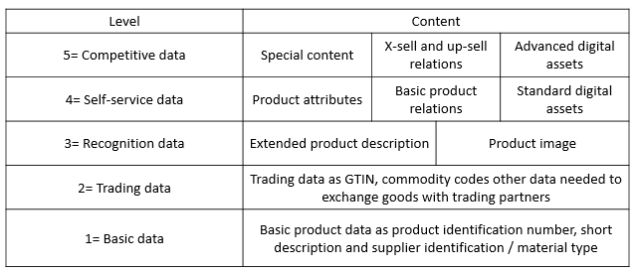
You may divide product information into these five levels:

Product Information Levels

Please learn more about the five levels of product information, including how hierarchies, pricing and logistics fits in, by visiting the product information castle.

Level 4 in this model is self-service product data being:

  • Product attributes, also sometimes called product properties or product features. These are up to thousands of different data elements that describes a product. Some are very common for most products like height, length, weight and colour. Some are very specific to the product category. This challenge is actually the reason of being for dedicated Product Information Management (PIM) solutions.
  • Basic product relations are the links between a product and other products like a product that have several different accessories that goes with the product or a product being a successor of another now decommissioned product.
  • Standard digital assets are documents like installation guides, line drawings and data sheets.

These are the product data that helps the end customer comparing products and making an objective choice when buying a product for a specific purpose of use. These data are also helpful in answering the questions a buyer may have when making a purchase.

Every piece of data belonging to any level of product information may be forwarded through the cross company supply chain from the manufacturer to the end seller. Self-service product data are however the data that most obviously will do so.

In order to support end customer self-service when producing, distributing and selling goods you must establish a process driven service that automates the introduction of new products with extensive product data, the inclusion of new kinds of product data and updates to those data. You must be a digitalized member of your business ecosystem. The modern solution for that is the Product Data Lake.

Bookmark and Share

Kinky Boots and Booths in London

Kinky BootsI am looking forward to visiting London in a fortnight and have already secured tickets for the new musical called Kinky Boots.

Another option is to pop in at the Master Data Management Summit Europe 2016 and the co-located Data Governance Conference Europe 2016 and visit the kinky booths where the exhibitors will tell you about their latest inventions. Someone to see could be:

SemarchySemarchy, who has always been kind of kinky with their evolutionary MDM approach as told in the post Eating the MDM Elephant. Last autumn I visited Semarchy in Lyon and it would be good to catch up with FX,  Richard and other good people from this exciting MDM vendor.

AtaccamaAtaccama has a kinky logo. Also on a recent engagement, we have been working with the data quality analyzer tool from Ataccama. So will be good to learn about all the other stuff as for example the big data analyzer.

Stibo SystemsStibo Systems, where I worked some years ago, has just released their new version 8.0 of STEP Trailblazer. This version has an enhanced web user interface. While STEP has always had lots of good functionality, I think many STEP users will welcome a more kinky user interface.

Bookmark and Share

Starting up at the age of 56

It is never too late to start up, I have heard. So despite I usually brag about having +35 years of experience in the intersection of business and IT and a huge been done list in Data Quality and Master Data Management (MDM) which can get me nice consultancy engagements, a certain need on the market has been puzzling in my head for some time.

Before that, when someone asked me what to do in the MDM space I told them to create something around sharing master data between organisations. Most MDM solutions are sold to a given organization to cover the internal processes there. There are not many solutions out there that covers what is going on between organizations.

But why not do that myself? – with the help of some younger people.

FirstLogoSaveYou may have noticed, that I during the last year have been writing about something called the Product Data Lake. This has until recently mostly just been a business concept that could be presented on power point slides. So called slideware. But now it is becoming real software being deployed in the cloud.

Right now a gifted team in Vietnam, where I also am this week, is building the solution. We aim to have it ready for the first trial subscribers in August 2016. We will also be exhibiting the solution in London in late September, where we will be at the Start-up Alley in the combined Customer Contact, eCommerce and Technology for Marketing exhibition.

At home in Denmark, some young people are working on our solution too as well as the related launching activities and social media upbeat. This includes a LinkedIn company page. For continuous stories about our start-up, please follow the Product Data Lake page on LinkedIn here.

Bookmark and Share

Multi-Side MDM

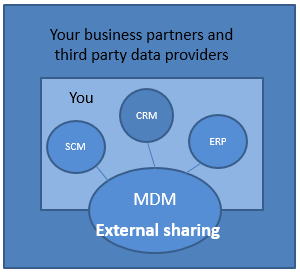
As reported in the post Gravitational Waves in the MDM World there is a tendency in the MDM (Master Data Management) market and in MDM programmes around to encompass both the party domain and the product domain.

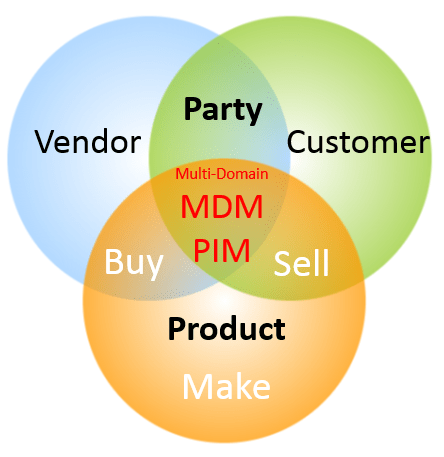
The party domain is still often treated as two separate domains, being the vendor (or supplier) domain and the customer domain. However, there are good reasons for seeing the intersection of vendor master data and customer master data as party master data. These reasons are most obvious when we look at the B2B (business-to-business) part of our master data, because:

  • You will always find that many real world entities have a vendor role as well as a customer role to you
  • The basic master data has the same structure (identification, names, addresses and contact data
  • You need the same third party validation and enrichment capabilities for customer roles and vendor roles.

These reasons also applies to other party roles as examined in the post 360° Business Partner View.

When we look at the product domain we also have a huge need to connect the buy side and the sell side of our business – and the make side for that matter where we have in-house production.

Multi-Side MDM

Multi-Domain MDM has a side effect, so to speak, about bringing the sell-side together with the buy- and make-side. PIM (Product Information Management), which we often see as the ancestor to product MDM, has the same challenge. Here we also need to bring the sell-side and and the buy-side together – on three frontiers:

  • Bringing the internal buy-side and sell-side together not at least when looking at product hierarchies
  • Bringing our buy-side in synchronization with our upstream vendors/suppliers sell-side when it comes to product data
  • Bringing our sell-side in synchronization with our downstream customers buy-side when it comes to product data

Bookmark and Share

A Quick Tour around the Product Data Lake

The Product Data Lake is a cloud service for sharing product data in the eco-systems of manufacturers, distributors, retailers and end users of product information.
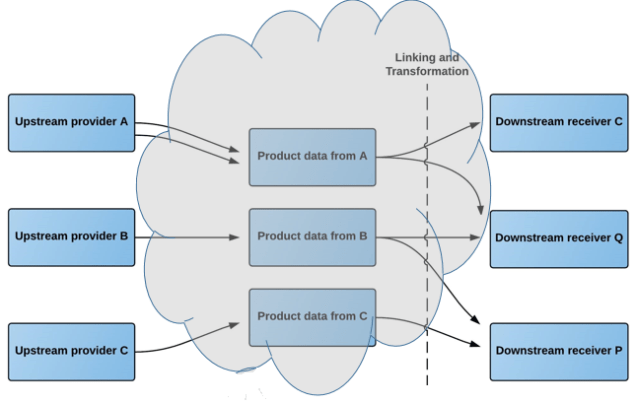
PDL tour 01As an upstream provider of products data, being a manufacturer or upstream distributor, you have these requirements:

  • When you introduces new products to the market, you want to make the related product data and digital assets available to  your downstream partners in a uniform way
  • When you win a new downstream partner you want the means to immediately and professionally provide product data and digital assets for the agreed range
  • When you add new products to an existing agreement with a downstream partner, you want to be able to provide product data and digital assets instantly and effortless
  • When you update your product data and related digital assets, you want a fast and seamless way of pushing it to your downstream partners
  • When you introduce a new product data attribute or digital asset type, you want a fast and seamless way of pushing it to your downstream partners.

The Product Data Lake facilitates these requirements by letting you push your product data into the lake in your in-house structure that may or may not be fully or partly compliant to an international standard.
PDL tour 02

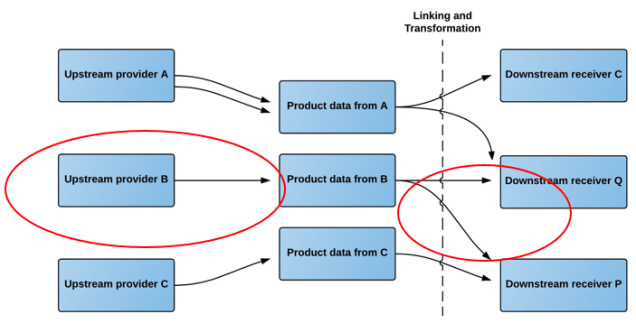
As an upstream provider, you may want to push product data and digital assets from several different internal sources.

The product data lake tackles this requirement by letting you operate several upload profiles.
PDL tour 03

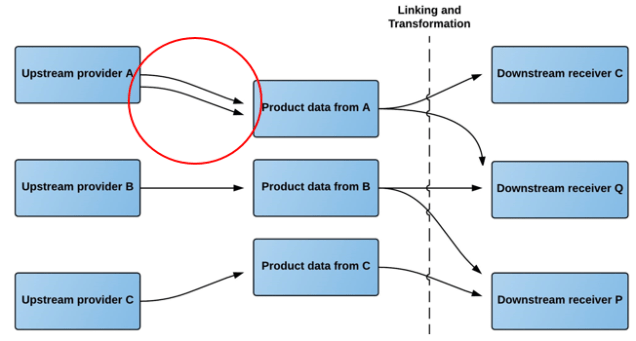
As a downstream receiver of product data, being a downstream distributor, retailer or end user, you have these requirements:

  • When you engage with a new upstream partner you want the means to fast and seamless link and transform product data and digital assets for the agreed range from the upstream partner
  • When you add new products to an existing agreement with an upstream partner, you want to be able to link and transform product data and digital assets in a fast and seamless way
  • When your upstream partners updates their product data and related digital assets, you want to be able to receive the updated product data and digital assets instantly and effortless
  • When you introduce a new product data attribute or digital asset type, you want a fast and seamless way of pulling it from your upstream partners
  • If you have a backlog of product data and digital asset collection with your upstream partners, you want a fast and cost effective approach to backfill the gap.

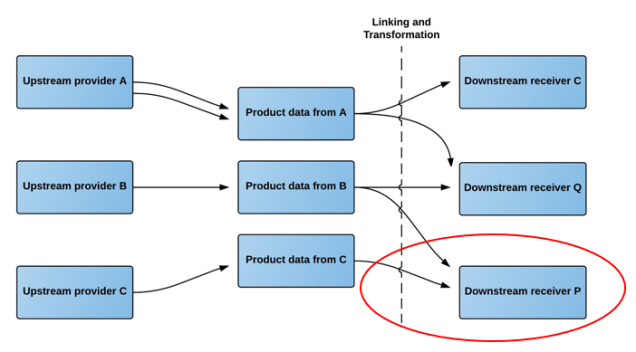
The Product Data Lake facilitates these requirements by letting you pull your product data from the lake in your in-house structure that may or may not be fully or partly compliant to an international standard.
PDL tour 04

In the Product Data Lake, you can take the role of being an upstream provider and a downstream receiver at the same time by being a midstream subscriber to the Product Data Lake. Thus, Product Data Lake covers the whole supply chain from manufacturing to retail and even the requirements of B2B (Business-to-Business) end users.
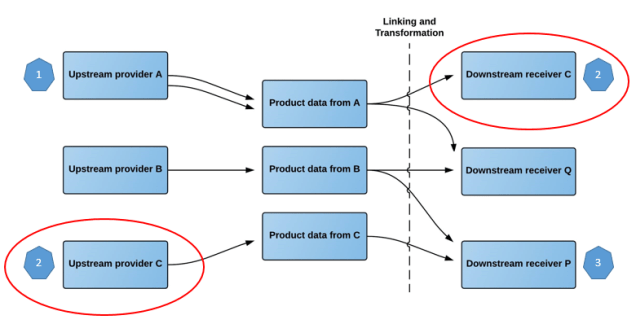
PDL tour 05

The Product Data Lake uses the data lake concept for big data by letting the transformation and linking of data between many structures be done when data are to be consumed for the first time. The goal is that the workload in this system has the resemblance of an iceberg where 10% of the ice is over water and 90 % is under water. In the Product Data Lake manually setting up the links and transformation rules should be 10 % of the duty and the rest being 90 % of the duty will be automated in the exchange zones between trading partners.

PDL tour 06

TwoLine Blue

Bookmark and Share

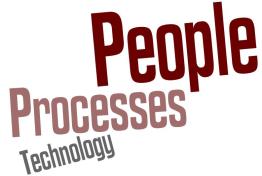
It is not all about People or Processes or Technology

People Processes TechnologyWhen following the articles, blog posts and other inspirational stuff in the data management realm you frequently stumble upon sayings about a unique angle towards what it is all about, like:

  • It is all about people, meaning that if you can change and control the attitude of people involved in data management everything will be just fine. The problem is that people have been around for thousands of years and we have not nailed that one yet – and probably will not do that isolated in the data management realm. But sure, a lot of consultancy fees will go down that drain still.
  • It is all about processes. Yes it is. The only problem is that processes are dependent on people and technology.
  • It is all about technology. Well, no one actually says so. However, relying on that sentiment – and that shit does happen, is a frequent reason why data management initiatives goes wrong.

The trick is to find a balance between a priceworthy people focused approach, a heartfelt process way of going forward and a solid methodology to exploit technology in the good cause of better data management all aligned with achieving business benefits.

How hard can it be?

Bookmark and Share

Tough Questions About MDM

This week I had the pleasure of speaking in Copenhagen at an event about The Evolution of MDM. The best speaking experiences is when there are questions and responses from the attendees. At this event, such lovely interuptions took us around some of the tough questions about Master Data Management (MDM), like

  • Is the single source of truth really achievable?
  • Does MDM belong within IT in the organization?
  • Is blockchain technology useful within MDM?

Single source of truth

Many seasoned MDM practitioners has experienced attempts to implement a single source of truth for a given MDM domain within a given organization and seen the attempt failed miserably. The obstacles are plentiful including business units with different goals and IT landscapes with heterogenic capabilities.

MDM Stage 3
Single place of trust

I think there is a common sentiment in the data management realm about to lower that bar a bit. Perhaps a single place of trust is a more realistic goal as examined in the post Three Stages of MDM Maturity.

MDM in IT

We all know that MDM should belong to the business part of the organization and anchoring MDM (and BI and CRM and so many other disciplines) in the IT part of the organization is a misunderstanding. However, we often see that MDM is placed in the IT department because IT already spans the needs of marketing, sales, logistics, finance and so on.

My take is that the actual vision, goals and holistic business involvement trumps the formal organizational anchoring. Currently I work with two MDM programmes, one anchored in IT and one in finance. As an MDM practitioner, you have to deal with business and IT anyway.

Blockchain

Blockchain is a new technology disrupting business these days. Recently Andrew White of Gartner blogged about how blockchain thinking could go where traditional single view of master data approaches haven’t been able to go. The blog post is called Why not Blockchain Data Synchronization? As Andrew states: “The next year could be very interesting, and very disrupted.”

PS: My slides from the event are available here: MDM before, now and in the future.

MDM Tools Revealed

Every organization needs Master Data Management (MDM). But does every organization need a MDM tool?

In many ways the MDM tools we see on the market resembles common database tools. But there are some things the MDM tools do better than a common database management tool. The post called The Database versus the Hub outlines three such features being:

  • Controlling hierarchical completeness
  • Achieving a Single Business Partner View
  • Exploiting Real World Awareness

Controlling hierarchical completeness and achieving a single business partner view is closely related to the two things data quality tools do better than common database systems as explained in the post Data Quality Tools Revealed. These two features are:

  • Data profiling and
  • Data matching

Specialized data profiling tools are very good at providing out-of-the-box functionality for statistical summaries and frequency distributions for the unique values and formats found within the fields of your data sources in order to measure data quality and find critical areas that may harm your business. These capabilities are often better and easier to use than what you find inside a MDM tool. However, in order to measure the improvement in a business context and fix the problems not just in a one-off you need a solid MDM environment.

When it comes to data matching we also still see specialized solutions that are more effective and easier to use than what is typically delivered inside MDM solutions. Besides that, we also see business scenarios where it is better to do the data matching outside the MDM platform as examined in the post The Place for Data Matching in and around MDM.

Looking at the single MDM domains we also see alternatives. Customer Relation Management (CRM) systems are popular as a choice for managing customer master data.  But as explained in the post CRM systems and Customer MDM: CRM systems are said to deliver a Single Customer View but usually they don’t. The way CRM systems are built, used and integrated is a certain track to create duplicates. Some remedies for that are touched in the post The Good, Better and Best Way of Avoiding Duplicates.

integriertWith product master data we also have Product Information Management (PIM) solutions. From what I have seen PIM solutions has one key capability that is essentially different from a common database solution and how many MDM solutions, that are built with party master data in mind, has. That is a flexible and super user angled way of building hierarchies and assigning attributes to entities – in this case particularly products. If you offer customer self-service, like in eCommerce, with products that have varying attributes you need PIM functionality. If you want to do this smart, you need a collaboration environment for supplier self-service as well as pondered in the post Chinese Whispers and Data Quality.

All in all the necessary components and combinations for a suitable MDM toolbox are plentiful and can be obtained by one-stop-shopping or by putting some best-of-breed solutions together.

My 2016 MDM Clairvoyance

Bowl
Magic glass bowl

Now is the time of the year where you can try predicting what will happen in the next year within a certain field of interest to you.

When we talk about predictions within data management, we usually mean something based on analysing historical data with emphasis on seeing some recent trends.

My precognitions for the Master Data Management (MDM) market I have to admit is of the more traditional kind. Gut feelings. Qualified guessing if you like.

So, here are three foreseeings:

  • Gartner, the analyst firm, will finally stop publishing two magic quadrants for MDM (one for customer and product MDM) and, using some suitable data from their surveys, admit that there now is only one true multidomain market for larger MDM vendors. They might however introduce a new quadrant for what was more or less known as Product Information Management (PIM). But under a new term and with focus on eCommerce capabilities.
  • There will be more acquisitions in the market than seen since five years ago. At least one of the larger former product MDM specialists will buy a customer MDM specialist first and foremost in order to gain reference clients. Also MDM vendors will be looking for buying land in the new big data world.
  • The numbers and scopes of MDM projects will increase and therefore there will be a shortage of people with MDM experience. This trend will pave the way for more agile approaches to MDM including implementing less complex MDM solutions and services whereof most, in contradiction to the multidomain trend, will be domain (customer/party, product, location) niche players.