Follow Friday Data Quality

Every Friday on Twitter people are recommending other tweeps to follow using the #FollowFriday (or simply #FF) hash tag.

My username on twitter is @hlsdk.

Sometimes I notice tweeps I follow are recommending the username @hldsk or @hsldk or other usernames with my five letters swapped.

It could be they meant me? – but misspelled the username. Or they meant someone else with a username close to mine?

As the other usernames wasn’t taken I have taken the liberty to create some duplicate (shame on me) profiles and have a bit of (nerdish) fun with it:

@hsldk

For this profile I have chosen the image being the Swedish Chef from the Muppet show. To make the Swedish connection real the location on the profile is set as “Oresund Region”, which is the binational metropolitan area around the Danish capital Copenhagen and the 3rd largest Swedish city Malmoe as explained in the post The Perfect Wrong Answer.

@hldsk

For this profile I have chosen the image being a gorilla originally used in the post Gorilla Data Quality.

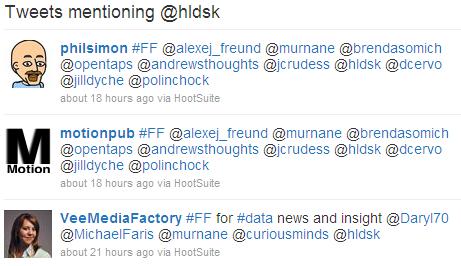
This Friday @hldsk was recommended thrice.

But I think only by two real life individuals: Joanne Wright from Vee Media and Phil Simon who also tweets as his new (one-man-band I guess) publishing company.
What’s the point?

Well, one of my main activities in business is hunting duplicates in party master databases.

What I sometimes find is that duplicates (several rows representing the same real world entity) have been entered for a good reason in order to fulfill the immediate purpose of use.

The thing with Phil and his one-man-band company is explained further in the post So, What About SOHO Homes.

By the way, Phil is going to publish a book called The New Small. It’s about: How a New Breed of Small Businesses is Harnessing the Power of Emerging Technologies.

Bookmark and Share

Linked Data Quality

The concept of linked data within the semantic web is in my eyes a huge opportunity for getting data and information quality improvement done.

The premises for that is described on the page Data Quality 3.0.

Until now data quality has been largely defined as: Fit for purpose of use.

The problem however is that most data – not at least master data – have multiple uses.

My thesis is that there is a breakeven point when including more and more purposes where it will be less cumbersome to reflect the real world object rather than trying to align fitness for all known purposes.

If we look at the different types of master data and what possibilities that may arise from linked data, this is what initially comes to my mind:

Location master data

Location data has been some of the data types that have been used the most already on the web. Linking a hotel, a company, a house for sale and so on to a map is an immediate visual feature appealing to most people. Many databases around however have poor location data as for example inadequate postal addresses. The demand for making these data “mappable” will increase to near unavoidable, but fortunately the services for doing so with linked data will help.

Hopefully increased open government data will help solve the data supply issue here.

Party master data

Linking party master data to external data sources is not new at all, but unfortunately not as widespread as it could be. The main obstacle until now has been smooth integration into business processes.

Having linked data describing real world entities on the web will make this game a whole lot easier.

Actually I’m working on implementations in this field right now.

Product master data

Traditionally the external data sources available for describing product master data has been few – and hard to find. But surely, at lot of data is already out there waiting to be found, categorized, matched and linked.

Bookmark and Share

Four Different Data Matching Stage Types

One of the activities I do in my leisure time is cycling. As a consequence I guess I also like to watch cycling on TV (or on the computer), not at least the cycling sport paramount of the year: Le Tour de France.

In Le Tour de France you basically have four different types of stages:

  • Time trial
  • Stages on flat terrain
  • Stages through hilly landscape
  • Stages in the high mountains

Some riders are specialists in one of the stage types and some riders are more all-around types.

With automated data matching, which is what I do the most in my business time, there are basically also four different types of processes:

  • Internal deduplication of rows inside one table
  • Removal of rows in one table which also appears in another table
  • Consolidation of rows from several tables
  • Reference matching with rows in one table against another (big) table

Internal deduplication

Examples of data matching objectives here is finding duplicates in names and addresses before sending a direct mail or finding the same products in a material master.

The big question in this type of process is if you are able to balance between not making any false positives (being too aggressive) while not leaving to many to many false negatives behind (losing the game). You also have to think about survivorship when merging into a golden record.

In Le Tour de France the overall leader who gets the yellow jersey has to make a good time trial.

Removal

Here the examples of data matching objectives will be eliminating nixies (people who don’t want offerings by mail) before sending a direct mail or eliminating bad payers (people you don’t want to offer a credit).

Probably the easiest process everyone can do – but in the end of the day some are better sprinters than others.

The best sprinter in Le Tour de France gets the green jersey.

Consolidation

When migrating databases and/or building a master data hub you often have to merge rows from several different tables into a golden copy.

Here you often see the difficulty of making data fit for the immediate purpose of use and at the same time be aligned with the real world in order to also being able to handle the needs that arises tomorrow.

Often some of the young riders in Le Tour de France makes an escape when climbing the hills and gets the white jersey.

Reference match

Doing business directory matching has been a focus area of mine including making a solution for match with the D&B worldbase. The worldbase holds over 165 million rows representing business entities from all over the world.

The results from automated matching with such directories may vary a lot like you see huge time differences in Le Tour de France when the riders faces the big mountains. Here the best climber gets the polka dotted jersey.

Bookmark and Share

Mixed Identities

A frequent challenge when building a customer master data hub is dealing with incoming records from operational systems where the data in one record belongs to several real world entities.

One situation may be that that a name contains two (or more) real world names. This situation was discussed in the post Splitting names.

Another situation may be that:

  • The name belongs to real world entity X
  • The address belongs to real world entity Y
  • The national identification number belongs to real world entity Z

Fortunately most cases only have 2 different real world representations like X and Y or Y and Z.

An example I have encountered often is when a company delivers a service through another organization. Then you may have:

  • The name of the 3rd party organization in the name column(s)
  • The address of the (private) end user in the address columns

Or as I remember seen once:

  • The name of the (private) end user in the name column(s)
  • The address of the (private) end user in the address columns
  • The company national identification number of the 3rd party organization in the national ID column

Of course the root cause solution to this will be a better (and perhaps more complex) way of gathering master data in the operational systems. But most companies have old and not so easy changeable systems running core business activities. Swapping to new systems in a rush isn’t something just done either. Also data gathering may take place outside your company making the data governance much more political.

A solution downstream at the data matching gates of the master data hub may be to facilitate complex hierarchy building.

Oftentimes the solution will be that the single customer view in the master data hub will be challenged from the start as the data in some perception is fit for the intended purpose of use.

Bookmark and Share

Location, Location, Location

Now, I am not going to write about the importance of location when selling real estates, but I am going to provide three examples about knowing about the location when you are doing data matching like trying to find duplicates in names and addresses.

Location uniqueness

Let’s say we have these two records:

  • Stefani Germanotta, Main Street, Anytown
  • Stefani Germanotta, Main Street, Anytown

The data is character by character exactly the same. But:

  • There is only a very high probability that it is the same real world individual if there is only one address on Main Street in Anytown.
  • If there are only a few addresses on Main Street in Anytown, you will still have a fair probability that this is the same individual.
  • But if there are hundreds of addresses on Main Street in Anytown, the probability that this is the same individual will be below threshold for many matching purposes.

Of course, if you are sending a direct marketing letter it is pointless sending both letters, as:

  • Either they will be delivered in the same mailbox.
  • Or both will be returned by postal service.

So this example highlights a major point in data quality. If you are matching for a single purpose of use like direct marketing you may apply simple processing. But if you are matching for multiple purposes of use like building a master data hub, you don’t avoid some kind of complexity.

Location enrichment

Let’s say we have these two records:

  • Alejandro Germanotta, 123 Main Street, Anytown
  • Alejandro Germanotta, 123 Main Street, Anytown

If you know that 123 Main Street in Anytown is a single family house there is a high probability that this is the same real world individual.

But if you know that 123 Main Street in Anytown is a building used as a nursing home, a campus or that this entrance has many apartments or other kind of units, then it is not so certain that these records represents the same real world individual (not at least if the name is John Smith).

So this example highlights the importance of using external reference data in data matching.

Location geocoding

Let’s say we have these two records:

  • Gaga Real Estate, 1 Main Street, Anytown
  • L.  Gaga Real Estate, Central Square, Anytown

If you match using the street address, the match is not that close.

But if you assigned a geocode for the two addresses, then the two addresses may be very close (just around the corner) and your match will then be pretty confident.

Assigning geocodes usually serve other purposes than data matching. So this example highlights how enhancing your data may have several positive impacts.

Bookmark and Share

Real World Alignment

I am currently involved in a data management program dealing with multi-entity (multi-domain) master data management described here.

Besides covering several different data domains as business partners, products, locations and timetables the data also serves multiple purposes of use. The client is within public transit so the subject areas are called terms as production planning (scheduling), operation monitoring, fare collection and use of service.

A key principle is that the same data should only be stored once, but in a way that makes it serve as high quality information in the different contexts. Doing that is often balancing between the two ways data may be of high quality:

  • Either they are fit for their intended uses
  • Or they correctly represent the real-world construct to which they refer

Some of the balancing has been:

Customer Identification

For some intended uses you don’t have to know the precise identity of a passenger. For some other intended uses you must know the identity. The latter cases at my client include giving discounts based on age and transport need like when attending educational activity. Also when fighting fraud it helps knowing the identity. So the data governance policy (and a business rule) is that customers for most products must provide a national identification number.

Like it or not: Having the ID makes a lot of things easier. Uniqueness isn’t a big challenge like in many other master data programs. It is also a straight forward process when you like to enrich your data. An example here is accurately geocoding where your customer live, which is rather essential when you provide transportation services.

What geocode?

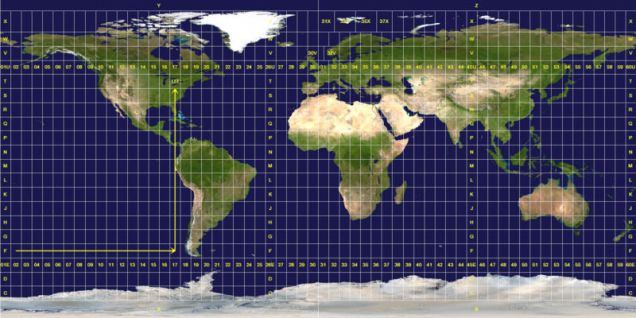
You may use a range of different coordinate systems to express a position as explained here on Wikipedia. Some systems refers to a round globe (and yes, the real world, the earth, is round), but it is a lot easier to use a system like the one called UTM where you easily may calculate the distance between two points directly in meters assuming the real world is as flat as your computer screen.


Bookmark and Share

Citizen ID within seconds

Here is a picture of my grandson Jonas taken minutes after his was born. He has a ribbon around his wrist showing his citizen ID which has just been assigned. There is even a barcode with it on the ribbon.

Now, I have mixed feelings about that. It is indeed very impersonal. But as a data quality professional I do realize that this is a way of solving a problem at the root. Duplicate master data in healthcare is a serious problem as Dylan Jones reported last year when he had a son in this article from DataQualityPro.

A unique citizen ID (National identification number) assigned in seconds after a birth have a lot of advantages. As said it is a foundation for data quality in healthcare from the very start of a life. Later when you get your first job you hand the citizen ID to your employer and tax is collected automatically. When the rest of the money is in the bank you are uniquely identified there. When you turn 18 you are seamlessly put on the electoral roll. Later your marriage is merely a relation in a government database between your citizen ID and the citizen ID of your beloved one.

Oh joy, Master Data Management at the very best.


Bookmark and Share

Data Matching 101

Following up on my post no. 100 I can’t resist making a post having 101 in the title. I’ll use 101 in the meaning of an introduction to a subject. As “Data Quality 101” and “MDM 101” is already widely discussed I think “Data Matching 101” is a good title.

Data matching deals with the dimension of data quality I like to call uniqueness. I use uniqueness because it is the positive term describing the state we want to bring our data to – opposite to duplication which is the state we want to change. Just like the other dimensions of data quality also describes the desired states such as accuracy, consistency and timeliness.

Data matching is besides data profiling the activity within data quality that has been automated the most.  No wonder since duplicates in especially master data and master data not being aligned with the real world is costing organizations incredible amounts of money. Finding duplicates among millions (or even thousands) of records by manual means is impossible. The same is true for matching with directories with timely descriptions of the real world. You have to use a computerized approach controlled by exactly that amount of manual verification that makes your return on investment positive.

Matching names and addresses (party master data) is the most common area of data matching. Matching product master data is probably going to be the next big thing in matching. I have also been involved in matching location data and timetables.

A computerized approach to data matching may include some different techniques like parsing and standardization, using synonyms, assigning match codes, advanced algorithms and probabilistic learning.

All that is best explained with examples. Therefore I am happy to do a webinar called “The Art of Data Matching” as part of a series of free webinars on eLearningCurve. The webinar will be a sightseeing looking at examples on challenges and solutions in the data matching world.

Date and time: Well, these are matching examples of expressing the moment the webinar starts:

  • Friday 06/04/10 12pm EDT
  • Friday 04/06/10 18:00 Central European Summer Time
  • Sydney, Sat Jun 5 2:00 AM

Link to the eLearningCurve free webinar here.

Bookmark and Share

Relational Data Quality

Most of the work related to data quality improvement I do is done with data in relational databases and is aimed at creating new relations between data. Examples (from party master data) are:

  • Make a relation between a postal address in a customer table and a real world address (represented in an official address dictionary).
  • Make a relation between a business entity in a vendor table and a real world business (represented in a business directory most often derived from an official business register).
  • Make a relation between a consumer in one prospect table and a consumer in another prospect table because they are considered to represent the same real world person.

When striving for multi-purpose data quality it is often necessary to reflect further relations from the real world like:

  • Make a relation in a database reflecting that two (or more) persons belongs to the same household (on the same real world address)
  • Make a relation in the database reflecting that two (or more) companies have the same (ultimate) mother.

Having these relations done right is fundamental for any further data quality improvement endeavors and all the exciting business intelligence stuff. In doing that you may continue to have more or less fruitful discussions on say the classic question: What is a customer?

But in my eyes, in relation to data quality, it doesn’t matter if that discussion ends with that a given row in your database is a customer, an old customer, a prospect or something else. Building the relations may even help you realize what that someone really is. Could be a sporadic lead is recognized as belonging to the same household as a good customer. Could be a vendor is recognized as being a daughter company of a hot prospect. Could be someone is recognized as being fake. And you may even have some business intelligence that based on the relations may report a given row as a customer role in one context and another role in another context.