Passive vs Active Product Information Exchange

Product information is the kind of data that usually flows cross company. The most common routes start with that the hard facts about a product originates at the manufacturer. Then the information may be used on the brands own website, propagated to a marketplace (online shop-in-shop) and also propagated downstream to distributors and merchants.

The challenge to the manufacturer is that this represent many different ways of providing product information, not at least when it comes to distributors and merchants, as these will require different structures and formats using various standards and not being on the same maturity level.

Looking at this from the downstream side, the distributors and merchants, we have the opposite challenge. Manufacturers provide product information in different structurers and formats using various standards and are not on the same maturity level.

Supply chain participants can challenge this in a passive or an active way. Unfortunately, many have chosen – or are about to choose – the passive way. It goes like this:

  • As a manufacturer, we have a product data portal where trading partners who wants to do business with us, who obviously is the best manufacturer in our field, can download the product information we have in our structure and format using the standards we have found best.
  • As a distributor/merchant we have a supplier product data portal where trading partners who wants to do business with us, the leading player in our field, can upload the product information we for the time being will require in our structure and format using the standard(s) we have found best.

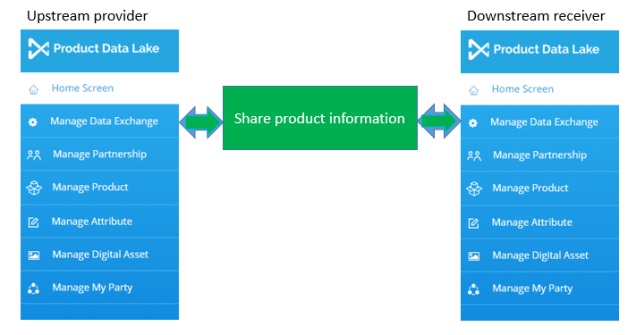
Passive vs ActiveThis approach seems to work if you are bigger than your trading partner. And many times one will be bigger than the other. But unless you are very big, you will in many cases not be the biggest. And in all cases where you are the biggest, you will not be seen as a company being easy to do business with, which eventually will decide how big you will stay.

The better way is the active way creating a win-win situation for all trading partners as described in the article about Product Data Lake Business Benefits.

Product Data Management is Like an Ironman

cofToday we have an Ironman passing through the streets of Copenhagen (and my breakfast). Kudos to the women and men who first have been on a swim lane of 3.86 km (2.4 miles), now is cycling 180.25 km (112 miles) and then will run a full Marathon of 42.2 km (26.22 miles).

Thinking about it doing product data management is a bit like an Ironman too. Overall it is a daunting task. And we have three disciplines to cover:

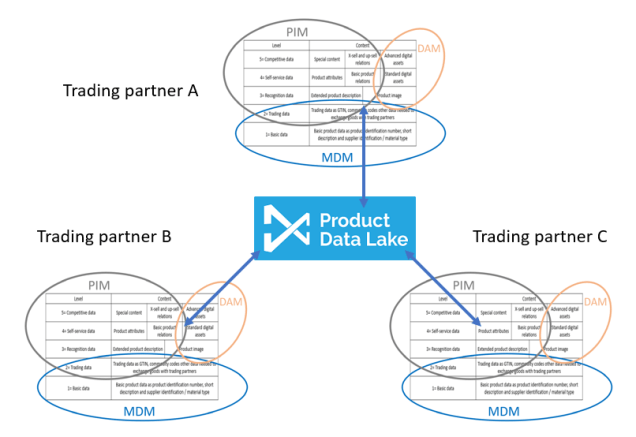
  • Digital Asset Management (DAM) is an activity where many organizations start. It is about handling product images in various sizes and versions along the way, as well as, depending on the product category, installation guides, line drawings, data sheets and other documents. Also videos with that and other content is becoming popular.
  • Product Information Management (PIM) is about maintaining hundreds (sometimes thousands) of different attributes describing a product. Some of these attributes are common for most products (like height, weight and colour) and some are very specific for a given product category.
  • Master Data Management (MDM) is a Marathon in itself. Here you link the above product data with product data in the overall system landscape including ERP, SCM (Supply Chain Management) and PLM (Product Lifecycle Management). Product data also forms the product domain that must be aligned with the location domain, asset domain, party domain and perhaps other domains in your MDM world.

How these disciplines stick together within your organization and your digital ecosystem was further examined in the post How MDM, PIM and DAM Stick Together.

The Link Between Privacy and Product Data

Do we as a consumer need to be told what to buy? Or do we rather want to be told what we are buying?

This theme was examined in a previous post titled You Must Supplement Customer Insight with Rich Product Data.

Not at least on the European scene with the upcoming General Data Protection Regulation (GDPR) there are limits to how far you can go in profiling your (prospective) costumers. And I am sure those people will value more you are telling them the complete story about your products, rather than guessing what products (from your range) they might need.

As a consumer, we want the facts about the products to make a self-service purchase. We want to be able to search for and navigate precisely to a product suitable for a specific use. We want the facts in a way, so we can compare, perhaps using a comparison service, between different brands and lines. We want to know what accessories goes with what product. We want to know what spare parts goes with what product.

By the way: Business buyers want all that too. And a person being a business buyer is a person (data subject) in the eyes of GDPR too.

For providing complete and consistent product data you as a (re)seller need to maintain high quality product data and if your product portfolio is just above very very simple, you need a Product Information Management (PIM) solution and, if you have trading partners, you need a PIM-2-PIM solution to exchange product information with your trading partners.

pdl-how-4

Supplier 360 + Product 360 = The Buy Side Oval

Having a 360 degree of something is a recurring subject within Master Data Management (MDM). “Customer 360” is probably the most used term. “Product 360” is promoted from time to time too and occasionally we also stumble upon “Supplier 360” (or “Vendor 360”).

Product 360 was recently examined by Simon Walker of Gartner, the analyst firm, in the post Creating the 360-Degree view of Product.

Supplier 360, as in having a single golden supplier/vendor record to connect all databases, was touched by Grant Watling of HICX Solutions a while ago in the post All Aboard! Six steps to supplier onboarding.

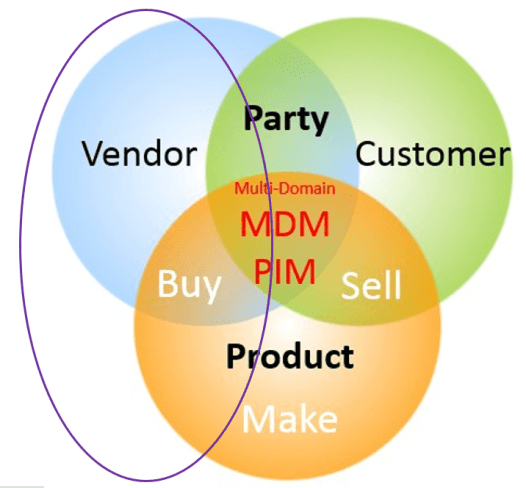
The Buy Side Oval is a combination of Product 360 and Supplier 360

Buy Side MDM 

Within (Multi-Domain) Master Data Management (MDM) and Product Information Management (PIM) we must be able to provide solutions that enables the buy side to effectively and consistently handle the core entities involved.

The solution to that is not having a supplier product data portal as discussed in the post PIM Supplier Portals: Are They Good or Bad? A key part lies outside your in-house platform in the business ecosystem where you and your suppliers all are participants and can be achieved as told in the post Master Data, Product Information, Digital Assets and Digital Ecosystems.

Master Data, Product Information, Digital Assets and Digital Ecosystems

When it comes to mastering product data there are these three kinds of data and supporting managing disciplines and solutions:

  • Master data and the supporting Master Data Management (MDM) discipline and a choice of MDM solutions for the technology part
  • Product information and the supporting Product Information Management (PIM) discipline and a choice of PIM solutions for the technology part
  • Digital assets and the supporting Digital Asset Management (DAM) discipline and a choice of DAM solutions for the technology part

What these disciplines are and how the available solutions relate was examined in the post How MDM, PIM and DAM Sticks Together. This post includes a model for that proposed by Simon Walker of Gartner (the analyst firm).

The right mix for your company depends on your business model and you will also have the choice of using a best of breed technology solution for your focus, that being MDM, PIM or DAM, as well as there are choices for a same branded solution, and in some cases also actually integrated solution, that supports MDM, PIM and DAM.

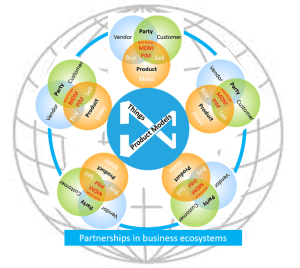
When selecting a (product) data management platform today you also must consider how this platform supports taking part in digital ecosystems, here meaning how you share product data with your trading partners in business ecosystems.

For the digital platform part supporting interacting with master data, product information and digital assets with your trading partners, who might have another focus than you, the solution is Product Data Lake.

MDM PIM DAM PDL

MDM / PIM Platform Vendors Need to Grow Up Too

Participating in digital ecosystems is the way forward for enterprises who wants to be tomorrow’s winners through digital transformation.

Some figures from Gartner, the analyst firm, tells this about digital transformation:

  • 79% of top performing companies indicate that they participate in a digital ecosystem
  • 49% of typical companies indicate the same
  • 24% of trailing companies does it

These figures were lately examined by Bryan Kirschner of Apigee (now part of Google) in a Cio.com article called Ecosystems: when digital transformation grows up.

Master Data Share
Master Data Share for Business Ecosystems

As a Master Data Management (MDM) and/or Product Information Management (PIM) platform vendor you should support your current and prospective clients with means to participate in digital ecosystems.

Current offerings from MDM and PIM platforms vendors have become quite mature in supporting inhouse (enterprise wide) handling of master data and product information. Next step is supporting sharing within business ecosystems. A concept for that is introduced in Master Data Share.

Country of Origin: An Increasingly Complex Data Element

When you buy stuff one of the characteristics you may emphasis on is where the stuff is made: The country of origin.

Buying domestic goods has always been both a political issue and something that in people’s mind may be an extra quality sign. When I lived in The UK I noticed that meat was promoted as British (maybe except from Danish bacon). Now when back in Denmark all meat seems to be best when made in Denmark (maybe except from an Argentinian beef). However, regulations have already affected the made in marking for meat, so you have to state several countries of origins in the product lifecycle.

Luxury shoes
Luxury shoes of multi-cultural origin

For some goods a given country of origin seems to be a quality sign. With luxury goods as fine shoes you can still get away with stating Italy or France as country of origin while most of the work has been made elsewhere as told in this article from The Guardian that Revealed: the Romanian site where Louis Vuitton makes its Italian shoes.

Country of origin is a product data element that you need to handle for regulatory reasons not at least when moving goods across borders. Here it is connected with commodity codes telling what kind of product it is in the custom way of classifying products as examined in the post Five Product Classification Standards.

When working with product data management for products that moves cross border you are increasingly asked to be more specific about the country of origin. For example, if you have a product consisting of several parts, you must specify the country of origin for each part.

Obstacles to Product Information Sharing

In a recent poll on this blog we had this question about how to share product information with trading partners:

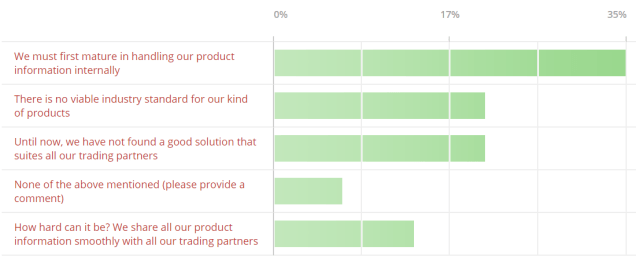
As a manufacturer: What is Your Toughest Product Information Sharing Issue?

The result turned out as seen below:

Survey final

Product information flow in supply chains will typically start with that manufacturers shares the detailed hard facts about products to the benefit of downstream partners as examined in the post Using Internal and External Product Information to Win.

This survey points to that the main reason why this does that take place is that manufacturers need to mature in handling and consolidating product information internally, before they are confident in sharing the detailed data elements (in an automated way) with their downstream partners. This subject was elaborated in the post Product Information Sharing Issue No 1: We Need to Mature Internally.

Another obstacle is the lack of a common standard for product information in the business ecosystem where the manufacturer is a part as further examined in the post Product Information Sharing Issue No 2: No Viable Standard.

Issue no 3 is the apparent absence of a good solution for sharing product information with trading partners that suites the whole business ecosystem. I guess it is needless to say to regular readers of this blog that, besides being able to support issue no 1 and issue no 2, that solution is Product Data Lake.

Product Information Sharing Issue No 1: We Need to Mature Internally

A current poll on sharing product information with trading partners running on this blog has this question: As a manufacturer: What is Your Toughest Product Information Sharing Issue?

The most votes in the current standing has gone to this answer:

We must first mature in handling our product information internally

PDL MenuSolving this issue is one of the things we do at Liliendahl.com. Besides being an advisory service in the Master Data Management (MDM) and Product Information Management (PIM) space, we have a developing collaboration with companies providing consultancy, cleansing and, when you come to that step, specialized technology for inhouse MDM and PIM. Take a look at Our Business Ecosystem.

If you are a manufacturer with a limited need for scaling the PIM technology part and already have much of your needs covered by an ERP and/or Product Lifecycle Management (PLM) solution, you may also fulfill your inhouse PIM capabilities and the external sharing needs in one go by joining Product Data Lake.

Your Toughest Upstream Product Information Sharing Issue

Only 5 percent of organizations share all their product data electronically with supply chain partners. So, there is room for improvement.

At Product Data Lake we want to find out what are the issues that is holding companies back from smoothly sharing product information with trading partners.

We will start with where product information is born: Upstream, at the manufacturer. If you work at a company being a manufacturer of goods, please answer the below question:

PS: If you do not work for a manufacturer, but know someone who does, please forward the poll.