Some Deduplication Tactics

When doing the data quality kind of deduplication you will often have two kinds of data matching involved:

  • Data matching in order to find duplicates internally in your master data, most often your customer database
  • Data matching in order to align your master data with an external registry

As the latter activity also helps with finding the internal duplicates, a good question is in which order to do these two activities.

External identifiers

If we for example look at business-to-business (B2B) customer master data it is possible to match against a business directory. Some choices are:

  • If you have mostly domestic data in a country with a public company registration you can obtain a national ID from matching with a business directory based on such a registry. An example will be the French SIREN/SIRET identifiers as mentioned in the post Single Company View.
  • Some registries cover a range of countries. An example is the EuroContactPool where each business entity is identified with a Site ID.
  • The Dun & Bradstreet WorldBase covers the whole world by identifying approximately 200 million active and dissolved business entities with a DUNS-number. The DUNS-number also serves as a privatized national ID for companies in the United States.

If you start with matching your B2B customers against such a registry, you will get a unique identifier that can be attached to your internal customer master data records which will make a succeeding internal deduplication a no-brainer.

Common matching issues

A problem is however is that you seldom get a 100 % hit rate in a business directory matching, often not even close as examined in the post 3 out of 10.
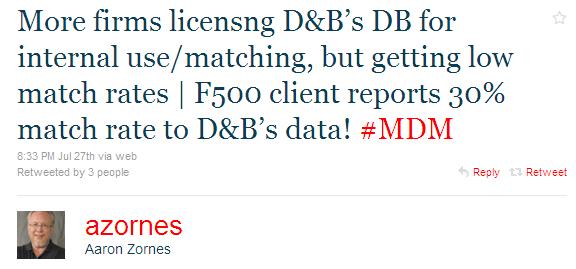
Another issue is the commercial implications. Business directory matching is often performed as an external service priced per record. Therefore you may save money by merging the duplicates before passing on to external matching. And even if everything is done internally, removing the duplicates before directory matching will save process load.

However a common pitfall is that an internal deduplication may merge two similar records that actually are represented by two different entities in the business directory (and the real world).

So, as many things data matching, the answer to the sequence question is often: Both.

A good process sequence may be this one:

  1. An internal deduplication with very tight settings
  2. A match against an external registry
  3. An internal deduplication exploiting external identifiers and having more loose settings for similarities not involving an external identifier

Bookmark and Share

Phishing in Wrong Waters

Yesterday a lot of Danes received an e-mail apparently coming from the tax authorities but was a phishing attempt.

The form to be filled may seem professional at first glance, but it actually had errors all over.


While such errors may be common in phishing as the ones behind only need a fraction of the receivers to take the bite, you actually do see many of the errors in lawful activities.

Some of the errors in the phishing attempt were:

  • It is very unlikely that the public sector would communicate in English instead of Danish
  • They got our national ID for every citizen right; it is called CPR-NR. But why ask for date of birth as this is included in the national ID.
  • Asking for “Mother Maiden Name” and “The name of your son” seems ridiculous to me. Don’t know if it’s some kind of custom anywhere else in the world.
  • The address format is (as usual) a United States standard. Here it would be: Address, Postal Code, Town/City.
  • You would never expect the public sector to pay anything to your credit/debit card. Our national ID is connected to a bank account selected for that purpose.

As the tax authorities stated in a warning e-mail today: “We do not know of anyone who has been cheated by the mail”.

I guess they are right.

Also, if you are doing lawful activities but committing the same kind of diversity errors in your forms: Don’t expect a whole lot of conversion.

Bookmark and Share

A Business Rule and a Missing Master Data Hub

It seems that the United States of America has a problem with the business rule saying you have to be born in the country to become president and a missing citizen master data hub telling about who’s born in the country.

This is an aspect of a previous blog post called Did They Put a Man on the Moon.

Bookmark and Share

Single Company View

Getting a single customer view in business-to-business (B2B) operations isn’t straight forward. Besides all the fuzz about agreeing on a common definition of a customer within each enterprise usually revolving around fitting multiple purposes of use, we also have complexities in real world alignment.

One Number Utopia

Back in the 80’s I worked as a secretary for the committee that prepared a single registry for companies in Denmark. This practice has been live for many years now.

But in most other countries there are several different public registries for companies resulting in multiple numbering systems.

Within the European Union there is a common registry embracing VAT numbers from all member states. The standard format is the two letter ISO country code followed by the different formatted VAT number in each country – some with both digits and letters.

The DUNS-number used by Dun & Bradstreet is the closest we get to a world-wide unique company numbering system.  

2-Tier Reality

The common structure of a company is that you have a legal entity occupying one or several addresses.

The French company numbering system is a good example of how this is modeled. You have two numbers:

  • SIREN is a 9-digit number for each legal entity (on the head quarter address).
  • SIRET is a 14-digit (9 + 5) number for each business location.

This model is good for companies with several locations but strange for single location companies.

Treacherous Family Trees (and Restaurants)

The need for hierarchy management is obvious when it comes to handling data about customers that belongs to a global enterprise.

Company family trees are useful but treacherous. A mother and a daughter may be very close connected with lots of shared services or it may be a strictly matter of ownership with no operational ties at all.

Take McDonald’s as a not perfectly simple (nor simply perfect) example. A McDonald’s restaurant is operated by a franchisee, an affiliate, or the corporation itself. I’m lovin’ modeling it.

Bookmark and Share

Inside India

This is the second post in a series of short blog posts focusing on data quality related to different countries around the world. I am not aiming at presenting a single version of the full truth but rather presenting a few random observations that I hope someone living in or with knowledge about the country are able to clarify in a comment.

Cultural Diversity

India‘s culture is marked by a high degree of syncretism and cultural pluralism. Every state and union territory has its own official languages, and the constitution also recognizes 21 languages.

National Identification Number for 1.2 Billion People

The government of India has initiated a program for assigning a unique citizen ID for the over 1.2 billion people living in India. The program called Aadhaar is the largest of that kind in the world.

A System Integration Superpower

Tata, Satyam, Infosys, Wipro is just some of the many mega system integrators within master data management and data quality with headquarters in India. Add to that that companies like Cognizant and many others have most of their professionals based in India.  

Bookmark and Share

No Privacy Customer Onboarding

This post is a follow up on today’s #DataKnightsJam happening on twitter. Today’s subject was data quality and data privacy.

Diversity in data quality is a subject discussed a lot of times on this blog.

So I want to share a real life example of a good upstream get it right first time data sharing approach that might compromise privacy thresholds in other places.

The image to the right is the data entry form from a Swedish webshop used for customer self-registration. The main flow is that:

  • You type your national ID (personnummer in Swedish)
  • You press the following button
  • The system fetches your name and address data from the public citizen hub
  • The webshop gets an accurate, complete single customer view  

The webshop www.jula.se sells tools for home improvement.

Bookmark and Share

Citizen ID and Biometrics

As I have stated earlier on this blog: The solution to the single most frequent data quality problem being party master data duplicates is actually very simple: Every person (and every legal entity) gets a unique identifier which is used everywhere by everyone.

Some countries, like Denmark where I live, has a unique Citizen ID (National identification number). Some countries are on the way like India with the Aadhaar project. But some of the countries with the largest economies in the world like United Kingdom, Germany and United States don’t seem to getting it in the near future.

I think United Kingdom was close lately, but as I understand it the project was cancelled. As seen in a tweet from a discussion on twitter today the main obstacles were privacy considerations and costs:

A considerable cost in the suggested project in United Kingdom, and also as I have seen in discussions for a US project, may be that an implementation today should also include biometric technology.

The question is however if that is necessary.

If we look at the systems in force today for example in Scandinavia they were implemented +40 years ago, and the Swedish citizen ID was actually implemented without digitalization in 1947. There are discussions going on about biometrics also as this is inevitable for issuing passports anyway. In the mean time the systems however continues to make a lot of data quality prevention and party master data management a lot easier than else around the world without having biometrics as a component.

No doubt about that biometrics will solve some problems related to fraud and so. But these are rare exceptions. So the cost/benefit analysis for enhancing an existing system with biometrics seems to be negative.

I guess the alleged need for biometric may have something to do with privacy considerations in a strange way: Privacy considerations are often overruled by the requirements for fighting terrorism – and here you need biometrics in identity resolution.

Bookmark and Share

Right the First Time

Since I have just relocated (and we have just passed the new year resolution point) I have become a member of the nearby fitness club.

Guess what: They got my name, address and birthday absolutely right the first time.

Now, this could have been because the young lady at the counter is a magnificent data entry person. But I think that her main competency actually rightfully is being a splendid fitness instructor.

What she did was that she asked for my citizen ID card and took the data from there. A little less privacy yes, but surely a lot better for data quality – or data fitness (credit Frank Harland) you might say.

Bookmark and Share

Did They Put a Man on the Moon?

Recently I have been reading some blog posts circling around having a national ID for citizens in the United States including a post from Steve Sarsfield and another post from Jeffrey Huth of Initiate.

In Denmark where I live we have had such a national ID for about half a century. So if you are a vendor with a great solution for data matching and master data management in healthcare and wants to approach a Danish prospect in healthcare (which are mainly public sector here), they will tell you, that the solutions looks really nice, but they don’t have that problem. You can’t stay many seconds as a patient in a Danish hospital before you are asked to provide your national ID. And if you came in inside your mother you will be given an ID for life within seconds after you are born.

The same national ID is the basis when we have elections. Some weeks before the authorities will push the button and every person with the right status and age gets a ballot. Therefore we are in disbelief when we every fourth year are following when United States elects a president and we learn about all the mess in voter registration.

Is that happening in the nation that put a man on the moon in 1969?. Or did they? Was it after all a studio recording?

Bookmark and Share

Data Quality is an Ingredient, not an Entrée

Fortunately it is more and more recognized that you don’t get success with Business Intelligence, Customer Relationship Management, Master Data Management, Service Oriented Architecture and many more disciplines without starting with improving your data quality.

But it will be a big mistake to see Data Quality improvement as an entrée before the main course being BI, CRM, MDM, SOA or whatever is on the menu. You have to have ongoing prevention against having your data polluted again over time.

Improving and maintaining data quality involves people, processes and technology. Now, I am not neglecting the people and process side, but as my expertise is in the technology part I will like to mention some the technological ingredients that help with keeping data quality at a tasty level in your IT implementations.

Mashups

Many data quality flaws are (not surprisingly) introduced at data entry. Enterprise data mashups with external reference data may help during data entry, like:

  • An address may be suggested from an external source.
  • A business entity may be picked from an external business directory.
  • Various rules exist in different countries for using consumer/citizen directories – why not use the best available where you do business.

External ID’s

Getting the right data entry at the root is important and it is agreed by most (if not all) data quality professionals that this is a superior approach opposite to doing cleansing operations downstream.

The problem hence is that most data erodes as time is passing. What was right at the time of capture will at some point in time not be right anymore.

Therefore data entry ideally must not only be a snapshot of correct information but should also include raw data elements that make the data easily maintainable.

Error tolerant search

A common workflow when in-house personnel are entering new customers, suppliers, purchased products and other master data are, that first you search the database for a match. If the entity is not found, you create a new entity. When the search fails to find an actual match we have a classic and frequent cause for introducing duplicates.

An error tolerant search are able to find matches despite of spelling differences, alternative arranged words, various concatenations and many other challenges we face when searching for names, addresses and descriptions.

Bookmark and Share