Welcome Stibo Systems on The Disruptive MDM List

I am happy to welcome Stibo Systems and their STEP platform as the next disruptive Master Data Management Solution on the disruptive MDM list. You can learn more about, and review, Stibo Systems STEP here.

My first encounter with Stibo Systems was 7 years ago when I started an engagement there taking part in the first steps in transforming Stibo Systems from a Product Master Data Management / Product Information Management (PIM) vendor to a multi-domain MDM vendor.

Since then I worked for some of Stibo Systems clients with implementing the STEP solution.

During both engagements types I learned how a robust but still extremely flexible MDM solution STEP is and also came to know the very professional staff at Stibo Systems. You can see them below:

Stibo Systems Group photo

How Bosch is Aiming for Unified Partner Master Data Management

A recurrent theme on this blog is the way organizations should handle party master data management as examined in the post What is Best Practice: Customer- and Vendor- or Unified Party Master Data Management?

What I advise my clients to do, is to have a common party (or business partner) structure for identification, names, addresses and contact data. This should be supported by data quality capabilities strongly build on external reference data (third party data). Besides this common structure, there should be specific structures for customer, vendor/supplier and other party roles.

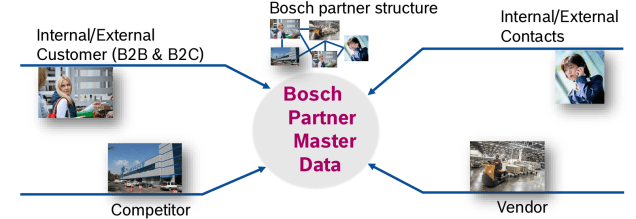
This week I attended the MDM event arranged by Marcus Evans in Barcelona. The presentation by Udo Couto Klütz of the industrial giant Robert Bosch highlighted the clever way of handling customer master data, by having a partner master data concept.

Bosch

At Bosch they have reached the conclusion, that unified partner master data management is the way to achieve:

  • A single source of truth
  • Transparency
  • Standardized processes
  • Worldwide applicability
  • One compliance standard
  • Increased efficiency

I absolutely agree.

Welcome Semarchy xDM on The Disruptive MDM List

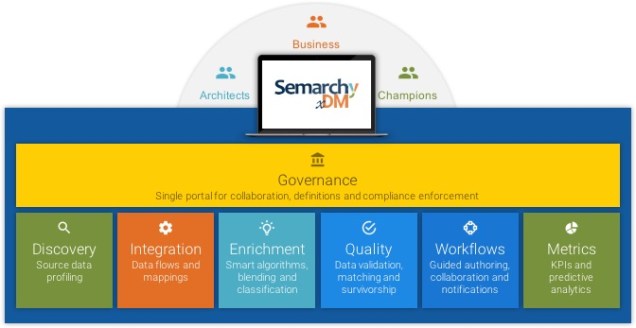
I am happy to welcome Semarchy xDM as the first disruptive Master Data Management Solution on the disruptive MDM list. You can learn more about, and review, Semarchy xDM here.

xDM Capabilities (002)

Semarchy has been a part of developing Product Data Lake, as the first prototype of this service was made using the Semarchy platform. I owe Salah Kamel, the Semarchy CEO, big thanks for his support in doing that.

By making that prototype, I can confirm that Semarchy caters for a fast track, when it comes to setting up a Master Data Management solution.

The Disruptive MDM List

As reported in the previous post on this blog, Gartner (the analyst firm) has stopped having a list of smaller and potential disruptive MDM solutions in their Magic Quadrant for Master Data Management Solutions.

I think it is time to have an alternative list of MDM solutions with room for the disruptive ones.

Therefore, I have created a new site for a list of MDM and similar solutions. This site is meant to be a list of available:

  • Master Data Management (MDM) solutions
  • Customer Data Integration (CDI) solutions
  • Product Information Management (PIM) solutions
  • Digital Asset Management (DAM) solutions

You can use this site as an alternative to the likes of Gartner, Forrester, MDM Institute and others when selecting a MDM / CDI / PIM / DAM solution, not at least because this site will also include smaller and disruptive solutions.

Vendors can register their solutions here and the crowd, being processional users, can review the solutions.

I will welcome vendors of all sizes, at all stages and from all geographies to register your solution at the disruptive MDM list.

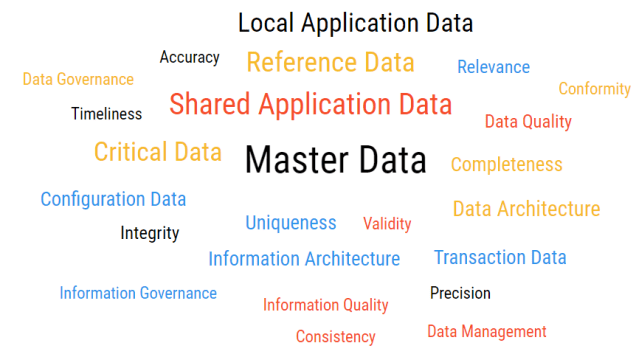
Master Data or

Please have a look at the current stage of The Disruptive MDM List

Disruptive Forces in MDM Land

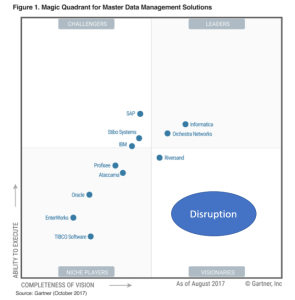
MDM 2017 disruptionFor the second time this year there is a Gartner Magic Quadrant for Master Data Management Solutions out. The two leaders, Orchestra Networks and Informatica, have released their free copies here and here.

Now Gartner have stopped having a list of vendors on the market too small to be in the actual quadrant. So, if you are looking for new thinking, you will have to read the section about disruptive forces in the MDM market.

Gartner says that every market experiences disruptive forces that influence its overall shape and trajectory over time, and that inspire innovation, both transformational and incremental. According to Gartner, those most prominent in the MDM market appear diametrically opposed.

The current market is dominated by vendors who have predominantly taken a platform-centric approach involving robust technology stacks categorized as application-neutral hub-based solutions. Thus, the business value of the resulting master data is realized through utilization of that data within business applications or suites, or analytics platforms, external to the MDM solution — such as CRM, ERP and e-commerce systems, and data warehouses.

One disruptive force against that is an increase in business applications or suites with embedded ADM (Application Data Management) capabilities that address organizational needs for data management, including MDM (to varying degrees), while also managing nonmaster data for the pertinent application. Gartner states that application-centric approaches for some organizations can return greater value than platform-centric approaches in the short term and do so at reduced cost.

The opposing disruptive force stems from the emergence of more generalized data management solutions. These provide for unified execution logic on top of what is effectively an integrated technology stack. Vendors envision the primary consumption model to be cloud-based subscription. As such, these solutions will also provide a means for midmarket organizations and SMBs to procure advanced data management capabilities (such as MDM) using this model of consumption. Executed crisply, cloud-based subscriptions to these solutions may even moderate the rise of cloud-based MDM offerings.

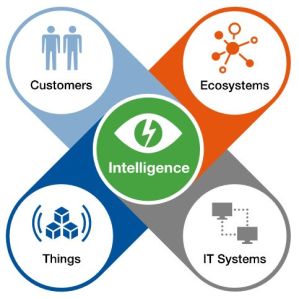
Regular readers of this blog may guess, that I see a coming third disruptive force in MDM land, being specialized data management services for business ecosystems as explored in the post Ecosystems are The Future of Digital and MDM.

Reduce Costs by Breaking Down Walls

Walls between data management silos are some of the worst causes of generating costs in data management. I have seen three main kinds of such walls:

The walls between enterprise units

If you have been working more than a day or two with data management within any kind of larger organization, you have probably noticed walls between data used in enterprise units. These walls may be due to using different applications in various geographies, lines of business, departments or other organizational units. It may also be different ways of storing data in the same application.

Countless Master Data Management (MDM) programmes are launched to tackle this conundrum, and many of them run into the wall without breaking it. But keep trying using more agile and lean thinking – and you will reduce costs by federating data silos.

The wall between business and IT

This is the silliest kind of wall I have ever seen as told in the post Tear Down This Wall! “Just break it” and reduce a lot of costs by simplifying data management.

The wall (and moat) around the enterprise

For some data domains, like product data, there are great cost reductions in working closely with your trading partners as told in the post The days of castle and moat are over, just as brick and mortar is slowly diminishing too.

tear-down-wall

The Good, the Better and the Best Kinds of Data Quality Technology

If I look at my journey in data quality I think you can say, that I started with working with the good way of implementing data quality tools, then turned to some better ways and, until now at least, is working with the best way of implementing data quality technology.

It is though not that the good old kind of tools are obsolete. They are just relieved from some of the repeating of the hard work in cleaning up dirty data.

The good (old) kind of tools are data cleansing and data matching tools. These tools are good at finding errors in postal addresses, duplicate party records and other nasty stuff in master data. The bad thing about finding the flaws long time after the bad master data has entered the databases, is that it often is very hard to do the corrections after transactions has been related to these master data and that, if you do not fix the root cause, you will have to do this periodically. However, there still are reasons to use these tools as reported in the post Top 5 Reasons for Downstream Cleansing.

The better way is real time validation and correction at data entry where possible. Here a single data element or a range of data elements are checked when entered. For example the address may be checked against reference data, phone number may be checked for adequate format for the country in question or product master data is checked for the right format and against a value list. The hard thing with this is to do it at all entry points. A possible approach to do it is discussed in the post Service Oriented MDM.

The best tools are emphasizing at assisting data capture and thus preventing data quality issues while also making the data capture process more effective by connecting opposite to collecting. Two such tools I have worked with are:

·        IDQ™ which is a tool for mashing up internal party master data and 3rd party big reference data sources as explained further in the post instant Single Customer View.

·        Product Data Lake, a cloud service for sharing product data in the business ecosystems of manufacturers, distributors, merchants and end users of product information. This service is described in detail here.

DQ

Sell more. Reduce costs.

Business outcome is the end goal of any data management activity may that be data governance, data quality management, Master Data Management (MDM) and Product Information Management (PIM).

Business outcome comes from selling more and reducing costs.

At Product Data Lake we have a simple scheme for achieving business outcome through selling more goods and reducing costs of sharing product information between trading partners in business ecosystems:

Sell more Reduce costs

Interested? Get in touch:

← Back

Thank you for your response. ✨

Neutron Star Collision and Data Quality

The scientific news of the day is the observed collision of two neutron stars resulting in gravitational waves, an extremely bright flash – and gold.

The connection between gravitational waves and Master Data Management (MDM) was celebrated here on the blog when those waves were detected for the first time as told in the post Gravitational Waves in the MDM World.

The ties to Product Information Management (PIM) was examined in the post Gravitational Collapse in the PIM Space.

Now we have seen a bright flash resembling what happens when two trading partners collide, as in makes business together encompassing sharing master data and product information. Seen from my telescope this improves data quality and thereby business outcome (gold, you know) as explained in the post Data Quality and Business Outcome.

Neutron Star Collide

MDM, Reltio, Gartner and Business Outcome

A recent well commented blog post by Andrew White of Gartner, the analyst firm, debates What’s Happening in Master Data Management (MDM) Land?

The post is an answer to a much liked and commented LinkedIn status post by Ramon Chen, Chief Product Officer of Reltio.

In his post Andrew connects the classic dots: How does technology lead to business outcome? Especially the use of cloud solutions and the multi-tenant aspect is in the focus. Andrew asks: What do you see “out there”?

My view is that multi-tenant is not just about offering the same subscription based cloud solutions to a range of clients. It is about making clients sharing the same business ecosystem work in the same MDM realm. This is the platform described in Master Data Share.

Gartner Digital Platforms 2
Source: Gartner

Oh, and what does that have to do with business outcome? A lot. Organizations will not win the future the race by optimizing there inhouse MDM capabilities alone. With the rise of digitalization, they need to connect with and understand their customers, which I believe is something Reltio is good at. Furthermore, organisations need to be much better at working with their business partners in a modern way, including at the master data level. The business outcome of this is:

  • Having complete, accurate and timely data assets needed for understanding and connecting with customers. You will sell more.
  • Having a fast and seamless flow of data assets, not at least product information, to and from your trading partners. You will reduce costs.
  • Having a holistic view of internal and external data needed for decision making. You will mitigate risks.