The previous post on this blog was called Gravitational Waves in the MDM World. Building further on space science, I would like to use the concept of gravitational collapse, which is the process that happens when a star or other space object is born. In this process, a myriad of smaller objects are gathered into a more dense object.
PIM (Product Information Management) is part of the larger MDM (Master Data Management) world. PIM solutions offered today serves very well the requirements for organizing and supporting the handling of product information inside each organization.
However, there is an instability when observing two trading partners. Today, the most common mean to share product data is to exchange one or several spreadsheets with product identification and product attributes (sometimes also called properties or features). Such spreadsheets may also contain links to digital assets being product images, line drawing documents, installation videos and other rich media stuff.
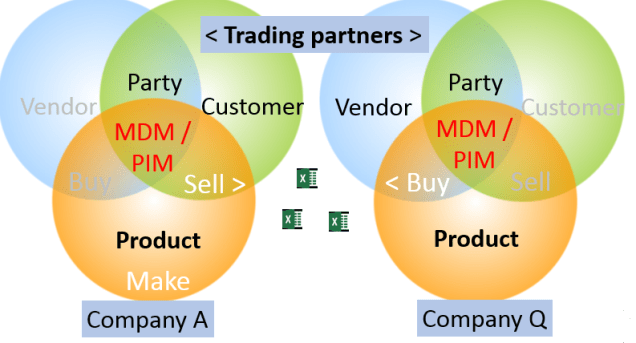
As an upstream provider of product data, being a manufacturer or upstream distributor, you have these requirements:
- When you introduces new products to the market, you want to make the related product data and digital assets available to your downstream partners in a uniform way
- When you win a new downstream partner you want the means to immediately and professionally provide product data and digital assets for the agreed range
- When you add new products to an existing agreement with a downstream partner, you want to be able to provide product data and digital assets instantly and effortless
- When you update your product data and related digital assets, you want a fast and seamless way of pushing it to your downstream partners
- When you introduce a new product data attribute or digital asset type, you want a fast and seamless way of pushing it to your downstream partners.
- You may want to push product data and digital assets from several different internal sources.
As a downstream receiver of product data, being a downstream distributor, retailer or end user, you have these requirements:
- When you engage with a new upstream partner you want the means to fast and seamless link and transform product data and digital assets for the agreed range from the upstream partner
- When you add new products to an existing agreement with an upstream partner, you want to be able to link and transform product data and digital assets in a fast and seamless way
- When your upstream partners updates their product data and related digital assets, you want to be able to receive the updated product data and digital assets instantly and effortless
- When you choose to use a new product data attribute or digital asset type, you want a fast and seamless way of pulling it from your upstream partners
- If you have a backlog of product data and digital asset collection with your upstream partners, you want a fast and cost effective approach to backfill the gap.
Fulfilling this with exchanging spreadsheets (and other peer-to-peer solutions) in the eco-system of trading partners is a chaotic mess.
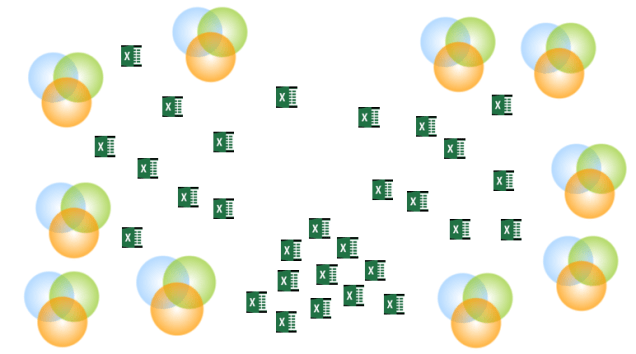
If you look at it from upstream being a manufacturer or upstream distributor the challenge is that you probably have hundreds of downstream receivers of product information. Each one requires their form of spreadsheet or other interface. They may even ask you to use their specific supplier portal meaning hundreds of different learning exercises on your side.
As a downstream receiver of product information being a downstream distributor, retailer or end user you have the opposite challenges. You probably have hundreds of upstream providers. If you go for having your own supplier portal you need to teach each of your suppliers and you have the software license and others burdens.
There is a need for a service that sits between the upstream and downstream trading partners. This service should help the upstream trading partners being manufactures and upstream distributors with sharing product data to many different downstream trading partners as well as it should eliminate or reduce the downstream trading partners need for implementing and maintaining supplier portals.
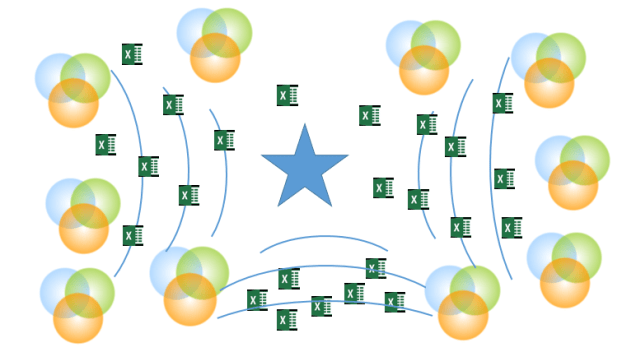
In the end such a service will collapse the doomed galaxy of spreadsheets into an agile process driven service for sharing product data – called the Product Data Lake.


 While every data quality dimension applies to all domains of Master Data Management (MDM), some different dimensions apply a bit more to one of the domains or the intersections of the domains as explained in the post Multi-Domain MDM and Data Quality Dimensions.
 Liliendahl on Data Quality