The Letter Å

I have previously written about the letter Æ and the letter Ø. Now it’s time to write about another letter in Scandinavian alphabets that doesn’t belong to the English alphabet: The letter Å which is å in lower case.

When transliterated to the English alphabet Å becomes AA and å becomes aa. When a name begins with Å it becomes Aa. For example the second largest city in Denmark was called Århus being Aarhus in English. Actually the city council by 1st January 2011, as reported here, changed the name of the city to Aarhus.

AarhusThe Master Data Management tool vendor Stibo Systems has it’s headquarter in an Aarhus suburban. As Stibo was founded in 1794 the company has stayed in Århus some of its life.

The term Master Data Management (MDM) wasn’t known in 1794 and IT wasn’t invented then. Stibo is basically a printing company who became a specialist in making catalogues, later electronic catalogues and the software for doing this, which led to being a Product Information Management (PIM) vendor and now a multi-domain MDM solution provider. By the way: å is pronounced as the o in catalogue. Catalåg.


Bookmark and Share

Doing Census versus doing Master Data Management

“In those days Caesar Augustus issued a decree that a census should be taken of the entire Roman world. This was the first census that took place while Quirinius was governor of Syria. And everyone went to their own town to register.”

These are the famous words from the Gospel According to Luke that you, if you belong to the part of the world where Christianity is practiced, hear every Christmas.

Today scholars don’t think that there actually was a census for the whole Roman Empire but there are evidences that a local census in Syria and Judea took place around year 1. This was in order to collect taxes in those provinces. As you know: The taxman is data quality’s best friend.

Today doing census is still the most practiced method of knowing about the people living in a given country. The alternative is a public registry that is constantly updated with all the information needed about you. I had the chance to describe such a method in the post on a Canadian blog some years ago. The post is called How Denmark does it.

India has a similar scheme with a centralized citizen registry on the go. This program is called Aadhaar.

As reported in the post Citizen ID and Biometrics the United Kingdom was close to adapting doing citizen Master Data Management some years ago. But it didn’t happen, so it’s still possible to have multiple names and multiple addresses at the same time in different registries while Cameron is Prime Minister of the United Kingdom, First Lord of the Treasury and Minister for the Civil Service.

Merry Christmas.

going to census

Bookmark and Share

What Happened in 1013

At this time of year it is very popular to try to predict what will happen in the next year, being 2013, within your field of expertise.

However, predictions, not at least about the future, may fail. And within data quality we don’t like flaws. So instead I will tell a little bit about what happened in year 1013 with respect to data quality.

1013As always Wikipedia is your friend when seeking knowledge. So I have picked a few of the highlights from the Wikipedia article about 1013:

Diversity

In 1013 the Viking warlord Sweyn Forkbeard replaced Æthelred the Unready as King of England. These were the happy days when the letter Æ was part of the English alphabet. Today Æ only exists in some of the Viking alphabets.

Definition

Kaifeng, capital of China, becomes the largest city of the world in 1013, taking the lead from Córdoba in Al-Andalus. However this is estimation. And even today, as reported by BBC, we actually can’t tell which one is the largest city in the world.

Multiple versions of the truth

The anti-pope John XVI dies in 1013. An anti-pope is a person who, in opposition to the one who is generally seen as the legitimately elected Pope, makes a significantly accepted competing claim to be the Pope. Even today we can’t always establish a single version of the truth.

Bookmark and Share

The Letter Æ

This blog is written in English. Therefore the letters used are normally restricted to A to Z.

The English alphabet is one of many alphabets using Latin (or Roman) letters. Other alphabets like the Russian uses Cyrillic letters. Then there are other script systems in the world which besides alphabets are abjads, abugidas, syllabic scripts and symbol scripts. Learn more about these in the post Script Systems.

Æ, which in lower case is æ, was part of the old English alphabet. For example an old English king was called Æthelred the Unready.

The letter Æ is a combined AE and is pronounced in English as the first letter in Edmund and Edward.

Today Æ exists in a few alphabets: The Danish/Norwegian, the Faroese and the Icelandic. People and places from the corresponding Viking territories  may have the letter Æ/æ as part of the string. For example the home of Microsoft Dynamics AX and NAV is the town Vedbæk north of Copenhagen. When represented in the English alphabet the town name will be Vedbaek.

So Vedbæk and Vedbaek should be a 100% match when doing data matching. And so should Vedbæk and Vedb%C%A6k when systems are as bad as Æthelred the Unready was in handling the Vikings.

And oh, Æthelred wasn’t actually unready. He was unræd meaning bad-counseled.

Bookmark and Share

Doctor Livingstone, I Presume?

The title of this blog post is a famous quote from history (which as most quotes are disputed) said by Henry Morton Stanley (who actually was born John Rowlands) when he found Doctor Livingstone (David Livingstone) deep into the African jungle in 1871 after a 6 month expedition with 200 men through unknown territory.

Today it’s much easier to find people. Mobile phone use, credit card transactions and tweet positions leads the way, unless of course you really, really don’t want to be found as it was with Osama bin Mohammed bin Awad bin Laden.

One of the biggest issues in data quality is real world alignment of the data registered about persons. As told in the post out Out of Africa there are some issues in the way we handle such data, as:

  • Cultural diversity: Names, addresses, national ID’s and other basic attributes are formatted differently country by country and in some degree within countries. Most data models with a person entity are build on the format(s) of the country where it is designed.
  • Intended purpose of use: Person master data are often stored in tables made for specific purposes like a customer table, a subscriber table a contact table and so on. Therefore the data identifying the individual is directly linked with attributes describing a specific role of that individual.
  • “Impersonal” use: Person data is often stored in the same table as other party master types as business entities, projects, households et cetera.

Besides that I have found that many organizations don’t use the sources available today in getting data quality right when it comes to contact data.

It’s not that I suggest actually hacking into mobile phone use logs and so. There are a lot of sources not compromising with privacy that let you exploit external reference data as explained in the post Beyond Address Validation.

Bookmark and Share

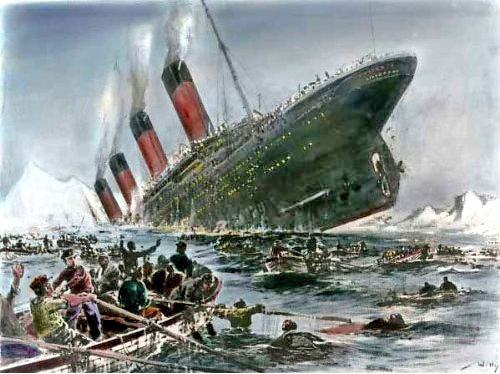
Iceberg, Right Ahead!

Tonight it is 100 years ago Titanic hit an iceberg and sank. So I guess it is rush hour for Titanic related blog posts. I’m going on board as well with some musings on lessons from Titanic to be learned within data management, be that migration projects, master data management implementations and data quality improvement programs.

From A to B

Why did Titanic have to sail through icy waters? There are no icebergs around Southampton, Cherbourg or Cork from where she departed, and no icebergs around New York where she was heading to. Unfortunately there is in the Iceberg Alley of Newfoundland where she passed.

In data management (and enterprise architecture too) we are often focused on the AS-IS and TO-BE states, while the dangers are on the route between these points.

Maturity

1,100 lifeboat seats are good enough for 2,200 people on an unsinkable ship, right? And why waste time and money on training the crew in evacuation. Unfortunately omitting that caused lifeboats available to be only half filled when Titanic was going down.

The maritime industry has improved a lot since then. The data management industry and discipline has a way to go still.

Real time decision making       

When the lookout reported “Iceberg, right ahead!” the officer in charge on Titanic had to make a swift decision. “Hard a’starboard!” unfortunately was the worst option, causing the ships side to be opened below the waterline. The ship would have been better off if it had sailed directly into the iceberg.

Supporting better real time decision making is a great challenge within data management today.

Bookmark and Share

The Taxman: Data Quality’s Best Friend

Collection of taxes has always been a main driver for having registries and means of identifying people, companies and properties.

5,000 years ago the Egyptians made the first known census in order to effectively collect taxes.

As reported on the Data Value Talk blog, the Netherlands have had 200 years of family names thanks to Napoleon and the higher cause of collecting taxes.

Today the taxman goes cross boarder and wants to help with international data quality as examined in the post Know Your Foreign Customer. The US FATCA regulation is about collecting taxes from activities abroad and as said on the Trillium blog: Data Quality is The Core Enabler for FATCA Compliance.

My guess is that this is only the beginning of a tax based opportunity for having better data quality in relation to international data.

In a tax agenda for the European Union it is said: “As more citizens and companies today work and operate across the EU’s borders, cooperation on taxation has become increasingly important.”.

The EU has a program called FISCALIS in the making. Soon we not only have to identify Americans doing something abroad but practically everyone taking part in the globalization.

For that we all need comprehensive accessibility to the wealth of global reference data through “cutting-edge IT systems” (a FISCALIS choice of wording).

I am working on that right now:

Bookmark and Share

Turning a Blind Eye to Data Quality

The idiom turning a blind eye originates from the sea battle at Copenhagen where Admiral Nelson ignored a signal with permission to withdraw by raising the telescope to his blind eye and say “I really do not see the signal”.

Nelson went on and won the battle.

As a data quality practitioner you are often amazed by how enterprises turns the blind eye to data quality challenges and despite horrible data quality conditions keeps on and wins the battle by growing as a successful business.

The evidence about how poor data quality is costing enterprises huge sums has been out there for a long time. But business success are made over and again despite of bad data. There may be casualties, but the business goals are met anyway. So, the poor data quality is just something that makes the fight harder, not impossible.

I guess we have to change the messaging about data quality improvement away from the doomsday prophesies, which make decision makers turn a blind eye to data quality challenges, and be more specific on maybe smaller but tangible wins where data quality improvement and business efficiency goes hand in hand.        

Bookmark and Share

Painted Data Quality

In a recent blog post called Plato’s Data by Jim Harris we are reminded about that data isn’t the real world but only an illusion of reality.

This makes me think about in what degree the data quality discipline is an exact science or merely an art. And surely there is a large element of art in some activities within data quality improvement as I also participated in a radio show on Jim’s blog discussing The Art of Data Matching.

One kind of (real) art is painting. Within painting good art may be that a painting reflects the real world as precisely as possible. But good art may certainly also be that the painting, like a surrealistic painting, doesn’t look like the real world, but makes you think.

With today’s technology you might also say that why bother making a painting that looks like the real world if you can simply take a photo.

However, with many good (famous) photos there is usually a controversy about if the photo was staged. An example is Raising the Flag on Iwo Jima, that also made it to a stamp.

For the record: The photo is believed not to be staged by the photographer, but it was the second raising of the flag where a smaller flag was replaced by a more impressive one. There wasn’t a hard fighting for the mountain top where the flag was raised. The fierce fighting on the island was down in the caves.   

My 3 cents….

Bookmark and Share

Data Quality Evangelism

There is a famous painting by Leonardo da Vinci with Jesus and the Twelve Apostles having The Last Supper:

Now, most classic historical paintings have anachronisms. In The Last Supper there are oranges on the table, which is strange, since oranges weren’t known in EMEA in the 1st century.  

But, anachronisms aside:

Q: Isn’t it also strange that everyone is on one side of the table?

A: Not at all. It’s like with data quality evangelism: Everyone is on the IT side. The business side has other things to do.

Bookmark and Share