255 Reasons for Data Quality Diversity

255 is one source of truth about how many countries we have on this planet. Even with this modest list of reference data there are several sources of the truth. Another list may have 262 entries and a third list 240 entries.

As I have made a blog post some years ago called 55 reasons to improve data quality I think 255 fits nice in the title of this post.

The 55 reasons to improve data quality in the former post revolves around name and address uniqueness. In the quest for having uniqueness, and fulfilling other data quality dimensions as completeness and timeliness, a have often advocated for using deep (or big) reference data sources as address directories, business directories and consumer/citizen directories.

Doing so in the best of breed way involves dealing with a huge number of reference data sources. Services claimed to have worldwide coverage often falls a bit short compared to local services using local reference sources.

For example when I lived in Denmark, at tiny place in one corner of the world, I was often amazed how address correction services from abroad only had (sometimes outdated) street level coverage, while local reference data sources provides building number and even suite level validation.

Another example was discussed in the post The Art in Data Matching where the multi-lingual capacities needed to do well in Belgium was stressed in the comments.

Every country has its own special requirement for getting name and address data quality right, the data quality dimensions for reference data are different and governments has found 255 (or so) different solutions to balancing privacy and administrative effectiveness.

Right now I’m working on internationalization and internationalisation of a data and software service called instant Data Quality. This service makes big reference data from all over the world available in a single mashup. For that we need at least 255 partners.

Bookmark and Share

Finding Me

Many people have many names and addresses. So have I.

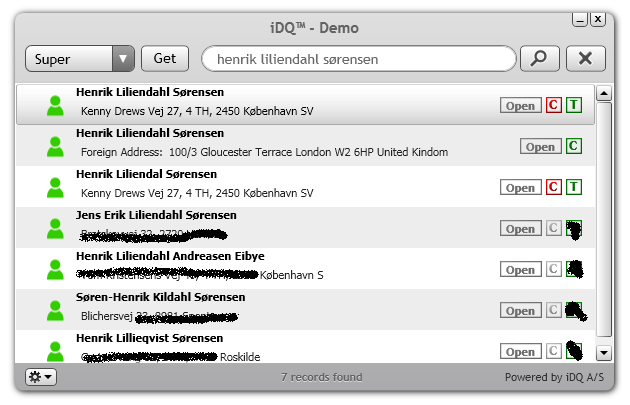
A search for me within Danish reference sources in the iDQ tool gives the following result:

Green T is positive in the Danish Telephone Books. Red C is negative in the Danish Citizen hub. Green C is positive in the Danish Citizen Hub.

Even though I have left Denmark I’m still registered with some phone subscriptions there. And my phone company hasn’t fully achieved single customer view yet, as I’m registered there with two slightly different middle (sur)names.

Following me to the United Kingdom I’m registered here with more different names.

It’s not that I’m attempting some kind of fraud, but as my surname contains The Letter Ø, and that letter isn’t part of the English alphabet, my National Insurance Number (kind of similar to the Social Security Number in the US) is registered by the name “Henrik Liliendahl Sorensen”.

But as the United Kingdom hasn’t a single citizen view, I am separately registered at the National Health Service with the name “Henrik Sorensen”. This is due to a sloppy realtor, who omitted my middle (sur)name on a flat rental contract. That name was taken further by British Gas onto my electricity bill. That document is (surprisingly for me) my most important identity paper in the UK, and it was used as proof of address when registering for health service.

How about you, do you also have several identities?

Bookmark and Share

Bat-and-ball Data Quality

Lately Jim Harris of the OCDQblog has written two excellent blog posts, or may I say home runs, discussing data quality with inspiration from baseball.

In the post Quality Starts and Data Quality Jim talks about that you may have a tough loss in business despite stellar data quality and have a cheap win in business despite of horrible data quality, but in the long run by starting off with good data quality, your organization have a better chance to succeed.

The follow up post called Pitching Perfect Data Quality Jim ponders that business success is achievable without perfect data quality, but data quality has a role to play.

Now, despite that baseball is a very popular sport in the United States, but largely unknown in the rest of world, I think we all understand the metaphors.

Also we have different but similar sports, with other rules, statistics and terms attached, over the world. The common name for these sports is bat-and-ball games.

In Britain, where I live now, cricket is huge and can be used to attract awareness of data issues. As late as yesterday the Ordnance Survey, a government body that have registries with addresses, coordinates and maps, made a blog post called Anyone for cricket? British blogger Peter Thomas also wrote among others a post on cricket and data quality called Wager.

Before coming to Britain I lived in Denmark, where we don’t know baseball, don’t know cricket but sometimes at family picnics, perhaps after a Carlsberg and a snaps or two, plays a similar game called rundbold, with kids and grandpa friendly rules and score board and usually using a tennis ball.

Data quality, not at least data quality in relation to party master data, which is the most prominent domain within the discipline, is also a same same but different game around the world as told in the post Partnerships for the Cloud.

Understanding the rules, statistics and terms of baseball, cricket, rundbold and all the other bat-and-ball games of the world is a daunting task, even though we all know how to hit a ball with a bat.

Bookmark and Share

Know Your Foreign Customer

I’m not saying that Customer Master Data Management is easy. But if we compare the capabilities within most companies with handling domestic customer records they are often stellar compared to the capabilities of handling foreign customer records.

It’s not that the knowledge, services and tools doesn’t exist. If you for example are headquartered in the USA, you will typically use best practice and services available there for domestic records. If you are headquartered in France, you will use best practice and services available there for domestic records. Using the best practices and services for foreign (seen from where you are) records is more seldom and if done, it is often done outside enterprise wide data management.

This situation can’t, and will not, continue to exist. With globalization running at full speed and more and more enterprise wide data management programs being launched, we will need best practices and services embracing worldwide customer records.

Also new regulatory compliance will add to this trend. Being effective next year the US Foreign Account Tax Compliance Act (FATCA) will urge both US Companies and Foreign Financial Institutions to better know your foreign customers and other business partners.

In doing that, you have to know about addresses, business directories and consumer/citizen hubs for an often large range of countries as described in the post The Big ABC of Reference Data.

It may seem a daunting task for each enterprise to be able to embrace big reference data for all the countries where you have customers and other business partners.

My guess, well, actually plan, is, that there will be services, based in the cloud, helping with that as indicated in the post Partnerships for the Cloud.

Bookmark and Share

Well Met, Stranger

Finally wordpress.com, the hosted version of WordPress that I am using, has added geography to the stats.

The counter has been running for 14 days now, so I have tried to have a first look into the numbers.

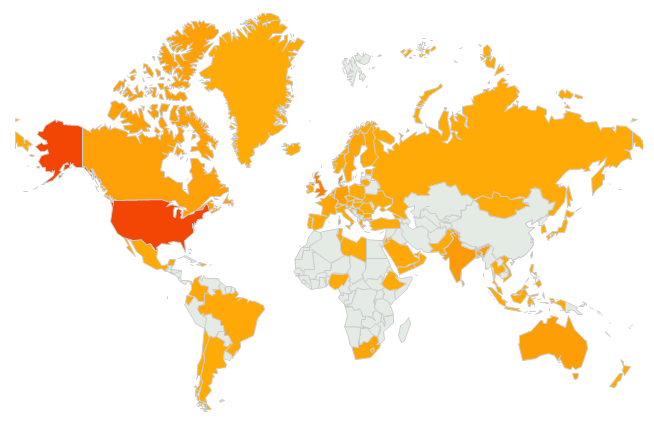
First of all I’m pleased that I during these 14 days have had visitors from 67 different countries around the globe:

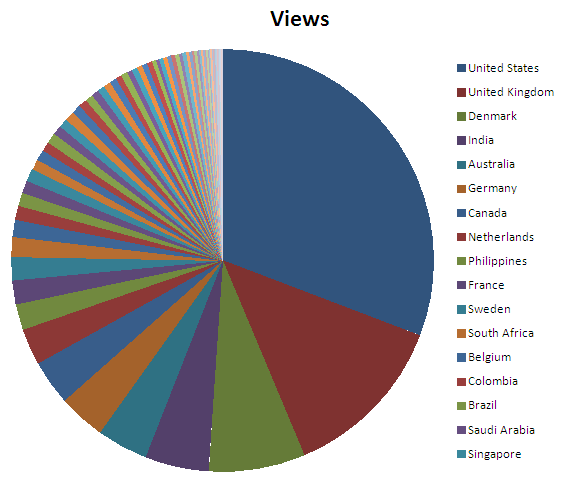
Most visitors have been from the United States, followed by my current home country United Kingdom and then my former home country Denmark:

Note: This figure is made by copying the results into excel.

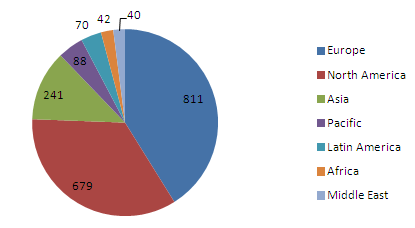
If grouped by regions of the world, it looks like this:

The world has certainly become a small place. Of course your interactions are biased towards your neighborhood, but in blogging as well as in business our success will increasingly become dependent on meeting, understanding and interacting with (maybe not so) strange people of the world.

Bookmark and Share

Your Point, My Comma

Spam mails can be great food for thought.

This morning I had this one in one of my many mailboxes:

So, the amount in question was:

It’s interesting to see how the spammer used points and commas in the large amount of money he wanted to trick me with. Don’t know if he was sloppy or had the problem of showing an amount to a not segmented audience of the world that are:

  • Using point as decimal mark and comma as thousand separator
  • Using comma as decimal mark and point as thousand separator

The use of a sign for decimal mark and thousand separators is indeed divided across the globe as seen on this map:

The blue countries are using point as decimal mark and comma as thousand separator and the green countries are doing the opposite.

Then there may be diversities within a country as in Canada there are always questions about Quebec, where they are following the French custom. India also has its own numerals with 100 groupings besides the English heritage.  

The pattern of a approximately one half world using one standard and approximately another half of the world using an opposite standard is seen in other notations as arranging person names, writing street addresses as well as place names and postal codes as told in the post Having the Right Element to the Left.

Bookmark and Share

Inaccurately Accurate

The public administrative practice for keeping track of the citizens within a country is very different between my former country of living being Denmark and my current country of living being the United Kingdom.

In Denmark there is an all-purpose citizen registry where you are registered “once and for all” seconds after you are born as told in the post Citizen ID within Seconds.

In the United Kingdom there are separate registries for different purposes. For example there is a registry dealing with your health care master data and there is a registry, called the electoral roll, dealing with your master data as a voter.

Today I was reading a recent report about data quality within the British electoral roll. The report is called Great Britain’s electoral registers 2011

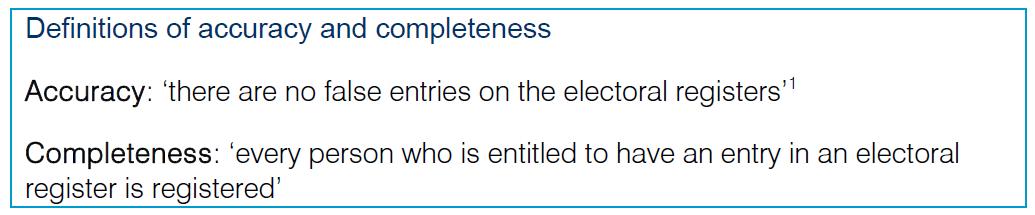
The report revolves around the two data quality dimensions: Accuracy and completeness.

In doing so, these two bespoke definitions are used:

There is a note about accuracy saying:


This is a very interesting precision, so to speak. Having fitness for the purpose of use is indeed the most common approach to data quality.

This does of course create issues when such data are used for other purposes. For example credit risk agencies here in the UK use appearance on the electoral roll as a parameter for their assessment of credit risk related to individuals.

Surely, often there isn’t a single source of the truth as pondered in the post The Big ABC of Reference Data.

However, this mustn’t make us stop in the search for getting high quality data. We just have to realize that we may look in different places in order to mash up a best picture of the real world as explained in the post Reference Data at Work in the Cloud.  

Bookmark and Share

Partnerships for the Cloud

Earlier this month Loraine Lawson was so kind to quote me in an article on IT Business Edge called New Partnerships Create Better Customer Data via the Cloud.

The article mentions some cloud services from StrikeIron and Melissadata. These services are currently based on improving North American, being US and Canadian, customer data.

I am involved in similar services that currently are based on improving Danish customer data, which then covers the rest of North America being Greenland.

Improving customer data from all over the world is surely a daunting task that needs partnerships.

The cloud is the same, the reference data isn’t and the rules and traditions aren’t either as governments around the world has found 240 (or so) different solutions to balancing privacy concerns and administrative efficiency.

So, if not partnering, you risk getting solutions that are nationally international.

Bookmark and Share

The Big ABC of Reference Data

Reference Data is a term often used either instead of Master Data or as related to Master Data. Reference data is those data defined and (initially) maintained outside a single organisation. Examples from the party master data realm are a country list, a list of states in a given country or postal code tables for countries around the world.

The trend is that organisations seek to benefit from having reference data in more depth than those often modest populated lists mentioned above.

In the party master data realm such reference data may be core data about:

  • Addresses being every single valid address typically within a given country.
  • Business entities being every single business entity occupying an address in a given country.
  • Consumers (or Citizens) being every single person living on an address in a given country.

There is often no single source of truth for such data. Some of the challenges I have met for each type of data are:

Addresses

The depth (or precision if you like) of an address is a common problem. If the depth of address data is at the level of building numbers on streets (thoroughfares) or blocks, you have issues as described in the blog post called Multi-Occupancy.

Address reference data of course have issues with the common data quality dimensions as:

  • Timeliness, because for example new addresses will exist in the real world but not yet in a given address directory.
  • Accuracy, as you are always amazed when comparing two official sources which should have the same elements, but haven’t.

Business Entities

Business directories have been accessible for many years and are often used when handling business-to-business (B2B) customer master data and supplier master data management. Some hurdles in doing this are:

  • Uniqueness, as your view of what a given business entity is occasionally don’t match the view in the business directory as discussed in the post 3 out of 10
  • Conformity, because for example an apparently simple exercise as assigning an industry vertical can be a complex matter as mentioned in the post What are they doing?

Consumers (or Citizens)

In business-to-consumer (B2C) or other activities involving citizens a huge challenge is identifying the individuals living on this planet as pondered in the post Create Table Homo Sapiens. Some troubles are:

  • Consistency isn’t easy, as governments around the world have found 240 (or so) different solutions to balancing privacy concerns and administrative effectiveness.
  • Completeness, as the rules and traditions not only between countries, but also within different industries, certain activities and various channels, are different.

Big Reference Data as a Service

Even though I have emphasized on some data quality dimensions for each type of data, all dimensions apply to all types of data.

For organisations operating multinational and/or multichannel exploiting the wealth and diversity of external reference data is a daunting task.

This is why I see reference data as a service embracing many sources as a good opportunity for getting data quality right the first time. There is more on this subject in the post Reference Data at Work in the Cloud.

Bookmark and Share

Nationally International

I am right now in the process of moving most of my business from the Kingdom of Denmark to the United Kingdom.

During that process I have become a regular customer at the Gatwick Express, the (sometimes) fast train going from London’s second largest airport to central London.

When buying tickets online they require you to enter a billing address. Here you can choose between entering a UK address or an international address.

If you enter a UK address the site takes advantage of the UK postal code system where you just have to enter a postcode, which is very granular in the UK, and a house number, and then the system will know your address.

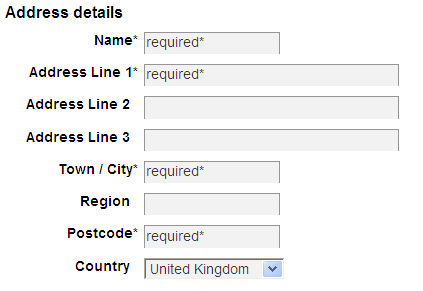
Alternatively you can choose to enter an international address. In that case you will get a form with more fields for you to enter. But, in order not to be too international the form still have the UK way of formatting an address.

Also the default country is United Kingdom which I guess is the only value that should not be applicable for this form.

Bookmark and Share