Bluetooth and Me

Bluetooth is a wonderful technology that allows me to browse the phone book stored on my cell phone and activate a call from my car cockpit even though my mobile is in my jacket pocket and my hands are on the wheel.

By the way: Bluetooth is a communication standard named after king Harald Bluetooth of Denmark because he united all the Danish tribes a thousand years ago, even though his father, Gorm the Sleepy, probably did most of it. Harald however was the guy who abandoned the Old Norse gods in favor of Christianity leaving Odin and Thor the humiliating fate of becoming American comic and film characters.

History aside, Bluetooth doesn’t do anything more than exposing my party master data hub on the cell phone made up from numerous SIM card changes and outlook synchronizations with all the resulting duplicates and outdated numbers even a data quality geek and master data management enthusiast is wearing.

Bookmark and Share

Tear Down This Wall!

Today is the 50th anniversary of the Berlin Wall. The wall is fortunately gone today, torn down as suggested by Ronald Reagan in 1987 with his famous words: Mr. Gorbachev, tear down this wall!

But today we have another bad wall, saying that an enterprise has two parts: Business and IT.

I disagree. So do many other people as for example Michael Baylon in this blog post called Is IT part of the business?

Yes, IT is part of the business. Tear down this wall!

Bookmark and Share

Word Quality

One of the top blogging advices is to be careful about your spelling and grammar and you might say that this should be even more important on a data quality blog.

Unfortunately I have to admit that I’m not particularly good at that.

Perhaps I’m somewhat excused because I’m blogging in English and English isn’t my mother tongue. When I write articles and other stuff in English for companies I work for, there is always someone with English skills to catch my mistakes. But when I’m blogging, I’m on my own.

I do strive to get it right. I always write my texts in a word processor with English spell check and grammar on. But there is a lot of mistakes that aren’t corrected by the spell checker as use of a wrong word, forgetting a word and not concatenating words that should (or might) be a compound word.

Many times I also try to google the terms I’m using. It’s a helpful trick, but sometimes you are cheated by hitting other people’s mistakes.

Occasionally folks are kind to help me by saying that I should use another word instead of some rare word I have found in an English dictionary.

So, not at least to the subscribers on this blog, who gets my first takes, please forgive my occasional bad spelling, grammar and odd words. I’m constantly thinking about continuous word quality improvement.            

Bookmark and Share

The 20 Million Rupees Question

Here we go again. The same old question: “What is the definition of customer?”  Latest Informatica (a data quality, master data management and data integration firm) has hired David Loshin to find out – started in the blog post The Most Dangerous Question to Ask Data Professionals.

Shortly, my take is that this question in practice has two major implications for data quality and master data management but in theory, it should only have one:

  • The first one is real world alignment. In theory real world alignment is independent of the definition of a customer as it is about the party behind the customer.
  • The second is party roles. It’s actually here we can have an endless discussion.

In practice we of course mix things up as discussed in the post Entity Revolution vs Entity Evolution.

And Now for Something Completely Different

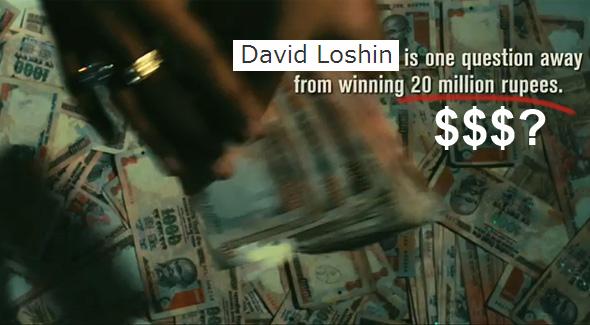
Instead of saying that “What is the definition of customer?”  is the million dollar question it’s probably more like the 20 million rupees question as most data management these days are taking place in India.

The amount of money involved is taken from the film Slumdog Millionaire where 20 million rupees is the top prize in the local “Who Wants to Be a Millionaire?” (Kaun Banega Crorepati), which by the way has the same jingle and graphics as all over the world.

And oh, how much is 20 million rupees? It’s near ½ million US dollars or 300.000 euro (with a dot as thousand separator). But a lot in buying power for a local customer. Exactly 2 crores (2,00,00,000 rupees).  

Party on.

Bookmark and Share

Marco Polo and Data Provenance

Besides being a data geek I am also interested in pre-modern history. So it’s always nice when I’m able to combine data management and history.

A recurring subject in historian circles is a suspicion saying that Explorer Marco Polo never actually went to China.

As said in the linked article from The Telegraph: “It is more likely that the Venetian merchant adventurer picked up second-hand stories of China, Japan and the Mongol Empire from Persian merchants whom he met on the shores of the Black Sea – thousands of miles short of the Orient”.

When dealing with data and ramping up data quality a frequent challenge is that some data wasn’t captured by the data consumer – not even by the organization using the data. Some of the data stored in company databases are second-hand data and in some cases the overwhelming part of data is captured outside the organization.

As with the book telling about Marco Polo’s (alleged) travels called “Description of the World” this doesn’t mean that you can’t trust anything. But maybe some data are mixed up a bit and maybe some obvious data are missing.

I have earlier touched this subject in the post Outside Your Jurisdiction and identified second-hand data as one of the Top 5 Reasons for Downstream Cleansing.

Bookmark and Share

It’s Hard to Be a Data Geek

Sometimes I, along with other folks in my social network circles and groups, describe myself as a data geek.

Another none anonymous data geek, Rich Murnane, recently started a series of excellent cartoons on his blog about DataGeek’s first days on a new job. Hard work indeed.

Then the data geeky corporate twitter account of IBM Initiate has made a twittpoll asking: Do you consider yourself a data geek or a management geek?

It’s a hard question. Because you know that a lot of things about better data is about better management and it’s much more admirable to be a management geek than a poor data geek.

Anyway I stood firm and admitted that I am a data geek. Because the world has always been crowded with management consultants with little attention to the needs of the data. Someone has to take care about the data. It’s hard, but it’s worth it.

Bookmark and Share

AAA

A top theme in the economic news these days is about credit ratings for countries – also called sovereign credit ratings.

The credit rating practice is a good example of how a lot of data (with a given quality) is transformed into a very compact piece of information as an AAA or whatever rating (with a disputed quality).   

The focus of this blog post is however about how credit ratings may be attached to reference and master data entities.

The figure below is a data visualization of S&P credit ratings for European countries:

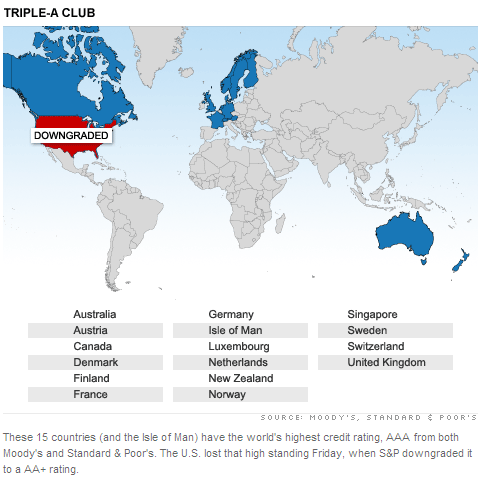
The big dark blue land in the upper left corner is the southern part of Greenland. Even though that Greenland has an ISO country code (GL) and an internet TLD (.gl) Greenland hasn’t actually been rated as a country, but is (my qualified guess) rated together with the Faroe Islands and continental Denmark as the Kingdom of Denmark.

On other maps Greenland isn’t included in the triple-A club:

So this is a good example of how a top level reference data list as a country list may have hierarchies and may be specific in a given context, a subject that often is pondered by fellow data geek and blogger Graham Rhind latest in the post: Have you checked your country drop down recently?

A much more frequent subject than sovereign credit rating is of course corporate credit rating.

Here we have the same hierarchical considerations.

A business-to-business (B2B) customer list may have a lot of entities belonging to the same enterprise that is credit rated as one. However you shouldn’t give a credit limit to each entity which would be the credit limit you would assign to the enterprise as a whole. Avoiding that will be an important result from practicing good customer master data management.   

An often observed data quality flaw in customer master data is that entities actually belonging to the same credit rated enterprise has different credit risk assignments resulting in exposed financial risk. Avoiding that will also be an important result from practicing good customer master data management.   

How do you rate your customer master data management? AAA or less?   

Bookmark and Share

Five Moments of Truth

Within Customer Relationship Management (CRM) and related Master Data Management (MDM) the party behind the business-to-business (B2B) customer is an important entity.

It is often said that the data capture is the most important moment where it is essential to get data quality right. However with a complex entity as a B2B customer, there are of course several moments of truth within the life circle for such an entity.     

These are probably the five most important ones:

  • A lead is born
  • Engaging a prospect
  • One more customer
  • Churn happens
  • Win-Back happiness

A lead is born

Leads are born in many different ways: A business card obtained from a little chit-chat on a conference, buying a list of leads or even an engagement in social media as the new way of doing things.

One of the most important things to do when capturing the data at this point is ensuring if you already have the party somewhere in the customer life circle or maybe even in other party roles as examined in the post 360° Business Partner View.

Engaging a prospect

When a lead is qualified as a new prospect and you typically engage in a one-to-one dialogue this process includes capturing more data.

Such new data may include adding a visit address to the first captured mail address or vice versa and expanding the firmographic collection of data.  

As explained in the post What are they doing? there are a lot of data quality issues in capturing such data as:

  • Unstructured versus structured data
  • Internal versus external reference data
  • One versus several values

One more customer

After a successful sales process a new customer can be added to the customer list often with more data being captured as adding a billing address and stating credit risk as credit limit and terms of payment.

This is the point where many party entities are split into data silos. Maybe the current customer master data lives on in the CRM system while new customer data are reentered and enriched in an ERP system and even other business applications.

Keeping these data silos aligned is the classic customer master data challenge as discussed in the post Boiling Data Silos.

Churn happens

There are actually two kind of churns (loss of customers):

  • A customer stops a subscription, a service contract or tell you that further buying will be at your competitors or that there is no further need for the products and services in question
  • A customer dissolves

Sometimes you don’t even discover the latter one. So your data isn’t very useful or valuable if you don’t practice Ongoing Data Maintenance.

Win-Back happiness

In the first kind of churn you may work hard (or be lucky) and win back the customer.

Be sure to build on the data from the first engagement and not start from scratch again capturing master data and history. Avoiding this covers up for some of the 55 reasons to improve data quality related to party master data uniqueness.

Bookmark and Share

Who Is Not Using Data Quality Magic?

The other day the latest Gartner Magic Quadrant for Data Quality Tools was released.

If you are interested in knowing what it says, it’s normally possible to download a copy from the leading vendors’ website.

Among the information in the paper you will find some estimated numbers of customers who has purchased the tools from the vendors included in the quadrant.

If you sum up these numbers, then it is estimated that 16,540 organizations worldwide is a customer at an included vendor.

So, if I matched that compiled customer list with the Dun & Bradstreet WorldBase holding at least 100 million active business entities worldwide, I will have a group of at least 99,983,460 companies who is not using magical data quality tools.

And that is probably falsely excluding that there are customers who has more than one vendor.

Anyway, what do all the others do then?

Well, of course the overwhelming number of companies will be too small to have any chance of investing in a data quality tool from a vendor that made it to the quadrant.

The quadrant also list a range of other vendors of data quality tools typically operating locally around the world. These vendors also have customers and probably more customers in numbers but not at the size of the companies who chooses a vendor in the quadrant.   

A lot of data quality technology is also used by service providers who either use a tool from a data quality tool vendor or has made a homegrown solution. So a lot of companies benefit from such services when processing large number of data records to be standardized, deduplicated and enriched.

Then we must not forget that technology doesn’t solve all your data quality issues as stated by the founder of DataQualityPro Dylan Jones in a recent post on a data quality forum operated by the (according to Gartner) leading data quality tool vendor. The post is called Finding the Passion for Data Quality.

My take is that it’s totally true that data quality tools doesn’t solve most of your data quality issues, but those issues addressed, typically data profiling and data matching, are hard to solve without a tool. So there is still a huge market out there currently covered by the true leader in the data quality market: Laissez-Faire.

Bookmark and Share

Good-Bye to the old CRM data model

Today I stumbled upon a blog post called Good-Bye to the “Job” by David Houle, a futurist, strategist and speaker.

In the post it is said: “In the Industrial Age, machines replaced manual or blue-collar labor. In the Information Age, computers replaced office or white-collar workers”.

The post is about that today we can’t expect to occupy one life-long job at a single employer.  We must increasingly create our own job.

My cyberspace friend Phil Simon also wrote about his advanced journey into this space recently in the post Diversifying Yourself Into a Platform Business.

The subject is close to me as I currently have approximately five different occupations as seen in my LinkedIn profile.

A professional angle to this subject is also how that development will turn some traditional data models upside down.

A Customer Relationship Management (CRM) system for business-to-business (B2B) environments has a basic data model with accounts having a number of contacts attached where the account is the parent and the contacts are the children in data modeling language.

Most systems and business processes have trouble when following a contact from account (company) to account (company) when the contact gets a new job or when the same real world individual is a contact at two or more accounts (companies) at the same time.

I have seen this problem many times and also failed to recognize it myself from time to time as told in the post A New Year Resolution.

My guess is that CRM systems in the B2B realm will turn to a more contact oriented view over time and this will probably be along with that CRM systems will rely more on Master Data Management (MDM) hubs in order to effectively reflect a fast, but not equally, changing world, as the development in the way we have jobs doesn’t happen at the same time at all places.  

Bookmark and Share