Your General Data Protection Roadmap

Being ready for the EU GDPR (European Union – General Data Protection Regulation) is – or should be – a topic on the agenda for European businesses and international businesses operating with an European reach.

The finish date is fixed: 25th May 2018. What GDPR is about is well covered (perhaps too overwhelmingly) on the internet. But how do you get there?

Below is my template for a roadmap:

GDPR Readiness RoadmapThe roadmap has as all programs should have an as-is phase, here in concrete as a Privacy Impact Assessment covering what should have been done, if the regulation was already in force. Then comes the phase stating the needed to-be state with the action plan that fills the gaps while absorbing business benefits as well. And then implementation of the prioritized tasks.

GDPR is not only about IT systems, but to be honest, for most companies it will mostly be. Your IT landscape determines which applications will be involved. Most companies will have sales and marketing applications holding personal data. Human Resource Management is a given too. Depending on your business model there will be others. Remember, this is about all kind of personal data – that includes for example supplier contact data that identifies a person too.

The skills needed spans from legal, (Master) Data Management and IT security. You may have these skills internally or you may need interim resources of the above-mentioned kind in order to meet the fixed finish date and being sure things are done right.

By the way: My well skilled associates and I are ready to help. Get in contact:

← Back

Thank you for your response. ✨

Varying Views on the MDM Market 2017

The Information Difference MDM Landscape Q2 2017 is out.

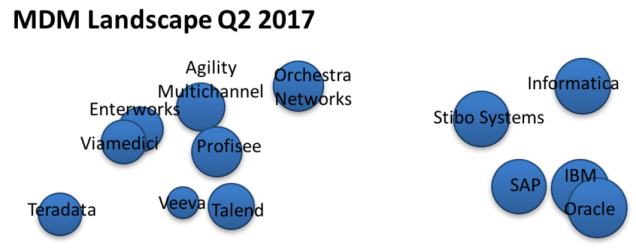
In the survey behind the vendor with the happiest customers was Agility Multichannel, followed closely by EnterWorks, then Stibo Systems, then Orchestra Networks and Informatica.

If you look at the positioning below these are by the way the ones with highest score on the technology axis (vertical) – but are not rated in the same order on the market strength axis (horizontal).

MDM Landscape Q2 2017
Source: Information Difference

The pack of vendors is organized by Information Difference only somewhat in line with Gartner as seen in the post Who will become Future Leaders in the Gartner Multidomain MDM Magic Quadrant?

Riversand and Tibco are not positioned by Information Difference, nor is Magnitude Software, which is the new wrap of Kalido, that had Andy Hayler of Information Difference as a founder.

Gartner did not position Agility Multichannel, Viamedici, Profisee, Terradata, Veeva and Talend in their quadrant.

All in all we see a market with a lot of unsettled business also considering exciting newer players as Reltio, Semarchy and Uniserv.

Where GDPR Still Becomes National

EU GDPRThe upcoming application of the EU General Data Protection Regulation (GDPR) is an attempt to harmonize the data protection and privacy regulations across member states in the European Union.

However, there is room for deviance in ongoing national law enforcement. Probably article 87 concerning processing of the national identification number and article 88 dealing with processing in the context of employment is where we will see national peculiarities.

National identification numbers are today used in different ways across the member states. In The Nordics, the use of an all-purpose identification number that covers identification of citizens from cradle to grave in public (tax, health, social security, election and even transit) as well as private (financial, employment, telco …) registrations have been practiced for many years, where more or less unlinked single purpose (tax, social security, health, election …) identification numbers are the norm most places else.

How you treat the employment force and the derived ways of registering them is also a field of major differences within the Union, and we should therefore expect to be observant of national specialties when it comes to mastering the human resource part of the data domains affected by GDPR.

Do you see other fields where GDPR will become national within the Union?

What is in a business directory?

When working with Party Master Data Management one approach to ensure accuracy, completeness and other data quality dimensions is to onboard new business-to-business (B2B) entities and enrich such current entities via a business directory.

While this could seem to be a straight forward mechanism, unfortunately it usually is not that easy peasy.

Let us take an example featuring the most widely used business directory around the world: The Dun & Bradstreet Worldbase. And let us take my latest registered company: Product Data Lake.

PDL at DnB

On this screen showing the basic data elements, there are a few obstacles:

  • The address is not formatted well
  • The country code system is not a widely used one
  • The industry sector code system shown is one among others

Address Formatting

In our address D&B has put the word “sal”, which is Danish for floor. This is not incorrect, but addresses in Denmark are usually not written with that word, as the number following a house number in the addressing standard is the floor.

Country Codes

D&B has their own 3-digit country code. You may convert to the more widely used ISO 2-character country code. I do however remember a lot of fun from my data matching days when dealing with United Kingdom where D&B uses 4 different codes for England, Wales, Scotland and Northern Ireland as well as mapping back and forth with United States and Puerto Rico. Had to be made very despacito.

Industry Sector Codes

The screen shows a SIC code: 7374 = Computer Processing and Data Preparation and Processing Services

This must have been converted from the NACE code by which the company has been registered:  63.11:(00) = Data processing, hosting and related activities.

The two codes do by the way correspond to the NAICS Code 518210 = Data processing, hosting and related activities.

The challenges in embracing the many standards for reference data was examined in the post The World of Reference Data.

A Pack of Wolves, Master Data and Reference Data

Pack of WolvesDuring the last couple years social media have been floating with an image and a silly explanation about how a pack of wolves are organized on the go. Some claims are that the three in the front should be the old and sick who sets the pace so everyone are able to stay in the pack and the leader is the one at the back.
This leadership learning lesson, that I have seen liked and shared by many intelligent people, is made up and does not at all correspond to what scientists know about a pack of wolves.

This is like when you look at master data (wolves) without the right reference data and commonly understood metadata. In order to make your interpretation trustworthy you have to know: ¿Who is the alpha male (if that designation exists), who is the alpha female (if that designation exists) and who is old and sick (and what does that mean)?

PS: For those of you who like me are interested in Tour de France, I think this is like the peloton. In front are the riders breaking the wind (snow), who will eventually fall to the back of the standings, and at the back you see Chris Froome having yet a mechanical problem when the going gets tough and thereby making sure that the entire pack stays together.

The Customer, Product and Thing Side of MDM

With the rise of the Internet of Things (IoT) you may regard the Master Data Management (MDM) discipline as yet a bit more complicated.

The most addressed part of MDM has traditionally been achieving a 360 degree view of customers.

Also, a 360 degree view of products within your organization has been a good old chestnut to deal with. The way we have managed products has mostly been by looking at product models, meaning things made up by the same ingredients in the same way under the same brand.

When entering the IoT era MDM now needs to take care of each physical instance of a product model: Each smartphone, each intelligent refrigerator, each big data producing drilling machine.

The theme of connecting Customer 360, Customer Experience (CX) and IoT was examined by Prash Chandramohan of Informatica in his recent post called MDM is the Foundation for Intelligent Engagement.

In here Prash states: “The IoT plays an ever-increasing role in CX across a variety of industries, and MDM delivers the context it requires to deliver value.”

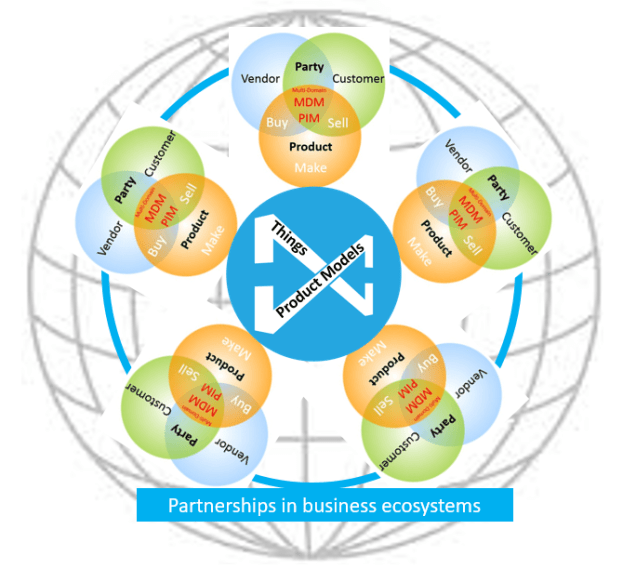
I agree with that – with an important amendment: In order not to over complicate every-thing, you have to implement a MDM landscape, where you are able to collaborate closely with your business partners as exemplified in the concept of Master Data Share.

Master Data Share

The Need for Data in Master Data Management

For nearly a decade we have lived with the Gartner 7 building blocks of MDM.

The 7 blocks encompassing vision, strategy, metrics, governance, organization, processes and technology was recently touched here on the blog in the post The Need for a MDM Vision.

Yesterday Justine Rodian of Stibo Systems wrote Why 7 Master Data Management Building Blocks Aren’t Enough Anymore: Revisiting Gartner’s Best Practice Model.

Block 8 proposed herein, based on a presentation by former Gartner analyst John Radcliffe, is data. I have no problem with that. I think data has been there always as the foundation for information leading to knowledge and topped by wisdom.

Yep, let’s include data in Master Data Management.

MDMDG 2013 wordle

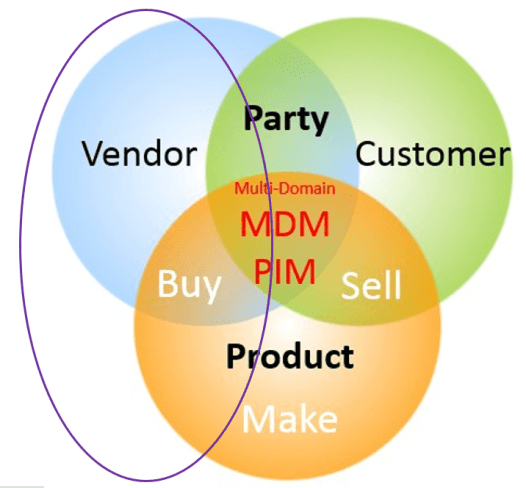
Supplier 360 + Product 360 = The Buy Side Oval

Having a 360 degree of something is a recurring subject within Master Data Management (MDM). “Customer 360” is probably the most used term. “Product 360” is promoted from time to time too and occasionally we also stumble upon “Supplier 360” (or “Vendor 360”).

Product 360 was recently examined by Simon Walker of Gartner, the analyst firm, in the post Creating the 360-Degree view of Product.

Supplier 360, as in having a single golden supplier/vendor record to connect all databases, was touched by Grant Watling of HICX Solutions a while ago in the post All Aboard! Six steps to supplier onboarding.

The Buy Side Oval is a combination of Product 360 and Supplier 360

Buy Side MDM 

Within (Multi-Domain) Master Data Management (MDM) and Product Information Management (PIM) we must be able to provide solutions that enables the buy side to effectively and consistently handle the core entities involved.

The solution to that is not having a supplier product data portal as discussed in the post PIM Supplier Portals: Are They Good or Bad? A key part lies outside your in-house platform in the business ecosystem where you and your suppliers all are participants and can be achieved as told in the post Master Data, Product Information, Digital Assets and Digital Ecosystems.

Master Data, Product Information, Digital Assets and Digital Ecosystems

When it comes to mastering product data there are these three kinds of data and supporting managing disciplines and solutions:

  • Master data and the supporting Master Data Management (MDM) discipline and a choice of MDM solutions for the technology part
  • Product information and the supporting Product Information Management (PIM) discipline and a choice of PIM solutions for the technology part
  • Digital assets and the supporting Digital Asset Management (DAM) discipline and a choice of DAM solutions for the technology part

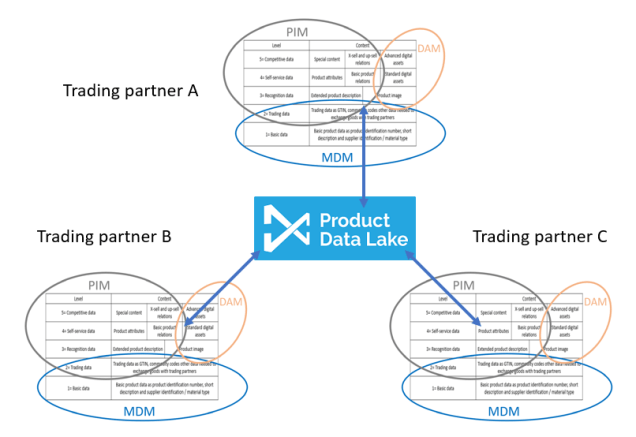
What these disciplines are and how the available solutions relate was examined in the post How MDM, PIM and DAM Sticks Together. This post includes a model for that proposed by Simon Walker of Gartner (the analyst firm).

The right mix for your company depends on your business model and you will also have the choice of using a best of breed technology solution for your focus, that being MDM, PIM or DAM, as well as there are choices for a same branded solution, and in some cases also actually integrated solution, that supports MDM, PIM and DAM.

When selecting a (product) data management platform today you also must consider how this platform supports taking part in digital ecosystems, here meaning how you share product data with your trading partners in business ecosystems.

For the digital platform part supporting interacting with master data, product information and digital assets with your trading partners, who might have another focus than you, the solution is Product Data Lake.

MDM PIM DAM PDL

The Need for a MDM Vision

Many of the MDM programs we see are increasingly tactical rather than enterprise in nature. This observation was examined in the previous post on this blog as well as in the comments. If you missed it, check out Do we need better business decisions about MDM?

MDM BlocksA crucial point is that organizations have a MDM vision. The need for a MDM vision was also the top block in the seven building blocks of MDM proposed by John Radcliffe, when John worked at Gartner (the analyst firm).

In here, John advised that there should be one unifying, strategic MDM vision that needs to reflect the organization’s business vision. However, due to internal politics and entrenched working practices a pragmatic, step-by-step approach is necessary for the entire organization to embrace the vision.

Does your organization have a MDM vision? What is included in the MDM vision? How is the vision embraced by various organizational entities?