Three kinds of a MDM Data Model that comes with a tool

Master Data Management (MDM) is a lot about data modelling. When you buy a MDM tool it will have some implications for your data model. Here are three kinds of data models that may come with a tool:

An off-the-shelf model

This kind is particularly popular with customer and other party master data models. Core party data are pretty much the same to every company. We have national identification numbers, names, addresses, phone numbers and that kind of stuff where you do not have to reinvent the wheel.

Also, you will have access to rich reference data with a model such as address directories (which you may regard as belonging to a separate location domain), business directories (as for example the Dun & Bradstreet Worldbase) and in some countries citizen directories as well. MDM tools may come with a model shaped for these sources.

Tools which are optimized for data matching, including deduplication of party master data, will often shoehorn your party master data into a data model feasible for that.

A buildable model

When it comes to multi-domain MDM we will deal with entities that are not common to everyone.

Here a capability to build your model in the MDM tool is needed. One such tool I have worked with is Semarchy. Here semi-technical people are able to build and deploy incrementally more complex data models, that are default equipped with needed functionality around handling a golden copy and auditing data onboarding and changing.

A dynamic model

Product Information Management (PIM) requires that your end users can build the model on the fly, as product data are so different between product groups.

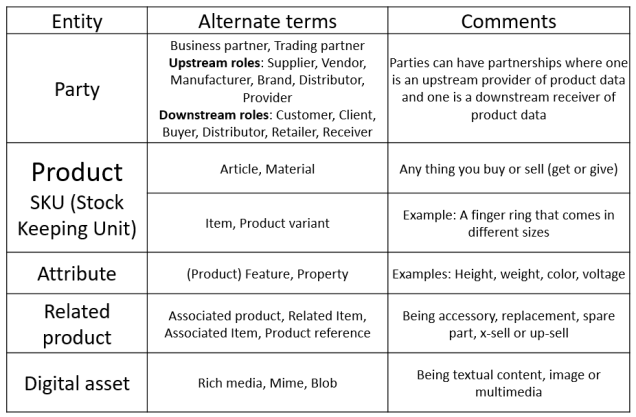
In my current venture called Product Data Lake the model has these main entities:

PDL Data Model

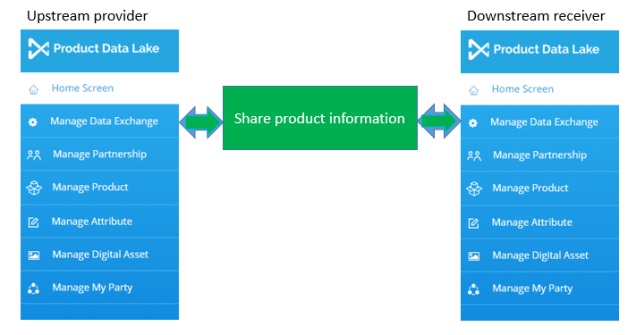
This model resembles the data model in most PIM solutions (and PIM based MDM solutions), except that we have the party and their two-way partnerships at the top, as Product Data Lake takes care of exchanging data between inhouse PIM solutions at trading partners participating in business ecosystems.

Betting on the Next Gartner MDM Magic Quadrant

The Gartner Magic Quadrant for Master Data Management Solutions 2016 came out early in 2017 as reported in the post Who will become Future Leaders in the Gartner Multidomain MDM Magic Quadrant?

So, it may be about time to take some bets on the next one.

First question will naturally be if Gartner is able to get the report out this year? Last year it was scheduled for November 2016 but was two months late into the next year, maybe due to some struggling with the vendors, who also are clients at Gartner, based on the form of a single MDM quadrant opposite to earlier years multiple MDM quadrants for customer and product MDM.

The scheduled date on the Gartner website is 10/31/17, which to none US people reads at the 10th day in the 31st month in year 17.

MDM BrandsNext question is if there are new entries or vendors dropping off? Another market report from Information Difference had a somewhat different crowd as examined in the post Varying Views on the MDM Market 2017.

In the comments to this post readers have posted questions about Magnitude Software, TIBCO Software and Riversand Technologies. Are they in danger? And who might be new entries?

Finally, of course we can have a guess on who will be able to brag about being the leaders. Will Informatica and Orchestra Networks be followed by other ones? Riversand was close last year in that visionaries space. Stibo Systems moves in from the challengers room.

Feel free to have your bet, or set the odds, in the comments below.

7 Considerations to Choose Digital Asset Management Right

Today’s guest blog post from Rajneesh Kumar is about Digital Asset Management (DAM) and 7 key factors to consider when choosing an in-house solution for that discipline. 

DAM_Blog_Resize

Digital assets are an enduring force of great value. They are the fuel of the new economy as organizations strive to be increasingly digitally driven. The way ocean of digital assets is rising, it is essential more than ever to optimally manage every type of digital content.

Organizations today put so much effort to deliver responsive, personalized and engaging experiences. Digital content has a very important role to play here. And, digital asset management (DAM) solutions are becoming a strategic priority for organizations to manage rising volume of content, streamline and automate processes for efficiency and quality.

Digital asset management supports solutions (web content management, eCommerce, and campaign management) by managing omnichannel brand and rich media content across all channels.

It also helps store, access, distribute, repurpose, and monetize digital content.  In fact, a good DAM contributes directly to the bottom line.

Organizations recognize this fact. And they are looking to transform their digital asset management solutions to improve marketing and sales performance for higher ROI.

But, it depends on how big their assets are, how distributed they are and how much integration they need to do.

Organizations must make an informed decision before choosing any DAM solution. They must choose a solution that fits well with their structure. And, it must also enable them to adopt the solution quickly with business benefits.

Here are 7 key factors to consider when choosing a DAM platform:

Implementation- Digital asset management plays a critical role to improve brand consistency across campaigns and channels. It serves many roles inside and outside of an organization. Thus, it must support greater automation in managing global or local versions of assets, various renditions of assets across channels, and integration with key systems of engagement.

Integration- A digital asset management solution should integrate well with the existing infrastructure of the organization. It should be easy for creative workflow and approval, collaboration, and version control. Your DAM solution must also allow you to take advantage of deep integration with campaign management, marketing automation, and marketing technology platforms to boost marketing agility.

Management- It should offer the deeper capability to efficiently manage a diverse set of content at reduced cost and lesser hassle.  Because, DAM is a creative innovation lab for your marketing and sales team. It must reduce time spent searching for assets, streamline approval processes, make it easy to collaborate better with external stakeholders, and provide better visibility of current status.

Infrastructure- DAM should be compatible with existing as well as modern infrastructure (like cloud and mobility) so that unnecessary cost can be avoided in the long-run. A next-generation DAM system must take advantage of the cloud and mobility to make access and sharing easier among all teams wherever and whenever they require.

Security- It must provide robust security, metadata, and workflow capabilities — along with the scalability to support or add n-numbers of assets.

Rich media capability- Today, rich media is created in bulk. The DAM solution should provide strong support for audio, video, and images (with the format conversion capability as well as previews and editing capabilities on images and rich media) to support today’s responsive, cross-channel digital experiences.

Adoption- The DAM platform must be easily adopted by both internal and external teams (using role-based accessibility) so that business value can be realized as soon as possible. It must empower teams for better asset reuse, avoid duplication of effort and rework, and reduce the number of digital assets that are created but never used.

The bottom line is: It is not about what digital asset management platform you choose. But it is more about how a DAM solution enables you to create value around your entire asset cycle— improving collaboration, strengthening brands, accelerating campaigns, and increasing the ROI. Plus, delivering amazing customer experiences that you always strive for.

As digital marketer and growth hacker, Rajneesh Kumar is currently marketing manager at Pimcore Global Services (PGS), an award-winning consolidated open source platform for product information management (PIM), web content management (CMS), digital asset management (DAM) and e-commerce.
Master Data: The Frontier of Infonomics

Still, the term infonomics does not run unmarked through my English spellchecker. But I think one day it will.

Infonomics BookInfonomics is first and foremost connected to Gartner analyst Doug Laney, who recently told a bit about his upcoming book on the subject in the post Why a Book on Infonomics?

In his preview Doug Laney writes: “Perhaps the book brings about a revolution of sorts, leading to the recognition of information as an accounting asset, and subject to the same legal treatment as other forms of property.

This resonates very well with me, as I think Master Data Management (MDM) is the new bookkeeping. One example of why it should be so, is examined in a nearly 10-year-old post about a financial scandal in Denmark, that would have been avoided if the auditors had spent 10 minutes on the company’s master data. Read more in Master Data Audit.

Master data is only one form of information. However, in my eyes it is the one with the best chance of making sense as an accounting asset.

As business ecosystems and related digital ecosystems are becoming increasingly important in information management I also think that exchange of master data will be worth accounting for as pondered in the post Infonomics and Second Party Data.

Passive vs Active Product Information Exchange

Product information is the kind of data that usually flows cross company. The most common routes start with that the hard facts about a product originates at the manufacturer. Then the information may be used on the brands own website, propagated to a marketplace (online shop-in-shop) and also propagated downstream to distributors and merchants.

The challenge to the manufacturer is that this represent many different ways of providing product information, not at least when it comes to distributors and merchants, as these will require different structures and formats using various standards and not being on the same maturity level.

Looking at this from the downstream side, the distributors and merchants, we have the opposite challenge. Manufacturers provide product information in different structurers and formats using various standards and are not on the same maturity level.

Supply chain participants can challenge this in a passive or an active way. Unfortunately, many have chosen – or are about to choose – the passive way. It goes like this:

  • As a manufacturer, we have a product data portal where trading partners who wants to do business with us, who obviously is the best manufacturer in our field, can download the product information we have in our structure and format using the standards we have found best.
  • As a distributor/merchant we have a supplier product data portal where trading partners who wants to do business with us, the leading player in our field, can upload the product information we for the time being will require in our structure and format using the standard(s) we have found best.

Passive vs ActiveThis approach seems to work if you are bigger than your trading partner. And many times one will be bigger than the other. But unless you are very big, you will in many cases not be the biggest. And in all cases where you are the biggest, you will not be seen as a company being easy to do business with, which eventually will decide how big you will stay.

The better way is the active way creating a win-win situation for all trading partners as described in the article about Product Data Lake Business Benefits.

Product Data Management is Like an Ironman

cofToday we have an Ironman passing through the streets of Copenhagen (and my breakfast). Kudos to the women and men who first have been on a swim lane of 3.86 km (2.4 miles), now is cycling 180.25 km (112 miles) and then will run a full Marathon of 42.2 km (26.22 miles).

Thinking about it doing product data management is a bit like an Ironman too. Overall it is a daunting task. And we have three disciplines to cover:

  • Digital Asset Management (DAM) is an activity where many organizations start. It is about handling product images in various sizes and versions along the way, as well as, depending on the product category, installation guides, line drawings, data sheets and other documents. Also videos with that and other content is becoming popular.
  • Product Information Management (PIM) is about maintaining hundreds (sometimes thousands) of different attributes describing a product. Some of these attributes are common for most products (like height, weight and colour) and some are very specific for a given product category.
  • Master Data Management (MDM) is a Marathon in itself. Here you link the above product data with product data in the overall system landscape including ERP, SCM (Supply Chain Management) and PLM (Product Lifecycle Management). Product data also forms the product domain that must be aligned with the location domain, asset domain, party domain and perhaps other domains in your MDM world.

How these disciplines stick together within your organization and your digital ecosystem was further examined in the post How MDM, PIM and DAM Stick Together.

The Link Between Privacy and Product Data

Do we as a consumer need to be told what to buy? Or do we rather want to be told what we are buying?

This theme was examined in a previous post titled You Must Supplement Customer Insight with Rich Product Data.

Not at least on the European scene with the upcoming General Data Protection Regulation (GDPR) there are limits to how far you can go in profiling your (prospective) costumers. And I am sure those people will value more you are telling them the complete story about your products, rather than guessing what products (from your range) they might need.

As a consumer, we want the facts about the products to make a self-service purchase. We want to be able to search for and navigate precisely to a product suitable for a specific use. We want the facts in a way, so we can compare, perhaps using a comparison service, between different brands and lines. We want to know what accessories goes with what product. We want to know what spare parts goes with what product.

By the way: Business buyers want all that too. And a person being a business buyer is a person (data subject) in the eyes of GDPR too.

For providing complete and consistent product data you as a (re)seller need to maintain high quality product data and if your product portfolio is just above very very simple, you need a Product Information Management (PIM) solution and, if you have trading partners, you need a PIM-2-PIM solution to exchange product information with your trading partners.

pdl-how-4

When You Know that Statement is Wrong

1271Oftentimes it still takes a human eye to establish if a number, year, term or other piece of information is wrong.

I had that experience today at Harvard Square in Cambridge (Boston) when looking at the sign in front of our lunch restaurant. Established 1271 it says. Hmmmm. North American natives were not known for establishing restaurants. Also, the Vikings did not stay that long or went that south in North America.

The restaurant website actually admits the sign is wrong and this is a printing flaw (should have been 1971) that they have chosen to keep – maybe also in order to test the clever people hanging around Harvard.

Anyway, without attempting to turn this into a foodie blog, the food is OK but the waiting time for being served does resemble spans of centuries.

You Must Supplement Customer Insight with Rich Product Data

school_420x310This week I attended an event called Retail Summer School at Columbia Business School in New York.

Much of the talking was about how to get insights on your (prospective) customers by collecting data in all kinds of ways – while observing the thin line between cool and creepy.

My thinking, of course biased by my current Product Data Lake venture, is that you should also pay attention to product data. For at least two reasons:

Algorithm effectiveness: Your algorithms on what products to present based on your rich insight into your customers need will only work if you are able to automatically match the needs against very specific product attributes. And most retailers don not have that today if you look at product descriptions on their ecommerce sites.

Also, I am not impressed by the suggestions I get today. They generally fall into two buckets:

  • Things I absolutely do not need
  • Things I just bought

Self-service craving: As a customer, we will strike back. We do not need to be told what to buy. But we do want to know what we are buying. This means we want to be able to see rich product information. Therefore retailers must maintain a lot of product data and related digital assets that they should fetch at a trusted source: From the manufactures. And if the manufacturer wants their products to be the ones selected by the end customers, they must be able to deliver these data seamlessly to all their distributors, retailers and marketplaces.

Party Master Data and the Data Subject

Within the upcoming EU General Data Protection Regulation (GDPR) the term data subject is used for the persons for whom we must protect the privacy.

These are the persons we handle as entities within party Master Data Management (MDM).

In the figure below the blue area covers the entity types and roles that are data subjects in the eyes of GDPR

Data Subjects

While GDPR is of very high importance in business-to-consumer (B2C) and government-to-citizen (G2C) activities, GDPR is also of importance for business-to-business (B2B) and government-to-business (G2B) activities.

GDPR does not cover unborn persons which may be a fact of interest in very few industries as for example healthcare. When it comes to minors, there are special considerations within GDPR to be aware of. GDPR does not apply to deceased persons. In some industries like financial services and utility, the handling of the estate after the death of a person is essential, as well as knowing about that sad event is of importance in general as touched in the post External Events, MDM and Data Stewardship.

One tough master data challenge in the light of GDPR will be to know the status of your registered party master data entities. This also means knowing when it is a private individual, a contact at an organization or an organization or department hereof as such. From my data matching days, I know that heaps of databases do not hold that clarity as reported in the post So, how about SOHO homes.