Watch Out for Interenterprise MDM

In the recent Gartner Magic Quadrant for Master Data Management Solutions there is a bold statement:

By 2023, organizations with shared ontology, semantics, governance and stewardship processes to enable interenterprise data sharing will outperform those that don’t.

The interenterprise data sharing theme was covered a couple of years ago here on the blog in the post What is Interenterprise Data Sharing?

Interenterprise data sharing must be leveraged through interenterprise MDM, where master data are shared between many companies as for example in supply chains. The evolution of interenterprise MDM and the current state of the discipline was touched in the post MDM Terms In and Out of The Gartner 2020 Hype Cycle.

In the 00’s the evolution of Master Data Management (MDM) started with single domain / departmental solutions dominated by Customer Data Integration (CDI) and Product Information Management (PIM) implementations. These solutions were in best cases underpinned by third party data sources as business directories as for example the Dun & Bradstreet (D&B) world base and second party product information sources as for example the GS1 Global Data Syndication Network (GDSN).

In the previous decade multidomain MDM with enterprise-wide coverage became the norm. Here the solution typically encompasses customer-, vendor/supplier-, product- and asset master data. Increasingly GDSN is supplemented by other forms of Product Data Syndication (PDS). Third party and second party sources are delivered in the form of Data as a Service that comes with each MDM solution.

In this decade we will see the rise of interenterprise MDM where the solutions to some extend become business ecosystem wide, meaning that you will increasingly share master data and possibly the MDM solutions with your business partners – or else you will fade in the wake of the overwhelming data load you will have to handle yourself.

So, watch out for not applying interenterprise MDM.

PS: That goes for MDM end user organizations and MDM platform vendors as well.

4 Supplier Product Data Onboarding Scenarios

When working with Product Information Management (PIM) and Product Master Data Management (Product MDM) one of the most important and challenging areas is how you effectively onboard product master data / product information for products that you do not produce inhouse.

There are 4 main scenarios for that:

  • Onboarding product data for resell products
  • Onboarding product data for raw materials and packaging
  • Onboarding product data for parts used in MRO (Maintenance, Repair and Operation)
  • Onboarding product data for indirect products

Onboarding product data for resell products

This scenario is the main scenario for distributors/wholesalers, retailers and other merchants. However, most manufactures also have a range of products that are not produced inhouse but are essential supplements when selling own produced products.

The process involves getting the most complete set of product information available from the supplier in order to fit the optimal set of product information needed to support a buying decision by the end customer. With the increase of online sales, the buying decision today is often self-serviced. This has dramatically increased the demand for product information throughput.

Onboarding product data for raw materials and packaging

This scenario exists at manufacturers of products. Here the objective is to get product information needed to do quality assurance and in organic production apply the right blend in order to produce a consistent finished product.

Also, the increasing demand for measures of sustainability is driving the urge for information on the provenance of the finished product and the packaging including the origin of the ingredients and circumstances of the production of these components.  

Onboarding product data for parts used in MRO

Product data for parts used in Maintenance, Repair and Operation is a main scenario at manufacturers related to running the production facilities. However, most organizations have facility management around logistic facilities, offices, and other constructions where products for MRO are needed.

With the rise of the Internet of Things (IoT) these products are becoming more and more intelligent and are operated in an automatic way. For that, product information is needed in an until now unseen degree.

Onboarding product data for indirect products

Every organization needs products and services as furniture, office supplies, travel services and much more. The need for onboarding product data for these purchases is still minimal compared to the above-mentioned scenarios. However, a foreseeable increased use of Artificial Intelligence (AI) in procurement operations will ignite the requirement for product data onboarding for this scenario too in the coming years.

The Need for Collaborative Product Data Syndication

The sharp rise of the need product data onboarding calls for increased collaboration between suppliers and Business-to-Business (B2B) customers. It is here worth noticing, that many organizations have both roles in one or the other scenario. The discipline that is most effectively applied to solve the challenges is Product Data Syndication. This is further explained in the post Inbound and Outbound Product Data Syndication.

Organizations can deliver more value when they collaborate in sharing data externally

The saying in the title of this blog post is taken from a recent Gartner article with the tile Data Sharing Is a Business Necessity to Accelerate Digital Business.

In this article authored by Laurence Goasduff a key takeaway is that:

‘By 2023, organizations that promote data sharing will outperform their peers on most business value metrics”.

Regular readers of this blog will know that many good data things come from data sharing as for example pondered in the 11 years old post called Sharing data is key to a single version of the truth.

A consequence of the business benefits in sharing data will be a rise in data management disciplines aiming at business ecosystem wide data sharing, where product data syndication is an obvious opportunity.

During the last years I have been working on such a solution. This one is called Product Data Lake.

Data Marketplaces, Exchanges and Multienterprise MDM

In the recent Gartner Top 10 Trends in Data and Analytics for 2020 trend number 8 is about data marketplaces and exchanges. As stated by Gartner: “By 2022, 35% of large organizations will be either sellers or buyers of data via formal online data marketplaces, up from 25% in 2020.”

The topic of selling and buying data was touched here on the blog in the post Three Flavors of Data Monetization

A close topic to data marketplaces and exchanges is Multienterprise MDM.

In the 00’s the evolution of Master Data Management (MDM) started with single domain / departmental solutions dominated by Customer Data Integration (CDI) and Product Information Management (PIM) implementations. These solutions were in best cases underpinned by third party data sources as business directories as for example the Dun & Bradstreet (D&B) world base and second party product information sources as for example the GS1 Global Data Syndication Network (GDSN).

In the previous decade multidomain MDM with enterprise wide coverage became the norm. Here the solution typically encompasses customer-, vendor/supplier-, product- and asset master data. Increasingly GDSN is supplemented by other forms of Product Data Syndication (PDS). Third party and second party sources are delivered in the form of Data as a Service that comes with each MDM solution.

Data Marketplaces and Exchange

In this decade we will see the rise of multienterprise MDM where the solutions to some extend become business ecosystem wide, meaning that you will increasingly share master data and possibly the MDM solutions with your business partners – or else you will fade in the wake of the overwhelming data load you will have to handle yourself.

The data sharing will be facilitated by data marketplaces and exchanges.

On July 23rd I will, as a representative of The Disruptive MDM/PIM/DQM List, present in the webinar How to Sustain Digital Ecosystems with Multi-Enterprise MDM. The webinar is brought to you by Winshuttle / Enterworks. It is a part of their everything MDM & PIM virtual conference. Get the details and make your free registration here.

B2B2C in Data Management

The Business-to-Business-to-Consumer (B2B2C) scenario is increasingly important in Master Data Management (MDM), Product Information Management (PIM) and Data Quality Management (DQM).

This scenario is usually seen in manufacturing including pharmaceuticals as examined in the post Six MDMographic Stereotypes.

One challenge here is how to extend the capabilities in MDM / PIM / DQM solutions that are build for Business-to-Business (B2B) and Business-to-Consumer (B2C) use cases. Doing B2B2C requires a Multidomain MDM approach with solid PIM and DQM elements either as one solution, a suite of solutions or as a wisely assembled set of best-of-breed solutions.B2B2C MDM PIM DQMIn the MDM sphere a key challenge with B2B2C is that you probably must encompass more surrounding applications and ensure a 360-degree view of party, location and product entities as they have varying roles with varying purposes at varying times tracked by these applications. You will also need to cover a broader range of data types that goes beyond what is traditionally seen as master data.
In DQM you need data matching capabilities that can identify and compare both real-world persons, organizations and the grey zone of persons in professional roles. You need DQM of a deep hierarchy of location data and you need to profile product data completeness for both professional use cases and consumer use cases.

In PIM the content must be suitable for both the professional audience and the end consumers. The issues in achieving this stretch over having a flexible in-house PIM solution and a comprehensive outbound Product Data Syndication (PDS) setup.

As the middle B in B2B2C supply chains you must have a strategic partnership with your suppliers/vendors with a comprehensive inbound Product Data Syndication (PDS) setup and increasingly also a framework for sharing customer master data taking into account the privacy and confidentiality aspects of this.

This emerging MDM / PIM / DQM scope is also referred to as Multienterprise MDM.

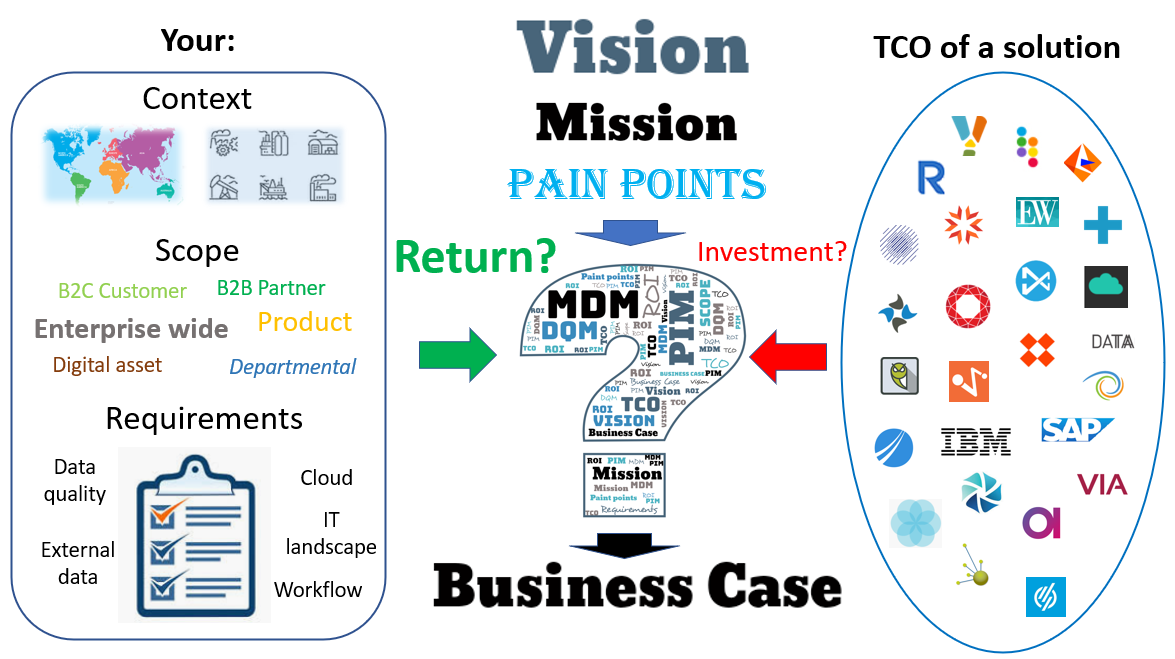
TCO, ROI and Business Case for Your MDM / PIM / DQM Solution

Any implementation of a Master Data Management (MDM), Product Information Management (PIM) and/or Data Quality Management (DQM) solution will need a business case to tell if the intended solution has a positive business outcome.

Prior to the solution selection you will typically have:

  • Identified the vision and mission for the intended solution
  • Nailed the pain points the solution is going to solve
  • Framed the scope in terms of the organizational coverage and the data domain coverage
  • Gathered the high-level requirements for a possible solution
  • Estimated the financial results achieved if the solution removes the pain points within the scope and adhering to the requirements

The solution selection (jump-starting with the Disruptive MDM / PIM / DQM Select Your Solution service) will then inform you about the Total Cost of Ownership (TCO) of the best fit solution(s).

From here you can, put very simple, calculate the Return of Investment (ROI) by withdrawing the TCO from the estimated financial results.

MDM PIM DQM TCO ROI Business Case

You can check out more inspiration about ROI and other business case considerations on The Disruptive MDM / PIM /DQM Resource List.

Collaborative Product Data Syndication vs Data Pools and Marketplaces

The previous post on this blog was called Inbound and Outbound Product Data Syndication.

As touched in this post there are two kinds of Product Data Syndication (PDS):

  • The public kind where everyone shares the same product information. The prominent examples are marketplaces and data pools.
  • The collaborative kind where you can exchange the same product information with all your accepted trading partners but also supplement with one-to-one product information that allows the merchant to stand out from the crowd.

When you syndicate to marketplaces everyone can easily watch and get inspired. A creepy kind of inspiration is the one surfacing at the moment where Amazon is believed to copy product data in order to make a physical twin as examined in the Wall Street Journal article telling that Amazon Scooped Up Data From Its Own Sellers to Launch Competing Products.

When syndicating – or synchronizing – through data pools you are limited to the consensus on the range of data elements, structure and format enforced by those who control the data pool – which can be you and your competitors.

With a collaborative PDS solution you can get the best of two worlds. You can have the market standard that makes you not falling behind your competitors. However, you can also have unique content coming through that puts you ahead of your competitors.

Collaborative PDS Data pools and Marketplaces

Right now, I am working with a collaborative PDS solution. This solution welcomes other (collaborative) PDS solutions as part of the product information flow. The solution will also encompass data pools in a reservoir concept. This PDS solution is called Product Data Lake.

Inbound and Outbound Product Data Syndication

If you google for the term Product Data Syndication you will get the explanation in a post on the sister site to this blog. The Disruptive MDM / PIM / DQM list blog post is called What is Product Data Syndication (PDS).

Inbound and Outbound Scenarios

Digging further into this subject one can divide the Product Data Syndication (PDS) scenarios as seen from the individual organization within a supply chain into inbound and outbound product data syndication.

As a merchant/retailer/dealer being downstream in the supply chain you will have these main scenarios:

  • Outbound product data syndication to marketplaces. This is the scenario covered by most solutions that are marketed as PDS solutions. The challenge here is that there are hundreds of marketplaces both internationally and nationally. These marketplaces have each their way of getting the product information. The advantage of such a PDS solution is that you as a merchant only need one downstream feed to (in theory) all marketplaces.
  • Inbound product data syndication from suppliers either directly from the manufacturer or through distributors. There are many ways this is done today stretching exchanging spreadsheets, getting the product information in your supplier portal, fetching the product information from each of the manufacturers customer portal, through data pools and, still in the emerging stage, utilizing a collaborative PDS solution (see further down).
  • Outbound product data syndication to large end users often being manufacturers utilizing MRO (Maintenance, Repair and Operation) parts.

As a manufacturer/brand owner being upstream in the supply chain you will have these main scenarios:

  • Outbound product data syndication to marketplaces, which most often only covers a fraction of the revenue.
  • Outbound product data syndication of product information for finished products to distributors and/or merchants. There are many ways this is done today stretching exchanging spreadsheets, putting the product information in each of the distributors/merchant’s supplier portal, exhibiting the product information in your customer portal, through data pools and, still in the emerging stage, utilizing a collaborative PDS solution (see further down).
  • Inbound product data syndication of product information for raw materials and MRO (Maintenance, Repair and Operation) parts from suppliers being other manufacturers, distributors and/or merchants. There are many ways this is done today stretching exchanging spreadsheets, through data pools and, still in the emerging stage, utilizing a collaborative PDS solution (see further down).

As a distributor/wholesaler being midstream in the supply chain you share the outbound PDS scenarios at manufactures and the inbound PDS scenarios at merchants.

In some cases, a marketplace can act as a data pool too.

Collaborative PDS

A Collaborative PDS Solution

In my eyes a collaborative PDS solution have these capabilities:

  • Catering for a win-win scenario between trading partners by allowing one uniform way of outbound push of product information from upstream trading partners (manufacturers, distributors) and one uniform way of inbound pull of product information at downstream trading partners (distributors, merchants).
  • Ability to work with all in-house Product Information Management (PIM) solutions and/or other in-house applications where product information is managed both for outbound push and inbound pull.
  • Can encompass outbound push to and pull from data pools and even other PDS solutions as elements in the total product information flow embracing both market standard product information and flow of individual product information that makes the merchant stand out from the crowd.

Right now, I am working with a collaborative PDS solution. This solution welcomes other (collaboratve) PDS solutions as part of the product information flow. And of course, also every in-house Product Information Management (PIM) solution out there. This PDS solution is called Product Data Lake.

Get Your Free Bespoke MDM / PIM / DQM Solution Ranking

The Disruptive MDM / PIM / DQM List has an interactive service that can help you jumpstart in your tool selection for a Master Data Management (MDM), Product Information Management (PIM) and/or Data Quality Management (DQM) solution.

MDM PIM DQM Context, Scope and RequirementsThe selection model is based on the context, scope and requirements for your solution.

The context includes the geographical reach and the industry where your organization operates.

The scope includes the number of entities as for example consumers (B2C customers), companies (B2B customers, suppliers and other business partners), products and digital assets as well as the organizational reach.

The requirements are those that differentiate the MDM / PIM / DQM solutions on the market.

MDM PIM DQM Vendor capabilitiesThe solution capabilities considered in the selection process are those of who are:

  • On this Disruptive MDM / PIM / DQM Solutions List or
  • Gartner MDM Magic Quadrant or
  • Forrester MDM Wave or Forrester PIM Wave or
  • Information Difference MDM Landscape

MDM PIM DQM AI EngineThese two sets of information are compared in a continuously supervised learning algorithm – also known in marketing as machine learning and artificial intelligence (AI).

Filling in the information usually takes less than 15 minutes. You will get your solution list within 1 to 48 hours.

MDM PIM DQM Ranking OutcomeThe outcome is:

  • The best fit solution for a Proof of Concept
  • Two more solutions to be in a shortlist
  • Four more solutions to be in a longlist
  • If fit, a couple of more solutions to be considered as alternatives or supplements

During the half year this service has been online, more than 100 end user organizations or their consultants have received their solution list.

This service is free. No information is shared with anyone unless requested. Are you ready? Start with step 1 here.

MDM / PIM / DQM Resources

Last week The Resource List went live on The Disruptive MDM / PIM / DQM List.

The rationale behind the scaling up of this site is explained in the article Preaching Beyond the Choir in the MDM / PIM / DQM Space.

These months are in general a yearly peak for conferences, written content and webinars from solution and service providers in the Master Data Management (MDM), Product Information Management (PIM) and Data Quality Management (DQM) space. With the covid-19 crises conferences are postponed and therefore the content providers are now ramping up the online channel.

As one who would like to read, listen to and/or watch relevant content, it is hard to follow the stream of content being pushed from the individual providers every day.

The Resource List on this site is a compilation of white papers, ebooks, reports, podcasts, webinars and other content from potentially all the registered tool vendors and service providers on The Solution List and coming service list. The Resource List is divided into sections of topics. Here you can get a quick overview of the content available within the themes that matters to you right now.

The list of content and topics is growing.

Check out The Resource List here.

MDM PIM DQM resourcesPS: The next feature on the site is planned to be The Case Study List. Stay tuned.