Customer Product Matrix Management

A customer/product matrix is a way of describing the relationships between customer types and product types/attributes.  

Example:

Note: Please find some data quality related product descriptions in the post Data Quality and World Food.

Filling out the matrix may be based on prejudices, gut feelings, assumptions, surveys, focus groups or data.

If we go for data we may do this by collecting available historical data related to sales and inquiries made by persons belonging to each customer type regarding products belonging to each product type.  

In doing that correctly we need two kinds of master data management and data quality assurance in place:

  • Customer Data Integration (CDI) for assigning the accurate customer type in the real world related to the uniquely identified person in transactions coming from all sources – here based on location master data.
  • Product Information Management (PIM) for categorizing the relevant fit for purpose product type.

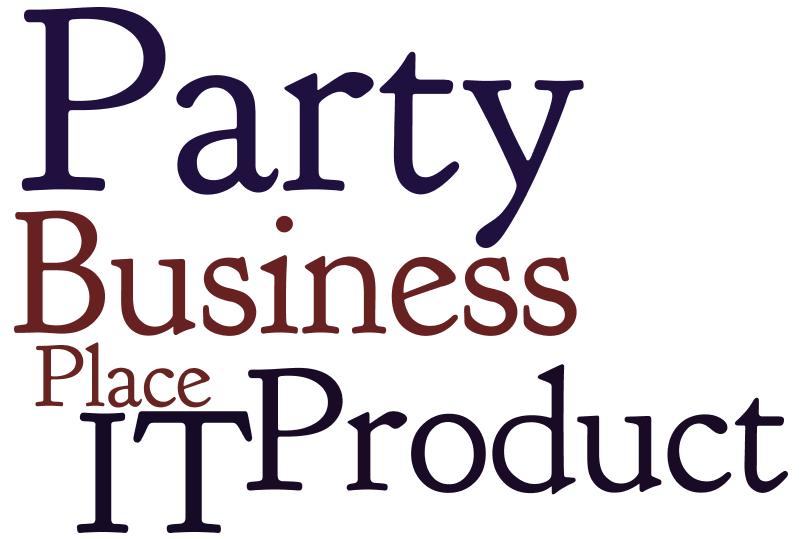
This reminds me about multi-domain master data management. Customer master data (or shall we say party master data), product master data and location master data used to figure out how to do business. I like it – both the master data management part and the mentioned product types.  

Bookmark and Share

Multi-Channel Data Quality

When I hear terms as multi-channel marketing, multi-channel retailing, multi-channel publishing and other multi-channel things I can’t resist thinking that there also must be a term called multi-channel data quality.

Indeed we are getting more and more channels where we do business. It stretches from the good old brick and mortar offline shop over eCommerce and the latest online touch points as mobile devices and social media.

Our data quality is challenged by how the way of the world changes. Customer master data is coming from these disparate channels with various purposes and in divergent formats. Product master data is exposed through these channels in different ways.     

We have to balance our business processes between having a unique single customer view and a unified product information basis and the diverse business needs within each channel.  

Some customer data may be complete and timely in one channel but deficient and out of date in another channel. Some product data may be useful here but inaccurate there.

I think the multi-channel things makes yet a business case for multi-domain (or multi-entity) master data management. Even if it is hard to predict the return on investment for the related data quality and master data management initiatives I think it is easy to foresee the consequences of doing nothing.

Bookmark and Share

Timeliness of Times

One of my several current engagements is within public transit.

I have earlier written about Real World Alignment issues in public transit (in my culture) as well as the special Multi-Entity Master Data Quality challenges there is in this specific industry.

Usually we talk about party master data and product master data as the most common domains of master data and sometimes we add places (locations) as the third domain in a P trinity of “parties, products and places” or perhaps a W trinity of “who, what and where”.

The when dimension, the times where events are taking place, is most often seen as belonging to the transaction side of life in the databases.

However in public transit you certainly also have timetables as an important master data domain. The service provided by a public transit authority or operator is described as belonging to a certain timeframe where a given combination of services is valid. An example is the “Summer Schedule 2011”.

An other industry with a time depending master data domain I have seen is education, where the given services (lessons) usually are described as belonging to a semester.

Wonder if you have met other master data types that is more belonging to the “when” domain than the “who, what and where” domains?  Did you have any problems with the timeliness of times?

Bookmark and Share

Product Placement

This wasn’t actually meant as a blog post series about the place entity in multi-domain master data management. But I think I have been carried away by my work, so now it is.

Places probably are most common related to the party domain as seen in the previous post called A Place in Time. But places certainly also have multiple relations to the product domain then forming a P trinity of parties, products and places in multi-domain master data management as seen in the post Your Place or My Place?

As with most things in the product domain also the product-place relations usually are very industry specific.

Some of the product-place relations I have worked with come from these industries:

Insurance

The fees you have to pay for some insurance products are related to the place where you live. In order to having the right fees (and for a lot of other reasons) an insurance company needs to analyze data based on the product-place relations. This may by the way go very wrong as told in the post A Really Bad Address.

Hospitality

Your product is a place where the selling attributes includes both the properties belonging to the place itself and the properties of the places being nearby.

Real Estate

Do I have to say more than three words: Location, Location, Location.

Your product-place relations

Tell me about what product-place relations you have worked with?

Bookmark and Share

A Place in Time

I remember when I had the first chemistry lesson in high school our teacher told us that we should forget all about the chemistry we had learned in primary school, because this was a too simply model not reflecting how the real world of chemistry actually work.

Since I have started working with data quality and master data management I have a pet peeve in data modeling, namely being the probably most common example of doing data modeling: The classic customer table. Example from a SQL tutorial here:

Compared to how the real world works this example has some diversity flaws, like:

  • state code as a key to a state table will only work with one country (the United States)
  • zipcode is a United States description only opposite to the more generic “Postal Code”
  • fname (First name) and lname (Last name) don’t work in cultures where given name and surname have the opposite sequence
  • The length of the state, zipcode and most other fields are obviously too small almost anywhere

More seriously we have:

  • fname and lname (First name and Last name) and probably also phone should belong to an own party entity acting as a contact related to the company
  • company name should belong to an own party entity acting in the role as customer
  • address1, address2, city, state, zipcode should belong to an own place entity probably as the current visiting place related to the company

Now I know this is just a simple example from a tutorial where you should not confuse by adding too much complexity. Agreed.

However many home grown solutions in business life and even many commercial ready-made applications use that kind of a data model to describe one of the most important business entities being our customers.

It may be that such a model does fit the purpose of use in some operations. Sometimes yes, sometimes no. But when reusing data from such a model on enterprise level and when adding business intelligence you are in big trouble. That is why we need master data hubs and why we need to transform data coming into the master data hub.

From such a customer record we don’t create just one golden record. We make or link several different related multi-domain entities as:

  • The contact as a person in our party domain – maybe we knew her before
  • The company in our party domain – maybe we knew the sister as a supplier before
  • The address in our place (location) domain – maybe we knew that address as a place in time before

Bookmark and Share

Your Place or My Place?

We, and that’s including myself, often talk about multi-domain master data management as a marriage between party master data management (also called Customer Data Integration abbreviated as CDI) and Product Master Data Management (also called Product Information Management abbreviated as PIM).

The third most common master data domain is locations (or places). I like the term place, because then we have a P trinity: Parties, Products and Places. However there may be a fourth P involved, as I read a post today by Steven Jones of Capgemini telling that multi-domain MDM is a Pointless question.

The Premise of the Pointlessness is that Party and Product is an IT Perspective. The rest of the business sees the world from mainly either a customer centric perspective or a supply centric perspective.

I agree about that these perspectives exists too and actually made a blog post recently on sell side vs buy side master data quality.

I don’t agree about that this is an (pointless) IT versus business question, obviously also because I have a hard time recognizing the great divide between IT and business. From my perspective is IT a part of the business just like sales, marketing and purchase is it too. And from a product vendor perspective in the MDM realm you actually address the conjunction of business and technological needs a bit opposite to either being a database manager vendor aimed mostly at the IT part of business or a CRM or SCM vendor aimed mostly at the sales or purchase part of business.

Multi-domain MDM isn’t in my perspective a pointless place, but a meeting place between IT and all the other places in business and the core business entities being parties, products and places.

Bookmark and Share

Lots of Product Names

In master data management the two most prominent domains are:

  • Parties and
  • Products

In the quest for finding representations of parties actually being the same real world party and finding representations of products actually being the same real world product we typically execute fuzzy data matching of:

  • Party names as person names and company names
  • Product descriptions

However I have often seen party names being an integral part of matching products.

Some examples:

Manufacturer Names:

A product is most often being regarded as distinct not only based on the description but also based on the manufacturer. So besides being sharp on matching product descriptions for light bulbs you must also consider if for example the following manufacturer company names are the same or not:

  • Koninklijke Philips Electronics N.V.
  • Phillips
  • Philips Electronic

Author Names:

A book is a product. The title of the book is the description. But also the author’s person name counts. So how do we collect the entire works made by the author:

  • Hans Christian Andersen
  • Andersen, Hans Christian
  • H. C. Andersen

as all three representations are superb bad data?

Bear Names:

A certain kind of teddy bears has a product description like “Plush magenta teddy bear”. But each bear may have a pet name like “Lots-O’-Huggin’ Bear” or just short “Lotso” as seen in the film “Toy Story 3”. And seriously: In real business I have worked with building a bear data model and the related data matching.

PS: For those who have seen Toy Story 3: Is that Lotso one or two real world entities?  

Bookmark and Share

Sell–side vs Buy-side Master Data Quality

The two most prominent domains in master data management and related data quality improvement are:

  • Party master data and
  • Product master data

Party Master Data

Most of the talk about party master data is about customer master data (including prospect master data). This discipline is often called Customer Data Integration (CDI).  Customer data is the sell-side of party master data. The organizations with the biggest pains in this area are mostly organizations with many customers (and prospects). The largest volumes of customer data is related to business-to-consumer (B2C) activities, but certainly we also see many grown customer databases in the business-to-business (B2B) realm.

The buy-side of party master data is supplier data. Fewer organizations have grown supplier databases, but surely big firms with many different departments and subsidiaries have supplier master data issues like the ones we see on the sell-side.

Also many organizations have a surprisingly large intersection of the same parties being both on the sell-side and on the buy-side. I have touched that subject in the post: 360° Business Partner View.

Product Master Data

Product Information Management (PIM) also has a sell-side and a buy-side. Also here the pains grow with the numbers. Opposite to party master data high sell-side numbers is more seldom than high buy-side numbers with product master data.

We often see high sell-side number of products at retailers where the same product also is buy-side at the same time, but where we maybe haven’t the same requirements for entity resolution at the same time. Most organizations don’t have that big issues (like problems with uniqueness) with own produced products.

Else high number of buy-side products is not so much related to buying raw materials as it is to buying things as spare parts and all kind of small equipment and assets of different kind (with software licenses being most close to herding cats I guess).

Multi-Domain Master Data Management

With multi-domain master data management there is of course a connection between sell-side party master data and sell-side product master data with opportunities in analyzing to whom we sell what and discovering cross selling openings and so on.

On the buy-side there are great potentials in looking into from where we buy similar things, looking into discount possibilities and so on.

Same same but different

A while ago I wrote a blog post about similarities and differences between party master data quality and product master data quality called Same Same But Different.

Besides having the differences between party master data and product master data I also find we have differences between sell-side and buy-side making it four different but somewhat similar and connected disciplines in master data management and data quality improvement.

Bookmark and Share

The Magic Numbers

An often raised question and a subject for a lot of blog posts in the data quality realm is whether data quality challenges should be solved by people or technology.

As in all things data quality I don’t think there is a single right answer for that.

Now, in this blog post I will not tell about what I then think is the answer(s) to the question, but simply tell about what I have seen been chosen as the solution to the question, which have been both people centric solutions and technology centric solutions.

If I look at the situations where people centric solutions have been chosen versus the situations where technology centric solutions have been chosen, the first differentiator seems to be numbers:

  • If you have only a small number of customers and a single channel where entered, the better solution to optimal data quality and uniqueness seems to be a people centric solution.
  • If you have millions of customers and multiple channels where entered, the only practical solution to optimal data quality and uniqueness seems to be a technology centric solution.
  • If you have only a small number of products and a single channel where entered, the only sensible solution to optimal data quality and uniqueness seems to be a people centric solution.
  • If you have thousands of products coming from multiple channels, the most reliable solution to optimal data quality and uniqueness seems to be a technology centric solution.

So, based on common sense the answer to the people or technology question is that it magically depends on the numbers.

Bookmark and Share

What is Multi-Domain MDM?

Doing master data management with several different entity types is most often seen as the federated discipline of handling Customer Data Integration (CDI) and Product Information Management (PIM) with the same software brand.

And sure, doing this (including making that software) is a challenge as there are basic differences between the two disciplines as discussed in the post Same Same But Different.

But doing both well at the same time is only a starting point. Making business value from the intersection between the two disciplines is the real challenge.

I learned that 20 years ago when I started a new client relationship (which also was before MDM, CDI and PIM was household TLA’s).

The client’s head quarter was in the southern outskirts of Copenhagen, so on a good summer day I could go there on my bike. They imported else wasted peels from oranges grown in the endless South American citrus plantations to be used for our morning juice and else useless seaweed harvested in the hot waters around the countless Philippine islands.

Along with a few other raw materials the peels and seaweed were made into approximately a hundred different semi-finished products. Based on customer orders these were blended into not much more than a thousand different defined finished products being valuable ingredients for food and pharmaceutical production.

The number of different customers was also modest, as I remember not much more than a thousand different worldwide customers.

So, managing 1,000 different customers buying 1,000 different products shouldn’t be much of a MDM case. Of course customer data management with global diverse entities had its challenges and not at least product information handling with rising regulatory demands in the food and pharmaceutical segment wasn’t a walk over either.

But some big hurdles were sure in the intersection between customer master data and product master data and solving the issues did almost always involve data quality related to core transactions referencing the entities described in the master data.

Bookmark and Share