Matching Light Bulbs

This morning I noticed this lightbulb joke in a tweet from @mortensax:

Besides finding it amusing I also related to it since I have used an example with light bulbs in a webinar about data matching as seen here:

The use of synonyms in Search Engine Optimization (SEO) is very similar to the techniques we use in data matching.

Here the problem is that for example these two product descriptions may have a fairly high edit distance (very different character by character), but are the same:

  • Light bulb, A 19, 130 Volt long life, 60 W
  • Incandescent lamp, 60 Watt, A19, 130V

while these two product descriptions have an edit distance of only one substitution of a character, but are not the same product (though being same category):

  • Light bulb, 60 Watt, A 19, 130 Volt long life
  • Light bulb, 40 Watt, A 19, 130 Volt long life

Working with product data matching is indeed very enlightening.

Bookmark and Share

Now, where’s the undo button?

I have just read two blog posts about the dangers of deleting data in the good cause of making data quality improvements.

In his post Why Merging is Evil Scott Schumacher of IBM Initiate describes the horrors of using survivorship rules for merging two (or more) database rows recognized to reflect the same real world entity.

Jim Harris describes the insane practices of getting rid of unwanted data in the post A Confederacy Of Data Defects.

On a personal note I have just had a related experience from outside the data management world. We have just relocated from a fairly large house to a modest sized apartment. Due to the downsizing and the good opportunity given by the migration we wasted a lot of stuff in the process. Now we are in the process of buying replacements for these things we shouldn’t have thrown away.

As Scott describes in his post about merging, there is an alternate approach to merging being linking – with some computation inefficiency attached. Also in the cases described by Jim we often don’t dare to delete at the root, so instead we keep the original values and makes a new cleansed copy without the supposed unwanted data for the purpose at hand.

In my relocation project we could have rented a self-storage unit for all the supposed not so needed stuff as well.

It’s a balance. As in all things data quality there isn’t a single right or wrong answer to what to do. And there will always be regrets. Now, where’s the undo button?

Bookmark and Share

Christmas at the old Bookstore

Once upon a time (let’s say 15 years ago) there was a nice old bookstore on a lovely street in a pretty town. The bookstore was a good shopping place caring about their customers. The business had grown during the years. Neighboring shops have been bought and added to the premises along with the apartments above the original shop.

Also the number of employees had increased. The old business processes didn’t fit into the new reality so the wise old business owner launched a business process reengineering project in order to have the shop ready for a new record selling Christmas season. All the employees were more or less involved from brainstorming ideas to the final implementation. All suggestions were prioritized according to business value in supporting the way of doing business: Handing books over the fine old cash desk in the middle of the bookstore.

Even some new technology adoptions were considered during the process. But not too much. As the wise old business owner said again and again: Technology doesn’t sell books. Ho ho ho.

Unfortunately something terrible happened somewhere else. I don’t remember if it was on the other side of the street, on the other side of the river or on the other side of the ocean. But someone opened an internet bookstore. During the next years the market for selling books changed drastically due to orchestrating a business process based on new technology.

The wise old business owner at the nice old bookstore was choked. He actually had read the best management books on the shelf in the bookstore telling him to improve his business processes based on the way of doing business today; rely on changing the attitude of the good people working for him and then maybe use technology as an enabler in doing that. Ho ho ho.

Now, what about a happy ending? Oh yes. Actually some people like to buy some books on the internet and like to buy some other books in a nice old bookstore. Some other people like to buy most books in a nice old bookstore but may want to buy a few other books on the internet. So the wise old business owner went into multi-channel book selling. In order to keep track on who is buying what and where he used a state of the art data matching tool. Ho ho ho. Besides that he of course relied on the good people still working for him. Ho ho ho.

Bookmark and Share

Storing a Single Version of the Truth

An ever recurring subject in the data quality and master data management (MDM) realms is whether we can establish a single version of the truth.

The most prominent example is whether an enterprise can implement and maintain a single version of the truth about business partners being customers, prospects, suppliers and so on.

In the quest for establishing that (fully reachable or not) single version of the truth we use identity resolution techniques as data matching and we are exploiting ever increasing sources of external reference data.

However I am often met with the challenge that despite what is possible in aiming for that (fully reachable or not) single version of the truth, I am often limited by the practical possibilities for storing it.

In storing party master data (and other kind of data) we may consider these three different ways:

Flat files

This “Keep It Simple, Stupid” way of storing data has been on an ongoing retreat – however still common, as well as new inventions of big flat file structures of data are emerging.

Also many external sources of reference data is still flat file like and the overwhelming choice of exchanging reference and master data is doing it by flat files.

Despite lots of work around solutions for storing the complex links of the real world in flat files we basically ends up with using very simplified representations of the real world (and the truth derived) in those flat files.  

Relational databases

Most Customer Relationship Management (CRM) systems are based on a relational data model, however mostly quite basic regarding master data structures making it not straight forward to reflect the most common hierarchical structures of the real world as company family trees, contacts working for several accounts and individuals forming a household.  

Master Data Management hubs are of course built for storing exactly these hierarchical kinds of structures. Common challenges here are that there often is no point in doing that as long as the surrounding applications can’t follow and that you often may restrict your use to a simplified model anyway like an industry model.   

Neural networks

The relations between parties in the real world are in fact not truly hierarchical. That is why we look into the inspiration from the network of biological neurons.

Doing that has been an option I have heard about for many years but still waits to meet as a concrete choice when delivering a single version of the truth.   

Bookmark and Share

Testing a Data Matching Tool

Many technical magazines have tests of a range of different similar products like in the IT world comparing a range of CPU’s or a selection of word processors. The tests are comparing measurable things as speed, ability to actually perform a certain task and an important thing as the price.

With enterprise software as data quality tools we only have analyst reports evaluating the tools on far less measurable factors often given a result very equivalent to stating the market strength. The analysts haven’t compared the actual speed; they have not tested the ability to do a certain task nor taken the price into consideration.  

A core feature in most data quality tools is data matching. This is the discipline where data quality tools are able to do something considerable better than if you use more common technology as database managers and spreadsheets, like told in the post about deduplicating with a spreadsheet.

In the LinkedIn data matching group we have on several occasions touched the subject of doing a once and for all benchmark of all data quality tools in the world.

My guess is that this is not going to happen. So, if you want to evaluate data quality tools and data matching is the prominent issue and you don’t just want a beauty contest, then you have to do as the queen in the fairy tale about The Princess and the Pea: Make a test.

Some important differentiators in data matching effectiveness may narrow down the scope for your particular requirements like:

  • Are you doing B2C (private names and addresses), B2B (business names and addresses) or both?
  • Do you only have domestic data or do you have international data with diversity issues?
  • Will you only go for one entity type (like customer or product) or are you going for multi-entity matching?

Making a proper test is not trivial.

Often you start with looking at the positive matches provided by the tool by counting the true positives compared to the false positives. Depending on the purposes you want to see a very low figure for false positives against true positives.

Harder, but at least as important, is looking at the negatives (the not matched ones) as explained in the post 3 out of 10.  

Next two features are essential:

  • In what degree are you able to tune the match rules preferable in a user friendly way not requiring too much IT expert involvement?
  • Are you able to evaluate dubious matches in a speedy and user friendly way as shown in the post called When computer says maybe?

A data matching effort often has two phases:

  • An initial match with all current stored data maybe supported by matching with external reference data. Here speed may be important too. Often you have to balance high speed with poor results. Try it.
  • Ongoing matching assisting in data entry and keeping up with data coming from outside your jurisdiction. Here using data quality tools acting as service oriented architecture components is a great plus including reusing the rules from the initial match. Has to be tested too.

And oh yes, from my experience with plenty of data quality tool evaluation processes: Price is an issue too. Make sure to count both license costs for all the needed features and consultancy needed experienced from your tests.

Bookmark and Share

Entity Revolution vs Entity Evolution

Entity resolution is the discipline of uniquely identifying your master data records, typically being those holding data about customers, products and locations. Entity resolution is closely related to the concept of a single version of the truth.

Questions to be asked during entity resolution are like these ones:

  • Is a given customer master data record representing a real world person or organization?
  • Is a person acting as a private customer and a small business owner going to be seen as the same?
  • Is a product coming from supplier A going to identified as the same as the same product coming from supplier B?
  • Is the geocode for the center of a parcel the same place as the geocode of where the parcel is bordering a public road?

We may come a long way in automating entity resolution by using advanced data matching and exploiting rich sources of external reference data and we may be able to handle the complex structures of the real world by using sophisticated hierarchy management and hereby make an entity revolution in our databases.

But I am often faced with the fact that most organizations don’t want an entity revolution. There are always plenty of good reasons why different frequent business processes don’t require full entity resolution and will only be complicated by having it (unless drastic reengineered). The tangible immediate negative business impact of an entity revolution trumps the softer positive improvement in business insight from such a revolution.

Therefore we are mostly making entity evolutions balancing the current business requirements with the distant ideal of a single version of the truth.

Bookmark and Share

Legal Forms from Hell

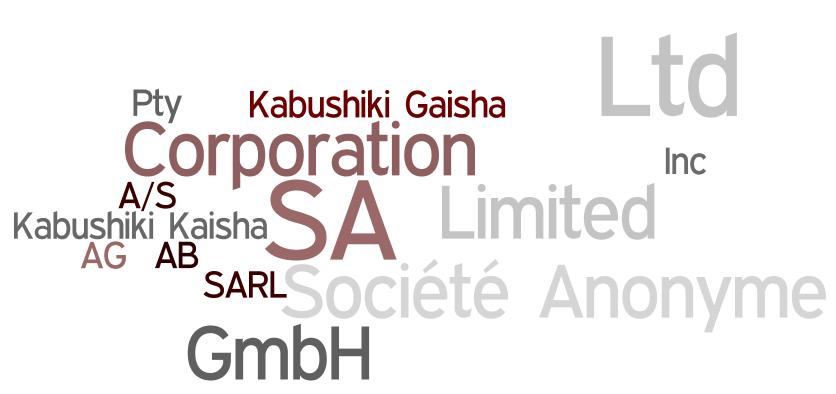
When doing data matching with company names a basic challenge is that a proper company name in most cultures in most cases have two elements:

  • The actual company name
  • The legal form

Some worldwide examples:

  • Informatica Corporation
  • Talend SA
  • SAP Deutschland AG & Co. KG
  • Sony Kabushiki Kaisha
  • LEGO A/S

There are hundreds of different legal forms in full and abbreviated forms. Wikipedia has a list here (here called types of business entity).

However, when typing in company names in databases the legal form is often omitted. And even where legal forms are present they may be represented differently in full or abbreviated forms, with varying spelling and punctuation and so on. As the actual company names also suffer from this fuzziness, the complexity is overwhelming.

A common way of handling this issue in data matching is to separate the legal form and then emphasize on comparing the remaining part being the actual company name. When doing that it has to be done country specific or else you may remove the entire name of a company like with a name of an Italian company called Société Anonyme, which is a French legal form.

While the practice of having legal forms in company names may serve well for the original purpose of knowing the risk of doing business with that entity, it is certainly not serving the purpose of having the uniqueness data quality dimension solved.

One should think that it is time for changing the bad (legal demanded) practice of mixing legal forms with company names and serve the original purpose in another more data quality friendly way.

Bookmark and Share

Golden Copy Musings

In a recent blog post by Jim Harris called Data Quality is not an Act, it is a Habit the term “golden mean” was mentioned.   

As I commented, mentioning the “golden mean” made me think about the terms “golden copy” and “golden record” which are often used terms in data quality improvement and master data management.

In using these terms I think we mostly are aiming on achieving extreme uniqueness. But we should rather go for symmetry, proportion, and harmony.

The golden copy subject is very timely for me as I this weekend is overseeing the execution of the automated processes that create a baseline for a golden copy of party master data at a franchise operator for a major brand in car rental.

In car rental you are dealing with many different party types. You have companies as customers and prospects and you have individuals being contacts at the companies, employees using the cars rented by the companies and individuals being private renters. A real world person may have several of these roles. Besides that we have cases of mixed identities.

During a series of workshops we have worked with defining the rules for merge and survivorship in the golden copy. Though we may be able to go for extreme uniqueness in identifying real world companies and persons this may not necessary serve the business needs and, like it or not, be capable of being related back into the core systems used in daily business.

Therefore this golden copy is based on a beautiful golden mean exposing symmetry, proportion, and harmony.

Bookmark and Share

To be called Hamlet or Olaf – that is the question

Right now my family and I are relocating from a house in a southern suburb of Copenhagen into a flat much closer to downtown. As there is a month in between where we haven’t a place of our own, we have rented a cottage (summerhouse) north of Copenhagen not far from Kronborg Castle, which is the scene of the famous Shakespeare play called Hamlet.

Therefore a data quality blog post inspired by Hamlet seems timely.

Though the feigned madness of Hamlet may be a good subject related to data quality, I will however instead take a closer data matching look at the name Hamlet.

Shakespeare’s Hamlet is inspired by an old Norse legend, but to me the name Hamlet doesn’t sound very Norse.

Nor does the same sounding name Amleth found in the immediate source being Saxo Grammaticus.

If Saxo’s source was a written source, it may have been from Irish monks in Gaelic alphabet as Amhlaoibh where Amhl=owl and aoi=ay and bh=v sounding just like the good old Norse name Olav or Olaf.

So, there is a possible track from Hamlet to Olaf.

Also today a fellow data quality blogger Graham Rhind posted a post called Robert the Carrot with the same issue. As Graham explains, we often see how data is changed through interfaces and in the end after passing through many interfaces doesn’t look at all as it was when first entered. There may be a good explanation for each transformation, but the end-to-end similarity is hard to guess when only comparing these two.

I have met that challenge in data matching often. An example will be if we have the following names living on the same address:

  • Pegy Smith
  • Peggy Smith
  • Margaret Smith

A synonym based similarity (or standardization) will find that Margaret and Peggy are duplicates.

An edit distance similarity will find that Peggy and Pegy are duplicates,

A combined similarity algorithm will find that all three names belong to a single duplicate group.

Bookmark and Share

Magic Quadrant Diversity

The Magic Quadrants from Gartner Inc. ranks the tool vendors within a lot of different IT disciplines. Related to my work the quadrants for data quality tools and master data management is the most interesting ones.

However, the quadrants examine the vendors in a global scope. But, how are the vendors doing in my country?

I tried to look up a few of the vendors in a local business directory for Denmark provided (free to use on the web) by the local Experian branch.

DataFlux

First up is DataFlux, the (according to Gartner) leading data quality tool vendor.

Result: No hits.

Knowing that DataFlux is owned by SAS Institute will however, with a bit of patience, finally bring you to information about the DataFlux product deep down on the SAS local website.

PS: Though SAS is more known here as the main airline (Scandinavian Airlines System), SAS Institute is actually very successful in Denmark having a much larger part of the Business Intelligence market here than most places else.

Informatica

Next up is Informatica, a well positioned company in both the quadrant for data quality tools and customer master data management.

Result: No Hits.

Here you have to know that Informatica is represented in the Nordic area by a company called Affecto. You will find information about the Informatica products deep down on the Affecto website – along with the competing product FirstLogic owned by Business Objects (owned by SAP) also historically represented by Affecto.

Stibo Systems

Stibo Systems may not be as well known as the two above, but is tailing the mega vendors in the quadrant for Product Master Data Management, as mentioned recently in a blog post by Dan Power.

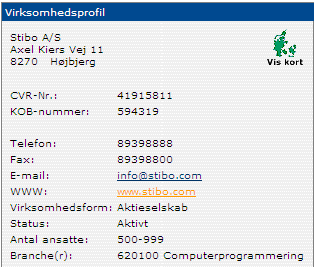
Result: Hit:

They are here with over 500 employees – at least in the legal entity called Stibo where Stibo Systems is an alternate name and brand. And it’s no kidding; I visited them last month at the impressive head quarter near Århus (the second largest city in Denmark).

Bookmark and Share