Social MDM and Systems of Engagement

Social Master Data Management has been an interest of mine the last couple of years and last week I have tried to reach out to others in exploring this new era of Master Data Management by creating a group on LinkedIn called Social MDM.

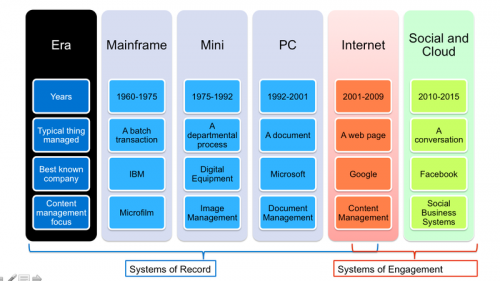
When reading a nice blog with the slogan ”Welcome to the Real (IT) World!” by Max J. Pucher I came across a good illustration by John Mancini showing the history of IT and how the term “Systems of Record” is being replaced (or at least supplemented) by the term “Systems of Engagement”:
Master Data Management (MDM) includes having a System of Record (SOR) describing the core entities that takes part in the transactional systems of record that supports the daily business in every organization. For example a golden MDM record is describing the party that acts as a customer on an order record while the products in the underlying order lines are described in golden MDM records for the things dealt with within the organization.

Social Master Data Management (Social MDM) will be about supplementing that System of Record so we are able to further describe the parties taking part in the new Systems of Engagement and link with the old Systems of Records. These parties are reflected as social network profiles that are owned by the same human beings who are our (prospective) customers, part of the same household or are a contact for a company being a (prospective) customer or any other business partner.

For a guy like me who started in IT in the mainframe era (just after it had ended according to the above illustration) and went on with mini computers, PC’s and the internet it’s very exciting to be moving on into the social and cloud era.

It will be good to be joined by even more data quality and MDM practitioners and anyone else in the LinkedIn Social MDM group.

Bookmark and Share

Finding Me

Many people have many names and addresses. So have I.

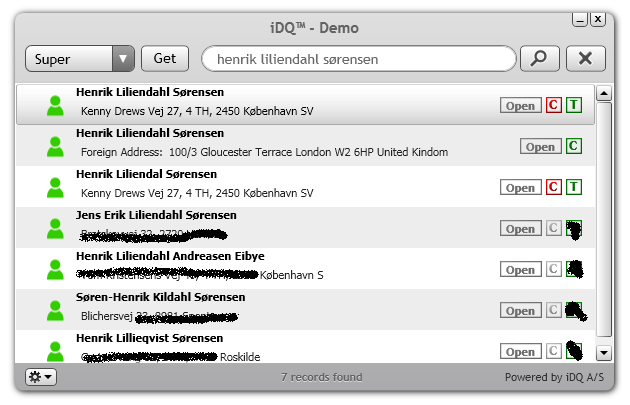
A search for me within Danish reference sources in the iDQ tool gives the following result:

Green T is positive in the Danish Telephone Books. Red C is negative in the Danish Citizen hub. Green C is positive in the Danish Citizen Hub.

Even though I have left Denmark I’m still registered with some phone subscriptions there. And my phone company hasn’t fully achieved single customer view yet, as I’m registered there with two slightly different middle (sur)names.

Following me to the United Kingdom I’m registered here with more different names.

It’s not that I’m attempting some kind of fraud, but as my surname contains The Letter Ø, and that letter isn’t part of the English alphabet, my National Insurance Number (kind of similar to the Social Security Number in the US) is registered by the name “Henrik Liliendahl Sorensen”.

But as the United Kingdom hasn’t a single citizen view, I am separately registered at the National Health Service with the name “Henrik Sorensen”. This is due to a sloppy realtor, who omitted my middle (sur)name on a flat rental contract. That name was taken further by British Gas onto my electricity bill. That document is (surprisingly for me) my most important identity paper in the UK, and it was used as proof of address when registering for health service.

How about you, do you also have several identities?

Bookmark and Share

The Taxman: Data Quality’s Best Friend

Collection of taxes has always been a main driver for having registries and means of identifying people, companies and properties.

5,000 years ago the Egyptians made the first known census in order to effectively collect taxes.

As reported on the Data Value Talk blog, the Netherlands have had 200 years of family names thanks to Napoleon and the higher cause of collecting taxes.

Today the taxman goes cross boarder and wants to help with international data quality as examined in the post Know Your Foreign Customer. The US FATCA regulation is about collecting taxes from activities abroad and as said on the Trillium blog: Data Quality is The Core Enabler for FATCA Compliance.

My guess is that this is only the beginning of a tax based opportunity for having better data quality in relation to international data.

In a tax agenda for the European Union it is said: “As more citizens and companies today work and operate across the EU’s borders, cooperation on taxation has become increasingly important.”.

The EU has a program called FISCALIS in the making. Soon we not only have to identify Americans doing something abroad but practically everyone taking part in the globalization.

For that we all need comprehensive accessibility to the wealth of global reference data through “cutting-edge IT systems” (a FISCALIS choice of wording).

I am working on that right now:

Bookmark and Share

Updating a Social Business Directory

Business directories have been around for ages. In the old days it was paper based as in the yellow pages for a phone book. The yellow pages have since made it to be online searchable. We also know commercial business directories as the Dun & Bradstreet WorldBase as well as government operated national wide directories of companies and industry specific business directories.

Such business directories often takes a crucial role in master data quality work as sources for data enrichment in the quest for getting as close as possible to a single version of the truth when dealing with B2B customer master data, supplier master data and other business partner master data.

A classic core data model for Master Data in CRM systems, SCM solutions and Master Data hubs when doing B2B is that you have:

  • Accounts being the BUSINESS entities who are your customers, suppliers, prospects and all kind of other business partners
  • Contacts being the EMPLOYEEs working there and acting in the roles as decision makers, influencers, gate keepers, users and so on

Today we also have to think about social master data management, being exploiting reference data in social media as a supplementary source of external data.

As all social activity this exercise goes two ways:

  • Finding and monitoring your existing and wanted business partners in the social networks
  • Updating your own data

Most business entities in this world are actually one-man-bands. So are mine. Therefore I went to the LinkedIn company pages this morning and updated data about my company Liliendahl Limited: Unlimited Data Quality and Master Data Management consultancy for tool and service vendors.

Bookmark and Share

Real World Identity

How far do you have to go when checking your customer’s identity?

This morning I read an article on the Danish Computerworld telling about a ferry line now dropping a solution for checking if the passenger using an access card is in fact the paying customer by using a lightweight fingerprint stored on the card. The reason for dropping was by the way due to the cost of upgrading the solution compared to future business value and not any renewed privacy concerns.

I have been involved in some balancing of real world alignment versus fitness for use and privacy in public transport as well as described in the post Real World Alignment. Here it was the question about using a national identification number when registering customers in public transportation.

As citizens of the world we are today used to sometimes having our iris scanned when flying as our passport holds our unique identification that way. Some of the considerations around using biometrics in general public registration were discussed in the post Citizen ID and Biometrics.

In my eyes, or should we say iris, there is no doubt that we will meet an increasing demand of confirming and registering our identification around. Doing that in the fight against terrorism has been there for long. Regulatory compliance will add to that trend as told in the post Know Your Foreign Customer, mentioning the consequences of the FATCA regulation and other regulations.

When talking about identity resolution in the data quality realm we usually deal with strings of text as names, addresses, phone numbers and national identification numbers. Things that reflect the real world, but isn’t the real world.

We will however probably adapt more facial recognition as examined in the post The New Face of Data Matching. We do have access to pictures in the cloud, as you may find your B2C customers picture on FaceBook and your B2B customer contacts picture on LinkedIn or other similar services. It’s still not the real world itself, but a bit closer than a text string. And of course the picture could be false or outdated and thus more suitable for traction on a dating site.

Fingerprint is maybe a bit old fashioned, but as said, more and more biometric passports are issued and the technology for iris and retinal scanning is used around for access control even on mobile devices.

In the story starting this post the business value for reinvesting in a biometric solution wasn’t deemed positive. But looking from the print on my fingers down to my hand lines I foresee some more identity resolution going beyond name and address strings into things closer to the real world as facial recognition and biometrics.

Bookmark and Share

Wildcard Search versus Fuzzy Search

My last post about search functionality in Master Data Management (MDM) solutions was called Search and if you are lucky you will find.

In the comments the use of wildcards versus fuzzy search was touched.

The problem with wildcards

I have a company called “Liliendahl Limited” as this is the spelling of the name as it is registered with the Companies House for England and Wales.

But say someone is searching using one of the following strings:

  • “Liliendahl Ltd”,
  • “Liliendal Limited” or
  • “Liljendahl Limited”

Search functionality should in these situations return with the hit “Liliendahl Limited”.

Using wildcard characters could, depending on the specific syntax, produce a hit in all combinations of the spelling with a string like this: “lil?enda*l l*”.

The problem is however that most users don’t have the time, patience and skills to construct these search strings with wildcard characters. And maybe the registered name was something slightly else not meeting the wildcard characters used.  

Matching algorithms

Tools for batch matching of name strings have been around for many years. When doing a batch match you can’t practically use wildcard characters. Instead matching algorithms typically rely of one, or in best case a combination, of these techniques:

The same techniques can be used for interactive search thus reaching a hit in one fast search.

Fuzzy search

I have worked with the Omkron FACT algorithm for batch matching. This algorithm has morphed into being implemented as a fuzzy search algorithm as well.

One area of use for this is when webshop users are searching for a product or service within your online shop. This feature is, along with other eCommerce capabilities, branded as FACT-Finder.

The fuzzy search capabilities are also used in a tool I’m involved with called iDQ. Here external reference data sources, in combination with internal master data sources, are searched in an error tolerant way, thus making data available for the user despite heaps of spelling possibilities.

Bookmark and Share

Small Business Owners

A challenge I encounter over and over again within Data Matching and customer Master Data Management is what to do with small business owners.

Examples of small business owners are:

  • Farmers
  • Healthcare professionals with an own clinic
  • Small family driven shop owners
  • Modest membership organisation administrators
  • Local hospitality providers as Basil Fawlty of Fawlty Towers
  • Independent Data Quality consultants as myself

When handling customer master data we often like to divide those into Business-to-consumer (B2C) or Business-to-business (B2B). We may have different source systems, different data models and different data owners and data stewards for each of the two divisions.

But small business owners usually belong to both divisions. In some transactions they act as private persons (B2C) and in some other transactions they act as a business contact (B2B). If you like to know your customer, have a single customer view , engage in social media and all that jazz, you must have a unique view of the person, the business and the household.

In several industries small business owners, the business and the household is a special target group with unique product requirements. This is true for industries as banking, insurance, telco, real estate, law.

So here are plenty of business cases for multi-domain Master Data Management embracing customer master data and product master data.

The capability to handle a single customer view of small business owners is in my experience very poorly fulfilled in Data Quality and Master Data Management solutions around. Here is certainly room for improvement and entrepreneurship.

Bookmark and Share

Indulgent Moderator or Ruthless Terminator?

I am the founder/moderator of two small niche LinkedIn groups in the data quality and Master Data Management (MDM) realm:

As a moderator I feel responsible for keeping the discussions in the group on target.

I guess my challenges in doing so resemble what nearly every other moderator on LinkedIn groups are faced with.

The postings that keep creating trouble are related to:

  • Jobs
  • Promotions

LinkedIn does have a facility to place entries into these two alternative tabs. But people seldom do that voluntary.

Jobs

In fact I’m pleased when a job is posted in one of the groups. But I also know that many people don’t like job postings coming up among the “normal” discussions in the groups.

I’m not so naive that I think recruiters forget to post as a job or don’t know how to do it. Many recruiters don’t respect the rules even if reminded. And some recruiters keep on entering the same job over and over again.

Therefore I have to mark recruiters, who twice “forget”, as subject to indulgent moderation. As said, I like job postings, so until now I haven’t practiced ruthless termination apart from deleting double entries – but that is also a destination of data matching anyway.

Promotions

With the relative small number of members in the groups in question, and recognising that most participants are tool vendors and service providers, I find it refreshing and informative with entries with promotional content, however most pleased when it’s done with limited marketing triviality.     

My indulgence may be explained by that I’m interconnected with tool makers and service providers myself. So these promotions are great ready-made competitor monitoring.

However, my indulgence has its limits when it comes to off topic promotion.

A special case here is outsourcing promotions. I find it peculiar that those people practicing this trade don’t target the message for the group where posted. It shouldn’t be too hard to make an angle with data matching or Multi-Domain MDM for your services. But I find that most out-sourcing people copy-paste their usual stuff.

So, in this area I mostly am the ruthless terminator. And there is seldom any hasta la vista, baby.

Bookmark and Share

Multi-Occupancy

The fact that many people doesn’t live in a single family house but live in a flat sharing the same building number on a street with people living in other flats in the same building is a common challenge in data quality and data matching.

The same challenge also applies to companies sharing the same building number with other companies and not to say when companies and households are in the same building. So this is a common party master data issue.

Address verification and geocoding is seen as important methods for achieving data quality improvement related to the top data quality pain all over being quality of party master data and aiming at getting a single customer view.

Multi-occupancy is a pain in the (you know) getting there.

My pain

I have had some personal experiences living at multi-occupancy addresses lately.

One and a half years ago I was living a painless life in single family house in a Copenhagen suburb.

Then I moved closer to downtown Copenhagen in a flat as mentioned in post Down the Street.

The tradition in Denmark is to send letters and make deliveries and register master data with a common format of units within a building and having separate mailboxes with flat ID and names for each flat. I have received most of my post since then and got all deliveries I’m aware of.

Then I moved to London in a flat. Here the flats in my building have numbers. But the postman delivers the letters in one batch in the street door, and there are no names on the doorbells in front of the door.

So now I sense I don’t get many letters and today I had to order the same stuff trice from amazon.co.uk, because I haven’t received the first two packages despite of their state of the art online accessible package tracking systems that tells me that delivery was successful.

Master data pains unresolved

Address reference data at building number level and related geocodes are becoming commonly available many places around these days.

But having reference data and real world aligned location and related party master data at the unit level is still a challenge most places. Therefore we are still struggling with using address verification and geocoding for single customer view where a given building number has more than a single occupancy.

Bookmark and Share

The Present Birthday

Today (or maybe yesterday) Steve Jones of Capgemeni wrote a blog post called Same name, same birth date – how likely is it? The post examines the likelihood of that two records with the same name and birthday is representing same real world individual. The chance that a match is a false positive is of course mainly depending on the frequency of the name.

Another angle in this context I have observed over and over again is the chance of a false negative if the name and other data are the same, but the birthday is different. In this case you may miss matching two records that are actually reflecting the same real world individual.

One should think that a datum like a birthday usually should be pretty accurate. My practical experience is that it in many cases isn’t.

Some examples:

Running against the time

Every fourth year when we have Olympic Games there is always controversies about if a tiny female athlete really is as old as said.

I have noticed the same phenomenon when I had the chance to match data about contesters from several years of subscription data at a large city marathon in order to identify “returning customers”.

I’m always looking for false positives in data matching and was really surprised when I found several examples of same name and contact data but a birthday been raised one year for each appearance at the marathon.

That’s not my birthday, this is my birthday

Swedish driving license numbers includes the birthday of the holder as the driving license number is the same as the all-purpose national ID that starts with the birthday.

In a database with both a birthday field and a driving license number field there were heaps of records with mismatch between those two fields.

This wasn’t usually discovered because this rule only applies to Swedish driving license numbers and the database also had registrations for a lot of other nationalities.

When investigating the root cause of this there were as usual not a single explanation and the problem could be both that the birthday belonged to someone else and the driving license belonged to someone else.

Using both fields cut down the number of false negatives here.

Today’s date format is?

In the United States and a few other countries it’s custom to use the month-day-year format when typing a date. In most other places we have the correct sequence of either day-month-year or year-month-day.  Once I matched data concerning foreign seamen working on ships in the Danish merchant fleet. When tuning the match process I found great numbers of good matches when twisting the date formats for birthdays, as the same seaman was registered on different ships with different captains and at different ports around the world.

When adding the fact that many birthdays was typed as 1st January of the known year of birth or 1st day in the known month of birth a lot of false positives was saved.

The question about occupation in the merchant fleet was actually a political hot potato at that time and until then the parliament had discussed the matter based on wrong statistics.

PS

I have used birthday synonymously with “date of birth” which of course is a (meta) data quality problem.

Bookmark and Share