Big Trouble with Big Names

An often seen issue in party master data management is handling information about your most active customers, suppliers and other roles of interest. These are often big companies with many faces.

I remember meeting that problem way back in the 80’s when I was designing a solution for the Danish Maritime Authorities.  

In relation to a ship there are three different main roles:

  • The owner of the ship, who has some legal rights and obligations
  • The operator of ship, who has responsibilities regarding the seaworthiness of the ship
  • The employer, who has responsibilities regarding the seamen onboard the ship

Sometimes these roles don’t belong to the same company (or person) for a given ship. That real world reality was modeled all right. But even if it practically is the same company, then the roles are materialized very different for each role. I remember this was certainly the case with the biggest ship-owner in Denmark (and also by far the biggest company in Denmark) being the A.P. Moller – Maersk Group.

We really didn’t make a golden record for that golden company in my time on the project.

Bookmark and Share

Out-of-Africa

Besides being a memoir by Karen Blixen (or the literary double Isak Dinesen) Out-of-Africa is a hypothesis about the origin of the modern human (Homo Sapiens). Of course there is a competing scientific hypothesis called Multiregional Origin of Modern Humans. Besides that there is of course religious beliefs.

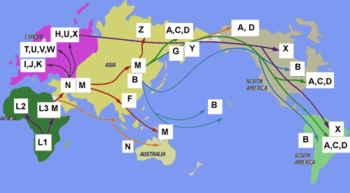
The Out-of-Africa hypothesis suggests that modern humans emerged in Africa 150,000 years ago or so. A small group migrated to Eurasia about 60,000 years ago. Some made it across the Bering Strait to America maybe 40,000 years ago or maybe 15,000 years ago. The Vikings said hello to the Native Americans 1,000 years ago, but cross Atlantic movement first gained pace from 500 years ago, when Columbus discovered America again again.

½ year ago (or so) I wrote a blog post called Create Table Homo_Sapiens. The comment follow up added to the nerdish angle with discussing subjects as mutating tables versus intelligent design and MAX(GEEK) counting.

But on the serious side comments also touched the intended subject about making data models reflect real world individuals.

Tables with persons are the most common entity type in databases around. As in the Out-of-Africa hypothesis it could have been as a simple global common same structural origin. But that is not the way of the world. Some of the basic differences practiced in modeling the person entity are:

  • Cultural diversity: Names, addresses, national ID’s and other basic attributes are formatted differently country by country and in some degree within countries. Most data models with a person entity are build on the format(s) of the country where it is designed.
  • Intended purpose of use: Person master data are often stored in tables made for specific purposes like a customer table, a subscriber table a contact table and so on. Therefore the data identifying the individual is directly linked with attributes describing a specific role of that individual.
  • “Impersonal” use: Person data is often stored in the same table as other party master types as business entities, projects, households et cetera.

Many, many data quality struggles around the world is caused by how we have modeled real world – old world and new world – individuals.

Bookmark and Share

Follow Friday Data Quality

Every Friday on Twitter people are recommending other tweeps to follow using the #FollowFriday (or simply #FF) hash tag.

My username on twitter is @hlsdk.

Sometimes I notice tweeps I follow are recommending the username @hldsk or @hsldk or other usernames with my five letters swapped.

It could be they meant me? – but misspelled the username. Or they meant someone else with a username close to mine?

As the other usernames wasn’t taken I have taken the liberty to create some duplicate (shame on me) profiles and have a bit of (nerdish) fun with it:

@hsldk

For this profile I have chosen the image being the Swedish Chef from the Muppet show. To make the Swedish connection real the location on the profile is set as “Oresund Region”, which is the binational metropolitan area around the Danish capital Copenhagen and the 3rd largest Swedish city Malmoe as explained in the post The Perfect Wrong Answer.

@hldsk

For this profile I have chosen the image being a gorilla originally used in the post Gorilla Data Quality.

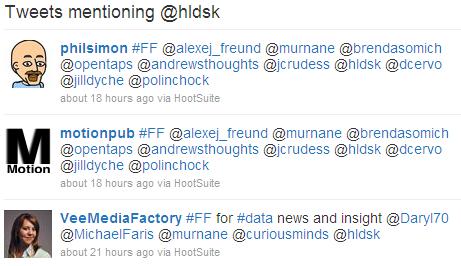
This Friday @hldsk was recommended thrice.

But I think only by two real life individuals: Joanne Wright from Vee Media and Phil Simon who also tweets as his new (one-man-band I guess) publishing company.

What’s the point?

Well, one of my main activities in business is hunting duplicates in party master databases.

What I sometimes find is that duplicates (several rows representing the same real world entity) have been entered for a good reason in order to fulfill the immediate purpose of use.

The thing with Phil and his one-man-band company is explained further in the post So, What About SOHO Homes.

By the way, Phil is going to publish a book called The New Small. It’s about: How a New Breed of Small Businesses is Harnessing the Power of Emerging Technologies.

Bookmark and Share

Mixed Identities

A frequent challenge when building a customer master data hub is dealing with incoming records from operational systems where the data in one record belongs to several real world entities.

One situation may be that that a name contains two (or more) real world names. This situation was discussed in the post Splitting names.

Another situation may be that:

  • The name belongs to real world entity X
  • The address belongs to real world entity Y
  • The national identification number belongs to real world entity Z

Fortunately most cases only have 2 different real world representations like X and Y or Y and Z.

An example I have encountered often is when a company delivers a service through another organization. Then you may have:

  • The name of the 3rd party organization in the name column(s)
  • The address of the (private) end user in the address columns

Or as I remember seen once:

  • The name of the (private) end user in the name column(s)
  • The address of the (private) end user in the address columns
  • The company national identification number of the 3rd party organization in the national ID column

Of course the root cause solution to this will be a better (and perhaps more complex) way of gathering master data in the operational systems. But most companies have old and not so easy changeable systems running core business activities. Swapping to new systems in a rush isn’t something just done either. Also data gathering may take place outside your company making the data governance much more political.

A solution downstream at the data matching gates of the master data hub may be to facilitate complex hierarchy building.

Oftentimes the solution will be that the single customer view in the master data hub will be challenged from the start as the data in some perception is fit for the intended purpose of use.

Bookmark and Share

Location, Location, Location

Now, I am not going to write about the importance of location when selling real estates, but I am going to provide three examples about knowing about the location when you are doing data matching like trying to find duplicates in names and addresses.

Location uniqueness

Let’s say we have these two records:

  • Stefani Germanotta, Main Street, Anytown
  • Stefani Germanotta, Main Street, Anytown

The data is character by character exactly the same. But:

  • There is only a very high probability that it is the same real world individual if there is only one address on Main Street in Anytown.
  • If there are only a few addresses on Main Street in Anytown, you will still have a fair probability that this is the same individual.
  • But if there are hundreds of addresses on Main Street in Anytown, the probability that this is the same individual will be below threshold for many matching purposes.

Of course, if you are sending a direct marketing letter it is pointless sending both letters, as:

  • Either they will be delivered in the same mailbox.
  • Or both will be returned by postal service.

So this example highlights a major point in data quality. If you are matching for a single purpose of use like direct marketing you may apply simple processing. But if you are matching for multiple purposes of use like building a master data hub, you don’t avoid some kind of complexity.

Location enrichment

Let’s say we have these two records:

  • Alejandro Germanotta, 123 Main Street, Anytown
  • Alejandro Germanotta, 123 Main Street, Anytown

If you know that 123 Main Street in Anytown is a single family house there is a high probability that this is the same real world individual.

But if you know that 123 Main Street in Anytown is a building used as a nursing home, a campus or that this entrance has many apartments or other kind of units, then it is not so certain that these records represents the same real world individual (not at least if the name is John Smith).

So this example highlights the importance of using external reference data in data matching.

Location geocoding

Let’s say we have these two records:

  • Gaga Real Estate, 1 Main Street, Anytown
  • L.  Gaga Real Estate, Central Square, Anytown

If you match using the street address, the match is not that close.

But if you assigned a geocode for the two addresses, then the two addresses may be very close (just around the corner) and your match will then be pretty confident.

Assigning geocodes usually serve other purposes than data matching. So this example highlights how enhancing your data may have several positive impacts.

Bookmark and Share

Algorithm Envy

The term “algorithm envy” was used by Aaron Zornes in his piece on MDM trends when talking about identity resolution.

In my experience there is surely a need for good data matching algorithms.

As I have a built a data matching tool myself I faced that need back in 2005. At that time my tool was merely based on some standardization and parsing, match codes, some probabilistic learning and a few light weight algorithms like the hamming distance (more descriptions of these techniques here).

My tool was pretty national (like many other matching tools) as it was tuned for handling Danish names and addresses as well as Swedish, Norwegian, Finish and German addresses which are very similar.

The task ahead was to expand the match tool so it could be used to match business-to-business records with the D&B worldbase. This database has business entities from all over the world. The names and addresses in there are only standardized to the extent that is provided by the public sector or other providers for each country.

The records to be matched came from Nordic companies operating globally. For such records you can’t assume that these are entered by people who know the name and address format for the country in question. So, all in all, standardization and parsing wasn’t the full solution. If you don’t trust me, there is more explanation here.

When dealing with international data match codes becomes either too complex or too bad. This is also due to lack of standardization in both the records to be compared.

For the probabilistic learning my problem was that all learned data until then was only gathered from Nordic data. They wouldn’t be any good for the rest of the world.

The solution was including an advanced data matching algorithm, in this case Omikron FACT.

Since then the Omikron FACT algorithm has been considerable improved and is now branded as WorldMatch®. Some of the new advantages is dealing with different character sets and script systems and having synonyms embedded directly into the matching logic, which is far superior to using synonyms in a prior standardization process.

For full disclosure I work for the vendor Omikron Data Quality today. But I am not praising the product because of that – I work for Omikron because of the product.


Bookmark and Share

Relational Data Quality

Most of the work related to data quality improvement I do is done with data in relational databases and is aimed at creating new relations between data. Examples (from party master data) are:

  • Make a relation between a postal address in a customer table and a real world address (represented in an official address dictionary).
  • Make a relation between a business entity in a vendor table and a real world business (represented in a business directory most often derived from an official business register).
  • Make a relation between a consumer in one prospect table and a consumer in another prospect table because they are considered to represent the same real world person.

When striving for multi-purpose data quality it is often necessary to reflect further relations from the real world like:

  • Make a relation in a database reflecting that two (or more) persons belongs to the same household (on the same real world address)
  • Make a relation in the database reflecting that two (or more) companies have the same (ultimate) mother.

Having these relations done right is fundamental for any further data quality improvement endeavors and all the exciting business intelligence stuff. In doing that you may continue to have more or less fruitful discussions on say the classic question: What is a customer?

But in my eyes, in relation to data quality, it doesn’t matter if that discussion ends with that a given row in your database is a customer, an old customer, a prospect or something else. Building the relations may even help you realize what that someone really is. Could be a sporadic lead is recognized as belonging to the same household as a good customer. Could be a vendor is recognized as being a daughter company of a hot prospect. Could be someone is recognized as being fake. And you may even have some business intelligence that based on the relations may report a given row as a customer role in one context and another role in another context.

Big Time ROI in Identity Resolution

Yesterday I had the chance to make a preliminary assessment of the data quality in one of the local databases holding information about entities involved in carbon trade activities. It is believed that up to 90 percent of the market activity may have been fraudulent with criminals pocketing 5 billion Euros. There is a description of the scam here from telegraph.co.uk.

Most of my work with data matching is aimed at finding duplicates. In doing this you must avoid finding so called false positives, so you don’t end up merging information about to different real world entities. But when doing identity resolution for several reasons including preventing fraud and scam you may be interested in finding connections between entities that are not supposed to be connected at all.

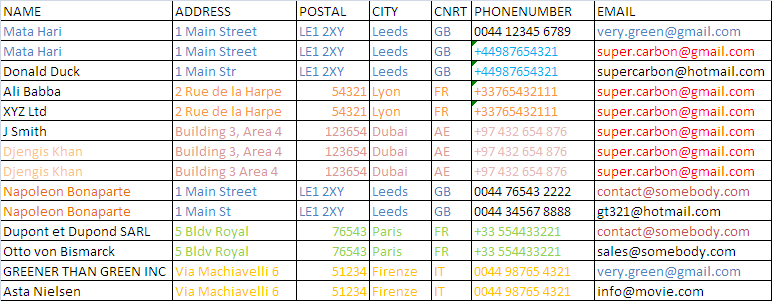
The result from making such connections in the carbon trade database was quite astonishing. Here is an example where I have changed the names, addresses, e-mails and phones, but such a pattern was found in several cases:

Here we have an example of a group of entities where the name, address, e-mail or phone is shared in a way that doesn’t seem natural.

My involvement in the carbon trade scam was initiated by a blog post yesterday by my colleague Jan Erik Ingvaldsen based on the story that journalists by merely gazing the database had found addresses that simply doesn’t exist.

So the question is if authorities may have avoided losing 5 billion taxpayer Euros if some identity resolution including automated fuzzy connection checks and real world checks was implemented. I know that you are so much more enlightened on what could have been done when the scam is discovered, but I actually think that there may be a lot of other billions of Euros (Pounds, Dollars, Rupees) to avoid losing out there by making some decent identity resolution.

Bookmark and Share

Enterprise Data Mashup and Data Matching

A mashup is a web page or application that uses or combines data or functionality from two or many more external sources to create a new service. Mashups can be considered to have an active role in the evolution of social software and Web 2.0. Enterprise Mashups are secure, visually rich web applications that expose actionable information from diverse internal and external information sources. So says Wikipedia.

I think that Enterprise Mashups will need data matching – and data matching will improve from data mashups.

The joys and challenges of Enterprise Mashups was recently touched in the post “MDM Mashups: All the Taste with None of the Calories” by Amar Ramakrishnan of Initiate. Data needs to be cleansed and matched before being exposed in an Enterprise Mashup. An Enterprise Mashup is then a fast way to deliver Master Data Management results to the organization.

Party Data Matching has typically been done in these two often separated contexts:

  • Matching internal data like deduplicating and consolidating
  • Matching internal data against an external source like address correction and business directory matching

Increased utilization of multiple functions and multiple sources – like a mashup – will help making better matching. Some examples I have tried includes:

  • If you know whether an address is unique or not this information is used to settle a confidence of an individual or household duplicate.
  • If you know if an address is a single residence or a multiple residence (like a nursing home or campus) this information is used to settle a confidence of an individual or household duplicate.
  • If you know the frequency of a name (in a given country) this information is used to settle a confidence of a private, household or contact duplicate.

As many data quality flaws (not surprisingly) are introduced at data entry, mashups may help during data entry, like:

  • An address may be suggested from an external source.
  • A business entity may be picked from an external business directory.
  • Various rules exist in different countries for using consumer/citizen directories – why not use the best available where you do business.

Also the rise of social media adds new possibilities for mashup content during data entry, data maintenance and for other uses of MDM / Enterprise Mashups. Like it or not, your data on Facebook, Twitter and not at least LinkedIn are going to be matched and mashed up.

Bookmark and Share

Candidate Selection in Deduplication

When a recruiter and/or a hiring manager finds someone for a job position it is basically done by getting in a number of candidates and then choose the best fit among them. This of course don’t make up for, that there may be someone better fit among all those people that were not among the candidates.

We have the same problem in data matching when we are deduplicating, consolidating or matching for other purposes.

Lets look at the following example. We have 2 names and addresses:

Banca di Toscana Società per azioni
Machiavelli 12
IT 51234 Firenze

Vanca di Toscana SpA
12, Via Niccolò Machiavelli
Florence
Italy

A human or a mature computerized matching engine will be able to decide, that this is the same real world entity with more or less confidence depending on taking some knowledge in consideration as:

  • The ISO country code for Italy is IT
  • Florence is the English name for the city called Firenze in Italian
  • In Italian (like Spanish, Germanic and Slavic cultures) the house number is written after the street name (opposite to in English and French cultures)
  • In Italian you sometimes don’t write “Via” (Italian for way) and the first name in a street named after a person
  • “Società per azioni” with the acronym SpA or S.p.A is an Italian legal form

But another point is if the 2 records even is going to be compared. Due to the above mentioned reasons related to diversity and the typo in the first letter of the name in the last record no ordinary sorting mechanism on the original data will get the 2 records in the same range.

If the one record is in a table with 1,000,000 rows and the other record is in another table with 1,000,000 rows the option of comparing every row with every row makes a Cartesian product of 1,000,000,000,000 similarity assignments which is not practical. Also a real-time check with 1,000,000 rows for every new entry don’t make a practical option.

I have worked with the following techniques for overcoming this challenge:

Parsing and standardization

The address part of the example data may be parsed and standardized (including using geographical reference data) so it is put on the same format like:

IT, 51234, Via Niccolo Machiavelli, 12

Then you are able to compare rows in a certain geographical depth like all on same entrance, street or postal code.

This technique is though heavily dependent on accurate and precise original addresses and works best applied for each different culture.

Fuzzy search

Here you make use of the same fuzzy techniques used in similarity assignment when searching.

Probabilistic learning

If earlier some variations of the same name or address is accepted as being the same, these variations may be recorded and used in future searching.

Hybrid

As always in data quality automation, using all different techniques in a given implementation makes your margins better.