The Letter Ø

This blog is written in English. Therefore the letters used are normally restricted to A to Z.  

The English alphabet is one of many alphabets using Latin (or Roman) letters. Other alphabets like the Russian uses Cyrillic letters. Then there are other script systems in the world which besides alphabets are abjads, abugidas, syllabic scripts and symbol scripts. Learn more about these in the post Script Systems.

My last surname is “Sørensen”. This word contains the lower case letter “ø” which is “Ø” in upper case. This letter is part of two alphabets: The Danish/Norwegian and the Faroese. Sometimes data has to be transformed into the English alphabet. Then the letter “ø” may be transformed to either “o” or “oe”. So my last surname will be either “Sorensen” or “Soerensen” in the English alphabet.

The town part of my address is “København”. The word “København” is what we call an endonym, which is the local word for place or a person. The opposite of endonym is exonym. The English exonym for “København” is “Copenhagen” which of course only has letters from the English alphabet. The Swedish exonym for “København” is “Köpenhamn”. Here we have a variant of “Ø” being “Ö”. The letter “Ö” exists in a lot of alphabets as Swedish, German, Hungarian and Turkish.

Usually “Ø” is transformed to “Ö” between Danish/Norwegian and these alphabets. The other way we usually accept the letter “Ö” in Danish/Norwegian master data.

These issues are of course a problem area in data quality, data matching and master data management. And with the complexity only between alphabets using Latin characters there is of course much more land to cover when including Cyrillic and Greek letters and then the other scripts systems with their hierarchical elements.

Bookmark and Share

Multi-Channel Data Quality

When I hear terms as multi-channel marketing, multi-channel retailing, multi-channel publishing and other multi-channel things I can’t resist thinking that there also must be a term called multi-channel data quality.

Indeed we are getting more and more channels where we do business. It stretches from the good old brick and mortar offline shop over eCommerce and the latest online touch points as mobile devices and social media.

Our data quality is challenged by how the way of the world changes. Customer master data is coming from these disparate channels with various purposes and in divergent formats. Product master data is exposed through these channels in different ways.     

We have to balance our business processes between having a unique single customer view and a unified product information basis and the diverse business needs within each channel.  

Some customer data may be complete and timely in one channel but deficient and out of date in another channel. Some product data may be useful here but inaccurate there.

I think the multi-channel things makes yet a business case for multi-domain (or multi-entity) master data management. Even if it is hard to predict the return on investment for the related data quality and master data management initiatives I think it is easy to foresee the consequences of doing nothing.

Bookmark and Share

Extreme Data Quality

This blog post is inspired by reading a blog post called Extreme Data by Mike Pilcher. Mike is COO at SAND, a leading provider of columnar database technology.

The post circles around a Gartner approach to extreme data. While the concept of “Big Data” is focused on the volume of data the concept of “Extreme Data” also takes into account the velocity and the variety of data.

So how do we handle data quality with extreme data being data of great variety moving in high velocity and coming in huge volumes? Will we be able to chase down all root causes of eventual poor data quality in extreme data and prevent the issues upstream or will we have to accept the reality of downstream cleansing of data at the time of consumption?

We might add a sixth reason being the rise of extreme data to the current Top 5 Reasons for Downstream Cleansing.

Bookmark and Share

Timeliness of Times

One of my several current engagements is within public transit.

I have earlier written about Real World Alignment issues in public transit (in my culture) as well as the special Multi-Entity Master Data Quality challenges there is in this specific industry.

Usually we talk about party master data and product master data as the most common domains of master data and sometimes we add places (locations) as the third domain in a P trinity of “parties, products and places” or perhaps a W trinity of “who, what and where”.

The when dimension, the times where events are taking place, is most often seen as belonging to the transaction side of life in the databases.

However in public transit you certainly also have timetables as an important master data domain. The service provided by a public transit authority or operator is described as belonging to a certain timeframe where a given combination of services is valid. An example is the “Summer Schedule 2011”.

An other industry with a time depending master data domain I have seen is education, where the given services (lessons) usually are described as belonging to a semester.

Wonder if you have met other master data types that is more belonging to the “when” domain than the “who, what and where” domains?  Did you have any problems with the timeliness of times?

Bookmark and Share

Product Placement

This wasn’t actually meant as a blog post series about the place entity in multi-domain master data management. But I think I have been carried away by my work, so now it is.

Places probably are most common related to the party domain as seen in the previous post called A Place in Time. But places certainly also have multiple relations to the product domain then forming a P trinity of parties, products and places in multi-domain master data management as seen in the post Your Place or My Place?

As with most things in the product domain also the product-place relations usually are very industry specific.

Some of the product-place relations I have worked with come from these industries:

Insurance

The fees you have to pay for some insurance products are related to the place where you live. In order to having the right fees (and for a lot of other reasons) an insurance company needs to analyze data based on the product-place relations. This may by the way go very wrong as told in the post A Really Bad Address.

Hospitality

Your product is a place where the selling attributes includes both the properties belonging to the place itself and the properties of the places being nearby.

Real Estate

Do I have to say more than three words: Location, Location, Location.

Your product-place relations

Tell me about what product-place relations you have worked with?

Bookmark and Share

A Place in Time

I remember when I had the first chemistry lesson in high school our teacher told us that we should forget all about the chemistry we had learned in primary school, because this was a too simply model not reflecting how the real world of chemistry actually work.

Since I have started working with data quality and master data management I have a pet peeve in data modeling, namely being the probably most common example of doing data modeling: The classic customer table. Example from a SQL tutorial here:

Compared to how the real world works this example has some diversity flaws, like:

  • state code as a key to a state table will only work with one country (the United States)
  • zipcode is a United States description only opposite to the more generic “Postal Code”
  • fname (First name) and lname (Last name) don’t work in cultures where given name and surname have the opposite sequence
  • The length of the state, zipcode and most other fields are obviously too small almost anywhere

More seriously we have:

  • fname and lname (First name and Last name) and probably also phone should belong to an own party entity acting as a contact related to the company
  • company name should belong to an own party entity acting in the role as customer
  • address1, address2, city, state, zipcode should belong to an own place entity probably as the current visiting place related to the company

Now I know this is just a simple example from a tutorial where you should not confuse by adding too much complexity. Agreed.

However many home grown solutions in business life and even many commercial ready-made applications use that kind of a data model to describe one of the most important business entities being our customers.

It may be that such a model does fit the purpose of use in some operations. Sometimes yes, sometimes no. But when reusing data from such a model on enterprise level and when adding business intelligence you are in big trouble. That is why we need master data hubs and why we need to transform data coming into the master data hub.

From such a customer record we don’t create just one golden record. We make or link several different related multi-domain entities as:

  • The contact as a person in our party domain – maybe we knew her before
  • The company in our party domain – maybe we knew the sister as a supplier before
  • The address in our place (location) domain – maybe we knew that address as a place in time before

Bookmark and Share

Storing a Single Version of the Truth

An ever recurring subject in the data quality and master data management (MDM) realms is whether we can establish a single version of the truth.

The most prominent example is whether an enterprise can implement and maintain a single version of the truth about business partners being customers, prospects, suppliers and so on.

In the quest for establishing that (fully reachable or not) single version of the truth we use identity resolution techniques as data matching and we are exploiting ever increasing sources of external reference data.

However I am often met with the challenge that despite what is possible in aiming for that (fully reachable or not) single version of the truth, I am often limited by the practical possibilities for storing it.

In storing party master data (and other kind of data) we may consider these three different ways:

Flat files

This “Keep It Simple, Stupid” way of storing data has been on an ongoing retreat – however still common, as well as new inventions of big flat file structures of data are emerging.

Also many external sources of reference data is still flat file like and the overwhelming choice of exchanging reference and master data is doing it by flat files.

Despite lots of work around solutions for storing the complex links of the real world in flat files we basically ends up with using very simplified representations of the real world (and the truth derived) in those flat files.  

Relational databases

Most Customer Relationship Management (CRM) systems are based on a relational data model, however mostly quite basic regarding master data structures making it not straight forward to reflect the most common hierarchical structures of the real world as company family trees, contacts working for several accounts and individuals forming a household.  

Master Data Management hubs are of course built for storing exactly these hierarchical kinds of structures. Common challenges here are that there often is no point in doing that as long as the surrounding applications can’t follow and that you often may restrict your use to a simplified model anyway like an industry model.   

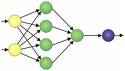
Neural networks

The relations between parties in the real world are in fact not truly hierarchical. That is why we look into the inspiration from the network of biological neurons.

Doing that has been an option I have heard about for many years but still waits to meet as a concrete choice when delivering a single version of the truth.   

Bookmark and Share

Entity Revolution vs Entity Evolution

Entity resolution is the discipline of uniquely identifying your master data records, typically being those holding data about customers, products and locations. Entity resolution is closely related to the concept of a single version of the truth.

Questions to be asked during entity resolution are like these ones:

  • Is a given customer master data record representing a real world person or organization?
  • Is a person acting as a private customer and a small business owner going to be seen as the same?
  • Is a product coming from supplier A going to identified as the same as the same product coming from supplier B?
  • Is the geocode for the center of a parcel the same place as the geocode of where the parcel is bordering a public road?

We may come a long way in automating entity resolution by using advanced data matching and exploiting rich sources of external reference data and we may be able to handle the complex structures of the real world by using sophisticated hierarchy management and hereby make an entity revolution in our databases.

But I am often faced with the fact that most organizations don’t want an entity revolution. There are always plenty of good reasons why different frequent business processes don’t require full entity resolution and will only be complicated by having it (unless drastic reengineered). The tangible immediate negative business impact of an entity revolution trumps the softer positive improvement in business insight from such a revolution.

Therefore we are mostly making entity evolutions balancing the current business requirements with the distant ideal of a single version of the truth.

Bookmark and Share

Free and Open Sources of Reference Data

This Monday I mingled in a tweetjam organized by the open source data integration vendor Talend.

One of the questions discussed was: Are free and open sources of reference data becoming more important in your projects?

When talking “free and open“, not at least in the open source realm, we can’t avoid talking about “free for a fee”. Some sources of open data like Geonames are free as in “free beer”. Other data comes with a fee. In my home country Denmark we have had some discussions about the reasoning in that the government likes to put a fee on mandatory collected data and I have observed similar considerations in our close neighbor country Sweden (By the way: The picture of a bridge that Talend uses a lot like on top of home page here looks like the bridge between Denmark and Sweden).

One challenge I have met over and over again in using free (maybe for a fee) and open data in data integration and data quality improvement is the cost of conformity. When using open government data there may, apart from the pricing, be a lot of differences between the countries in formats, coverage and so on. I think there is a great potential in delivering conformed data from many different sources for specific purposes.

Bookmark and Share

Big Trouble with Big Names

An often seen issue in party master data management is handling information about your most active customers, suppliers and other roles of interest. These are often big companies with many faces.

I remember meeting that problem way back in the 80’s when I was designing a solution for the Danish Maritime Authorities.  

In relation to a ship there are three different main roles:

  • The owner of the ship, who has some legal rights and obligations
  • The operator of ship, who has responsibilities regarding the seaworthiness of the ship
  • The employer, who has responsibilities regarding the seamen onboard the ship

Sometimes these roles don’t belong to the same company (or person) for a given ship. That real world reality was modeled all right. But even if it practically is the same company, then the roles are materialized very different for each role. I remember this was certainly the case with the biggest ship-owner in Denmark (and also by far the biggest company in Denmark) being the A.P. Moller – Maersk Group.

We really didn’t make a golden record for that golden company in my time on the project.

Bookmark and Share