Since the birth of this blog one of the key concepts that has been repeatedly visited is the business partner / party concept in Master Data Management (MDM). This concept is about unifying the handling of data about customers, vendors, contacts, employees and other real-world objects that are all legal entities. One of the first posts from 16 years back was called 360° Business Partner View.
Since then, the uptake for this idea has been greatly helped by all the major ERP vendors over the years, as they have adopted this concept in their newer data models.
This is true for SAP, where the business partner concept was introduced as an option in the old ECC system and now has become the overarching concept is the new S4 system. The concept in S4 is explained by SAP here.
Also, Microsoft has adopted a party concept in their D365 solution. This is explained here.
The Technical Balancing Act
While the data models have been twisted to reflect the business partner / party concept in principle, there are still some halfway solutions in force.
For SAP some examples I have come across are:
The hierarchy management is for some purposes better suited for the business partner layer and for other purposes better suited for the underlaying customer or vendor layers, which are still there.
A real-world employee has at least two business partner records to work properly. This became the standard in the newest versions of S4 as the unified option had multiple challenges.
The main SAP MDM add on (MDG) still has a customer workflow side (MDG-C) and a vendor workflow side (MDG-V).
The Business Balancing Act
Though the technical uptake is there, the business uptake is slower.
In all the SAP and D365 renewal projects I have been involved in, there were concerns from parts of the business side about aligning sell-side customer-facing processes and buy-side vendor-facing processes and thus harvesting any business benefits around a unified handling of the two most prominent entities in the business partner / party concept.
The main reasons for the unified approach are:
You will always find that many real-world entities have a vendor role as well as a customer role to you.
The basic master data has the same structure (identification, names, addresses and contact data.
You need the same third-party validation and enrichment capabilities for customer roles and vendor roles.
The main arguments against, as I have heard them, are:
I don’t care.
So what?
Well, yes, but that is a thin business case against all the needed change management.
What are the pros and cons that you have experienced?
Data observability is a new discipline on the rise within data management. As with many new disciplines everything is not new, though. There are several capabilities that come with a data observability solution that have been known for decades within Master Data Management (MDM) and not at least Data Quality Management (DQM).
The brief reason of being for data observability is to prevent data issues at scale. Compared to MDM and DQM you will usually utilize a data observability solution more upstream and have more data sources in scope. The emphasis of data observability is to early and continuously identify data issues. MDM and DQM is geared towards resolving the issues.
Below is a short walkthrough of the common capabilities you can deploy as part of the triangle of data observability, MDM and data quality.
Data Matching
Implementing a data observability solution will usually not extend to data matching capabilities. These capabilities will still reside in the intersection of MDM and data quality.
You will probably find a better home for data discovery in a data observability solution as this is better deployed for multiple upstream data flows.
Data Profiling
In Data Quality Management (DQM) solutions data profiling has often been seen as a one-off exercise that precedes data quality improvement and data matching, data migration and other data management initiatives.
With a data observability solution, you will be able to implement continuous data profiling and related monitoring.
Metadata Management
Metadata management is essential for data observability, MDM and data quality respectively and over essential for getting the full return of investment in a triangle of data observability, MDM and data quality solutions.
Data Matching is the discipline within data quality management where you deal with the probably most frequent data quality issue that you meet in almost every organization, which is duplicates in master data. This is duplicates in customer master data, duplicates in supplier master data, duplicates in combined / other business partner master data, duplicates in product master data and duplicates in other master data repositories.
A duplicate (or duplicate group) is where two (or more) records in a system or across multiple systems represent the same real-world entity.
Typically, you can use a tool to identify these duplicates. It can be as inexpensive as using Excel, it can be a module in a CRM or other application, it can be a capability in a Master Data Management (MDM) platform, or it can be a dedicated Data Quality Management (DQM) solution.
Over the years there have been developed numerous tools and embedded capabilities to tackle the data matching challenge. Some solutions focus on party (customer/supplier) master data and some solutions focus on product master data. Within party master data many solutions focus on person master data. Many solutions are optimized for a given geography or a few major geographies.
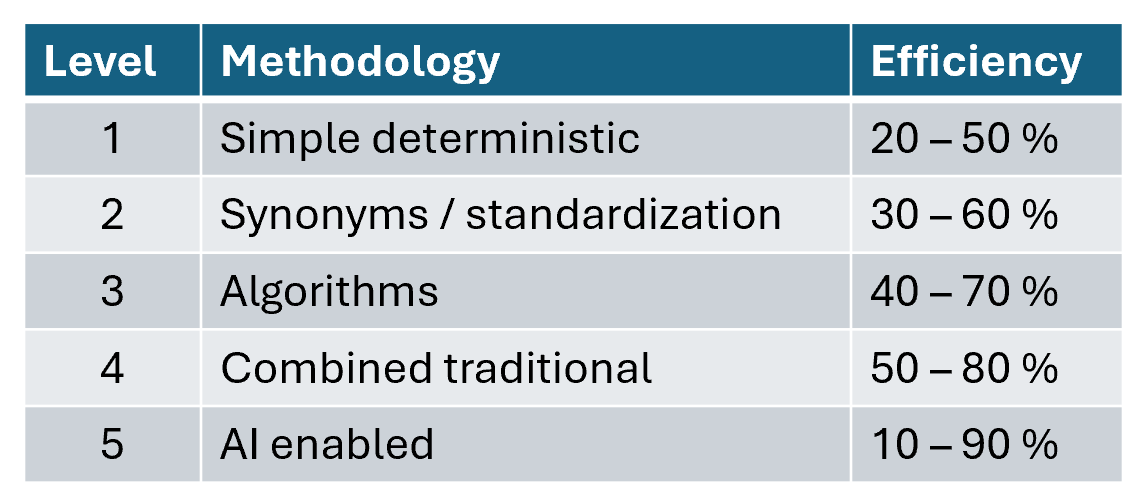
In my experience you can classify available tools / capabilities into the below 5 levels of efficiency:
The efficiency percentage here is an empirical measure of the percentage of actual duplicates the solution can identify automatically.
In more detail, the levels are:
1: Simple deterministic
Here you compare exact values between two duplicate candidate records or use simple transformed values as upper-case conversion or simple phonetic codes as for example soundex.
Don’t expect to catch every duplicate using this approach. If you have good, standardized master data 50 % is achievable. However, with a normal cleanliness, it will be lower.
Surprisingly many organizations still start here as a first step of reinventing the wheel in a Do-It-Yourself (DIY) approach.
2: Synonyms / standardization
In this more comprehensive approach you can replace, substitute, or remove values or words in values based on synonym lists. Examples are replacing person nicknames with guessed formal names, replacing common abbreviations in street names with a standardized term and removing legal forms in company names.
Enrichment / verification with external data can also be used, for example by standardizing addresses or classifying products.
3: Algorithms
Here you will use an algorithm as part of the comparison. Edit distance algorithms, as we know from autocorrection, are popular here. One frequently used one is the Levenshtein distance algorithm. But there are plenty out there to choose from each with their pros and cons.
Many data matching tools simply let you choose from using one of these algorithms in each scenario.
4: Combined traditional
If your DIY approach didn’t stop when encompassing more and more synonyms it will probably be here where you realize that further quest for raising efficiency includes combining several methodologies and doing dynamic combined algorithm utilization.
A minor selection of commercial data matching tools and embedded capabilities can do that for you so you avoid reinventing the wheel one more time.
This will yield high efficiency, but not perfection.
5: AI Enabled
Using Artificial Intelligence (AI) in data matching has been practiced for decades as told in the post The Art in Data Matching. With the general rise of AI in recent years there is renewed interest both at tool vendors and at users of data matching to industrialize this.
The results are still sparse out there. With limited training of models, it can be less efficient than traditional methodology. However, it can for sure also limit the gap between traditional efficiency and perfection.
More on Data Matching
There is of course much more to data matching than comparing duplicate candidates. Learn some more about The Art of Data Matching.
The impact of poor data quality issues in different industries such as healthcare, banking, and telecom cannot be overemphasized. It can lead to financial losses, customer churn, real-life impact on users, waste of resources, and conflicts within the data team. When a data quality issue arises, data managers, Chief Data Officers, and Data team leads are often the primary targets. Therefore, all data stakeholders must be as thorough and inquisitive as possible in their search for the right data quality tool that can solve their data problems. With numerous options in the market, it can be challenging to select the right tool that meets your unique data needs. In this article, four promising modern data quality tools are explored, each with its distinctive features, to help you make an informed decision.
Known for its user-friendly interface, Soda.io is a top pick for teams seeking an agile approach to data quality. It offers customizable checks and alerts, enabling businesses to maintain control over their data health. Soda.io excels in providing real-time insights, making it an excellent choice for dynamic data environments.
UNIQUE FEATURES
– User-friendly interface: Easy for teams to use and manage.
– Customizable checks and alerts: Tailor the tool to specific data health needs.
– Real-time insights: Immediate feedback on data quality issues.
Digna, with its AI-driven approach, stands out in how data quality issues are predicted, detected, and addressed. It not only flags data quality issues but also offers insights into their implications, helping businesses understand the impact on their operations. Digna’s unique selling points include its seamless integration, real-time monitoring, and the ability to provide reports on past data quality issues within three days – a process that typically takes months. It’s adaptable across various domains and ensures data privacy compliance while being scalable for any business size.
UNIQUE FEATURES
– AI-powered capabilities: Advanced predictive analysis and anomaly detection.
– Real-time monitoring: Immediate detection and notification of data quality issues.
– Automated Machine Learning: Efficiently corrects data irregularities.
– Scalability: Suitable for both startups and large enterprises.
– Flexible Installation: Cloud or On-prem installation, your choice.
– Automated Rule Validation: Say Goodbye to manually defining technical data quality rules. See the use case here
This tool offers a unique approach to data quality by focusing on data observability. Monte Carlo helps businesses monitor the health of their data pipelines, providing alerts for anomalies and breakdowns in data flow. It is particularly useful for companies with complex data systems, ensuring data reliability across the board.
UNIQUE FEATURES
– Focus on data observability: Monitors the health of data pipelines.
– Anomaly and breakdown alerts: Notifies about issues in data flow.
– Useful for complex data systems: Ensures reliability across all data.
Specializing in automatic data validation, Anomalo is ideal for businesses that deal with large volumes of data. It quickly identifies inconsistencies and errors, streamlining the data validation process. Anomalo’s machine learning algorithms adapt to your data, continually improving the detection of data quality issues.
UNIQUE FEATURES
– Automatic data validation: Ideal for handling large volumes of data.
– Machine learning algorithms: Adapt and improve issue detection over time.
– Quick identification of inconsistencies and errors: Streamlines the data validation process.
What You Should Know Before Choosing an Emerging Modern Data Quality Tool
Selecting the right data quality tool requires an understanding of your specific data challenges and goals. Consider how well it integrates with your existing infrastructure, the ease of setup and use, and the tool’s ability to scale as your data grows. Additionally, evaluate the tool’s ability to provide actionable insights and not just data alerts. The tool should be agile enough to adapt to various data types and formats while ensuring compliance with data privacy regulations.
In conclusion, whether you’re inclined towards the user-friendly approach of Soda.io, the observability focus of Monte Carlo, the automatic validation of Anomalo, or the AI-driven versatility of Digna, 2024 offers a range of top-tier data quality tools.
Digna in particular offers a comprehensive solution that stands out for its simplicity and effectiveness in data observability. Digna’s AI-driven approach not only predicts and detects data quality issues but also provides detailed alerts to users, ensuring that data problems are addressed promptly. With its ability to inspect a subset of customer data and provide rapid analysis, Digna saves costs and mitigates risks associated with data quality issues. Its seamless integration and real-time monitoring make it a user-friendly tool that fits effortlessly into any data infrastructure.
Make an informed choice today and steer your business toward data excellence with the right tool in hand.
Today’s guest blog post is from Marcin Chudeusz of DIGNA.AI. a company specializing in creating Artificial Intelligence-powered Software for Data Platforms.
Have you ever experienced the frustration of missing crucial pieces in your data puzzle? The feeling of the weight of responsibility on your shoulders when data issues suddenly arise and the entire organization looks to you to save the day? It can be overwhelming, especially when the damage has already been done. In the constantly evolving world of data management, where data warehouses, data lakes, and data lakehouses form the backbone of organizational decision-making, maintaining high-quality data is crucial. Although the challenges of managing data quality in these environments are many, the solutions, while not always straightforward, are within reach.
Data warehouses, data lakes, and lakehouses each encounter their own unique data quality challenges. These challenges range from integrating data from various sources, ensuring consistency, and managing outdated or irrelevant data, to handling the massive volume and variety of unstructured data in data lakes, which makes standardizing, cleaning, and organizing data a daunting task.
Today, I would like to introduce you to Digna, your AI-powered guardian for data quality that’s about to revolutionize the game! Get ready for a journey into the world of modern data management, where every twist and turn holds the promise of seamless insights and transformative efficiency.
Digna: A New Dawn in Data Quality Management
Picture this: you’re at the helm of a data-driven organization, where every byte of data can pivot your business strategy, fuel your growth, and steer you away from potential pitfalls. Now, imagine a tool that understands your data and respects its complexity and nuances. That’s Digna for you – your AI-powered guardian for data quality.
Goodbye to Manually Defining Technical Data Quality Rules
Gone are the days when defining technical data quality rules was a laborious, manual process. You can forget the hassle of manually setting thresholds for data quality metrics. Digna’s AI algorithm does it for you, defining acceptable ranges and adapting as your data evolves. Digna’s AI learns your data, understands it, and sets the rules for you. It’s like having a data scientist in your pocket, always working, always analyzing.
Figure 1: Learn how Digna’s AI algorithm defines acceptable ranges for data quality metrics like missing values. Here, the ideal count of missing values should be between 242 and 483, and how do you manually define technical rules for that?
Seamless Integration and Real-time Monitoring
Imagine logging into your data quality tool and being greeted with a comprehensive overview of your week’s data quality. Instant insights, anomalies flagged, and trends highlighted – all at your fingertips. Digna doesn’t just flag issues; it helps you understand them. Drill down into specific days, examine anomalies, and understand the impact on your datasets.
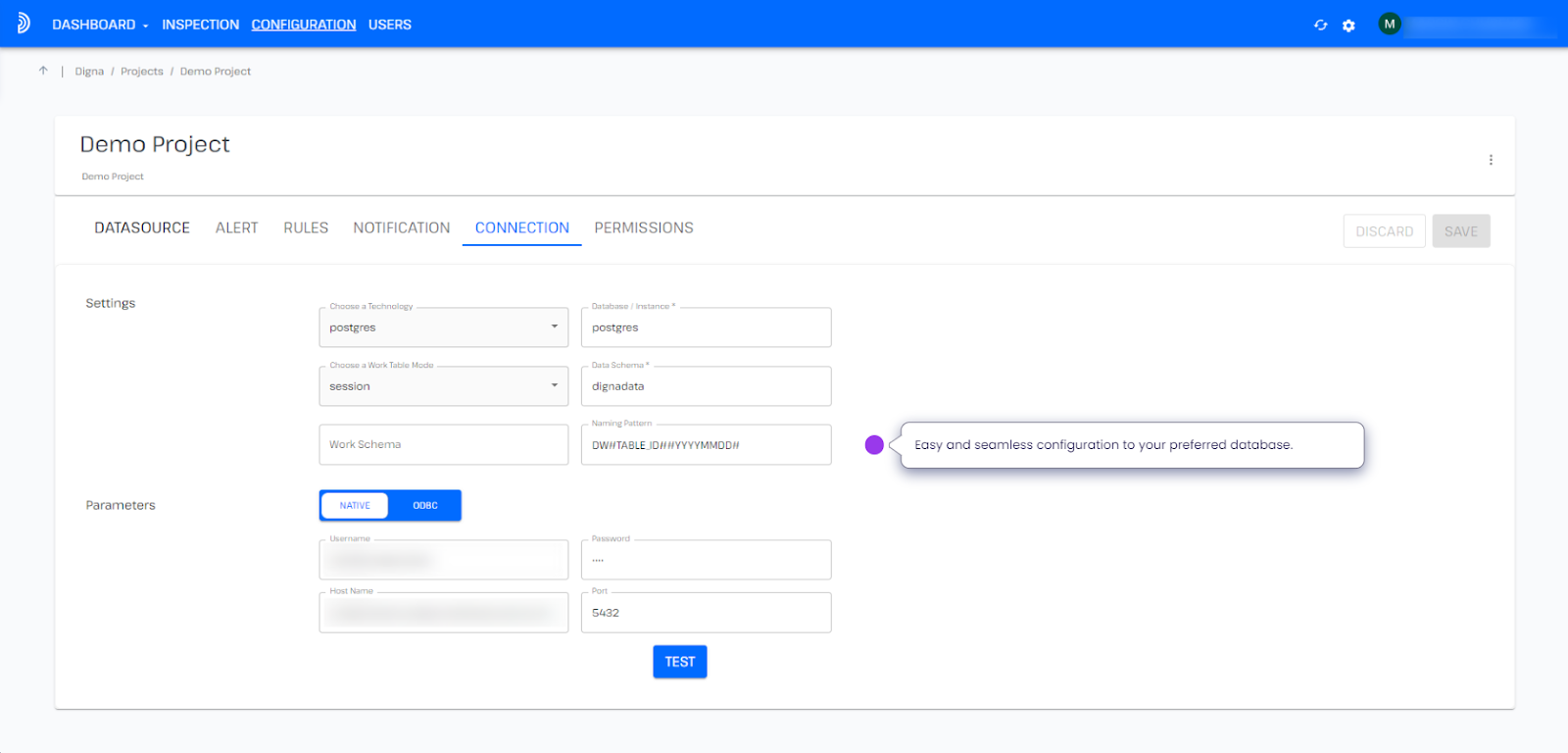
Whether you’re dealing with data warehouses, data lakes, or lakehouses, Digna slips in like a missing puzzle piece. It connects effortlessly to your preferred database, offering a suite of features that make data quality management a breeze. Digna’s integration with your current data infrastructure is seamless. Choose your data tables, set up data retrieval, and you’re good to go.
Figure 2: Connect seamlessly to your preferred database. Select specific tables from your database for detailed analysis by Digna.
Navigate Through Time and Visualize Data Discrepancies
With Digna, the journey through your data’s past is as simple as a click. Understand how your data has evolved, identify patterns, and make informed decisions with ease. Digna’s charts are not just visually appealing; they’re insightful. They show you exactly where your data deviated from expectations, helping you pinpoint issues accurately.
With Digna, every column in your data table gets attention. Switch between columns, unravel anomalies, and gain a holistic view of your data’s health. It doesn’t just monitor data values; it keeps an eye on the number of records, offering comprehensive analysis and deep insights with minimal configuration. Digna’s user-friendly interface ensures that you’re not bogged down by complex setups.
Figure 3: Observe how Digna tracks not just data values but also the number of records for comprehensive analysis. Transition seamlessly to Dataset Checks and witness Digna’s learning capabilities in recognizing patterns.
Real-time Personalized Alert Preferences
Digna’s alerts are intuitive and immediate, ensuring you’re always in the loop. These alerts are easy to understand and come in different colors to indicate the quality of the data. You can customize your alert preferences to match your needs, ensuring that you never miss important updates. With this simple yet effective system, you can quickly assess the health of your data and stay ahead of any potential issues. This way, you can avoid real-life impacts of data challenges.
Whether you prefer inspecting your data directly from the dashboard or integrating it into your workflow, I invite you to commence your data quality journey. It’s more than an inspection; it’s an exploration—an adventure into the heart of your data with a suite of features that considers your data privacy, security, scalability, and flexibility.
Automated Machine Learning
Digna leverages advanced machine learning algorithms to automatically identify and correct anomalies, trends, and patterns in data. This level of automation means that Digna can efficiently process large volumes of data without human intervention, erasing errors and increasing the speed of data analysis.
The system’s ability to detect subtle and complex patterns goes beyond traditional data analysis methods. It can uncover insights that would typically be missed, thus providing a more comprehensive understanding of the data.
This feature is particularly useful for organizations dealing with dynamic and evolving data sets, where new trends and patterns can emerge rapidly.
Domain Agnostic
Digna’s domain-agnostic approach means it is versatile and adaptable across various industries, such as finance, healthcare, and telcos. This versatility is essential for organizations that operate in multiple domains or those that deal with diverse data types.
The platform is designed to understand and integrate the unique characteristics and nuances of different industry data, ensuring that the analysis is relevant and accurate for each specific domain.
This adaptability is crucial for maintaining accuracy and relevance in data analysis, especially in industries with unique data structures or regulatory requirements.
Data Privacy
In today’s world, where data privacy is paramount, Digna places a strong emphasis on ensuring that data quality initiatives are compliant with the latest data protection regulations.
The platform uses state-of-the-art security measures to safeguard sensitive information, ensuring that data is handled responsibly and ethically.
Digna’s commitment to data privacy means that organizations can trust the platform to manage their data without compromising on compliance or risking data breaches.
Built to Scale
Digna is designed to be scalable, accommodating the evolving needs of businesses ranging from startups to large enterprises. This scalability ensures that as a company grows and its data infrastructure becomes more complex, Digna can continue to provide effective data quality management.
The platform’s ability to scale helps organizations maintain sustainable and reliable data practices throughout their growth, avoiding the need for frequent system changes or upgrades.
Scalability is crucial for long-term data management strategies, especially for organizations that anticipate rapid growth or significant changes in their data needs.
Real-time Radar
With Digna’s real-time monitoring capabilities, data issues are identified and addressed immediately. This prompt response prevents minor issues from escalating into major problems, thus maintaining the integrity of the decision-making process.
Real-time monitoring is particularly beneficial in fast-paced environments where data-driven decisions need to be made quickly and accurately.
This feature ensures that organizations always have the most current and accurate data at their disposal, enabling them to make informed decisions swiftly.
Choose Your Installation
Digna offers flexible deployment options, allowing organizations to choose between cloud-based or on-premises installations. This flexibility is key for organizations with specific needs or constraints related to data security and IT infrastructure.
Cloud deployment can offer benefits like reduced IT overhead, scalability, and accessibility, while on-premises installation can provide enhanced control and security for sensitive data.
This choice enables organizations to align their data quality initiatives with their broader IT and security strategies, ensuring a seamless integration into their existing systems.
Conclusion
Addressing data quality challenges in data warehouses, lakes, and lakehouses requires a multifaceted approach. It involves the integration of cutting-edge technology like AI-powered tools, robust data governance, regular audits, and a culture that values data quality.
Digna is not just a solution; it’s a revolution in data quality management. It’s an intelligent, intuitive, and indispensable tool that turns data challenges into opportunities.
I’m not just proud of what we’ve created at DIGNA.AI; I’m most excited about the potential it holds for businesses worldwide. Join us on this journey, schedule a call with us, and let Digna transform your data into a reliable asset that drives growth and efficiency.
Cheers to modern data quality at scale with Digna!
This article was written by Marcin Chudeusz, CEO and Co-Founder of DIGNA.AI. a company specializing in creating Artificial Intelligence-powered Software for Data Platforms. Our first product, Digna offers cutting-edge solutions through the power of AI to modern data quality issues.
Contact me to discover how Digna can revolutionize your approach to data quality and kickstart your journey to data excellence.
Today’s guest blog post is from Marcin Chudeusz of DIGNA.AI. a company specializing in creating Artificial Intelligence-powered Software for Data Platforms.
Data quality isn’t just a technical issue; it’s a journey full of challenges that can affect not only the operational efficiency of an organization but also its morale. As an experienced data warehouse consultant, my journey through the data landscape has been marked with groundbreaking achievements and formidable challenges. The latter, particularly in the realm of data quality in some of the most data-intensive industries: banks, and telcos, have given me profound insights into the intricacies of data management. My story isn’t unique in data analytics, but it highlights the evolution necessary for businesses to thrive in the modern data environment.
Let me share with you a part of my story that has shaped my perspective on the importance of robust data quality solutions.
The Daily Battles with Data Quality
In the intricate data environments of banks and telcos, where I spent much of my professional life, data quality issues were not just frequent; they were the norm.
The Never-Ending Cycle of Reloads
Each morning would start with the hope that our overnight data loads had gone smoothly, only to find that yet again, data discrepancies necessitated numerous reloads, consuming precious time and resources. Reloads were not just a technical nuisance; they were symptomatic of deeper data quality issues that needed immediate attention.
Delayed Reports and Dwindling Trust in Data
Nothing diminishes trust in a data team like the infamous phrase “The report will be delayed due to data quality issues.” Stakeholders don’t necessarily understand the intricacies of what goes wrong—they just see repeated failures. With every delay, the IT team’s credibility took a hit.
Team Conflicts: Whose Mistake Is It Anyway?
Data issues often sparked conflicts within teams. The blame game became a routine. Was it the fault of the data engineers, the analysts, or an external data source? This endless search for a scapegoat created a toxic atmosphere that hampered productivity and satisfaction.
Data quality issues aren’t just a technical problem; they’re a people problem. The complexity of these problems meant long hours, tedious work, and a general sense of frustration pervading the team. The frustration and difficulty in resolving these issues created a bad atmosphere and made the job thankless and annoying.
Decisions Built on Quicksand
Imagine making decisions that could influence millions in revenue based on faulty reports. We found ourselves in this precarious position more often than I care to admit. Discovering data issues late meant that critical business decisions were sometimes made on unstable foundations.
High Turnover: A Symptom of Data Discontent
The relentless cycle of addressing data quality issues began to wear down even the most dedicated team members. The job was not satisfying, leading to high turnover rates. It wasn’t just about losing employees; it was about losing institutional knowledge, which often exacerbated the very issues we were trying to solve.
The Domino Effect of Data Inaccuracies
Metrics are the lifeblood of decision-making, and in the banking and telecom sectors, year-to-month and year-to-date metrics are crucial. A single day’s worth of bad data could trigger a domino effect, necessitating recalculations that spanned back days, sometimes weeks. This was not just time-consuming—it was a drain on resources amongst other consequences of poor data quality.
The Manual Approach to Data Quality Validation Rules
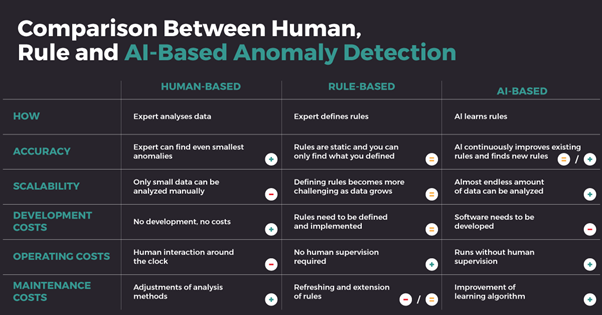
As an experienced data warehouse consultant, I initially tried to address these issues through the manual definition of validation rules. We believed that creating a comprehensive set of rules to validate data at every stage of the data pipeline would be the solution. However, this approach proved to be unsustainable and ineffective in the long run.
The problem with manual rule definition was its inherent inflexibility and inability to adapt to the constantly evolving data landscape. It was a static solution in a dynamic world. As new data sources, data transformations, and data requirements emerged, our manual rules were always a step behind, and keeping the rules up-to-date and relevant became an arduous and never-ending task.
Moreover, as the volume of data grew, manually defined rules could not keep pace with the sheer amount of data being processed. This often resulted in false positives and negatives, requiring extensive human intervention to sort out the issues. The cost and time involved in maintaining and refining these rules soon became untenable.
Comparison between Human, Rule, and AI-based Anomaly Detection
Embracing Automation: The Path Forward
This realization was the catalyst for the foundation of digna.ai. Danijel (Co-founder at Digna.ai) and I combined our AI and IT Know-How to create AI-powered software for Data Warehouses. This led to our first product Digna, we needed intelligent, automated systems that could adapt, learn, and preemptively address data quality issues before they escalated. By employing machine learning and automation, we could move from reactive to proactive, from guesswork to precision.
Automated data quality tools don’t just catch errors—they anticipate them. They adapt to the ever-changing data landscape, ensuring that the data warehouse is not just a repository of information, but a dependable asset for the organization.
Today, we’re pioneering the automation of data quality to help businesses navigate the data quality landscape with confidence. We’re not just solving technical issues; we’re transforming organizational cultures. No more blame games, no more relentless cycles of reloads—just clean, reliable data that businesses can trust.
In the end, navigating the data quality landscape isn’t just about overcoming technical challenges; it’s about setting the foundation for a more insightful, efficient, and harmonious future. This is the lesson my journey has taught me, and it is the mission that drives us forward at digna.ai.
This article was written by Marcin Chudeusz, CEO and Co-Founder of DIGNA.AI. a company specializing in creating Artificial Intelligence-powered Software for Data Platforms. Our first product, Digna offers cutting-edge solutions through the power of AI to modern data quality issues.
Contact us to discover how Digna can revolutionize your approach to data quality and kickstart your journey to data excellence.
Earlier this year Gartner published a report with the title Top Trends in Data and Analytics, 2023. The report is currently available on the Parsionate site here.
The report names three opportunities within this theme:
Think Like a Business,
From Platforms to Ecosystems and
Don’t Forget the Humans
While thinking like a business and don’t forget the humans are universal opportunities that have always been here and will always be, the move from platforms to ecosystems is a current opportunity worth a closer look.
Here data sharing, according to Gartner, is essential. Some recommended actions are to
Consider adopting data fabric design to enable a single architecture for data sharing across heterogeneous internal and external data sources.
Brand data reusability and resharing as a positive for business value, including ESG (Environmental, Social and Governance) efforts.
Data Fabric is the Gartner buzzword that resembles the competing non-Gartner buzzword Data Mesh. According to Gartner, organizations use data fabrics to capture data assets, infer new relationships in datasets and automate actions on data.
Data sharing can be internal and external.
In my mind there are two pillars in internal data sharing:
MDM (Master Data Management) with the aim of sharing harmonized core data assets as for example business partner records and product records across multiple lines of business, geographies, and organizational disciplines.
Knowledge graph approaches where MDM is supplemented by modern capabilities in detecting many more relationships (and entities) than before as explained in the post MDM and Knowledge Graph.
In external data sharing we see solutions for:
Sharing the burden of collecting business partner records like CDQ.
External data sharing is on the rise, however at a much slower pace than I had anticipated. The main obstacle seems to be that the internal data sharing is still not mature in many organizations and that external data sharing require interaction between at least two data mature organizations.
Most Master Data Management implementations revolve around the business partner (customer/supplier) domain and/or the product domain. But there is a growing appetite for also including the finance domain in MDM implementations. Note that the finance domain here is about finance related master data that every organization has and not the specific master data challenges that organizations in the financial service sector have. The latter topic was covered on this blog in a post called “Master Data Management in Financial Services”.
In this post I will examine some high-level considerations for implementing an MDM platform that (also) covers finance master data.
Finance master data can roughly be divided into these three main object types:
Chart of accounts
Profit and cost centers
Accounts receivable and accounts payable
Chart of Accounts
The master data challenge for the chart of accounts is mainly about handling multiple charts of accounts as it appears in enterprises operating in multiple countries, with multiple lines of business and/or having grown through mergers and acquisitions.
For that reason, solutions like Hyperion have been used for decades to consolidate finance performance data for multiple charts of accounts possibly held in multiple different applications.
Where MDM platforms may improve the data management here is first and foremost related to the processes that take place when new accounts are added, or accounts are changed. Here the MDM platform capabilities within workflow management, permission rights and approval can be utilized.
Profit and Cost Centers
The master data challenge for profit and cost centers relates to an extended business partner concept in master data management where external parties as customers and suppliers/vendors are handled together with internal parties as profit and cost centers who are internal business units.
Here silo thinking still rules in my experience. We still have a long way to go within data literacy in order to consolidate financial perspectives with HR perspectives, sales perspectives and procurement perspectives within the organization.
Accounts Receivable and Accounts Payable
The accounts receivable data has an overlap and usually share master data with customer master data that are mastered from a sales and service perspective and accounts payable data has an overlap and usually share master data with supplier/vendor master data that are mastered from a procurement perspective.
But there are differences in the selection of parties covered as touched on in the post “Direct Customers and Indirect Customers”. There are also differences in the time span of when the overlapping parties are handled. Finally, the ownership of overlapping attributes is always a hard nut to crack.
A classic source of mess in this area is when you have to pay money to a customer and when you get money from a supplier. This most often leads to creation of duplicate business partner records.
MDM Platforms and Finance Master Data
Many large enterprises use SAP as their ERP platform and the place of handling finance master data. Therefore, the SAP MDG-F offer for MDM is a likely candidate for an MDM platform here with the considerations explored in the post “SAP and Master Data Management”.
However, if the MDM capabilities in general are better handled with a non-SAP MDM platform as examined in the above-mentioned post, or the ERP platform is not (only) SAP, then other MDM platforms can be used for finance master data as well.
Informatica and Stibo STEP are two examples that I have worked with. My experience so far is though that compared to the business partner domain and the product domain these platforms at the current stage do not have much to offer for the finance domain in terms of capabilities and methodology.
SAP is the predominant ERP solution for large companies, and it seems to continue that way as nearly all these organizations are currently on the path of updating and migrating from the old SAP version to the new SAP S/4 HANA solution.
During this process there is a welcomed focus on master data and the surrounding data governance. For the technical foundation for that we see 4 main scenarios:
Handling the master data management within the SAP ERP solution
Adding a plugin for master data management
Adding the SAP MDG offering to the SAP application stack
Adding a non-SAP MDM offering to the IT landscape
Let’s have a brief look into these alternative options:
MDM within SAP ERP
In this option you govern the master data as it is represented in the SAP ERP data model.
When going from the old R/3 solution to the new S/4 solution there are some improvements in the data model. This includes:
All business partners are in the same structure instead of having separate structures for customers and suppliers/vendors as in the old solutions.
The structure for material master objects is also consolidated.
For the finance domain accounts now also covers the old cost elements.
The advantage of doing MDM within SAP ERP is avoiding the cost of ownership of additional software. The governance though becomes quite manual typically with heavy use of supplementary spreadsheets.
Plugins
There are various forms of third-party plugins that help with data governance and ensuring the data quality for master data within SAP ERP. One of those I have worked with is it.master data simplified (it.mds).
Here the extra cost of ownership is limited while the manual tasks in question are better automated.
SAP MDG
MDG is the master data management offering from SAP. As such, this solution is very well suited for handling the master data that sits in the SAP ERP solution as it provides better capabilities around data governance, data quality and workflow management.
MDG comes with an extra cost of ownership compared to pure SAP ERP. An often-mentioned downside of MDG compared to other MDM platforms is that handling master data that sits outside SAP is cumbersome in SAP MDG.
Other MDM platforms
Most companies have master data outside SAP as well. Combined with that other MDM platforms may have capabilities better suited for them than SAP MDG and/or have a lower cost of ownership than SAP MDG. Therefore, we see that some organizations choose to handle also SAP master data in such platforms.
While MDO is quite close to SAP other MDM platforms, for example Informatica and Stibo STEP, have surprisingly very little ready-made capability and methodology for co-existing with SAP ERP.
Over the recent months, I have been engaged with the boutique Master Data Management (MDM) consultancy parsionate on some visionary projects in the multi-domain MDM area.
The overall approach at parsionate is that MDM is much more than just an IT issue. It is a strategic necessity. This is based on an experience that I share, which is that if you treat MDM as an isolated technological problem, you will inevitably fail!
Multi-domain MDM
MDM implementations today are increasingly becoming enterprise wide and are thus also multi-domain meaning that they cover business partner domains as customer and supplier/vendor, the product domain and a longer tail of other core business entities that matters within the given business model.
The primary goal of a multi-domain MDM implementation is to unify and consolidate heterogeneous data silos across the enterprise. The more source systems are integrated, the more information will be available and the more your enterprise will benefit from a 360° view of its data.
To achieve the desired goal for your multi-domain MDM program, you need to have a clear vision and a long-term strategic roadmap that shows how the various MDM implementation stages fit together with other related initiatives within your enterprise and where the Return of Investment (ROI) is expected and how it can be measured.
Seven Phases of Forming the Roadmap
In the approach at parsionate there are seven phases to go through when forming the roadmap and launching an MDM program.
Phase 1: Identify business needs
Before embarking on an MDM program, consider what data is most important to your business and where you can create the most value by putting this data under the MDM umbrella.
The main rationale is that through MDM organizations can control the way their most important data is viewed and shared in a more efficient, traceable way and thus improve their performance and productivity. An effective MDM implementation helps you streamline your workflows. It breaks down data silos that prevent data from being reused and shared across the enterprise
Phase 2: Set up a data committee
Establishing a data committee (with any equivalent name for a data focussed body) is perhaps the most frequently mentioned aspect of an MDM strategy. This team would usually consist of many different stakeholders who are in a position to enforce the roadmap and the underlaying activities.
This body must be able to convey the importance of data across the enterprise at all organizational levels. The main concern is to make data a top priority in the enterprise.
Phase 3: Set up a data governance program before defining the MDM roadmap
Many organizations shy away from data governance programs that consulting firms suggest because they seem too complex and costly.
The bitter truth is though that if you fail to implement data governance or embed it strategically into the way the organization works, you will inevitably have to address it at a later stage – in a more time-consuming and costly process.
Phase 4: Set clear goals to ingrain the MDM vision in the organization’s culture
It is difficult to promote an MDM program without a clear vision and objectives. At the executive level, the program could be misunderstood as a technological issue. Sometimes decision-makers struggle to understand the value an MDM program will generate. In this case, they will either not fund it or, if it does go ahead, consider it a failure because the result does not meet their expectations.
It is crucial to involve all relevant stakeholders in the roadmap development process at an early stage and engage with them to understand their expectations and requirements. Only then can you ensure that the core elements of a successful MDM program are aligned with the needs of your entire organization.
Phase 5: Choose a step-by-step approach and rapidly implement sub-projects
The most effective way to implement an MDM program is to start with a few key sources and provide meaningful information in a very short time. It is always difficult to implement everything at once (multiple sources, several integration points, and complex data) with a „big bang“ or build a data hub without a specific goal in mind.
If a pilot project quickly realizes a series of short-term benefits, users and business leaders will appreciate the value of the MDM program. As soon as it becomes clear that the initial project is successful, you can promote a wider roadmap that shows how the next steps will be carried out in line with the strategic goals of your organization. With this iterative approach, the long-term benefits will become clearer.
Phase 6: The mammoth task: Adopt a data-driven mindset
Building a data-driven corporate culture may be considered the supreme challenge of any MDM program. Data culture goes far beyond a simple corporate strategy that uses data for business processes. Rather, it is a mindset that encourages employees to appreciate the tremendous added value of high-quality data.
Many organizations believe they can simply buy new tools to drive digital transformation. That is an illusion.
Phase 7: Integrate technology
This illusion does however not mean that that MDM technology is not important.
Hardly any other IT system affects as many different departments and data domains in a company and is, implemented the right way, as powerful as an MDM solution. The extreme importance of this type of software within the entire corporate IT infrastructure means that you need to select a system very carefully and strategically.
The Full Guide If you want to read the full guide to MDM mapping out the high road to a successful implementation you can download it from this parsionate site: Master Data Management







 Liliendahl on Data Quality