Process of consolidating Master Data

stormp1

In my previous blog post “Multi-Purpose Data Quality” we examined a business challenge where we have multiple purposes with party master data.

The comments suggested some form of consolidation should be done with the data.

How do we do that?

I have made a PowerPoint show “Example process of consolidating master data” with a suggested way of doing that.

The process uses the party master data types explained here.

The next questions in solving our business challenge will include:

  • Is it necessary to have master data in optimal shape real time – or is it OK to make periodic consolidation?
  • How do we design processes for maintaining the master data when:
    • New members and customers are inserted?
    • We update existing members and customers?
    • External reference data changes?   
  • What changes must be made with the existing applications handling the member database and the eShop?

Also the question of what style of Master Data Hub is suitable is indeed very common in these kinds of implementations.

Bookmark and Share

Multi-Purpose Data Quality

Say you are an organisation within charity fundraising. Since many years you had a membership database and recently you also introduced an eShop with related accessories.

The membership database holds the following record (Name, Address, City, YearlyContribution):

  •  Margaret & John Smith, 1 Main Street, Anytown, 100 Euro

The eShop system has the following accounts (Name, Address, Place, PurchaseInAll):

  • Mrs Margaret Smith, 1 Main Str, Anytown, 12 Euro
  • Peggy Smith, 1 Main Street, Anytown, 218 Euro
  • Local Charity c/o Margaret Smith, 1 Main Str, Anytown, 334 Euro

Now the new management wants to double contributions from members and triple eShop turnover. Based on the recommendations from “The One Truth Consulting Company” you plan to do the following:

  • Establish a platform for 1-1 dialogue with your individual members and customers
  • Analyze member and customer behaviour and profiles in order to:
    • Support the 1-1 dialogue with existing members and customers
    • Find new members and customers who are like your best members and customers

As the new management wants to stay for many years ahead, the solution must not be a one-shot exercise but must be implemented as a business process reengineering with a continuous focus on the best fit data governance, master data management and data (information) quality.

question-marksSo, what are you going to do with your data so they are fit for action with the old purposes and the new purposes?

Recently I wrote some posts related to these challenges:

Any other comments on the issues in how to do it are welcome.

Bookmark and Share

Echoes in the Database

A basic structure of B2B (Business-to-Business) Party Master Data is that you have accounts being business entities each having one or several contacts being employees in each business entity. These employees act in the roles of decision makers, gate keepers, invoice receivers and so on. In Data Model language there is a parent-child relationship between accounts and contacts.

When doing deduplication with such data you aim to make a golden copy with unique business entities having unique contacts.

After achieving that you may gaze the data and stumble over rows in the golden copy as these (function, contact name, account name, address):

  • HR, John Smith, Smashing Estates Ltd, Same Place in Anytown
  • HR, John Smith, Smashing Solicitors Ltd, Same Place in Anytown
  • IT, Tushnelda von Keine-Mustermann, The Old Treadmill Ltd, Anytown
  • IT, Tushnelda von Keine-Mustermann, Brand New Brands Ltd, Anytown

Duplicates? Probably it’s the same real world individuals.
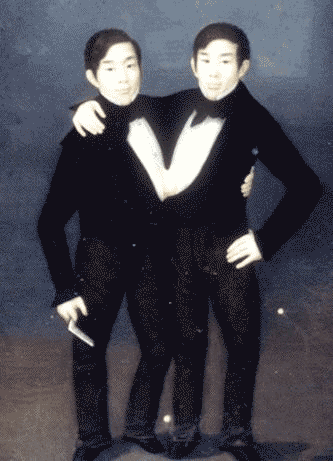
Chang-eng-bunker-PDJohn Smith is the ultimate Anglo common name, but if your favorite external business directory tells you that the 2 companies has the same mother and are modest size organizations, the possibility of John Smith being the same person having the same role at the same time in 2 companies is very high.

Tushnelda has a very unique name, so here there is a high possibility that she has got a new job in a new company, which makes one of the entries inactive. If one is going to be selected as the active survivor it may be chosen from newest update, found in external reference data or investigated otherwise.

B2B is often not actually Business-to-Business but also E2E – Employee-to-Employee – as the relationship exists between employees in the selling and buying business entities and it is not unusual that the relation may follow the employees when they change employer.

So striving for “one version of the truth” through “360 degree view on customer” is not a one layer exercise. This fact must be modeled in the Master Data structure, supported by functionality and prevented by feasible data quality implementations.

It’s my plan to do some blog posts around hierarchies in Party Master Data and how this must be handled in data matching. Next post will be about B2C data.

Bookmark and Share

Master Data meets the Customer

In the old days Master Data was predominately created, maintained and used by the staff in the organisation having these data. This is in many cases not the fact anymore. Besides exchanging data with partners in doing business, today the customer – and prospect – has become an important person to be considered when doing Data Governance and implementing technology around Master Data.

In the online world the customer works with your Master Data when:

  • The customer creates and maintains name, address and communication information by using registration functions
  • The customer searches for and reads product information on web shops and information sites

Having the prospects and customers helping with the name and address (party) data is apparently great news for lowering costs in the organisation. But in the long run you got yourself another silo with data and your Data Quality issues has become yet more challenging.

First thing to do is to optimise your registration forms. An important thing to consider here is that online is worldwide (unless you restrict your site to visitors from a single country). When doing business online with multi national customers then take care that the sequence, formats and labels are useful to everyone and that mandatory checks and other validations are in line with rules for the country in question.

External reference data may be used for lookup and validation integrated in the registration forms.

The concept of “one version of the truth” is a core element in most Master Data Management solutions. Doing deduplication within online registration have privacy considerations. When asking for personal data you can’t prompt “Possible duplicate found” and then present the data about someone else. Here you need more than one data quality firewall.

Many organisations are not just either offline or online but are operating in both worlds. To maintain the 360 degree view on customer in this situation you need strong data matching techniques capable of working with offline and online captured data. As the business case for online registration is very much about reducing staff involvement, this is about using technology and keeping human interaction to a minimum.

Search and navigationWhen a prospect comes to your site and tries to find information about your products, the first thing to do is very often using the search function. From deduplication of names and addresses we know that spelling is difficult and that sometimes we use other synonyms than used in the Master Data descriptions. Add to that the multi-cultural aspect. The solution here is that you use the same fuzzy search techniques that we use for data matching. This is a kind of reuse. I like that.

Bookmark and Share

Government says so

Capitol_Building_Full_ViewExternal reference data are going to play an increasing role in data quality improvement and a recent trend around the world helps a lot: Governments are unlocking their data stores.

Some available initiatives in English are the US data.gov and the UK “show us a better way”.

Today I attended a “Workshop on the use of public data in the private sector” arranged by the Danish National IT and Telecom Agency as part of the similar initiative in my home country.cristiansborg

The initiatives around the world are a bit different in focus areas and on which data to be released depending on the administrative traditions and local privacy policies.

As an organisation you may integrate with such public reference data either directly or through services from private vendors who add value by reformatting, merging, enriching and bundling with other services. One add on service on the international scene will be supplying consistency – as far as possible – between the datasets from each country.

One way or the other public reference data will become a part of the data architecture in most organisations. Applications in the cloud will probably be (actually are) first movers in this field.

Public reference data will bring operational databases and data warehouses closer to that “one version of the truth” that we talk so much about but have so much trouble achieving and even define. Now some of the trouble can be solved by: Government says so.

Bookmark and Share