Mixed Identities

A frequent challenge when building a customer master data hub is dealing with incoming records from operational systems where the data in one record belongs to several real world entities.

One situation may be that that a name contains two (or more) real world names. This situation was discussed in the post Splitting names.

Another situation may be that:

  • The name belongs to real world entity X
  • The address belongs to real world entity Y
  • The national identification number belongs to real world entity Z

Fortunately most cases only have 2 different real world representations like X and Y or Y and Z.

An example I have encountered often is when a company delivers a service through another organization. Then you may have:

  • The name of the 3rd party organization in the name column(s)
  • The address of the (private) end user in the address columns

Or as I remember seen once:

  • The name of the (private) end user in the name column(s)
  • The address of the (private) end user in the address columns
  • The company national identification number of the 3rd party organization in the national ID column

Of course the root cause solution to this will be a better (and perhaps more complex) way of gathering master data in the operational systems. But most companies have old and not so easy changeable systems running core business activities. Swapping to new systems in a rush isn’t something just done either. Also data gathering may take place outside your company making the data governance much more political.

A solution downstream at the data matching gates of the master data hub may be to facilitate complex hierarchy building.

Oftentimes the solution will be that the single customer view in the master data hub will be challenged from the start as the data in some perception is fit for the intended purpose of use.

Bookmark and Share

Real World Alignment

I am currently involved in a data management program dealing with multi-entity (multi-domain) master data management described here.

Besides covering several different data domains as business partners, products, locations and timetables the data also serves multiple purposes of use. The client is within public transit so the subject areas are called terms as production planning (scheduling), operation monitoring, fare collection and use of service.

A key principle is that the same data should only be stored once, but in a way that makes it serve as high quality information in the different contexts. Doing that is often balancing between the two ways data may be of high quality:

  • Either they are fit for their intended uses
  • Or they correctly represent the real-world construct to which they refer

Some of the balancing has been:

Customer Identification

For some intended uses you don’t have to know the precise identity of a passenger. For some other intended uses you must know the identity. The latter cases at my client include giving discounts based on age and transport need like when attending educational activity. Also when fighting fraud it helps knowing the identity. So the data governance policy (and a business rule) is that customers for most products must provide a national identification number.

Like it or not: Having the ID makes a lot of things easier. Uniqueness isn’t a big challenge like in many other master data programs. It is also a straight forward process when you like to enrich your data. An example here is accurately geocoding where your customer live, which is rather essential when you provide transportation services.

What geocode?

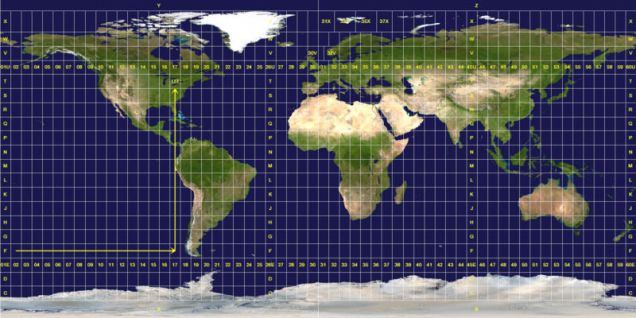
You may use a range of different coordinate systems to express a position as explained here on Wikipedia. Some systems refers to a round globe (and yes, the real world, the earth, is round), but it is a lot easier to use a system like the one called UTM where you easily may calculate the distance between two points directly in meters assuming the real world is as flat as your computer screen.


Bookmark and Share

Citizen ID within seconds

Here is a picture of my grandson Jonas taken minutes after his was born. He has a ribbon around his wrist showing his citizen ID which has just been assigned. There is even a barcode with it on the ribbon.

Now, I have mixed feelings about that. It is indeed very impersonal. But as a data quality professional I do realize that this is a way of solving a problem at the root. Duplicate master data in healthcare is a serious problem as Dylan Jones reported last year when he had a son in this article from DataQualityPro.

A unique citizen ID (National identification number) assigned in seconds after a birth have a lot of advantages. As said it is a foundation for data quality in healthcare from the very start of a life. Later when you get your first job you hand the citizen ID to your employer and tax is collected automatically. When the rest of the money is in the bank you are uniquely identified there. When you turn 18 you are seamlessly put on the electoral roll. Later your marriage is merely a relation in a government database between your citizen ID and the citizen ID of your beloved one.

Oh joy, Master Data Management at the very best.


Bookmark and Share

Multi-Entity Master Data Quality

Master Data is the core entities that describe the ongoing activities in an organization being:

  • Business partners (who)
  • Products (what)
  • Locations (where)
  • Timetables (when)

Many Master Data Management and Data Quality initiatives is in first place only focused on a single entity type, but sooner or later you are faced with dealing with all entity types and the data quality issues that arises from combining data from each entity type.

In my experience business partner data quality issues are in many ways similar cross all different industry verticals while product master data challenges may be different in many ways when comparing companies in various industry verticals. The importance of location data quality is very different, so are the questions about timetable data quality.

A journey in a multi-entity master data world

My latest experience in multi-entity master data quality comes from public transportation.

The most frequent business partner role here is of course the passengers. By the way (so to speak): A passenger may be a direct customer but the payer may also be someone else. But it doesn’t really change anything with the need for data quality whether the passenger is defined as a customer or not, you will regardless of that have to solve problems with uniqueness and real world alignment.

The product sold to a passenger is in the first place a travel document like a single ticket or an electronic card holding a season pass. But the service worth something for the passenger is a ride from point A to point B, which in many cases is delivered as a trip consisting of a series of rides from point A via point C (and D…) to point B. Having consistent hierarchies in reference data is a must when making data fit for multiple purposes of use in disciplines as fare collection, scheduling and so on.

Locations are mainly stop points including those at the start and end of the rides. These are identified both by a name and by geocoding – either as latitude and longitude on a round globe or by coordinates in a flat representation suitable for a map (on a screen). The distance between stops is important for grouping stops in areas suitable for interchange, e.g. bus stops on each side of a road or bus stops and platforms at a rail station. Working with the precision dimension of data quality is a key to accuracy here.

Timetables changes over time. It is essential to keep track of timetable validity in offline flyers, websites with passenger information, back office systems and on-board bus computers. Timeliness is as ever vital here.

Matching transactions made by drivers and passengers in numerous on-board computers, by employees in back office systems and coming from external sources with the various master data entities that describes the transaction correctly is paramount in an effective daily operation and the foundation for exploiting the data in order to make the right decisions for future services.

Bookmark and Share

Big Time ROI in Identity Resolution

Yesterday I had the chance to make a preliminary assessment of the data quality in one of the local databases holding information about entities involved in carbon trade activities. It is believed that up to 90 percent of the market activity may have been fraudulent with criminals pocketing 5 billion Euros. There is a description of the scam here from telegraph.co.uk.

Most of my work with data matching is aimed at finding duplicates. In doing this you must avoid finding so called false positives, so you don’t end up merging information about to different real world entities. But when doing identity resolution for several reasons including preventing fraud and scam you may be interested in finding connections between entities that are not supposed to be connected at all.

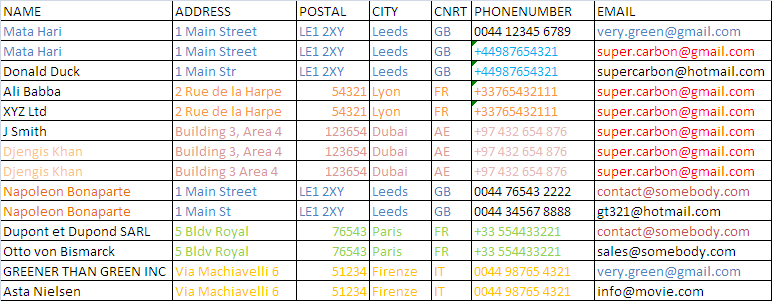
The result from making such connections in the carbon trade database was quite astonishing. Here is an example where I have changed the names, addresses, e-mails and phones, but such a pattern was found in several cases:

Here we have an example of a group of entities where the name, address, e-mail or phone is shared in a way that doesn’t seem natural.

My involvement in the carbon trade scam was initiated by a blog post yesterday by my colleague Jan Erik Ingvaldsen based on the story that journalists by merely gazing the database had found addresses that simply doesn’t exist.

So the question is if authorities may have avoided losing 5 billion taxpayer Euros if some identity resolution including automated fuzzy connection checks and real world checks was implemented. I know that you are so much more enlightened on what could have been done when the scam is discovered, but I actually think that there may be a lot of other billions of Euros (Pounds, Dollars, Rupees) to avoid losing out there by making some decent identity resolution.

Bookmark and Share

Aadhar (or Aadhaar)

The solution to the single most frequent data quality problem being party master data duplicates is actually very simple. Every person (and every legal entity) gets an unique identifier which is used everywhere by everyone.

Now India jumps the bandwagon and starts assigning a unique ID to the 1.2 billion people living in India. As I understand it the project has just been named Aadhar (or Aadhaar). Google translate tells me this word (आधार) means base or root – please correct if anyone knows better.

In Denmark we have had such an identifier (one for citizens and one for companies) for many years. It is not used by everyone everywhere – so you still are able to make money being a data quality professional specializing in data matching.

The main reason that the unique citizen identifier is not used all over is of course privacy considerations. As for the unique company identifier the reason is that data quality often are defined as fit for immediate purpose of use.

Bookmark and Share

Merging Customer Master Data

One of the most frequent assignments I have had within data matching is merging customer databases after two companies have been merged.

This is one of the occasions where it doesn’t help saying the usual data quality mantras like:

  • Prevention and root cause analysis is a better option
  • Change management is a critical factor in ensuring long-term data quality success
  • Tools are not important

It is often essential for the new merged company to have a 360 degree view of business partners as soon as possible in order to maximize synergies from the merger. If the volumes are above just a few thousand entities it is not possible to obtain that using human resources alone. Automated matching is the only realistic option.

The types of entities to be matched may be:

  • Private customers – individuals and households (B2C)
  • Business customers (B2B) on account level, enterprises, legal entities and branches
  • Contacts for these accounts

I have developed a slightly extended version of this typification here.

One of the most common challenges in merging customer databases is that hierarchy management may have been done very different in the past within the merging bodies. When aligning different perceptions I have found that a real world approach often fulfils the different reasoning.

The fuzziness needed for the matching is basically dependent on the common unique keys available in the two databases. These are keys as citizen ID’s (whatever labeled around the world) and public company ID’s (the same applies). Matching both databases with an external source (per entity type) is an option. “Duns Numbering” is probably the most common known type of such an approach. Maintaining a solution for assigning Duns Numbers to customer files from the D&B WorldBase is by the way one of my other assignments as described here.

The automated matching process may be divided into these three steps:

During my many years of practice in doing this I have found that the result from the automated process may vary considerable in quality and speed depending on the tools used.

Bookmark and Share

My Ash Cloud Prediction

The Master Data Management Summit Europe 2010 starts tomorrow. I have attended the IRM events in London several times (and also spoken there once). This year I didn’t plan to go to London in April because I predicted the no fly havoc in Northern Europe that would follow the Iceland volcanic eruption given the wind direction. Not?

Beyond Home Improvement

During my many years in customer master data quality improvement I have worked with a lot of clients having data from several countries. In almost every case the data has been prioritized in two pots:

  • Master Data referring to domestic customers
  • Master Data referring to foreign customers

Even though the enterprise defines itself as an international organization, the term domestic still in a lot of cases is easily assigned to the country where a headquarter is situated and where the organization was born.

Signs of this include:

  • Data formats are designed to fit domestic customers
  • Internal reference data are richer for domestic locations
  • External reference data services are limited to domestic customers

The high prioritizing of domestic data is of course natural for historical reasons, because domestic customers almost certainly are the largest group, and because the rules are common to most delegates in a data quality program.

If we accept the fact that improving data quality will be reflected in an improved bottom line, there is still a margin you may improve by not stopping when having optimal procedures for domestic data.

One way of dealing with this in an easy way is to apply general formats, services and rules that may work for data from all over the world, and this approach may in some cases be the best considering costs and benefits.

But I have no doubt that achieving the best data quality with customer master data is done by exploiting the specific opportunities that exist for each country / culture.

Examples are:

  • The completeness and depth for address (location) data available in each country is very different – so are the rules of the postal service’s operating there
  • Public sector company and citizen registration practice also differs why the quality of external reference data is different and so are the rules of access to the data.
  • Using local character sets, script systems, naming conventions and addressing formats besides (or instead of) what applies to that of the headquarter helps with data quality through real world alignment

My guess is that we will see services in cloud in the near future helping us making the global village also come true for master data quality.

Bookmark and Share