Deduplication vs Identity Resolution

When working with data matching you often finds that there basically is a bright view and a dark view.

Traditional data matching as seen in most data quality tools and master data management solutions is the bright view: Being about finding duplicates and making a “single customer view”. Identity resolution is the dark view: Preventing fraud and catching criminals, terrorists and other villains.

These two poles were discussed in a blog post and the following comments last year. The post was called What is Identity Resolution?

While deduplication and identity resolution may be treated as polar opposites and seemingly contrary disciplines they are in my eyes interconnected and interdependent. Yin and Yang Data Quality.

At the MDM Summit in London last month one session was about the Golden Nominal, Creating a Single Record View. Here Corinne Brazier, Force Records Manager at the West Midlands Police in the UK told about how a traditional data quality tool with some matching capabilities was used to deal with “customers” who don’t want to be recognized.

In the post How to Avoid Losing 5 Billion Euros it was examined how both traditional data matching tools and identity screening services can be used to prevent and discover fraudulent behavior.

Deduplication becomes better when some element of identity resolution is added to the process. That includes embracing big reference data in the process. Knowing what is known in available sources about the addresses that is being matched helps. Knowing what is known in business directories about companies helps. Knowing what is known in appropriate citizen directories when deduping records holding data about individuals helps.

Identity Resolution techniques is based on the same data matching algorithms we use for deduplication. Here for example a fuzzy search technology helps a lot compared to using wildcards. And of course the same sources as mentioned above are a key to the resolution.

Right now I’m dipping deep into the world of big reference data as address directories, business directories, citizen directories and the next big thing being social network profiles. I have no doubt about that deduplication and identity resolution will be more yinyang than yin and yang in the future.

Bookmark and Share

Finding Me

Many people have many names and addresses. So have I.

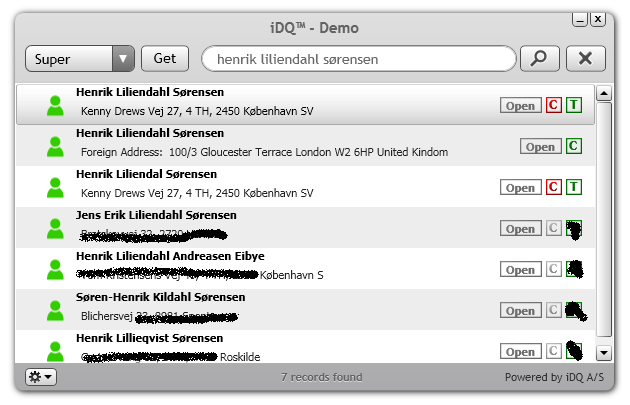
A search for me within Danish reference sources in the iDQ tool gives the following result:

Green T is positive in the Danish Telephone Books. Red C is negative in the Danish Citizen hub. Green C is positive in the Danish Citizen Hub.

Even though I have left Denmark I’m still registered with some phone subscriptions there. And my phone company hasn’t fully achieved single customer view yet, as I’m registered there with two slightly different middle (sur)names.

Following me to the United Kingdom I’m registered here with more different names.

It’s not that I’m attempting some kind of fraud, but as my surname contains The Letter Ø, and that letter isn’t part of the English alphabet, my National Insurance Number (kind of similar to the Social Security Number in the US) is registered by the name “Henrik Liliendahl Sorensen”.

But as the United Kingdom hasn’t a single citizen view, I am separately registered at the National Health Service with the name “Henrik Sorensen”. This is due to a sloppy realtor, who omitted my middle (sur)name on a flat rental contract. That name was taken further by British Gas onto my electricity bill. That document is (surprisingly for me) my most important identity paper in the UK, and it was used as proof of address when registering for health service.

How about you, do you also have several identities?

Bookmark and Share

Indulgent Moderator or Ruthless Terminator?

I am the founder/moderator of two small niche LinkedIn groups in the data quality and Master Data Management (MDM) realm:

As a moderator I feel responsible for keeping the discussions in the group on target.

I guess my challenges in doing so resemble what nearly every other moderator on LinkedIn groups are faced with.

The postings that keep creating trouble are related to:

  • Jobs
  • Promotions

LinkedIn does have a facility to place entries into these two alternative tabs. But people seldom do that voluntary.

Jobs

In fact I’m pleased when a job is posted in one of the groups. But I also know that many people don’t like job postings coming up among the “normal” discussions in the groups.

I’m not so naive that I think recruiters forget to post as a job or don’t know how to do it. Many recruiters don’t respect the rules even if reminded. And some recruiters keep on entering the same job over and over again.

Therefore I have to mark recruiters, who twice “forget”, as subject to indulgent moderation. As said, I like job postings, so until now I haven’t practiced ruthless termination apart from deleting double entries – but that is also a destination of data matching anyway.

Promotions

With the relative small number of members in the groups in question, and recognising that most participants are tool vendors and service providers, I find it refreshing and informative with entries with promotional content, however most pleased when it’s done with limited marketing triviality.     

My indulgence may be explained by that I’m interconnected with tool makers and service providers myself. So these promotions are great ready-made competitor monitoring.

However, my indulgence has its limits when it comes to off topic promotion.

A special case here is outsourcing promotions. I find it peculiar that those people practicing this trade don’t target the message for the group where posted. It shouldn’t be too hard to make an angle with data matching or Multi-Domain MDM for your services. But I find that most out-sourcing people copy-paste their usual stuff.

So, in this area I mostly am the ruthless terminator. And there is seldom any hasta la vista, baby.

Bookmark and Share

The Present Birthday

Today (or maybe yesterday) Steve Jones of Capgemeni wrote a blog post called Same name, same birth date – how likely is it? The post examines the likelihood of that two records with the same name and birthday is representing same real world individual. The chance that a match is a false positive is of course mainly depending on the frequency of the name.

Another angle in this context I have observed over and over again is the chance of a false negative if the name and other data are the same, but the birthday is different. In this case you may miss matching two records that are actually reflecting the same real world individual.

One should think that a datum like a birthday usually should be pretty accurate. My practical experience is that it in many cases isn’t.

Some examples:

Running against the time

Every fourth year when we have Olympic Games there is always controversies about if a tiny female athlete really is as old as said.

I have noticed the same phenomenon when I had the chance to match data about contesters from several years of subscription data at a large city marathon in order to identify “returning customers”.

I’m always looking for false positives in data matching and was really surprised when I found several examples of same name and contact data but a birthday been raised one year for each appearance at the marathon.

That’s not my birthday, this is my birthday

Swedish driving license numbers includes the birthday of the holder as the driving license number is the same as the all-purpose national ID that starts with the birthday.

In a database with both a birthday field and a driving license number field there were heaps of records with mismatch between those two fields.

This wasn’t usually discovered because this rule only applies to Swedish driving license numbers and the database also had registrations for a lot of other nationalities.

When investigating the root cause of this there were as usual not a single explanation and the problem could be both that the birthday belonged to someone else and the driving license belonged to someone else.

Using both fields cut down the number of false negatives here.

Today’s date format is?

In the United States and a few other countries it’s custom to use the month-day-year format when typing a date. In most other places we have the correct sequence of either day-month-year or year-month-day.  Once I matched data concerning foreign seamen working on ships in the Danish merchant fleet. When tuning the match process I found great numbers of good matches when twisting the date formats for birthdays, as the same seaman was registered on different ships with different captains and at different ports around the world.

When adding the fact that many birthdays was typed as 1st January of the known year of birth or 1st day in the known month of birth a lot of false positives was saved.

The question about occupation in the merchant fleet was actually a political hot potato at that time and until then the parliament had discussed the matter based on wrong statistics.

PS

I have used birthday synonymously with “date of birth” which of course is a (meta) data quality problem.

Bookmark and Share

The Database versus the Hub

In the LinkedIn Multi-Domain MDM group we have an ongoing discussion about why you need a master data hub when you already got some workflow, UI and a database.

I have been involved in several master data quality improvement programs without having the opportunity of storing the results in a genuine MDM solution, for example as described in the post Lean MDM. And of course this may very well result in a success story.

However there are some architectural reasons why many more organizations than those who are using a MDM hub today may find benefits in sooner or later having a Master Data hub.

Hierarchical Completeness

If we start with product master data the main issue with storing product master data is the diversity in the requirements for which attributes is needed and when they are needed dependent on the categorization of the products involved.

Typical you will have hundreds or thousands of different attributes where some are crucial for one kind of product and absolutely ridiculous for another kind of product.

Modeling a single product table with thousands of attributes is not a good database practice and pre-modeling tables for each thought categorization is very inflexible.

Setting up mandatory fields on database level for product master data tables is asking for data quality issues as you can’t miss either over-killing or under-killing.

Also product master data entities are seldom created in one single insertion, but is inserted and updated by several different employees each responsible for a set of attributes until it is ready to be approved as a whole.

A master data hub, not at least those born in the product domain, is built for those realities.

The party domain has hierarchical issues too. One example will be if a state/province is mandatory on an address, which is dependent on the country in question.

Single Business Partner View

I like the term “single business partner view” as a higher vision for the more common “single customer view”, as we have the same architectural requirements for supplier master data, employee master data and other master data concerning business partners as we have for the of course extremely important customer master data.

The uniqueness dimension of data quality has a really hard time in common database managers. Having duplicate customer, supplier and employee master data records is the most frequent data quality issue around.

In this sense, a duplicate party is not a record with accurately the same fields filled and with accurate the same values spelled accurately the same as a database will see it. A duplicate is one record reflecting the same real world entity as another record and a duplicate group is more records reflecting the same real world entity.

Even though some database managers have fuzzy capabilities they are still very inadequate in finding these duplicates based on including several attributes at one time and not at least finding duplicate groups.

Finding duplicates when inserting supposed new entities into your customer list and other party master data containers is only the first challenge concerning uniqueness. Next you have to solve the so called survivorship questions being what values will survive unavoidable differences.

Finally the results to be stored may have several constructing outcomes. Maybe a new insertion must be split into two entities belonging to two different hierarchy levels in your party master data universe.

A master data hub will have the capabilities to solve this complexity, some for customer master data only, some also for supplier master data combined with similar challenges with product master data and eventually also other party master data.

Domain Real World Awareness

Building hierarchies, filling incomplete attributes and consolidating duplicates and other forms of real world alignment is most often fulfilled by including external reference data.

There are many sources available for party master as address directories, business directories and citizen information dependent on countries in question.

With product master data global data synchronization involving common product identifiers and product classifications is becoming very important when doing business the lean way.

Master data hubs knows these sources of external reference data so you, once again, don’t have to reinvent the wheel.

Bookmark and Share

Some Deduplication Tactics

When doing the data quality kind of deduplication you will often have two kinds of data matching involved:

  • Data matching in order to find duplicates internally in your master data, most often your customer database
  • Data matching in order to align your master data with an external registry

As the latter activity also helps with finding the internal duplicates, a good question is in which order to do these two activities.

External identifiers

If we for example look at business-to-business (B2B) customer master data it is possible to match against a business directory. Some choices are:

  • If you have mostly domestic data in a country with a public company registration you can obtain a national ID from matching with a business directory based on such a registry. An example will be the French SIREN/SIRET identifiers as mentioned in the post Single Company View.
  • Some registries cover a range of countries. An example is the EuroContactPool where each business entity is identified with a Site ID.
  • The Dun & Bradstreet WorldBase covers the whole world by identifying approximately 200 million active and dissolved business entities with a DUNS-number. The DUNS-number also serves as a privatized national ID for companies in the United States.

If you start with matching your B2B customers against such a registry, you will get a unique identifier that can be attached to your internal customer master data records which will make a succeeding internal deduplication a no-brainer.

Common matching issues

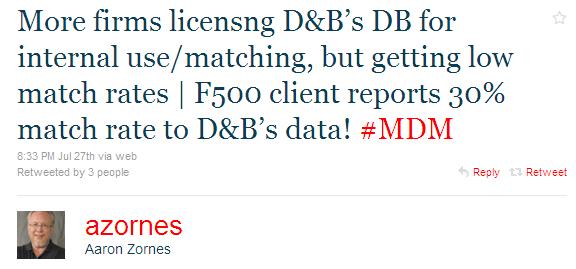
A problem is however is that you seldom get a 100 % hit rate in a business directory matching, often not even close as examined in the post 3 out of 10.

Another issue is the commercial implications. Business directory matching is often performed as an external service priced per record. Therefore you may save money by merging the duplicates before passing on to external matching. And even if everything is done internally, removing the duplicates before directory matching will save process load.

However a common pitfall is that an internal deduplication may merge two similar records that actually are represented by two different entities in the business directory (and the real world).

So, as many things data matching, the answer to the sequence question is often: Both.

A good process sequence may be this one:

  1. An internal deduplication with very tight settings
  2. A match against an external registry
  3. An internal deduplication exploiting external identifiers and having more loose settings for similarities not involving an external identifier

Bookmark and Share

Happy Uniqueness

When making the baseline for customer data in a new master data management hub you often involve heavy data matching in order to de-duplicate the current stock of customer master data, so you so to speak start with a cleansed duplicate free set of data.

I have been involved in such a process many times, and the result has never been free of duplicates. For two reasons:

  • Even with the best data matching tool and the best external reference data available you obviously can’t settle all real world alignments with the confidence needed and manual verification is costly and slowly.
  • In order to make data fit for the business purposes duplicates are required for a lot of good reasons.

Being able to store the full story from the result of the data matching efforts is what makes me, and the database, most happy.

The notion of a “golden record” is often not in fact a single record but a hierarchical structure that reflects both the real world entity as far as we can get and the instances of this real world entity in a form that are suitable for different business processes.

Some of the tricky constructions that exist in the real world and are usual suspects for multiple instances of the same real world entity are described in the blog posts:

The reasons for having business rules leading to multiple versions of the truth are discussed in the posts:

I’m looking forward to yet a party master data hub migration next week under the above conditions.

Bookmark and Share

Lots of Product Names

In master data management the two most prominent domains are:

  • Parties and
  • Products

In the quest for finding representations of parties actually being the same real world party and finding representations of products actually being the same real world product we typically execute fuzzy data matching of:

  • Party names as person names and company names
  • Product descriptions

However I have often seen party names being an integral part of matching products.

Some examples:

Manufacturer Names:

A product is most often being regarded as distinct not only based on the description but also based on the manufacturer. So besides being sharp on matching product descriptions for light bulbs you must also consider if for example the following manufacturer company names are the same or not:

  • Koninklijke Philips Electronics N.V.
  • Phillips
  • Philips Electronic

Author Names:

A book is a product. The title of the book is the description. But also the author’s person name counts. So how do we collect the entire works made by the author:

  • Hans Christian Andersen
  • Andersen, Hans Christian
  • H. C. Andersen

as all three representations are superb bad data?

Bear Names:

A certain kind of teddy bears has a product description like “Plush magenta teddy bear”. But each bear may have a pet name like “Lots-O’-Huggin’ Bear” or just short “Lotso” as seen in the film “Toy Story 3”. And seriously: In real business I have worked with building a bear data model and the related data matching.

PS: For those who have seen Toy Story 3: Is that Lotso one or two real world entities?  

Bookmark and Share

Now, where’s the undo button?

I have just read two blog posts about the dangers of deleting data in the good cause of making data quality improvements.

In his post Why Merging is Evil Scott Schumacher of IBM Initiate describes the horrors of using survivorship rules for merging two (or more) database rows recognized to reflect the same real world entity.

Jim Harris describes the insane practices of getting rid of unwanted data in the post A Confederacy Of Data Defects.

On a personal note I have just had a related experience from outside the data management world. We have just relocated from a fairly large house to a modest sized apartment. Due to the downsizing and the good opportunity given by the migration we wasted a lot of stuff in the process. Now we are in the process of buying replacements for these things we shouldn’t have thrown away.

As Scott describes in his post about merging, there is an alternate approach to merging being linking – with some computation inefficiency attached. Also in the cases described by Jim we often don’t dare to delete at the root, so instead we keep the original values and makes a new cleansed copy without the supposed unwanted data for the purpose at hand.

In my relocation project we could have rented a self-storage unit for all the supposed not so needed stuff as well.

It’s a balance. As in all things data quality there isn’t a single right or wrong answer to what to do. And there will always be regrets. Now, where’s the undo button?

Bookmark and Share

The Overlooked MDM Feature

When engaging in the social media community dealing with master data management an often seen subject is creating a list of important capabilities for the technical side of master data management. I have at some occasions commented on such posts by adding a feature I often see omitted from these lists, namely: Error tolerant search functionality. Examples from the DataFlux CoE blog here and the LinkedIn Master Data Management Interest Group here.

Error tolerant search (also called fuzzy search) technology is closely related to data matching technology. But where data matching is basically none interactive, error tolerant search is highly interactive.

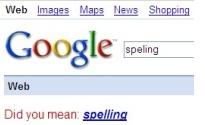
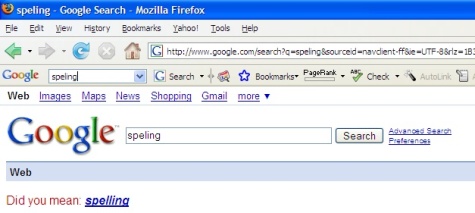
Most people know error tolerant search from googling. You enter something with a typo and google prompts you back with: Did you mean…? When looking for entities in master data management hubs you certainly need something similar. Spelling of names, addresses, product descriptions and so on is not easy – not at least in a globalized world.

As in data matching error tolerant search may use lists of synonyms as the basic technology. But also the use of algorithms is common going from an oldie like the soundex phonetic algorithm over more sophisticated algorithms.

The business benefits from having error tolerant search as a capacity in your master data management solution are plenty, including:

  • Better data quality by upstream prevention against duplicate entries as explained in this post.
  • More efficiency by bringing down the time users spends on searching for information about entities in the master data hub.
  • Higher employee satisfaction by eliminating a lot of frustration else coming from not finding what you know must be inside the hub already.

Error tolerant search has been one of the core features in the master data management implementations where I have been involved. What about you?

Bookmark and Share