The Pond

The term ”The Pond” is often used as an informal term for the Atlantic Ocean, especially the North Atlantic Ocean being the waters that separates North America and Europe.

Within information technology and not at least my focus areas being data quality and master data management there is a lot of exchange going on over the pond as European companies are using North American technology and sometimes vice versa. Also European companies are setting up operations in North America and of course also the other way around.

Some technologies works pretty much the same regardless of in which country it is deployed. A database manager product is an example of that kind of technology. Other pieces of software must be heavily localized. An ERP application belongs to that category. Data quality and master data management tools and implementation practice are indeed also subject to diversity considerations.

When North American companies go to Europe my gut feeling is that an overwhelming part of them chooses to start with a European or EMEA wide head quarter on the British Isles – and that again means mostly in the London area.

The reasons for that may be many. However I guess that the fact that people on the British Isles doesn’t speak a strange language has a lot to say. What many North American companies with a head quarter in London often has to realize then is, that this move only got them half way over the pond.  

Bookmark and Share

Nonprofit Data Quality

One of the industries where I have worked a lot with data quality issues is at nonprofit organizations such as charities and other form of membership based organizations.

A general characteristic of such organizations is that they have databases with as many “customers” as huge global enterprises; however the number of employee records is only a fraction compared to those large companies.

So the emphasis is often not at creating well manned data governance organizational structures but implementing the best automation available in order to have optimal party master data management, where the parties involved are members and other roles played by individuals and companies with a common interest.

Many nonprofit organizations have several different fundraising activities going on at the same time. This means that real world individuals, households, organizations and their contacts are registered through different channels. The challenges of getting a “single view of customer” from the data streams created in these processes are discussed in the post Multi-Purpose Data Quality.

There are many nonprofit organizations working internationally. The often decentralized management structures in nonprofit organizations means that way of doing things will naturally be different between countries where nonprofits are operating. Also the differences in legislation and culture are important. Some examples related to how to exploit master data are examined in the post Feasible Names and Addresses.

When it comes to creating business cases for data quality nonprofits are basically of course not different from any other organization. The main goals are increased fundraising and lowering administration costs. As said, the low number of employees often leads to using technology. The low amount of money available often leads to using agile technology.

Bookmark and Share

Citizen Master Data Management

Citizen Master Data Management in the public sector is the equivalence of Customer Master Data Management in the private sector.

Where are we?

As private organizations find different solutions to how to manage customer master data, governments around the world also have found their particular solution for managing citizen master data.

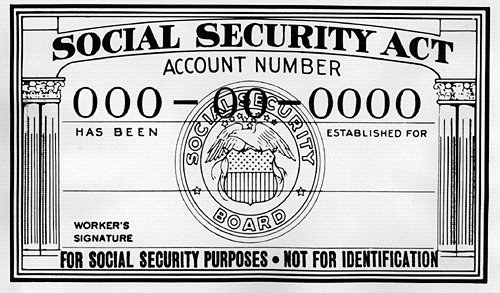
Most descriptions on data management are originated in the United States and so are also many examples and issues related to citizen master data management. One example is this blog post from IBM Initiate called The End of the Social Security Number?

As mentioned in the post there are different administrative practices around the world where governments may learn from experiences with alternative solutions in other countries.

During last year’s discussion in Canada about the census form I had the chance to write a guest blog post on a Canadian blog about How Denmark does it.

The way of the world does change. One example is the program in India called Aadhaar aiming at providing a unique national ID for the over one billion people living in India.

When to register?

The question about when a citizen has to be included in a citizen master data registry of course depends on the purpose of the registry. If the single purpose for example is driving license administration it will depend on when a citizen may obtain a driving license and that will exclude citizens under a certain age depending on the rules in place. The same applies to an electoral roll.

In my country we have an all-purpose citizen master data hub, which today means that a new born is registered and provided a unique Citizen ID within seconds.

Similar considerations apply to immigration and cross boarder employment.

What to store?

Citizen master data registries typically hold attributes as an identifier, name and address and status information.

As new technologies matures governments of course considers if such technologies may be feasible and may add benefits as part of the master data stored about citizens.

Using biometrics is a controversial topic here. The pros and cons were discussed, based on the cancelled program in the United Kingdom, in the post Citizen ID and Biometrics.

Who will share?

Privacy considerations are paramount in most discussions around citizen master data hubs.

Even if you have an all-purpose citizen registry there will be laws limiting how public sector may exploit data identified with the registry and the identifier in use.

On the other hand, in some countries even private sector organizations may benefit from such a master data hub.

An example from Sweden is shown here in the post No Privacy Customer Onboarding.

Bookmark and Share

International Data Steward of the Year

The 11th October is declared International Data Steward Day by the Data Roundtable and yesterday I threw in my candidate for the The Data Steward of the Year. So the next month I will be lobbying the fine selection of judges.

It’s going to be hard work as my candidate is behind from the start, as she will not see the 11th October 2011 as 10.11.11 but as 11.10.11. Let’s see if the contest is truly international or if the US candidates are playing on home ground.

Bookmark and Share

Oranges, Apples and Pears go Bananas

My post yesterday about Data Quality Evangelism included the fruit oranges and a comment from Jim Harris added apples to the analogies by using the idiom about comparing apples and oranges.

There are a lot of linguistic musings around the words apples and oranges.

In many languages we use the similar idiom as comparing apples and pears. But it may be geographic depended as in European French it is apples and pears but in Quebec French it is apples and oranges.

In some Germanic languages the fruit orange can be translated as “Chinese apple”. For example the Dutch word is “sinaasappel”  and the Danish/Norwegian word is “appelsin”. In Germany it is “Apfelsine” in the North and “Orange” in the South. The linguistic line across Germany is by the way called the apple-line, but for the opposite reason.

In English a “Chinese apple” is a pomegranate.

The word orange has two meanings in English: A fruit and the color (as they write in American English) or a colour (as they write on the British English).

The two meanings make Google Translate go bananas. When Google translates between languages it does it via English. So if I translate “appelsin” from Danish to Dutch I don’t get “sinaasappel”. Instead I get “oranje”, the Dutch national color.

No wonder Data Quality Evangelism most often isn’t fruitful.

Bookmark and Share

The 20 Million Rupees Question

Here we go again. The same old question: “What is the definition of customer?”  Latest Informatica (a data quality, master data management and data integration firm) has hired David Loshin to find out – started in the blog post The Most Dangerous Question to Ask Data Professionals.

Shortly, my take is that this question in practice has two major implications for data quality and master data management but in theory, it should only have one:

  • The first one is real world alignment. In theory real world alignment is independent of the definition of a customer as it is about the party behind the customer.
  • The second is party roles. It’s actually here we can have an endless discussion.

In practice we of course mix things up as discussed in the post Entity Revolution vs Entity Evolution.

And Now for Something Completely Different

Instead of saying that “What is the definition of customer?”  is the million dollar question it’s probably more like the 20 million rupees question as most data management these days are taking place in India.

The amount of money involved is taken from the film Slumdog Millionaire where 20 million rupees is the top prize in the local “Who Wants to Be a Millionaire?” (Kaun Banega Crorepati), which by the way has the same jingle and graphics as all over the world.

And oh, how much is 20 million rupees? It’s near ½ million US dollars or 300.000 euro (with a dot as thousand separator). But a lot in buying power for a local customer. Exactly 2 crores (2,00,00,000 rupees).  

Party on.

Bookmark and Share

Phishing in Wrong Waters

Yesterday a lot of Danes received an e-mail apparently coming from the tax authorities but was a phishing attempt.

The form to be filled may seem professional at first glance, but it actually had errors all over.


While such errors may be common in phishing as the ones behind only need a fraction of the receivers to take the bite, you actually do see many of the errors in lawful activities.

Some of the errors in the phishing attempt were:

  • It is very unlikely that the public sector would communicate in English instead of Danish
  • They got our national ID for every citizen right; it is called CPR-NR. But why ask for date of birth as this is included in the national ID.
  • Asking for “Mother Maiden Name” and “The name of your son” seems ridiculous to me. Don’t know if it’s some kind of custom anywhere else in the world.
  • The address format is (as usual) a United States standard. Here it would be: Address, Postal Code, Town/City.
  • You would never expect the public sector to pay anything to your credit/debit card. Our national ID is connected to a bank account selected for that purpose.

As the tax authorities stated in a warning e-mail today: “We do not know of anyone who has been cheated by the mail”.

I guess they are right.

Also, if you are doing lawful activities but committing the same kind of diversity errors in your forms: Don’t expect a whole lot of conversion.

Bookmark and Share

Managing Client On-Boarding Data

This year I will be joining FIMA: Europe’s Premier Financial Reference Data Management Conference for Data Management Professionals. The conference is held in London from 8th to 10th November.

I will present “Diversities In Using External Registries In A Globalised World” and take part in the panel discussion “Overcoming Key Challenges In Managing Client On-Boarding Data: Opportunities & Efficiency Ideas”.

As said in the panel discussion introduction: The industry clearly needs to normalise (or is it normalize?) regional differences and establish global standards.

The concept of using external reference data in order to improve data quality within master data management has been a favorite topic of mine for long.

I’m not saying that external reference data is a single source of truth. Clearly external reference data may have data quality issues as exemplified in my previous blog post called Troubled Bridge Over Water.

However I think there is a clear trend in encompassing external sources, increasingly found in the cloud, to make a shortcut in keeping up with data quality. I call this Data Quality 3.0.

The Achilles Heel though has always been how to smoothly integrate external data into data entry functionality and other data capture processes and not to forget, how to ensure ongoing maintenance in order to avoid else inevitable erosion of data quality.

Lately I have worked with a concept called instant Data Quality. The idea is to make simple yet powerful functionality that helps with hooking up with many external sources at the same time when on-boarding clients and making continuous maintenance possible.

One aspect of such a concept is how to exploit the different opportunities available in each country as public administrative practices and privacy norms varies a lot over the world.

I’m looking forward to present and discuss these challenges and getting a lot of feedback.

Bookmark and Share

Party On

The most frequent data domain addressed in data quality improvement and master data management is parties.

Some of the issues related to parties that keeps on creating difficulties are:

  • Party roles
  • International diversity
  • Real world alignment

Party roles

Party data management is often coined as customer data management or customer data integration (CDI).

Indeed, customers are the lifeblood of any enterprise – also if we refer to those who benefit from our services as citizens, patients, clients or whatever term in use in different industries.

But the full information chain within any organization also includes many other party roles as explained in the post 360° Business Partner View. Some parties are suppliers, channel partners and employees. Some parties play more than one role at the same time.

The classic question “what is a customer?” is of course important to be answered in your master data management and data quality journey. But in my eyes there is lot of things to be solved in party data management that don’t need to wait for the answer to that question which anyway won’t be as simple as cutting the Gordian Knot as said in the post Where is the Business.

International diversity

As discussed in the post The Tower of Babel more and more organizations are met with multi-cultural issues in data quality improvement within party data management.

Whether and when an organization has to deal with international issues is of course dependent on whether and in what degree that organization is domestic or active internationally. Even though in some countries like Switzerland and Belgium having several official languages the multi-cultural topic is mandatory. Typically in large countries companies grows big before looking abroad while in smaller countries, like my home country Denmark, even many fairly small companies must address international issues with data quality.

However, as Karen Lopez recently pondered in the post Data Quality in The Wild, Some Where …, actually everyone, even in the United States, has some international data somewhere looking very strange if not addressed properly.

Real world alignment

I often say that real world alignment, sometimes as opposed to the common definition of data quality as being fit for purpose, is the short cut to getting data quality right related to party master data.

It is however not a straight forward short cut. There are multiple challenges connected with getting your business-to-business (B2B) records aligned with the real world as discussed in the post Single Company View.  When it comes to business-to-consumer (B2C) or government-to-citizen (G2C) I think the dear people who sometimes comments on this blog did a fine job on balancing mutating tables and intelligent design in the post Create Table Homo_Sapiens.

Bookmark and Share

A geek about Greek

This ninth Data Quality World Tour blog post is about Greece, a favorite travel destination of mine and the place of origin of so many terms and thoughts in today’s civilization.

Super senior citizens

Today Greece has a problem with keeping records over citizens. A recent data profiling activity has exposed that over 9,000 Greeks receiving pensions are over 100 years old. It is assumed that relatives has missed reporting the death of these people and therefore are taking care of the continuing stream of euro’s. News link here.

Diverse dimensions

I found those good advices for you, when going to Greece today:

Timeliness: When coming to dinner, arriving 30 minutes late is considered punctual.

Accuracy:  Under no circumstances should you publicly question someone’s statements.

Uniqueness: Meetings are often interrupted. Several people may speak at the same time.

(We all have some Greek in us I guess).

Previous Data Quality World Tour blog posts: