Postal Address Hierarchy, Granularity, Precision and History

Penny_blackIn my last blog post the term “single version of the truth” was discussed. Some prerequisites for having raw data stored in one version that meets all known purposes are that:

  • They are kept with the granularity needed for all purposes
  • They have the most advanced precisions with all purposes
  • They reflect all time states asked for regarding all purposes

In the following I will go through some challenges with postal addresses. Don’t take this as an attempt to list all challenges in the world around this subject – it is only what I have been up to.

Countries

The country is the highest level in the address hierarchy. A source of truth may be a list of ISO 2 character country codes. But there are other lists and between these lists there a different perceptions of the fact that even countries are internally in hierarchies. Some examples related to the Olympic contest as my last blog post was part of are:

  • York (the old one) is placed in England – or is it Great Britain – or is it United Kingdom?
  • Referring to United States of America may or may not include Puerto Rico, US Virgin Islands, Guam, Samoa and Northern Mariana Islands.
  • The Kingdom of Denmark is not Denmark but Denmark, Faroe Islands and Greenland.

An example of a very slow changing dimension in here is that US Virgin Islands was part of the Kingdom of Denmark until 1917.

I had a great deal of fun with country codes and names when setting up a data matching solution around the D&B WorldBase and the world picture kept in there opposite to what is contained in other data samples.

States

Some countries have states, some countries have provinces and some other countries don’t have states or provinces. In some countries the state is a mandatory part of a postal address like in the US. In other countries having states the state is not a part of a printed address like in Germany, but you may have other purposes for storing the data anyway.

Postal codes and districts

Often local postal code systems are translated to the term ZIP-code – but ZIP code is actually the name of the US system.

The granularity of postal code systems differs a lot around the world. The UK postal codes are very specific while a postal code in other countries may refer to a large city. In most countries the postal code system is a hierarchy of numbers. The UK system is different. The Irish is very different – no postal codes until now.

In many countries companies are assigned a postal code of their own. The same goes for post office box addresses. In France the name of the referring district is followed by the word CEDEX for these addresses. So, be careful when matching or grouping city names in French addresses. Paris not Cedex is the centre of the universe in that country.

Locations, streets, blocks, house names, whatever

A lot of different hierarchies in various levels exist around the world – and the custom sequence also varies. This is a too complex and comprehensive subject for a blog post. So I will only emphasis a few selected subjects:

  • Vanity addressing is a phenonemen not at least in the UK where keeping up appearances rules. Here you may have to include a lie in the single version of truth.
  • Coding rules in my home country Denmark as we have a way of assigning a unique code to every real world entity. It helps with automated taxation. So a main road in central Copenhagen may be known to people as “H.C. Andersens Boulevard” but is stored in any mature database as “1010148”.
  • When matching party entities don’t make a false negative with an entity having a visit (geographical) address versus an entity having a mail address.

Entrances

Entrance – most often referred to as house number – is where addressing meets geocoding. Here you by using geocodes can point to an exact value identifying an address. When comparing with other addresses you just have to make sure whether you are talking latitude/longitude in a round world or WGS84 x-y coordinates or other geographic coordinate systems in a flat world and whether we are pointing at the centre of the building, at the door, at the spot where a public road is reachable or it is interpolated values.

Units

Larger buildings, high rising buildings and skyscrapers are usually not one address but is an entrance having multiple family apartments and/or multiple business addresses. These may be presented in many formats and in many depths including floors, sides, door numbers, you name it.

Large business entities may occupy a range of entrances.

Some entrances may in first impression look like a single address occupied by a nuclear family, but are in fact a nursing home or a campus occupied by a number of named individuals living on the same address.

Data models

The postal (geographical and mailing) address elements are in many data models just some of the attributes in a party entity. By separating the postal address elements in a specific entity with granulated attributes you will be more aligned with the real world and thereby have a better chance of fulfilling all purposes with the raw data. One of the most obvious advantages will be history tracking as business’ and consumers/citizens relocates from time to time.

Bookmark and Share

Sweden meets United States

obama-ikea

Finding duplicate customers may be very different tasks depending on from which country you are and from which country the data origins.

Besides all the various character sets, naming traditions and address formats also the alternative possibilities with external reference data makes something easy – and then something very hard.

Most technology, descriptions and presented examples around are from the United States.

But say you are a Swedish company having Swedish persons in your database and among those these 2 rows (name, address, postal code and city):

  • Oluf Palme, Sveagatan 67, 10001 Stockholm
  • Oluf Palme, Savegatan 76, 10001 Stockholm

What you do is that you plug into the government provided citizen master data hub and ask for a match. The outcome can be:

  • The same citizen ID is returned because the person has relocated. It’s a duplicate.
  • Two different citizen ID’s is returned. It’s not a duplicate.
  • Either only one or no citizen ID is returned. Leave it or do fuzzy matching.

If you go for fuzzy matching then you better be good, because all the easy ones are handled and you are left with the ones where false positives and false negatives are most likely. Often you will only do fuzzy matching if you have phone numbers, email addresses or other data to support the match.

Another angle is that it is almost only Swedish companies who use this service with the government provided reference data – but everyone having Swedish data may use it upon an approval.

Data quality solutions with party master data is not only about fuzzy matching but also about integrating with external reference data exploiting all the various world wide possibilities and supporting the logic and logistics in doing that. Also we know that upstream prevention as close to the root as possible is better than downstream cleansing.

Deployment of such features as composable SOA components is described in a previous post here.

The Tower of Babel

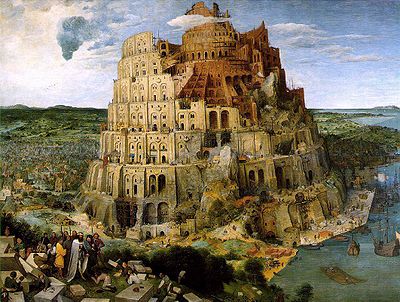
Brueghel-tower-of-babelSeveral old tales including in the Genesis and the Qur’an have stories about a great tower built by mankind at a time with a single language of all people. Since then mankind was confused by having multiple languages. And indeed we still are.

Multi-cultural issues is one of the really big challenges in data quality improvement. This includes not only language variations but also different character sets reflecting different alphabets and script systems, naming traditions, address formats, measure units, privacy norms, government registration practice to name the ones I have experienced.

As globalization moves forward these challenges becomes more and more important. Enterprises tend to standardize world wide on tools and services, shared service centres takes care of data covering many countries and so on. When an employee works with data from another country he often wrongly adapts his local standards to these data and thereby challenges the data quality more than seen before.

Recently I updated this site with pages around “The art of Matching”. One topic is “Match Techniques” and comments posted here were exactly very much around the need for methods that solves the problems arising from having multi-cultural data. Have a look.

International and multi-cultural aspects of data quality improvement has been a favourite topic of mine for a long time.

Whether and when an organisation has to deal with international issues is of course dependent on whether and in what degree that organisation is domestic or active internationally. Even though in some countries like Switzerland and Belgium having several official languages the multi-cultural topic is mandatory. Typically in large countries companies grows big before looking abroad while in smaller countries, like my home country Denmark, even many fairly small companies must address international issues with data quality. 

Some of the many different observations I have made includes the following:

  • Nicknames is a top issue in name matching in some cultures, but not of much importance in other cultures
  • Family names is key element in identifying households in some cultures, but not very useful in other cultures
  • Address verification and correction is very useful in some countries but close to impossible in other countries
  • Business directories are complete, consistent and available in some countries, but not that good in other countries
  • Citizen information is available for private entities in some countries, but is a no go in other countries

While working with data quality tools and services for many years I have found that many tools and services are very national. So you might discover that a tool or service will make wonders with data from one country, but be quite ordinary or in fact useless with data from another country.

Bookmark and Share

The GlobalMatchBox

dnbLogo10 years ago I spend most of the summer delivering my first large project after being a sole proprietorship. The client – or actually rather the partner – was Dun & Bradsteet’s Nordic operation, who needed an agile solution for matching customer files with their Nordic business reference data sets. The application was named MatchBox.

bisnode-logoThis solution has grown over the years while D&B’s operation in the Nordics and other parts of Europe is now operated by Bisnode.

Today matching is done with the entire WorldBase holding close to 150 million business entities from all over the world – with all the diversity you can imagine. On the technology side the application has been bundled with the indexing capacities of www.softbool.com and the similarity cleverness of www.omikron.net (disclosure: today I work for Omikron) all built with the RAD tool www.magicsoftware.com. The application is now called GlobalMatchBox.

It has been a great but fearful pleasure for me to have been able to work with setting up and tuning such a data matching engine and environment. Everybody who has worked with data matching knows about the scars you get when avoiding false positives and false negatives. You know that it is just not good enough to say that you only are able to automatically match 40% of the records when it is supposed to be 100%.

So this project has very much been an unlike experience compared to the occasional SMB (Small and Medium size Business) hit and run data quality improvement projects I also do as described in my previous post. With D&B we are not talking about months but years of tuning and I have been guilty of practicing excessive consultancy.

Bookmark and Share