Select Company_ID from External_Source where possible

With the risk of having the comment area on this blog filled up with SQL statements I will follow the track and tone from the last post called Create Table Homo_Sapiens.

In the last post some challenges around modelling people in databases was discussed with focus on uniqueness. Now we will have a look at the same challenges with companies – the other big part of party master data.

Companies often act in the same role as individual people in business processes – not at least in the role as a customer. Companies also behave as persons in a lot of ways like being born (establish), change name, relocate, marry (mergers and acquisitions), divorce (split) and decease (dissolve).

All over the world a lot of people spend the days entering and updating the data held on business partners in numerous databases. The world wide sum of B2B connections between a customer and a vendor each entering and maintaining the data about the other resembles (though less aggressive) the grains on a chessboard story:

  • 2 companies both exchanging goodies makes 1+1 customers and 1+1 vendors = 4 rows
  • 3 companies all exchanging goodies makes 2+2+2 customers and 2+2+2 vendors = 12 rows
  • 4 companies all exchanging goodies makes 3+3+3+3 customers and 3+3+3+3 vendors = 24 rows
  • 5 companies all exchanging goodies makes 4+4+4+4+4 customers and 4+4+4+4+4 vendors = 40 rows
  • n companies all exchanging goodies makes n*(n-1) customers and n*(n-1) vendors = 2*n*(n-1) rows

Last time I checked the D&B WorldBase held more the 150 millions companies. Some are dissolved and fortunately? everyone doesn’t do business with everyone – but as said, the sum of B2B connections is huge and the work in entering and maintaining the master data seems overwhelming.

If we look at one single company and how it may be represented differently in databases around only taking basic data as name and address into account, there will be lots of variations. Even in the same table the same real world company often occupies several rows spelled differently.

One of the most effective methods for avoiding duplicates of company master data is plugging into a business directory. By using an external sourced company ID as a key in your master data you are able to hold a golden record of that real world entity. As a bonus you are offered updates and access to a lot of additional data you would never be able to collect yourself.

55 reasons to improve data quality

The business value in data quality improvement is an ever recurring topic in the realm of data quality.

In the following I will list the first 55 reasons that comes to my mind for improving data quality related to the single most frequent data quality issue around, which is duplicates (and unresolved hierarchies) in party master data – names and addresses.

It goes like this:

1.  It’s a waste of money sending the same printed material twice or more times to the same individual consumer.

2.  Allowing the same customer enter twice or more times for an introduction offer challenges the return of investment in such campaigns.

3.  When measuring churn and win-back two or more unrelated accounts for the same business hierarchy will produce an incomplete result leading to a wrong decision.

4.  Sending the same promotion eMail twice or more times to the same individual consumer looks like spam even if different eMail addresses are used. Spam has more offending than selling power.

5.  It’s probably a waste of money sending the same printed material with presentation and offerings to a household already having a customer.

6.  Assigning different credit terms for two or more unrelated accounts for the same business hierarchy will make uncontrolled financial risk.

7.  When measuring cross selling results two or more unrelated accounts for the same household will produce an incomplete result leading to a wrong decision.

8.  When measuring life time value two or more unrelated accounts for the same individual consumer will produce a wrong result leading to a wrong decision.

9.  It’s probably a waste of money sending the same printed material twice or more times to the same household.

10.  When measuring life time value two or more unrelated accounts for the same individual being a consumer and a business owner will produce an incomplete result leading to a wrong decision.

11.  When wanting a 1-1 dialogue two or more unrelated accounts for the same individual consumer will not lead to a 1-1 dialogue.

12.  Having companies represented in two or more unrelated accounts for the same company with a different line-of-business assigned will produce an incomplete segmentation.

13.  When trying to point at your best customers being households in order to find similar households two or more unrelated accounts for the same household will produce an incomplete segmentation.

14.  When measuring cross selling results two or more unrelated accounts for the same individual consumer will produce a wrong result leading to a wrong decision.

15.  It’s a waste of money sending printed material with presentation and offerings to an individual consumer already being a customer.

16.  When wanting a 1-1 dialogue two or more unrelated accounts for the same business hierarchy will not lead to a complete 1-1 dialogue.

17.  When measuring life time value two or more unrelated accounts for the same business hierarchy will produce an incomplete result leading to a wrong decision.

18.  Assigning different credit terms for two or more unrelated accounts for the same individual consumer will increase financial risk.

19.  When measuring cross selling results two or more unrelated accounts for the same individual being a consumer and a business owner will produce only an incoherent result leading to a wrong decision.

20.  When wanting a 1-1 dialogue two or more unrelated accounts for the same household will not lead to a true 1-1 dialogue.

21.  Assigning different credit terms for two or more unrelated accounts for the same business entity could increase financial risk.

22.  Having activities related to companies attached to two or more unrelated accounts for the same company will show an incomplete customer history with the risk of taking damaging actions.

23.  It’s a waste of money and credibility sending printed material with presentation and offerings to an individual business decision maker in a business entity already being a customer.

24.  When buying from a supplier having two or more unrelated accounts despite being the same business entity you may miss discount opportunities.

25.  Having companies represented in two or more unrelated accounts for the same company with a different lead source assigned will produce a false measure of marketing and sales performance.

26.  Sending the same promotion eMail or newsletter twice or more times to the same individual business decision maker looks like spam even if different eMail addresses are used. Spam has more offending than selling power.

27.  When measuring  churn and win-back two or more unrelated accounts for the same household will produce an incomplete result leading to a wrong decision.

28.  Having activities related to influencers attached to two or more unrelated business contact records for the same person will show an incomplete business partner history with the risk of retaking already made actions.

29.  When buying from a supplier having two or more unrelated accounts despite they are belonging the same business hierarchy you could miss discount opportunities.

30.  Having activities related to households attached to two or more unrelated accounts for the same household will show an incomplete customer history with the risk of taking insufficient  actions.

31.  When trying to point at your best customers being individual consumers in order to find similar individuals two or more unrelated accounts for the same individual consumer will produce a wrong segmentation.

32.  Having companies represented in two or more unrelated accounts for the same company with a different address assigned will produce an incomplete segmentation.

33.  When measuring life time value two or more unrelated accounts for the same business entity will produce a false result leading to a wrong decision.

34.  Having activities related to decision makers in companies attached to two or more unrelated contacts for the same person will show an incomplete customer contact history with the risk of not taking appropriate actions.

35.  When wanting a 1-1 dialogue two or more unrelated accounts for the same business entity will not lead to a real 1-1 dialogue.

36.  When trying to point at your best customers being companies in order to find similar companies two or more unrelated accounts for the same company will produce a false segmentation.

37.  Maintaining data related to two or more unrelated accounts for the same real world entity will probably be more costly than necessary when exploiting external reference data.

38.  It’s probably a waste of money sending printed material with presentation and offerings to a business entity already being a customer at a higher or lower hierarchy level.

39.  Having individual consumers represented in two or more unrelated accounts for the same individual consumer with a different lead source assigned will produce a wrong measure of marketing and sales performance.

40.  Allowing the same customer re-enter for an offer already turned down (e.g. credit services) will create unnecessary double validation work.

41.  When measuring churn and win-back two or more unrelated accounts for the same business entity will produce a false result leading to a wrong decision.

42.  When wanting a 1-1 dialogue two ore more unrelated accounts for the same individual being a consumer and a business owner will not lead to a sensible 1-1 dialogue.

43.  When measuring cross selling results two or more unrelated accounts for the same business entity will produce a false result leading to a wrong decision.

44.  Having activities related to individual consumers attached to two or more unrelated accounts for the same individual consumer will show an incomplete customer history with the risk of taking wrong actions.

45.  When measuring life time value two or more unrelated accounts for the same household will produce an incomplete result leading to a wrong decision.

46.  Having activities related to customers attached to two or more unrelated accounts for the same real world entity may lead to that different sales representatives are working against each other.

47.  Allowing sales representatives creating new accounts for already existing customers may create time consuming commission disputes.

48.  Having households represented in two or more unrelated accounts for the same household with a different lead source assigned will produce an incomplete measure of marketing and sales performance.

49.  Maintaining data related to two or more unrelated accounts for the same real world entity will consume more manual work than necessary.

50.  When measuring churn and win-back two or more unrelated accounts for the same individual consumer will produce a wrong result leading to a wrong decision.

51.  When buying from a supplier having two or more unrelated accounts despite being the same business entity you may have multiple unnecessary inventory costs.

52.  It’s a waste of money and credibility sending the same printed material twice or more times to the same individual business decision maker.

53.  When measuring churn and win-back two or more unrelated accounts for the same individual being a consumer and a business owner will produce only an incoherent result leading to a wrong decision.

54.  Assigning different credit terms for two or more unrelated accounts for the same household may increase financial risk.

55.  When measuring cross selling results two or more unrelated accounts for the same business hierarchy will produce an incomplete result leading to a wrong decision.

Bookmark and Share

Who is working where doing what?

A classic core data model for Master Data in CRM databases and Master Data hubs when doing B2B is that you have:

  • Accounts being the BUSINESS entities who are your customers, prospects and all kind of other business partners
  • Contacts being the EMPLOYEEs working there and acting in the roles as decision makers, influencers, gate keepers, users and so on – and having some kind of job title

Establishing and maintaining an optimal data quality with B2B records are often done by integrating with external reference data.

Available sources for the account layer have been in place for many years as business directories. The D&B Worldbase is one example but there are plenty around with varying scopes. Those directories offered by service providers often also covers the contact layer. But actuality has always been a problem and depth (completeness) have been limited not at least with large business entities. So in most cases I have witnessed only the account level has been integrated with external reference data while the use of external contact layer data have been limited to new market campaigns (with varying results).  

With the rise of social network sites information about employees are made more or less available to anyone. Last time (mid-October) I checked on LinkedIn the rate of profiles compared to population was:

  • Denmark had 435,628 profiles, population 5,519,441 giving a ratio of 7.89 %.
  • Netherlands had 1,278,927 profiles, population 16,500,156 giving a ratio of 7.75 %
  • USA had 23,089,079 profiles, population 307,698,000 giving a ratio of 7.50 %.  

LinkedInOther countries I checked had lesser ratios but fast increasing numbers. All in all a formidable source of reference data for the contact layer.

Of course there are data quality issues with social networking sites. Data are maintained by the persons themselves which most often means good actuality and validity – but sometimes also means exaggeration and deceit. And yes, there are duplicate profiles.

Doing Social CRM is already hot stuff. Social MDM – in the meaning of exploiting social network reference data – will follow.

Bookmark and Share

Slowly Changing Hierarchies

The term “slowly changing dimensions” is known from building data warehouses and attempting to make sense of data with business intelligence using reference data.

family treeThe fact that the world is changing all the time is also present when we look at Master Data Management and the essential hierarchy building taking place when structuring these data.

Company family trees are a common hierarchy structure in Master Data. One source of information about company family trees is the D&B Worldbase – a database operated by Dun & Bradstreet holding over 150 million business entities from all over the world.

I used to have Dun & Bradstreet as a customer. I don’t have that anymore – but I’m still working with the very same project. Because since I started this assignment US based Dun & Bradstreet handed over the operation in a range of European countries to the Swedish publishing group Bonnier. They later handed it over to Swedish company Bisnode. I started the project when I worked for Swedish consultancy group Sigma, continued in my Danish sole proprietorship and now serve Bisnode through German data quality tool vendor Omikron. Slowly changing relationships indeed.

As with many other activities in the realm of data quality establishing the “golden view”, “the single version of the truth” is only the beginning. If that “golden view” is not put into an ongoing maintenance the shiny gold will fade – slowly but steady.

Bookmark and Share

Business Rules and Duplicates

When finding or avoiding duplicates or doing similar kind of consolidation with party master data you will encounter lots of situations, where it is disputable what to do.

The “political correct” answer is: Depends on your business rules.

Yea right. Easier said than done.

Often you face the following:

  • Business rules doesn’t exist. Decisions are based on common sense.
  • Business rules differs between data providers.

Lets have an example.

We have these business rules (Owner, Brief):

Finance, No sales and deliveries to dissolved business entities
Logistics, Access to premises must be stated in Address2 if different from Address1
Sales, Every event must be registered with an active contact
Customer Service, In case of duplicate contacts the contact with the first event date wins

In a CRM system we have these 2 accounts (AccountID, CompanyName, Address1, Address2, City):

1, Restaurant San Remo, 2 Main Street, entrance thru no 4, Anytown
2, Ristorante San Remo, 2 Main Street, , Anytown

Also we have some contacts (AccountID, ContactID, JobTitle, ContactName, Status, StartYear. EventCount):

1, 1, Manager, Luigi Calda, Inactive, 2001, 2
1, 2, Chef de la Cusine, John Hothead, Active, 2002, 87
2, 1, Chef de la Cuisine, John Hothead, Duplicate, 2008, 2
2, 2, Owner, Gordon Testy, Active, 2008, 7

We are so lucky that a business directory is available now. Here we have (NationalID, Name, Address, City, Owner, Status):

3, Ristorante San Remo, 2 Main Street, Anytown, Luigi Calda, Dissolved
4, Ristorante San Remo, 2 Main Street, Anytown, Gordon Testy, Active

Under New ManagementSo, I don’t think we will produce a golden view of this business relationship based on the data (structure) available and the business rules available.


Building and aligning business rules and data structures to solve this example – and a lot of other examples with different challenges – may seem difficult and are often omitted in the name of simplicity. But:

  • Master data – not at least business partners – is a valuable asset in the enterprise, so why treat it with simplicity while we do complex handling with a lot of other (transaction) data.
  • Common sense may help you a lot. Many of these questions are not specific to your business but are shared among most other enterprises in your industry and many others in the whole real world.
  • I guess the near future will bring increased number of available services with software and external data support that helps a lot in selecting common business rules and apply these in the master data processing landscape.

Bookmark and Share

Settling a Match

In a recent post on this blog we went trough how a process of consolidating master data could involve a match with a business directory.

Having more than a few B2B records often calls for an automated process to do that.

So, how do you do that?

Say you have a B2B record as this (Name, HouseNo, Street, City):

  • Smashing Estate, 1, Main Street, Anytown

The business directory has the following entries (ID, Name, HouseNo, Street, City):

  • 1, Smashing Estates, , Central Square, Anytown
  • 2, Smashing Holding, 1, Main Street, Anytown
  • 3, Smashing East, 1, Main Street, Anytown
  • 4, Real Consultants, 1, Main Street, Anytown

Several different forms of functionality are used around to settle the matter.

Here are some:

Exact match:

Here no candidates at all are found.

Match codes:

Say you make a match code on input and directory rows with:

  • 4 first consonants in City
  • 4 first consonants in Street
  • 4 digit with leading zero of HouseNo
  • 4 first consonants in Name

This makes:

  • Input: NTWN-MNST-0001-SMSH
  • Directory 1: NTWN-CNTR-0000-SMSH
  • Directory 2: NTWN-MNST-0001-SMSH
  • Directory 3: NTWN-MNST-0001-SMSH
  • Directory 4: NTWN-MNST-0001-RLCN

Here directory entry 2 and 3 will be considered equal hits. You may select a random automated match or forward to manual inspection.

Many other and more sophisticated match code assignments exist including phonetic match codes.

Scoring:

You may assign a similarity between each element and then calculate a total score of similarity between the input and each directory row.

Often you use a percentage like measure here where similarity 100 is exact, 90 is close, 75 is fair, 50 and below is far away.

match score

Selecting the best match candidate with this scoring will result in directory entry 3 as the winner given we accept automated matches with score 95 (and a gap of 5 points between this and next candidate).

The assigning of similarity and calculating of total score may be (and are) implemented in many ways in different solutions.

Also the selection of candidates plays a role. If you have to select from a directory with millions of rows you may use swapped match codes and other techniques like advanced searching.

Matrix:

The following example is based on a patented method by Dun & Bradstreet.

Based on an element similarity as above you assign a match grade with a character for each element as:

  • A being exact or very close e.g. scores above 90
  • B being close e.g. scores between 50 and 90
  • F being no match e.g. scores below 50
  • Z being missing values

Including Name, HouseNo, Street and City this will make the following match grades:

  • Directory 1: AZFA
  • Directory 2: BAAA
  • Directory 3: BAAA
  • Directory 4: FAAA

Based on the match grade you have a priority list of combinations giving a confidence code, e.g.:

  • AAAA = 10 (High)
  • BAAA = 9
  • AZAA = 8
  • A—A = 1 (Low)

Directory entry 3 and 2 will be winners with confident code 9 remotely challenged by entry 1 with confidence code 1. Directory entry 4 is out of the game.

Satisfied?

I am actually not convinced that the winner should be directory entry 3 (or 2). I think directory entry 1 could be the one if we have to select anyone.

Adding additional elements:

While we may not have additional information in the input we may derive more elements from these elements not to say that the business directory may hold many more useful elements, e.g.

  • Geocoding may establish that there is a very short distance from “Central Square” to “1 Main Street” thus making directory 1 a better fit.
  • LOB code (e.g. SIC or NACE) may confirm that directory 2 is a holding entity which typically (but not always) is less desirable as match candidate.
  • Hierarchy code may tell that directory 3 is a branch entity which typically (but not always) is less desirable as match candidate.

Probabilistic learning:

Here you don’t relay on or supplement the deterministic approaches shown above with results from confirmed matching with the same elements and combination and patterns of elements.

This topic deserves a post of its own.

Process of consolidating Master Data

stormp1

In my previous blog post “Multi-Purpose Data Quality” we examined a business challenge where we have multiple purposes with party master data.

The comments suggested some form of consolidation should be done with the data.

How do we do that?

I have made a PowerPoint show “Example process of consolidating master data” with a suggested way of doing that.

The process uses the party master data types explained here.

The next questions in solving our business challenge will include:

  • Is it necessary to have master data in optimal shape real time – or is it OK to make periodic consolidation?
  • How do we design processes for maintaining the master data when:
    • New members and customers are inserted?
    • We update existing members and customers?
    • External reference data changes?   
  • What changes must be made with the existing applications handling the member database and the eShop?

Also the question of what style of Master Data Hub is suitable is indeed very common in these kinds of implementations.

Bookmark and Share

So, how about SOHO homes

This post is the 3rd in a series of challenges in Data Matching with Party Master Data hierarchies.

80 % of all business entities are one-man-bands operated from so called SOHO’s (Small-Office-Home-Office). The home part is very often seen as a business is sharing a private residence address with a household.

farm

Examples are:

  • Farmers
  • Healthcare professionals
  • Small shops
  • Small membership organisation administrations
  • Fawlty Towers
  • Independent Data Quality consultants

Here we have a 3 layer relationship:

  • An ADDRESS occupied by a HOUSEHOLD and a BUSINESS (if not several)
  • The HOUSEHOLD consists of one or several CONSUMERS
  • The BUSINESS(s) has an EMPLOYEE being the Business Owner / Representative

One of the CONSUMERs and the EMPLOYEE is the same real world individual.

(About party master data entity types please have a look here.)

This very, very common construction creates some challenges in Data Matching and Master Data hierarchy building such as:

  • If you focus on B2B (Business-to-Business) you want to include the Business and Owner in that role, but not the same individual in the consumer role.
  • If you focus on B2C (Business-to-Consumer) you want to include the consumer role of that individual, but not the business (owner) role.
  • If you do both B2B and B2C you may want to assign either a B2B or a B2C category, and that’s tricky with those individuals
  • In several industries business owners, the business and the household is a special target group with unique product requirements. This is true for industries as banking, insurance, telco, real estate, law.

In my previous post on B2B (E2E) and B2C hierarchies methods for solving this is fuzzy matching, exploiting external reference data and other investigations – and so it is with this challenge as well. This makes Data Matching and Master Data hierarchy building a very exciting profession were you need both business and technology skills – and a real world perspective – to go all the way.

Bookmark and Share

Echoes in the Database

A basic structure of B2B (Business-to-Business) Party Master Data is that you have accounts being business entities each having one or several contacts being employees in each business entity. These employees act in the roles of decision makers, gate keepers, invoice receivers and so on. In Data Model language there is a parent-child relationship between accounts and contacts.

When doing deduplication with such data you aim to make a golden copy with unique business entities having unique contacts.

After achieving that you may gaze the data and stumble over rows in the golden copy as these (function, contact name, account name, address):

  • HR, John Smith, Smashing Estates Ltd, Same Place in Anytown
  • HR, John Smith, Smashing Solicitors Ltd, Same Place in Anytown
  • IT, Tushnelda von Keine-Mustermann, The Old Treadmill Ltd, Anytown
  • IT, Tushnelda von Keine-Mustermann, Brand New Brands Ltd, Anytown

Duplicates? Probably it’s the same real world individuals.

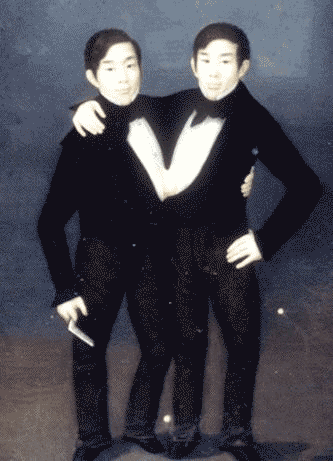
Chang-eng-bunker-PDJohn Smith is the ultimate Anglo common name, but if your favorite external business directory tells you that the 2 companies has the same mother and are modest size organizations, the possibility of John Smith being the same person having the same role at the same time in 2 companies is very high.

Tushnelda has a very unique name, so here there is a high possibility that she has got a new job in a new company, which makes one of the entries inactive. If one is going to be selected as the active survivor it may be chosen from newest update, found in external reference data or investigated otherwise.

B2B is often not actually Business-to-Business but also E2E – Employee-to-Employee – as the relationship exists between employees in the selling and buying business entities and it is not unusual that the relation may follow the employees when they change employer.

So striving for “one version of the truth” through “360 degree view on customer” is not a one layer exercise. This fact must be modeled in the Master Data structure, supported by functionality and prevented by feasible data quality implementations.

It’s my plan to do some blog posts around hierarchies in Party Master Data and how this must be handled in data matching. Next post will be about B2C data.

Bookmark and Share