Product Information Sharing Issue No 2: No Viable Standard

A current poll on sharing product information with trading partners running on this blog has this question: As a manufacturer: What is Your Toughest Product Information Sharing Issue?

Some votes in the current standing has gone to this answer:

There is no viable industry standard for our kind of products

Indeed, having a standard that all your trading partners use too, will be Utopia.

This is however not the situation for most participants in supply chains. There are many standards out there, but each applicable for a certain group of products, geography or purpose as explained in the post Five Product Classification Standards.

At Product Data Lake we embrace all these standards. If you use the same standard in the same version as your trading partner, linking and transformation is easy. If you do not, you can use Product Data Lake to link and transform from your way to the way your trading partners handles product information. Learn more at Product Data Lake Documentation and Data Governance.

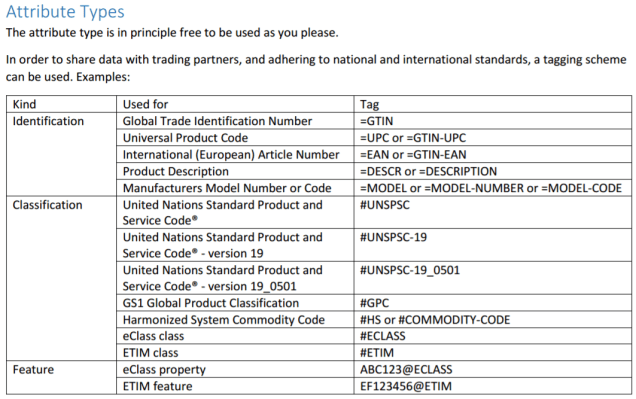
Attribute Types
The tagging scheme used in Product Data Lake attributes (metadata)

Product Information Sharing Issue No 1: We Need to Mature Internally

A current poll on sharing product information with trading partners running on this blog has this question: As a manufacturer: What is Your Toughest Product Information Sharing Issue?

The most votes in the current standing has gone to this answer:

We must first mature in handling our product information internally

PDL MenuSolving this issue is one of the things we do at Liliendahl.com. Besides being an advisory service in the Master Data Management (MDM) and Product Information Management (PIM) space, we have a developing collaboration with companies providing consultancy, cleansing and, when you come to that step, specialized technology for inhouse MDM and PIM. Take a look at Our Business Ecosystem.

If you are a manufacturer with a limited need for scaling the PIM technology part and already have much of your needs covered by an ERP and/or Product Lifecycle Management (PLM) solution, you may also fulfill your inhouse PIM capabilities and the external sharing needs in one go by joining Product Data Lake.

IIoT (or Industry 4.0) Will Mature Before IoT

Internet of Things (IoT) is a hot topic in the data management world and yours truly is also among those who sees IoT as a theme that will have a tremendous impact on data management including data quality, data governance and Master Data Management (MDM).

However, I think the flavour of IoT called Industrial Internet of Things (IIoT) or Industry 4.0 will mature, and already have matured, before the general IoT theme.

globalIIoT / Industry 4.0 is about how manufacturers use connected intelligent devices to improve manufacturing processes where the general IoT theme extends the reach out in the consumer world – with all the security and privacy concerns related to that.

A clue about the maturity in IIoT is found in a Forbes article by Bernard Marr. The article is called Unlocking The Value Of The Industrial Internet Of Things (IIoT) And Big Data In Manufacturing.

In this article, Justin Hester of automotive part manufacturer Hirotec tells about their approach to embracing IIoT. Justin Hester states that “…we can finally harness the data coming in from all of these different sources, whether they are machines, humans, parts – but I think the real challenge is the next step – how do I execute? That’s the challenge.”

Indeed, how to execute and take (near) real-time action on data will be the scenario where Return on Investment (ROI) will show up. This means, as explained in the article, that you should make incremental implementations.

It also means, that you must be able to maintain master data that can support (near) real-time execution. As IIoT/Industry 4.0 is about connected devices in business ecosystems, my suggestion is a data architecture as described on Master Data Share.

Your Toughest Upstream Product Information Sharing Issue

Only 5 percent of organizations share all their product data electronically with supply chain partners. So, there is room for improvement.

At Product Data Lake we want to find out what are the issues that is holding companies back from smoothly sharing product information with trading partners.

We will start with where product information is born: Upstream, at the manufacturer. If you work at a company being a manufacturer of goods, please answer the below question:

PS: If you do not work for a manufacturer, but know someone who does, please forward the poll.

Don’t put Lipstick on a PIM

The other day Shamanth Shankar of Riversand Technologies published a blog post called The Beautiful and the Geek: From Mascara to Managing Data.

In this post Shamanth, exemplified with mascara products, discusses how PIM (Product Information Management) as an enterprise solution helps with effective data management, cutting down new product introduction timelines, multi-channel content management, adhering to regulations and facilitating advanced data analytics.

I agree with all the goodness gained from an enterprise PIM solution for these matters. PIM is the new bacon.

However, in the end Shamanth mentions PIM vendor portals: “The Vendor portal automates the product onboarding process and significantly cuts down operating costs by allowing Vendors to upload complete and curated product data, in bulk, into the system.”

pig-lipstickI am sorry to say that I think that using a PIM vendor (or supplier) portal is like lipstick on a pig.

The concept looks tempting by first glance. But it is a flawed concept. The problem is that it is hostile to your trading partners. Your upstream trading partner may have hundreds of downstream trading partners and if every one of these offers their vendor (supplier) portal, they will have to learn and update into hundreds of different portals.

All these portals will have a different look and feel coming from many different PIM solution providers.

The opposite concept, having suppliers providing their customer product data portals, has the same flaw, just the other way around.

The best solution is having a PIM vendor neutral hub sitting in the product information exchange zone. This is the idea behind Product Data Lake.

Encompassing Relational, Document and Graph the Best Way

The use of graph technology in Master Data Management (MDM) has been a recurring topic on this blog as the question about how graph approaches fits with MDM keeps being discussed in the MDM world.

Multi-Domain MDM GraphRecently Salah Kamel, the CEO at the agile MDM solution provider Semarchy, wrote a blog post called Does MDM Need Graph?

In here Salah states: “A meaningful graph query language and visualization of graph relationships is an emerging requirement and best practice for empowering business users with MDM; however, this does not require the massive redesign, development, and integration effort associated with moving to a graph database for MDM functionality”.

In his blog post Salah discusses how relationships in the multi-domain MDM world can be handled by graph approaches not necessarily needing a graph database.

At Product Data Lake, which is a business ecosystem wide product information sharing service that works very well besides Semarchy MDM inhouse solutions, we are on the same page.

Currently we are evaluating how graph approaches are best delivered on top of our document database technology (using MongoDB). The current use cases in scope are exploiting related products in business ecosystems and how to find a given product with certain capabilities in a business ecosystem as examined in the post Three Ways of Finding a Product.

Room for Improvement in the PIM World

Ventana Stibo ReportThe analyst firm Ventana Research recently made a report called The Next Generation of Product Information Management with the subtitle Maximizing the Potential Value of Products for Customers and Suppliers.

One, perhaps shocking, number mentioned in the report is that there is “room for improvement, as only 5 percent of organizations share all their product data electronically with supply chain partners”.

However, this resonates very well with my experience, as it has been hard to find a good way to share all kind of product information electronically with all your trading partners, as:

  • The most common used way today is exchanging spreadsheets, which is cumbersome and error prone and therefore many companies experience that it simply is not done or only done partly and certainly not timely.
  • Using consensus data pools (eg GS1 GDSN) only covers a fraction of product groups and product data elements with varying penetration and coverage in different geographies
  • Providing supplier product data portals (and customer product data portals) is a flawed one-sided concept as discussed in the post PIM Supplier Portals: Are They Good or Bad?

This is the reason why Product Data Lake has been launched.

You can get an 18 pager write up of the research report free from Stibo Systems here.

PS: If you are a PIM solution vendor or a PIM system integrator you can, as a legal entity, help with and gain from filling this room by becoming a Product Data Lake Commissioner.

The Future of Data Quality Tools

When looking at the data quality tool market it is interesting to observe, that the tools available does pretty much the same and that all of them are pretty good at what they do today.

A visualization of this is the vendor landscape in the latest Information Difference Data Quality Landscape:

Data Quality Landscape 2017

As you see, the leaders as Experian Data Quality, Informatica, Trillium and others are assembling at the right edge. But that is due to market strength. Else the bunch is positioned pretty much equal.

This report does in my eyes also mention some main clues about where the industry is going.

One aspect is that: “Some data quality products are stand-alone, while others link to separate master data or data governance tools with varying degrees of smoothness.”

Examples among the leaders are Informatica, with data quality, MDM, PIM and other data management tools under the same brand, and Trillium with their partnership with the top data governance vendor Collibra. We will see more of that.

Another aspect is that: “Although name and address is the most common area addressed in data quality, product data is another broad domain requiring different approaches.”

I agree with Andy Hayler of Information Difference about that product data needs a different treatment as discussed in the post Data Quality for the Product Domain vs the Party Domain.

Three Ways of Finding a Product

One goal of Product Information Management (PIM) is to facilitate that consumers of product information can find a product they are looking for. Facilitating that includes feasible functionality and optimal organization of data.

Search

There is a whole industry making software that helps with searching for products as touched in the post Search and if you are lucky you will find.

However, even the best error tolerant and super elastic search engines are dependent on the data to search on and are challenged by differences in the taxonomy used by the one who searches and the taxonomy used in the product data.

As we are being better at providing more and more data about products that also makes issues in searching, as we are getting more and more hits of which many are irrelevant for the intention of a given search.

Drill down

You can start by selecting in what main group of products you are looking for something and then drill down through a more and more narrow classification.

Again, this approach is challenged by different perspectives of product grouping and even if we are looking for standards, there are too many of them as described in the post Five Product Classification Standards.

Traverse

The term traverse has (or will) become trendy with the introduction of graph technology. By using graph technology in Product Information Management (PIM) you will have a way of overcoming the challenges related to using search or drill down when looking for a product.

Big HammerFinding a product has in many use cases the characteristic of that we know some pieces of information and want to find a product that match those pieces of information, but often expressed in a different way. This fit very well with the way graph technology works by having a given set of root nodes from where we traverse through edges and nodes (also called vertices) until we end at reachable nodes of the wanted type.

In doing that we will be able to translate between different wording, classifications and languages.

At Product Data Lake we are currently exploring – or should I say traversing – this space. I will very much welcome your thoughts on this subject.
The Panama Papers and MDM

A keynote at the Master Data Management Summit Europe 2017 was presented by Mar Cabra, Editor, Data & Research Unit, International Consortium of Investigative Journalists (ICIJ). In her presentation Mar told how journalists explored huge amounts of data in order to reveal how rich and famous people used tax havens to avoid paying tax in their home countries.

Some of the technologies used in doing that are the same emerging technologies we right now are considering, and some are already using, within Master Data Management as for example graph databases.

Panama PapersWhat stroke me the most was however the sharing approach that probably made all the difference in the impact achieved from revealing the core data in the Panama Papers. The journalists from Süddeutsche Zeitung who originality was offered the data did not keep the data to themselves but shared the data with the community of journalists in the news media ecosystem from around the world.

We can also make better use of master data, and gain better business impact, if we share feasible master data in wider business ecosystems as explained here on the piece on Master Data Share.

I’m not saying all enterprises should share everything with their business ecosystems. For party master data there are indeed many limitations as very much trending these days with the upcoming GDPR regulations. With product master data you should also consider what is best managed as your own story and what is best for your business in a sharing approach. These considerations are elaborated in the post Using Internal and External Product Information to Win.