Why do you watch it?

Statler and Waldorf is a pair of Muppet characters. They are two ornery, disagreeable old men. Despite constantly complaining about the show and how terrible some acts were, they would always be back the following week in the best seats in the house. At the end of one episode, they looked at the camera and asked: “Why do you watch it?”.

This is a bit like blogging about data quality, isn’t it? Always describing how bad data is everywhere. Bashing executives who don’t get it. Telling about all the hard obstacles ahead. Explaining you don’t have to boil the ocean but might get success by settling for warming up a nice little drop of water.

Despite really wanting to tell a lot of success stories, being the funny Fuzzy Bear on the stage, well, I am afraid I also have been spending most time on the balcony with Statler and Waldorf.

So, from this day forward: More success stories.

This is the start of a series of 1.3 blog posts…. No, just kidding.

Bookmark and Share

Did They Put a Man on the Moon?

Recently I have been reading some blog posts circling around having a national ID for citizens in the United States including a post from Steve Sarsfield and another post from Jeffrey Huth of Initiate.

In Denmark where I live we have had such a national ID for about half a century. So if you are a vendor with a great solution for data matching and master data management in healthcare and wants to approach a Danish prospect in healthcare (which are mainly public sector here), they will tell you, that the solutions looks really nice, but they don’t have that problem. You can’t stay many seconds as a patient in a Danish hospital before you are asked to provide your national ID. And if you came in inside your mother you will be given an ID for life within seconds after you are born.

The same national ID is the basis when we have elections. Some weeks before the authorities will push the button and every person with the right status and age gets a ballot. Therefore we are in disbelief when we every fourth year are following when United States elects a president and we learn about all the mess in voter registration.

Is that happening in the nation that put a man on the moon in 1969?. Or did they? Was it after all a studio recording?

Bookmark and Share

Four Different Data Matching Stage Types

One of the activities I do in my leisure time is cycling. As a consequence I guess I also like to watch cycling on TV (or on the computer), not at least the cycling sport paramount of the year: Le Tour de France.

In Le Tour de France you basically have four different types of stages:

  • Time trial
  • Stages on flat terrain
  • Stages through hilly landscape
  • Stages in the high mountains

Some riders are specialists in one of the stage types and some riders are more all-around types.

With automated data matching, which is what I do the most in my business time, there are basically also four different types of processes:

  • Internal deduplication of rows inside one table
  • Removal of rows in one table which also appears in another table
  • Consolidation of rows from several tables
  • Reference matching with rows in one table against another (big) table

Internal deduplication

Examples of data matching objectives here is finding duplicates in names and addresses before sending a direct mail or finding the same products in a material master.

The big question in this type of process is if you are able to balance between not making any false positives (being too aggressive) while not leaving to many to many false negatives behind (losing the game). You also have to think about survivorship when merging into a golden record.

In Le Tour de France the overall leader who gets the yellow jersey has to make a good time trial.

Removal

Here the examples of data matching objectives will be eliminating nixies (people who don’t want offerings by mail) before sending a direct mail or eliminating bad payers (people you don’t want to offer a credit).

Probably the easiest process everyone can do – but in the end of the day some are better sprinters than others.

The best sprinter in Le Tour de France gets the green jersey.

Consolidation

When migrating databases and/or building a master data hub you often have to merge rows from several different tables into a golden copy.

Here you often see the difficulty of making data fit for the immediate purpose of use and at the same time be aligned with the real world in order to also being able to handle the needs that arises tomorrow.

Often some of the young riders in Le Tour de France makes an escape when climbing the hills and gets the white jersey.

Reference match

Doing business directory matching has been a focus area of mine including making a solution for match with the D&B worldbase. The worldbase holds over 165 million rows representing business entities from all over the world.

The results from automated matching with such directories may vary a lot like you see huge time differences in Le Tour de France when the riders faces the big mountains. Here the best climber gets the polka dotted jersey.

Bookmark and Share

Data Quality is an Ingredient, not an Entrée

Fortunately it is more and more recognized that you don’t get success with Business Intelligence, Customer Relationship Management, Master Data Management, Service Oriented Architecture and many more disciplines without starting with improving your data quality.

But it will be a big mistake to see Data Quality improvement as an entrée before the main course being BI, CRM, MDM, SOA or whatever is on the menu. You have to have ongoing prevention against having your data polluted again over time.

Improving and maintaining data quality involves people, processes and technology. Now, I am not neglecting the people and process side, but as my expertise is in the technology part I will like to mention some the technological ingredients that help with keeping data quality at a tasty level in your IT implementations.

Mashups

Many data quality flaws are (not surprisingly) introduced at data entry. Enterprise data mashups with external reference data may help during data entry, like:

  • An address may be suggested from an external source.
  • A business entity may be picked from an external business directory.
  • Various rules exist in different countries for using consumer/citizen directories – why not use the best available where you do business.

External ID’s

Getting the right data entry at the root is important and it is agreed by most (if not all) data quality professionals that this is a superior approach opposite to doing cleansing operations downstream.

The problem hence is that most data erodes as time is passing. What was right at the time of capture will at some point in time not be right anymore.

Therefore data entry ideally must not only be a snapshot of correct information but should also include raw data elements that make the data easily maintainable.

Error tolerant search

A common workflow when in-house personnel are entering new customers, suppliers, purchased products and other master data are, that first you search the database for a match. If the entity is not found, you create a new entity. When the search fails to find an actual match we have a classic and frequent cause for introducing duplicates.

An error tolerant search are able to find matches despite of spelling differences, alternative arranged words, various concatenations and many other challenges we face when searching for names, addresses and descriptions.

Bookmark and Share

The Many Worlds of Data Quality

This morning I had some fun reading the articles on Wikipedia explaining about Data Quality.

I tried to compare the texts available in:

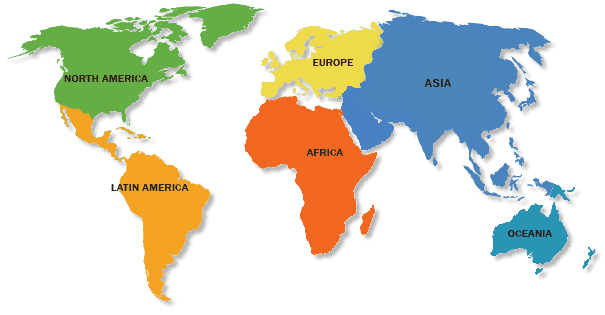
I am afraid that the quality of texts and some differences between how the subject is presented in the different languages shows the immaturity of the data quality discipline and not at least the lack of global embracement that is seen in literature, published articles and the technology available.

Three observations from the Wikipedia articles:

The French piece is in some parts a translation from the English text. However the translation became very difficult in the History section, as the English text here has the well known narrowly United States scope.

The German text is completely different from the English text. Also the title is Information Quality. The references are largely from German authors.

The Japanese text seems to be a Google Translate of the (former) English text. This is strange as much of the quality inspiration originally came from Japan.

Bookmark and Share

Mixed Identities

A frequent challenge when building a customer master data hub is dealing with incoming records from operational systems where the data in one record belongs to several real world entities.

One situation may be that that a name contains two (or more) real world names. This situation was discussed in the post Splitting names.

Another situation may be that:

  • The name belongs to real world entity X
  • The address belongs to real world entity Y
  • The national identification number belongs to real world entity Z

Fortunately most cases only have 2 different real world representations like X and Y or Y and Z.

An example I have encountered often is when a company delivers a service through another organization. Then you may have:

  • The name of the 3rd party organization in the name column(s)
  • The address of the (private) end user in the address columns

Or as I remember seen once:

  • The name of the (private) end user in the name column(s)
  • The address of the (private) end user in the address columns
  • The company national identification number of the 3rd party organization in the national ID column

Of course the root cause solution to this will be a better (and perhaps more complex) way of gathering master data in the operational systems. But most companies have old and not so easy changeable systems running core business activities. Swapping to new systems in a rush isn’t something just done either. Also data gathering may take place outside your company making the data governance much more political.

A solution downstream at the data matching gates of the master data hub may be to facilitate complex hierarchy building.

Oftentimes the solution will be that the single customer view in the master data hub will be challenged from the start as the data in some perception is fit for the intended purpose of use.

Bookmark and Share

LinkedIn and the other Thing

I have a profile in two different business oriented social networking services: LinkedIn and XING.

I have far more connections in LinkedIn than in XING.

My connections in LinkedIn are mainly from English speaking countries (US, UK, IE, IN, AU) and from Scandinavia (DK, NO, SE) where I live and where English is widely spoken not at least by people in white-collar.

The connections I have with people in XING are almost only with people from Germany.

This picture matches very well how these two tools are positioned.

The US based LinkedIn is strong in “English speaking” countries with most profiles per capita in:

  • Denmark, Netherlands and USA followed by
  • Norway, Sweden, United Kingdom and Australia

(I have some figures from last year when LinkedIn passed 50 million profiles).

XING is strong in Germany, where XING was founded, and through acquisitions also in Spain and Turkey.

Now, it’s not that you can’t operate LinkedIn in German and Spanish; you can. Also you can operate XING in English.

It’s about meeting your connections where they are.

Bookmark and Share

Seeing Is Believing

One of my regular activities as a practice manager at a data quality tool vendor is making what we call a ”Test Report”.

Such a “Test Report” is a preferable presale activity regardless of if we are against a competitor or the option of doing nothing (or no more) to improve data quality. In the latter case I usually name our competitor “Laissez-Faire”.

The most test reports I do is revolving around the most frequent data quality issue being duplicates in party master data – names and addresses.

Looking at what an advanced data matching tool can do with your customer master data and other business partner registries is often the decisive factor for choosing to implement the tool.

I like to do the test with a full extract of all current party master data.

A “Test Report” has two major outcomes:

  • Quantifying the estimated number of different types of duplicates, which is the basis for calculating expected Return on Investment for implementing such an advanced data matching tool.
  • Qualifying both some typical and some special examples in order to point at the tuning efforts needed both for an initial match and the recommended ongoing prevention.

When participating in follow up meetings I have found that discussions around what a tool can do (and not do) is much more sensible when backed up by concrete numbers and concrete examples with your particular data.

Bookmark and Share

Location, Location, Location

Now, I am not going to write about the importance of location when selling real estates, but I am going to provide three examples about knowing about the location when you are doing data matching like trying to find duplicates in names and addresses.

Location uniqueness

Let’s say we have these two records:

  • Stefani Germanotta, Main Street, Anytown
  • Stefani Germanotta, Main Street, Anytown

The data is character by character exactly the same. But:

  • There is only a very high probability that it is the same real world individual if there is only one address on Main Street in Anytown.
  • If there are only a few addresses on Main Street in Anytown, you will still have a fair probability that this is the same individual.
  • But if there are hundreds of addresses on Main Street in Anytown, the probability that this is the same individual will be below threshold for many matching purposes.

Of course, if you are sending a direct marketing letter it is pointless sending both letters, as:

  • Either they will be delivered in the same mailbox.
  • Or both will be returned by postal service.

So this example highlights a major point in data quality. If you are matching for a single purpose of use like direct marketing you may apply simple processing. But if you are matching for multiple purposes of use like building a master data hub, you don’t avoid some kind of complexity.

Location enrichment

Let’s say we have these two records:

  • Alejandro Germanotta, 123 Main Street, Anytown
  • Alejandro Germanotta, 123 Main Street, Anytown

If you know that 123 Main Street in Anytown is a single family house there is a high probability that this is the same real world individual.

But if you know that 123 Main Street in Anytown is a building used as a nursing home, a campus or that this entrance has many apartments or other kind of units, then it is not so certain that these records represents the same real world individual (not at least if the name is John Smith).

So this example highlights the importance of using external reference data in data matching.

Location geocoding

Let’s say we have these two records:

  • Gaga Real Estate, 1 Main Street, Anytown
  • L.  Gaga Real Estate, Central Square, Anytown

If you match using the street address, the match is not that close.

But if you assigned a geocode for the two addresses, then the two addresses may be very close (just around the corner) and your match will then be pretty confident.

Assigning geocodes usually serve other purposes than data matching. So this example highlights how enhancing your data may have several positive impacts.

Bookmark and Share